Two schedules, one job
A partnership earns 40,000 dollars of foreign-source income, pays 10,000 dollars of foreign tax, and has three partners. The partnership itself pays no income tax, yet every dollar of that foreign income and tax still has to land on a return where a credit can be claimed. Schedule K-2 is the partnership-level total, an extension of Schedule K on Form 1065. Schedule K-3 is the partner-level share, an extension of Schedule K-1, and the document the partner uses for Form 1116 or Form 1118. Both schedules are new for tax years beginning in 2021, replacing the loose line-20 reporting on Schedules K and K-1.
Any partnership required to file Form 1065 with items relevant to its partners' U.S. tax, withholding tax, or reporting obligations under the international provisions of the Code must complete the relevant parts. The same rule reaches an S corporation filing Form 1120-S: under section 1366 each shareholder takes a pro rata share through with its character intact, as section 702 does for partners. A partnership with no foreign-source income, no foreign partners, and no foreign taxes can still be caught if a partner claims a foreign tax credit. Each K-3 carries the partner's name and taxpayer identification number — an SSN for an individual, an ITIN where the partner holds one — and the partnership's EIN.
The thirteen-part map
K-2 and K-3 carry the same thirteen parts, each feeding a different form on the partner's return.
| Part | What it reports | Partner uses it for | Authority |
|---|---|---|---|
| I | Other international items | Items reported nowhere else | 2025 Instructions |
| II | Income by source and category | Credit limitation | IRC § 904 |
| III | R&E and interest allocation | Credit limitation | IRC § 861 |
| IV | FDII information | Section 250 deduction | IRC § 250 |
| V | PTEP distributions; § 986(c) gain or loss | Dividends; § 245A | IRC §§ 245A, 959, 986(c) |
| VI | Subpart F and GILTI | Form 8992 | IRC § 951A |
| VII | PFIC information | Form 8621 | IRC § 1291 |
| VIII | Foreign corporation net income | Deemed-paid credit | IRC § 960 |
| IX | Base erosion payments | BEAT | IRC § 59A |
| X | ECI and FDAP income | Form 1040-NR / 1120-F | IRC § 871 |
| XI | Section 871(m) equivalents | Form 1042 / 1042-S | IRC § 871(m) |
| XII | QDD activity | Withholding | Rev. Proc. 2022-43 |
| XIII (K-3 only) | Deemed-sale items on transfer | Schedule P | IRC § 864(c)(8) |
A partnership completes only the parts its facts require. One that owns no stock of a foreign corporation, other than solely by reason of downward attribution under section 958(b), is not required to complete Parts V, VI, VII, and VIII. A QDD partnership must complete Part XII if it has foreign partners or is directly or indirectly owned by foreign persons.
The three exits
The 2025 instructions give small domestic partnerships three exits — apply them in order, because a partnership that fails one may still pass the next.
Exit one: the domestic filing exception. A partnership that is not a QDD partnership skips both schedules if all four criteria are met for 2025. Criterion 1 is no or limited foreign activity: either none at all, or passive-category income with not more than 300 dollars of creditable foreign taxes under section 901, shown on a payee statement. Criterion 2 is the partner roster: every direct partner during 2025 is a U.S. citizen, a resident alien, a domestic estate or trust, an S corporation, a single-member LLC disregarded as separate from its owner, or a domestic partnership — each with solely U.S. citizen or resident alien individual beneficiaries or grantors. Criterion 3 is partner notification: with the Schedule K-1, the partnership tells the partner that no K-3 will be furnished unless requested. Criterion 4 is the 1-month date: no partner requests Schedule K-3 information on or before the date one month before the partnership files Form 1065 — August 17, 2026, at the latest for a calendar-year 2025 partnership on extension.
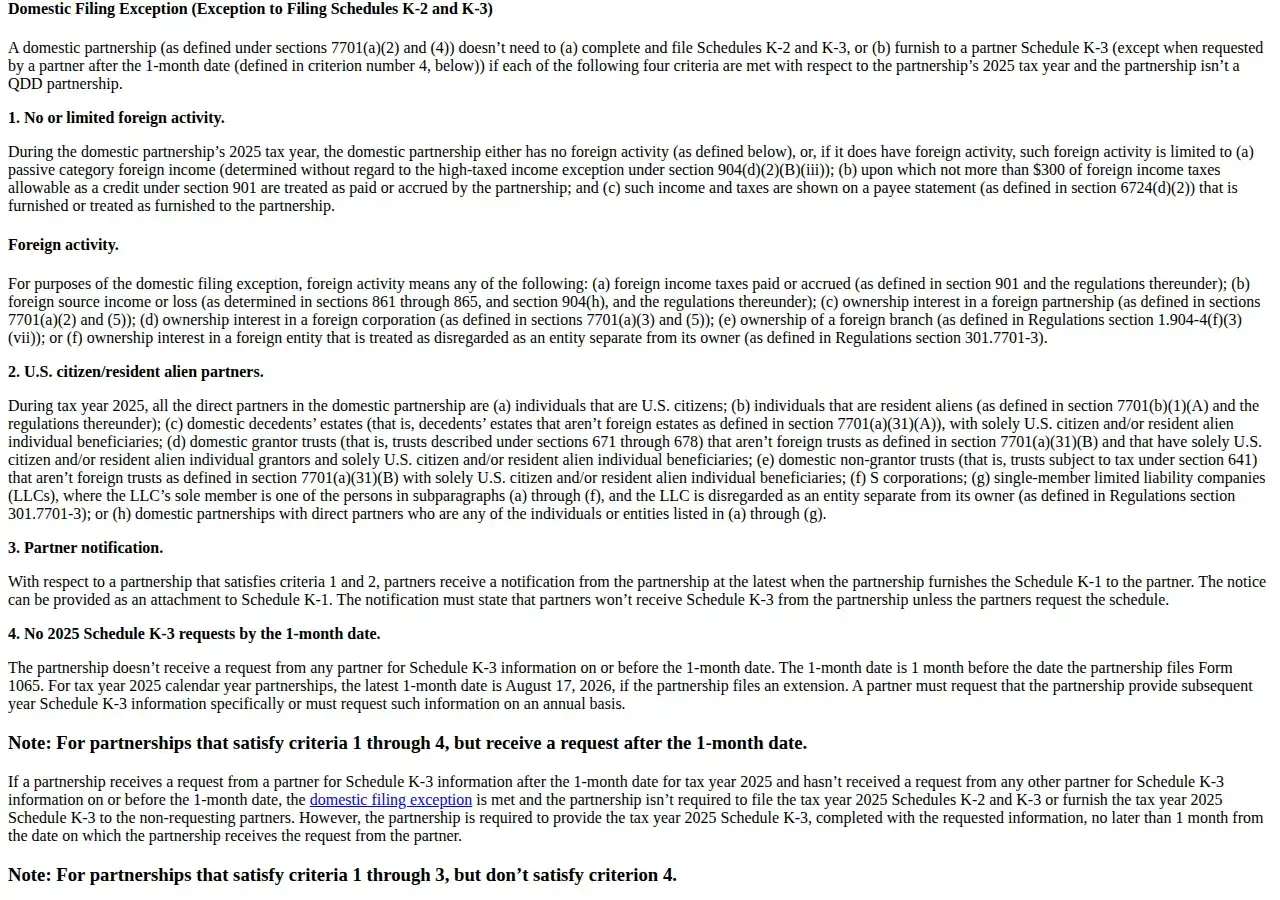
The 1-month date is where the exception is won or lost. A request on or before it defeats criterion 4, and the partnership must file Schedules K-2 and K-3 and furnish K-3 to the requesting partner — only the relevant parts. A request after it leaves the exception intact, and the partnership must provide the completed K-3 to the requesting partner within one month. The IRS's Example 2 shows the boundary: a married couple, each owning 50 percent, receives a Form 1099 from a regulated investment company reporting 100 dollars of creditable foreign taxes on passive-category income — within the limit, so the exception is met.
Exit two: the small partnership filing exception. New for 2025, this exception keys off Form 1065, Schedule B, question 4: receipts under 250,000 dollars; assets under 1,000,000 dollars at year-end; K-1s filed and furnished on or before the due date, including extensions; and no Schedule M-3 filed or required. For an S corporation the parallel exception is tighter on assets: receipts and assets under 250,000 dollars at year-end.
Exit three: the Form 1116 exemption exception. Under section 904(j), an individual whose creditable foreign taxes do not exceed 300 dollars, or 600 dollars on a joint return, and whose only foreign-source income is passive-category income, need not file Form 1116. If every partner is eligible and the partnership is notified by the 1-month date, it need not complete Schedules K-2 and K-3. The IRS's Example 6 draws the line: the same couple, but the Form 1099 now reports 400 dollars. That breaks the 300-dollar limit in criterion 1, so the domestic filing exception closes — but the couple file jointly, 400 dollars is within the 600-dollar joint-return limit under section 904(j), and they notify the partnership by the 1-month date, so this exception opens. If only some partners notify, the partnership skips K-3 for the exempt partners and completes the schedules for the rest.
The 2021 transition relief
Schedules K-2 and K-3 arrived with almost no runway: draft instructions in mid-2021, final forms for tax years beginning in 2021. Notice 2021-39, in Internal Revenue Bulletin 2021-27, gave transition relief for tax years beginning in 2021: a filer would not be subject to the penalties under sections 6698, 6699, 6721, 6722, and 6038(b) and (c) for incorrect or incomplete reporting if the filer showed a good faith effort to comply. IR-2022-38 added a further exception for tax year 2021 alone, for domestic partnerships and S corporations with no foreign partners, no foreign activity, and no knowledge that a partner wanted the old line 16 or line 20c information.
Both reliefs are history now: they covered tax years beginning in 2021 only. For tax year 2025, the only exits are the three in the instructions; the reasonable-cause defence under sections 6698 and 6699 is all that remains.
Worked numbers
Example A — the foreign tax credit limitation. A partner's K-3, Part II, reports 40,000 dollars of general-category foreign-source income and 10,000 dollars of foreign taxes paid, against worldwide income of 200,000 dollars and U.S. tax before credits of 44,000 dollars. The section 904 limitation caps the credit at the share of U.S. tax attributable to that income:
The partner paid 10,000 dollars of foreign tax but may claim only 8,800 dollars this year; the remaining 1,200 dollars carries back one year and forward ten years under section 904(c). Note what Part III does to the numerator: interest and research expense apportioned against foreign-source income shrink the fraction, and with it the limitation.
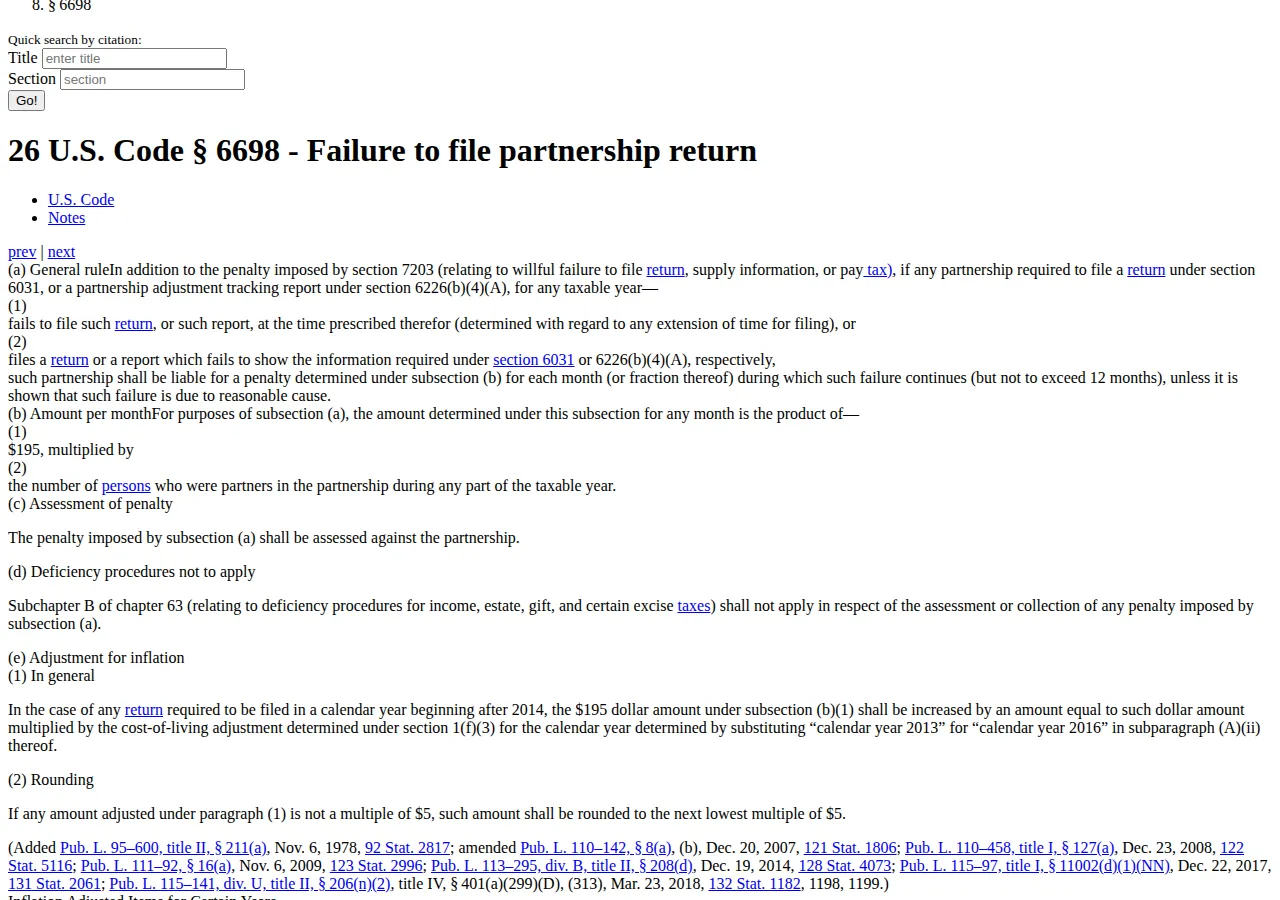
Example B — the late-filing penalty. A six-partner LLC files Form 1065 four months late and omits Schedules K-2 and K-3. Section 6698 imposes the penalty for each month or part of a month, up to 12 months, multiplied by the number of partners. The statute sets the base at 195 dollars per partner per month; the inflation adjustment in section 6698(e) brings the figure published in the 2025 Form 1065 instructions to 255 dollars:
The furnishing failure is a separate penalty: 340 dollars for each schedule not furnished when due, or furnished without all required information. Six late K-3s add 2,040 dollars:
The furnishing penalty has annual caps: 4,098,500 dollars for entities with gross receipts over 5,000,000 dollars, and 1,366,000 dollars for entities at or below that line. Intentional disregard removes the cap and raises each 340-dollar penalty to 680 dollars or 10 percent of the aggregate amount of items required to be reported, if greater. An S corporation faces the mirror penalty under section 6699: the same 195-dollar base per shareholder per month, subject to the same inflation adjustment, with reasonable cause as the only escape in either section. Form 7004 buys six months, and the penalty clock runs from the extended due date.
How the partner uses the K-3
The K-3 is not a form the partner files; it is the data feed for the partner's own return. An individual partner takes Part II income by source and category and Part III taxes paid or accrued onto Form 1116, applies the section 904 limitation by category, and claims the credit. A corporate partner does the same on Form 1118, adding the deemed-paid taxes from Part VIII. A partner in a partnership that owns a controlled foreign corporation reads Part VI for the GILTI and subpart F inclusions and Part V for the PTEP distribution excluded from income. A foreign partner reads Part X for the ECI and FDAP figures on Form 1040-NR, and Part XIII if the partner transferred an interest during the year. An S-Corp shareholder reads the same parts, with the pro rata share under section 1366 replacing the distributive share under section 702.
Two boundaries keep the K-3 from being mistaken for a second K-1. First, the K-3 carries no QBI items: the section 199A qualified business income deduction is computed from the K-1, not from K-2 or K-3. Second, the K-3 does not change the distributive share under section 702 — it characterises and sources items the K-1 already reports. Guaranteed payments under section 707(c) and the SECA treatment of a general partner's share are K-1 matters; wages stay subject to FICA.
Run the K-2/K-3
- Map the facts before year-end: list every foreign item — taxes, income, partners, foreign corporations, PTEP, QDD — and assign each to its K-2 part.
- Test the three exits in order: domestic filing exception, small partnership filing exception, Form 1116 exemption exception. Record the test and the date.
- Send the partner notification with the K-1: no K-3 will be furnished unless requested. Keep a copy.
- Calendar the 1-month date: one month before filing Form 1065 — August 17, 2026, for a calendar-year 2025 return filed on extension.
- Collect the data by part: Part II income, Part III taxes and apportionment, Parts V–VIII for any foreign corporation, Part IX for any base erosion payment, Part X for any foreign partner.
- Complete only the applicable parts and do not attach the rest.
- Reconcile K-2 to K-3: the K-3 shares must sum to the K-2 totals, part by part, and K-1 box 16 must match the K-3 attachment.
- File on the extended deadline: attach K-2 to Form 1065; furnish K-3 with the K-1.
- [x] Test all three exceptions before preparing a single part.
- [x] Record the 1-month date and every K-3 request.
- [x] Check K-1 box 16 whenever a K-3 is attached.
- [x] Reconcile every K-3 share to the K-2 total, part by part.
Failure modes
Most K-2 and K-3 failures are classification errors. Assuming no foreign activity means no filing: a partner who claims a foreign tax credit needs K-3 data, and a domestic corporate partner may need Part IX for its BEAT computation even with no foreign income. Missing the 1-month date: a request on the 1-month date defeats criterion 4, and a partnership that files without checking its request log files a return it must amend.
Founder & CEO Insight — Enow A. Jovial
The operation is a sequence: map the foreign items, test the three exits, notify the partners, watch the 1-month date, complete only the applicable parts, reconcile K-2 to K-3, and file on the extended deadline. The distributive share mechanics are in our K-1 playbook, the audit regime that can rewrite these schedules is in our BBA audit playbook, and a trust or estate reports its beneficiaries' shares on Form 1041 K-1. Before the deadline, run the numbers through our pricing calculator to confirm the fee covers the K-2/K-3 hours.