Form 1120 is the return that makes the corporation a taxpayer
A C corporation is a separate taxable person: it earns income, deducts expenses, and pays tax on what is left, and Form 1120 is the return that reports it all. Shareholders do not report the corporation's income; it reports it, pays 21% on it, and only then distributes what remains.
Who files Form 1120 — and who must not
Every domestic corporation that is not an S corporation files Form 1120 — including one with no income or in its first year. A corporation that elected S status under § 1362 files Form 1120-S instead, and its income passes through to shareholders. A partnership files Form 1065.
| Return | Filer | Who pays the income tax | Governing authority |
|---|---|---|---|
| Form 1120 | C corporation | The corporation, at 21% | 26 U.S.C. § 11(b) |
| Form 1120-S | S corporation | Shareholders, on their own returns | 26 U.S.C. §§ 1361–1362 |
| Form 1065 | Partnership | Partners, on their own returns | 26 U.S.C. § 701 |
The fork that matters most is 1120 versus 1120-S, made once, by election. Our Form 1120-S corporation tax return playbook runs the pass-through side: no entity-level tax, but reasonable compensation and a 100-shareholder ceiling. Form 1120 has neither — it has a 21% toll at the entity door and a second toll when the money leaves as a dividend.
The calendar: April 15, Form 7004, and the June 30 exception
The due date is a formula: the Instructions for Form 1120 require filing by the 15th day of the 4th month after the end of the tax year — April 15 for a calendar-year corporation.
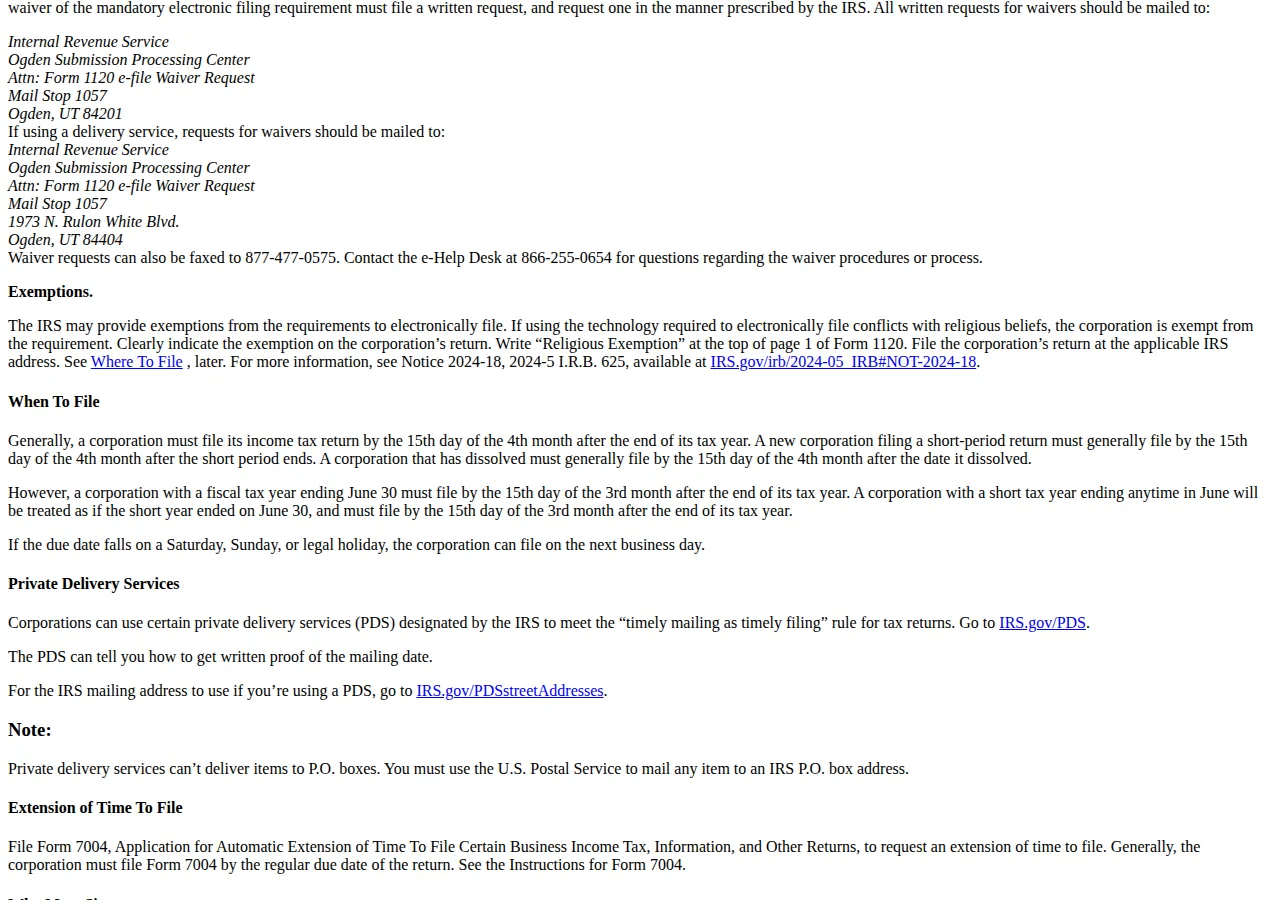
One fiscal year breaks the pattern: a tax year ending June 30 is due by the 15th day of the 3rd month — September 15. If the due date falls on a Saturday, Sunday, or legal holiday, the corporation may file on the next business day.
Form 7004 is the only way to move the filing date. File it by the regular due date and the deadline extends automatically by 6 months — October 15 for a calendar-year corporation. Two limits: Form 7004 does not extend the time to pay, and there is no second extension. Our Form 7004 business tax extension playbook runs the form line by line.
The 21% flat rate and what it taxes
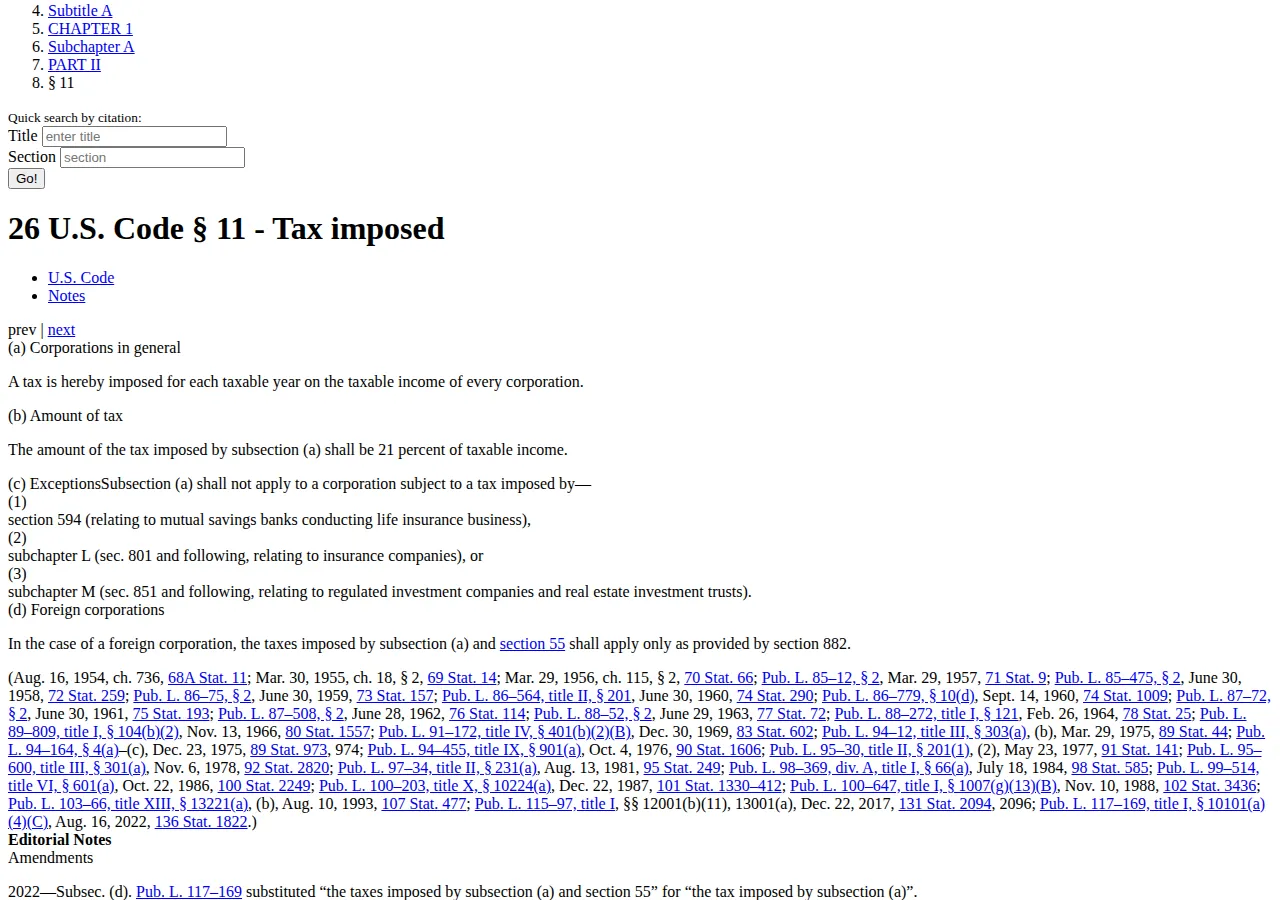
Section 11(a) imposes a tax on the taxable income of every corporation; § 11(b) sets it in one sentence: 21 percent of taxable income — no brackets, no small-corporation rate. Section 11(c) excepts mutual savings banks, insurers, and RICs and REITs.
Taxable income is defined by § 63(a): gross income minus the deductions allowed by the chapter, other than the standard deduction, which a corporation never takes. The return runs from gross receipts, through deductions, to taxable income on page 1, line 30 — then 21%:
Worked example A — the entity tax. Gross income $2,400,000 less deductions of $1,900,000 is taxable income of $500,000; the tax is $0.21 \times \$500,000 = \$105,000$.
Then the second layer: the $395,000 remaining after the $105,000 tax is taxed again at the shareholder level as a dividend, to the extent of earnings and profits. The combined burden is therefore:
where $d$ is the shareholder's own rate on the dividend — which is why the C corporation fits retained profits and fails when every dollar is distributed each year.
Founder & CEO Insight — Enow A. Jovial
The deductions that move the number: § 162 and the § 163(j) interest cap
The deductions are where the return is won or lost. Section 162(a) allows all ordinary and necessary expenses paid or incurred in carrying on a trade or business — including reasonable salaries, traveling expenses while away from home, and rentals. Ordinary means common in the trade; necessary means helpful and appropriate.
Business interest is different: § 163(j) caps it at business interest income plus 30% of adjusted taxable income (ATI) plus floor plan financing interest:
Disallowed interest is not destroyed: § 163(j)(2) treats it as business interest paid in the succeeding taxable year, so it carries forward until a later year's cap has room, with no expiry.
ATI is where the 2025 change bites. Section 163(j)(8) defines ATI as taxable income computed without regard to non-business items, business interest, any NOL deduction, any § 199A deduction, and — since Pub. L. 119-21, § 70303(a), enacted July 4, 2025 — any deduction for depreciation, amortization, or depletion. The 2025 law struck the pre-2022 limitation from the addback, effective for taxable years beginning after December 31, 2024 — for 2022–2024 ATI was EBIT; for 2025 and later the EBITDA basis is restored.
Worked example B — the interest cap. ATI $2,000,000 for 2025, business interest expense $800,000, business interest income $50,000, no floor plan interest. The cap is $\$50,000 + 0.30 \times \$2,000,000 = \$650,000$. The corporation deducts $650,000 and carries the remaining $150,000 forward under § 163(j)(2). At 21%, the disallowed $150,000 is $31,500 of tax deferred, not saved.
Small corporations escape the cap entirely. Section 163(j)(3) exempts a taxpayer meeting the § 448(c) gross receipts test — average annual gross receipts of $31 million or less for the 3 prior tax years, for tax years beginning in 2025 (Rev. Proc. 2024-40), rising to $32 million for 2026. A tax shelter is excepted.
Losses: § 172 net operating losses and the 80% ceiling
A loss year creates a tax asset, but § 172 rations how fast it can be spent. For a taxable year beginning after December 31, 2020, the NOL deduction is pre-2018 losses carried in, plus the lesser of post-2017 losses carried in or 80% of taxable income computed without the NOL, § 199A, and § 250 deductions:
The 80% ceiling means a corporation with a large carryforward can never zero out its tax in a profitable year: at least 20% of taxable income remains taxable. The trade is duration — a post-2017 loss carries forward indefinitely, while a pre-2018 loss carries forward only 20 years. There is no general carryback for post-2017 losses. The one carryback that survives is for farming losses, which § 172(b)(1)(B) carries back to each of the 2 preceding taxable years.
Worked example C — the 80% ceiling. Taxable income before NOL of $1,000,000; post-2017 carryforward $600,000. The ceiling is $0.80 \times \$1,000,000 = \$800,000$; the deduction is $\min(\$600,000,\ \$800,000) = \$600,000$, leaving taxable income of $400,000 and tax of $0.21 \times \$400,000 = \$84,000$. With a $900,000 carryforward, the deduction caps at $800,000 and $100,000 carries forward indefinitely. Our § 382 NOL ownership-change limitation playbook covers the second rationing rule.
Paying as you go: § 6655 estimated tax
The corporation does not pay its tax once, in April. Section 6655 requires four installments. For a calendar-year corporation they fall on April 15, June 15, September 15, and December 15, each 25% of the required annual payment — the lesser of 100% of the current year's tax or 100% of the prior year's tax:
The prior-year figure is the safe harbor: paying 25% of last year's tax each quarter avoids any estimated-tax penalty, provided the preceding year was a 12-month year with a return showing a liability. A large corporation — taxable income of $1,000,000 or more in any of the 3 preceding taxable years — must pay 100% of the current year's tax, except for the first installment, the reduction recaptured in the second.
Worked example D — the safe harbor. 2025 tax $210,000, 2024 tax $160,000, not a large corporation. Required annual payment is $\min(\$210,000,\ \$160,000) = \$160,000$, so each installment is $0.25 \times \$160,000 = \$40,000$; the remaining $50,000 is paid with the return and no estimated-tax penalty applies. If it were large, the required annual payment would be $210,000 and the installments $52,500 each — except the first, which could be $40,000 on the prior-year figure, the $12,500 reduction recaptured in the second installment ($65,000). Form 1120-W is the worksheet; the tax estimator runs the quarterly arithmetic.
Schedule M-3: the book-tax reconciliation
Form 1120 asks for taxable income. Schedule M-3 asks why that number differs from the income on the financial statements: a domestic corporation with $10 million or more in total assets on Schedule L at year-end must file Schedule M-3 instead of Schedule M-1.
The $50 million line decides how much must be completed: at $50 million or more, the corporation must complete Schedule M-3 in its entirety — Parts I, II, and III. Between $10 million and $50 million, it may complete Part I and file Schedule M-1 in place of Parts II and III; below $10 million, Schedule M-1 is the reconciliation and Schedule M-3 is optional. Part I reconciles financial-statement net income to net income for U.S. tax purposes; Parts II and III reconcile that figure to taxable income on Form 1120, page 1, line 28.
§ 382: the ownership-change brake on old losses
A corporation with a large NOL carryforward is worth more to a buyer than its assets alone — which is why § 382 exists. An ownership change occurs if, immediately after an owner shift involving a 5-percent shareholder or an equity structure shift, the stock owned by one or more 5-percent shareholders has increased by more than 50 percentage points over their lowest percentage during the testing period — the 3-year period ending on the day of the shift, under § 382(i)(1).
Once a change occurs, annual use of pre-change losses is capped:
The rate is published monthly by the IRS. Unused limitation carries to the next year. Illustration — with a $10,000,000 value and an illustrative 4% rate, the annual limit is $400,000, so a $12,000,000 loss takes at least 30 years to absorb. Price the limit before the purchase agreement, not after.
What late costs: the penalty stack
Three penalties can apply to the same return, and they stack. Late filing is 5% of the unpaid tax for each month or part of a month the return is late, up to 25%; for a return required to be filed in 2026 that is more than 60 days late, the minimum is the smaller of the tax due or $525. Late payment is 0.5% per month, also capped at 25%. Interest under § 6601 runs on top of both; neither applies if the corporation shows reasonable cause.
Worked example E — the stack. Tax due $100,000, filed 3 months late with no extension and no reasonable cause, paid with the return. Late filing: $0.05 \times 3 \times \$100,000 = \$15,000$. Late payment: $0.005 \times 3 \times \$100,000 = \$1,500$. Total $16,500, plus interest.
The Form 1120 filing sequence
- Confirm the filer: C corporation, not S.
- Fix the calendar: 15th day of the 4th month after year-end (3rd month for a June 30 fiscal year); next business day after a weekend or holiday.
- File Form 7004 by the regular due date — 6 months, automatic; pay the estimated balance the same day.
- Compute taxable income under § 63: gross income minus allowable deductions.
- Run the § 163(j) cap: interest income plus 30% of ATI plus floor plan interest; carry disallowed interest forward; check the § 448(c) exemption first ($31 million for 2025).
- Apply the § 172 ceiling: post-2017 losses capped at 80% of taxable income before the NOL; pre-2018 losses on the 20-year clock; farming losses on the 2-year carryback.
- Pay the § 6655 installments: 25% each on April 15, June 15, September 15, December 15.
- Test § 382 after any stock sale or issuance moving 5-percent shareholders.
- Attach Schedule M-3 and e-file: M-3 at $10 million of Schedule L assets, in full at $50 million; e-file if the corporation files 10 or more returns of any type during the year.
- [x] Return filed by the deadline or under a timely Form 7004.
- [x] Estimates paid on the § 6655 dates: four installments of 25%.
- [x] NOL schedule reconciled to filed returns.
Who should not file Form 1120
A business distributing all of its profit every year should not be a C corporation: the 21% entity tax plus the dividend tax exceeds a single layer of pass-through tax. A business with fewer than 100 shareholders wanting pass-through treatment should elect S status on Form 2553 instead — due by the 15th day of the 3rd month of the tax year. A corporation with no activity should still file: a zero return preserves the loss years and the § 382 record.
The return is due once a year. The decisions that determine it are made all year.