IRS Form 1041: The Trust and Estate Income Tax Return Playbook
A father dies in March. His estate holds a brokerage account and a rental house, and a revocable trust becomes irrevocable at his death. The account keeps paying dividends and the house keeps collecting rent — and somebody owes income tax on that income until it closes: the estate or the trust itself, on Form 1041.
Form 1041 taxes the income an estate or trust earns after death or after funding — interest, dividends, rents, business income, capital gains — not the transfer of the assets. That transfer is taxed, if at all, on Form 706; lifetime gifts go on Form 709.
Who must file, and who signs
The fiduciary files and signs under penalties of perjury — the executor for an estate, the trustee for a trust — under the entity's own employer identification number (EIN).
| Entity | Must file Form 1041 if… |
|---|---|
| Domestic decedent's estate | Gross income of $600 or more, or any beneficiary is a nonresident alien |
| Domestic trust | Any taxable income, or gross income of $600 or more, or any nonresident alien beneficiary |
| Bankruptcy estate (ch. 7 and 11) | Gross income reaches $15,750 for tax years beginning in 2025 |
| Grantor trust | Generally no separate return; the grantor reports the income |
The $600 line is gross income, measured before deductions (2025 Instructions for Form 1041 PDF, "Who Must File").
The conduit model: distributable net income
Section 641(b) states the architecture in one sentence: the taxable income of an estate or trust is computed in the same manner as in the case of an individual, except as otherwise provided in subchapter J. Income the entity distributes is deducted by the entity and taxed to the beneficiary; income it keeps is taxed to the entity. How much can pass through is decided by distributable net income, DNI (§ 643(a)).
DNI is taxable income with three modifications: no deduction for distributions under §§ 651 and 661, no deduction for the personal exemption under § 642(b), and capital gains allocated to corpus are excluded unless paid, credited, or required to be distributed to a beneficiary, or set aside for charity under § 642(c).
A simple trust — one whose instrument requires all income to be distributed currently and that pays nothing to charity — deducts under § 651(a) the income required to be distributed currently, limited to DNI by § 651(b). A complex trust or an estate deducts under § 661(a) that income plus any other amounts properly paid or credited for the year, capped at DNI.
Worked example: the core math, end to end
Take a complex trust, calendar year 2026. It earns $80,000 of interest and $40,000 of dividends, pays $6,000 of trustee fees, $2,000 to its CPA for tax preparation, and sets aside $5,000 for charity under § 642(c). It distributes $70,000 to its two beneficiaries.
The $100 is the personal exemption for a complex trust under § 642(b)(2)(A); an estate takes $600, a simple trust $300. The beneficiaries report $70,000, split pro rata under § 662: two-thirds ordinary interest, one-third dividends.
The retained $36,900 is taxed at the compressed trust rates of § 1(j)(2)(E) — Rev. Proc. 2025-32 sets the 2026 schedule: 10 percent to $3,300; 24 percent to $11,700; 35 percent to $16,000; 37 percent above $16,000:
That is a 31.4 percent effective rate on retained income. The same $36,900 in the hands of a beneficiary in the 22 percent bracket would cost $8,118 — a $3,466 difference, the case for distributing rather than accumulating. Retained capital gains get preferential Schedule D rates (2026: $3,300 at zero percent, $16,250 at 15 percent).
| Tax year | 10% up to | 24% up to | 35% up to | 37% above | Authority |
|---|---|---|---|---|---|
| 2025 | $3,150 | $11,450 | $15,650 | $15,650 | Rev. Proc. 2024-40, Table 5 |
| 2026 | $3,300 | $11,700 | $16,000 | $16,000 | Rev. Proc. 2025-32, Table 5 |
The 65-day rule: § 663(b)
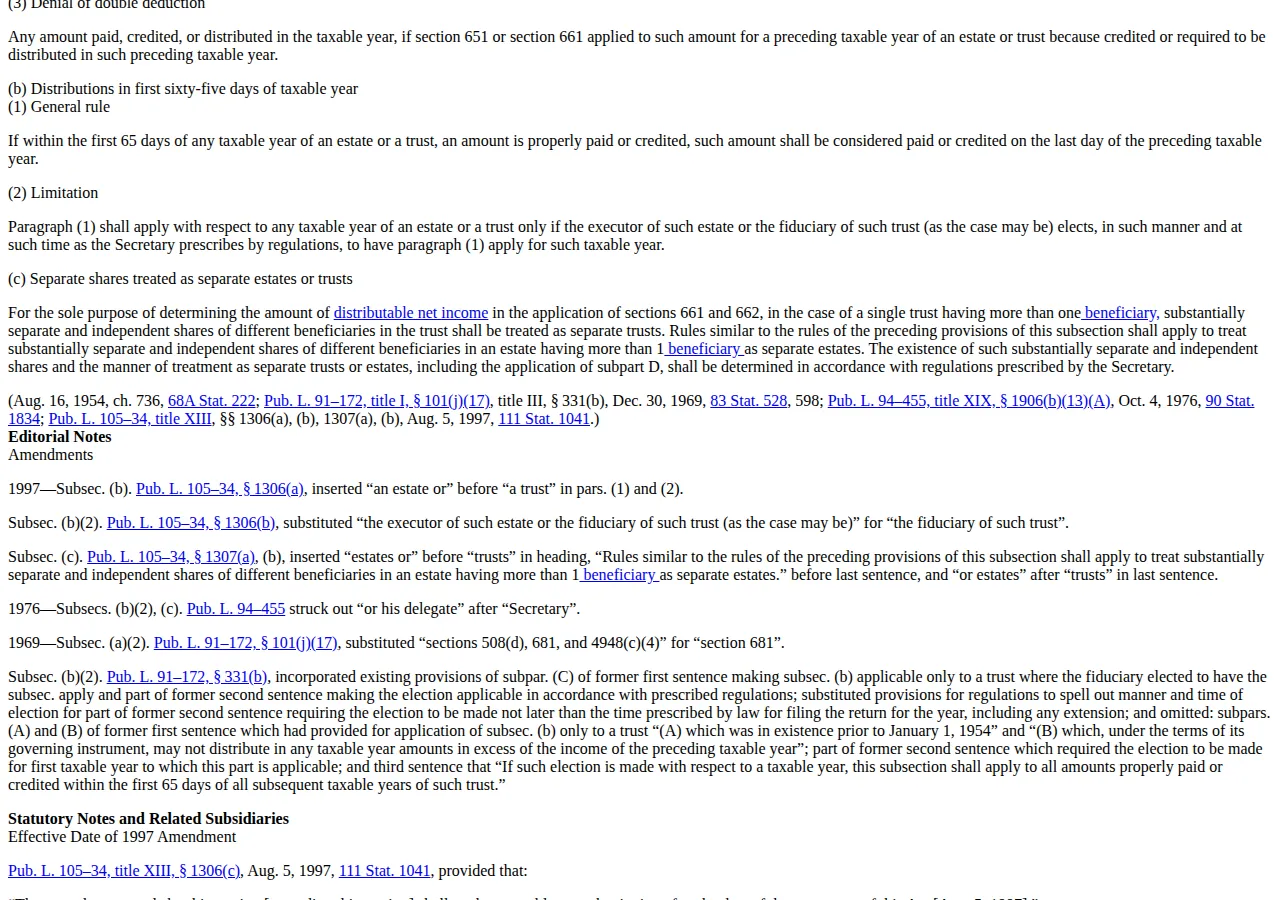
Section 663(b)(1) provides that an amount properly paid or credited within the first 65 days of a taxable year is considered paid or credited on the last day of the preceding taxable year. The election is made at Question 6 under "Other Information" on Form 1041, as § 663(b)(2) requires.
Return to the worked trust. The trustee distributed $70,000 during 2026, then on February 20, 2027 — day 51 of the new year — pays a further $20,000 and makes the § 663(b) election for 2026. The deduction becomes $90,000, taxable income falls to $16,900, and the tax becomes:
The election saves $11,584 − $4,184 = $7,400 of 2026 tax, and the beneficiaries report $90,000 on their 2026 returns. Section 663(a)(3) denies any double deduction: the $20,000 cannot be deducted again in 2027. The election is annual, for complex trusts and estates only.
Schedule K-1: what the beneficiary actually receives
Every beneficiary who receives a distribution gets Schedule K-1 (Form 1041), identified by the beneficiary's SSN or ITIN, reporting the beneficiary's share of income, deductions, and credits by character: interest, dividends, capital gains, LLC pass-through income, tax-exempt interest, foreign taxes, and the estate tax deduction under § 691(c) for income in respect of a decedent. The beneficiary reports the K-1 amounts on their own Form 1040 in the same year the trust claims the deduction, so the K-1 deadline is the return deadline: April 15, including extensions.
The § 645 election: treating a revocable trust as part of the estate
Without an election, a revocable trust becomes a separate taxpayer at the grantor's death, with a calendar year, its own return, and its own compressed brackets from day one. Section 645(a) lets the executor and the trustee jointly elect to treat a qualified revocable trust as part of the decedent's estate, on Form 8855, no later than the due date — with extensions — of the estate's first return. Once made it is irrevocable under § 645(c).
The election buys three things: the estate's choice of taxable year — a fiscal year ending on the last day of any month except December, so an October 31 year-end defers the first year's income by ten months; the estate's $600 exemption instead of the trust's $100; and an election period running until the applicable date under § 645(b)(2) — two years after death if no estate tax return is required, or six months after the final determination of estate tax liability.
The § 643(g) estimated-tax election
Section 643(g)(1) gives the trustee of a trust — a trust, not an estate — an election to treat any portion of an estimated tax payment made by the trust as a payment made by a beneficiary: paid to the beneficiary on the last day of the trust's taxable year, and an estimated tax payment by the beneficiary on January 15 following the year. The election is made on Form 1041-T, by the 65th day after year-end.
A trust that overpaid estimated tax can pass the excess to a beneficiary who underpaid, crediting the beneficiary as of January 15 and wiping out the fourth-quarter underpayment penalty. It does not change the total tax paid. The individual mechanics are in the quarterly estimated tax payments guide.
What is no longer deductible: § 67(h) and the § 67(e) carve-out
The Tax Cuts and Jobs Act suspended the deduction for 2018 through 2025 under former § 67(g). The One Big Beautiful Bill Act, Pub. L. 119-21 § 70110(a), struck the sunset: the suspension now applies to any taxable year beginning after December 31, 2017, with no end date, redesignated § 67(h).
What survives is § 67(e): costs of administering the estate or trust that would not have been incurred if the property were not held in trust — fiduciary fees for administration, probate costs, tax preparation — are allowable in arriving at adjusted gross income, above the line, in full. The distinction is functional: a trustee fee for administering the trust is deductible; a fee for managing its investments is not.
Deadlines, extensions, and penalties
For calendar-year estates and trusts, Form 1041 and the Schedules K-1 are due April 15 of the following year — April 15, 2026, for the 2025 return. A fiscal-year filer files by the 15th day of the fourth month after its year closes: a June 30 year-end files by October 15.
Form 7004 buys an automatic 5½-month extension of time to file — September 30 for a calendar-year filer — and it extends the filing deadline only, never the payment deadline.
Failure to file costs 5 percent of the tax due for each month or part of a month the return is late, up to 25 percent; if the failure is fraudulent, 15 percent per month up to 75 percent. If the return is more than 60 days late, the minimum penalty is the smaller of $525 or the tax due, per the 2025 instructions. Failure to pay costs 0.5 percent per month, also up to 25 percent; the two overlap rather than stack, and interest under § 6601 runs on top of both from the original due date.
The decisions: retain, distribute, or elect
| Decision | Retain / default | Distribute / elect | Authority |
|---|---|---|---|
| Income above DNI needs | Taxed to the trust at 37% above $16,000 | Deducted, taxed to beneficiaries | §§ 661, 662; Rev. Proc. 2025-32 |
| Year-end shortfall | Income stays in the trust, taxed there | Pay within 65 days, elect § 663(b) | § 663(b) |
| Revocable trust at death | Separate calendar-year taxpayer | Elect § 645 on Form 8855 | § 645; Form 8855 |
| Overpaid estimates | Refund to the trust after filing | Elect § 643(g) on Form 1041-T | § 643(g) |
| Filing deadline pressure | File by April 15 or face § 6651 penalties | File Form 7004 | § 6651; Form 7004 |
Failure modes: how a clean estate produces a bad return
Treating the trust like a person. A trust gets a $100, $300, or $600 exemption, no standard deduction, and brackets compressing to 37 percent at $16,000.
Distributing corpus and calling it income. A distribution of principal is not deductible and does not carry out DNI. Trustees who distribute $150,000 against $107,000 of DNI and deduct the full $150,000 overstate the deduction by $43,000.
Filing the K-1s late. The K-1 deadline is the return deadline. A fiduciary who files on time and mails K-1s in November leaves beneficiaries reporting in the wrong year.
Who should not use this playbook
This playbook is for fiduciaries of domestic estates and trusts holding income-producing assets — brokerage accounts, rentals, operating businesses — and their CPAs. It is not for grantor trusts, where the grantor reports the income directly, nor for foreign estates or trusts, which generally file Form 1040-NR.
Founder & CEO Insight — Enow A. Jovial
Execution checklists
First 30 days after appointment:
- [x] Apply for the estate or trust EIN on Form SS-4.
- [x] Determine the taxable year and the § 645 election before the first return is due.
- [x] Open the fiduciary books and classify every receipt as income or corpus — the classification drives DNI.
Annual filing sequence:
- [x] Close the books and compute DNI before year-end under § 643(a), capital gains allocated to corpus excluded.
- [x] Compare distributions to DNI and plan the § 663(b) payment inside the 65-day window.
- [x] Prepare Schedule K-1 for every beneficiary; reconcile K-1 income to the distribution deduction.
The filing sequence, in order
- Obtain the EIN and open fiduciary books.
- Choose the taxable year and decide the § 645 election on Form 8855.
- Close the books, compute DNI under § 643(a), and compare distributions.
- Pay any shortfall within 65 days and check the § 663(b) box at Question 6.
- Issue Schedule K-1 to every beneficiary.
- File Form 1041 by April 15, or file Form 7004, paying any balance due by April 15.
- Consider the § 643(g) election on Form 1041-T by the 65th day after year-end.
The decision in advance
Form 1041 is decided before the return is prepared: the taxable year is chosen at appointment, the § 645 election is made with the first return, distributions are set against DNI before year-end, and the 65-day window is the last chance to fix the prior year.