IRS Form 1040 Schedule H: The Household Employment Taxes Playbook (2026)
You hired a nanny, housekeeper, or home health aide, paid weekly from your own pocket — not through a business. You are now an employer under the Code, and the form that proves it is Schedule H (Form 1040): one page attached to your personal return.
Households fail two ways: some never file, treating weekly pay as a private arrangement — until the caregiver claims unemployment or Social Security credits; others over-file, running a full business payroll with quarterly Form 941 deposits for a babysitter who needed only a W-2 and a Schedule H. This playbook gives you the thresholds, the filing, the arithmetic, and the boundary. Every figure below comes from Publication 926 (2026), the Schedule H instructions, Topic 756, or the statute — all opened and verified on November 6, 2026.
> [!FOUNDER]
> "A household is not a business, and the tax code knows it. Schedule H exists because Congress decided your nanny should not force you to become a payroll department — one page, once a year, attached to the return you already file. The households that get hurt are the ones that treat that simplicity as permission to ignore the form entirely."
> — Enow A. Jovial, Founder & Chief Executive Officer
What Schedule H Actually Is
Schedule H computes Social Security tax, Medicare tax, FUTA tax, and federal income tax withheld. Attach it to Form 1040, 1040-SR, 1040-SS, 1040-NR, or 1041 and pay by April 15, 2027.
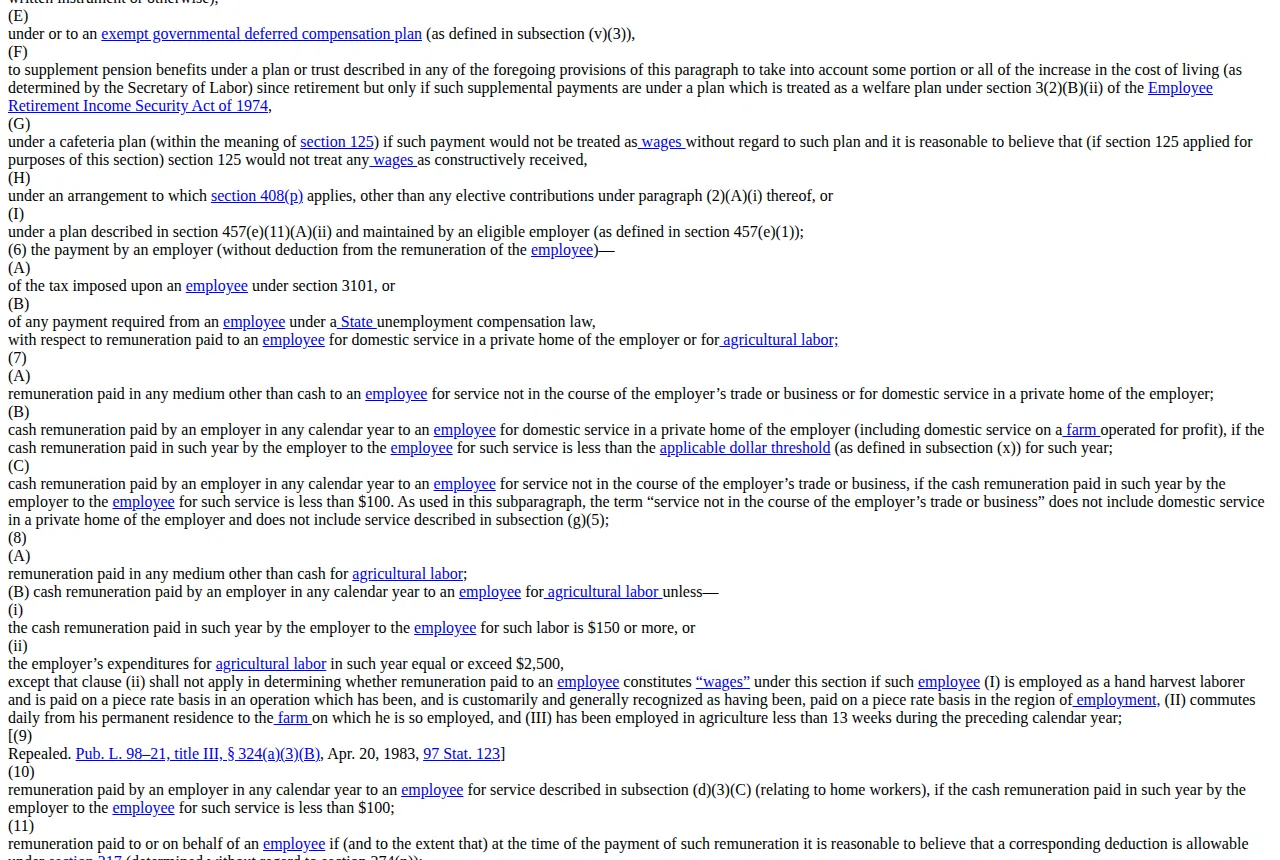
Two Code sections carry the law. Section 3121(a)(7)(B) excludes from FICA "wages" cash remuneration for domestic service in a private home below the applicable dollar threshold in section 3121(x) — $1,000 base, indexed from 1993, rounded down to the nearest $100. Section 3306(a)(3) defines a household employer for FUTA purposes as anyone who paid $1,000 or more in cash wages for domestic service in any quarter of the current or preceding year, and section 3306(c)(2) excludes domestic service from FUTA employment unless that test is met.
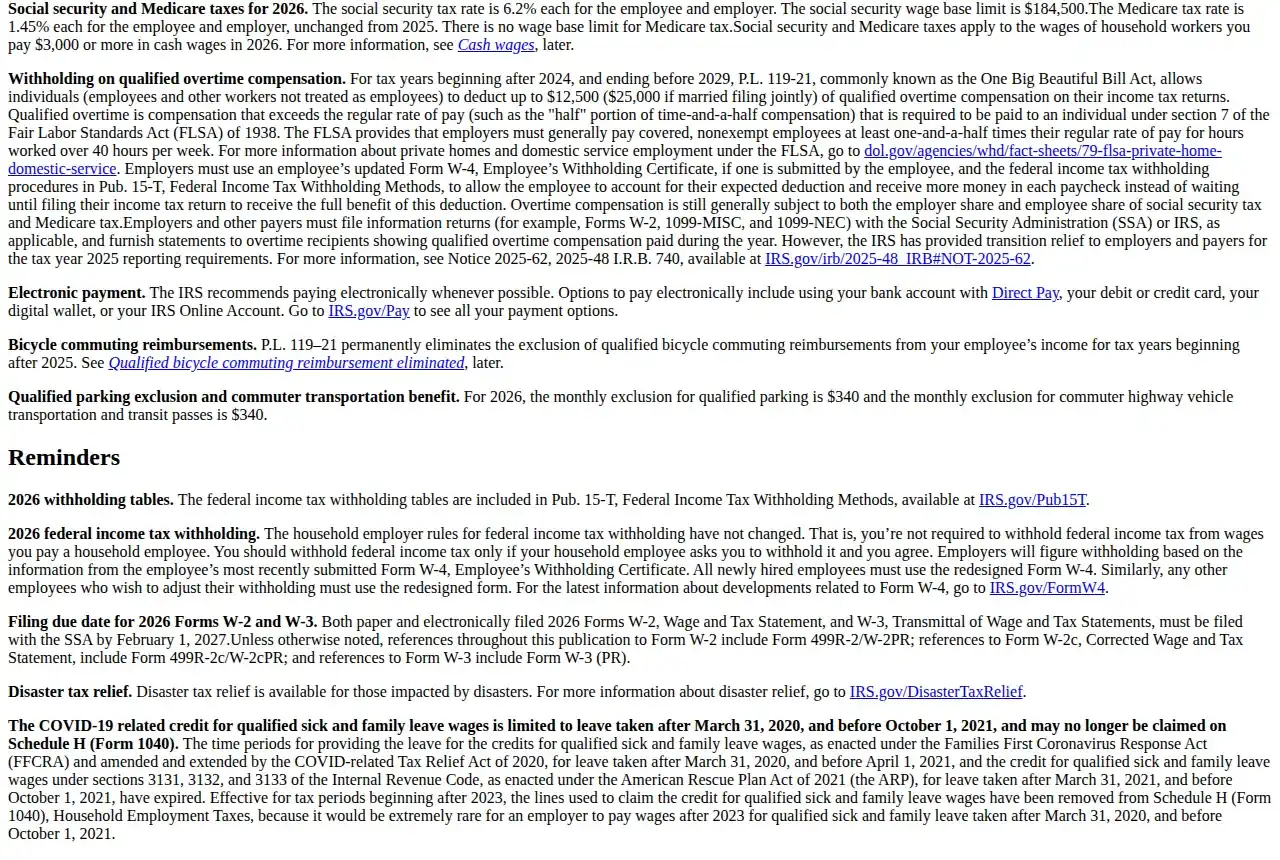
!IRS Publication 926 (2026): the $3,000 threshold and 2026 FICA rates
The 2026 Threshold Is $3,000 — Not $2,800
The correction that matters most this filing season: the threshold for 2025 was $2,800; for 2026 it is $3,000. Publication 926 (2026) states it plainly: "Social security and Medicare taxes apply to the wages of household workers you pay $3,000 or more in cash wages in 2026." Topic 756 confirms it, and the screenshot above shows the IRS text verbatim.
The threshold is per employee, per year — a cliff, not a phase-in. Pay one employee $2,999 during 2026 and none of those wages are Social Security or Medicare wages. Pay $3,000 and every dollar counts, including the first $2,999. The test counts wages paid during the year, regardless of when earned.
Cash wages are wages paid by check, money order, or cash. Noncash wages — food, lodging, clothing, transit passes — do not count toward the $3,000 test, though cash given in place of those items does. A sitter paid $60 every Saturday crosses the line in the fiftieth week, owing FICA on the whole $3,120.
> [!KEY TAKEAWAY]
> The 2026 FICA threshold is $3,000 per employee — up from $2,800 in 2025. Below it, zero FICA; at or above it, FICA applies to every dollar from the first.
Two Tests, Two Thresholds: The Decision Table
| Test | Threshold (2026) | Measured how | Tax if triggered | Authority |
| :--- | :--- | :--- | :--- | :--- |
| FICA (Social Security + Medicare) | $3,000 cash wages per employee per year | Per employee, calendar year | 15.3% combined (12.4% SS + 2.9% Medicare) | § 3121(a)(7)(B), (x); Pub. 926 |
| FUTA (federal unemployment) | $1,000 total cash wages in any calendar quarter, 2025 or 2026 | All household employees combined, any quarter | 6.0% on first $7,000, less state credit up to 5.4%, net 0.6% | § 3306(a)(3), (b)(1), (c)(2); Pub. 926 |
| Federal income tax withholding | No threshold — only if employee asks and you agree | Per employee, by Form W-4 | Amount per Pub. 15-T tables | Pub. 926; IRS Topic 756 |
Take a housekeeper paid $725 a quarter — $2,900 a year. She never reaches the $3,000 FICA threshold, and the quarterly household total of $725 stays below $1,000, so no tax is due. Add a gardener at $400 a quarter and the quarterly total becomes $1,125, clearing the $1,000 test. FUTA now applies to the first $7,000 of cash wages paid to each employee — including the housekeeper whose wages never triggered FICA: her bill is $2,900 × 0.6% = $17.40; the gardener's is $1,600 × 0.6% = $9.60. FUTA comes entirely from your funds — never withhold it.
!26 U.S.C. § 3121(a)(7)(B): domestic-service wages below the threshold
Schedule H, Line by Line
Schedule H has three parts — I, II, III. The 2025 instructions are the latest published edition.
Part I, lines 1–8. Line 1: cash wages subject to Social Security tax, capped at the $184,500 wage base per employee for 2026. Line 2: line 1 × 12.4%, both 6.2% shares in one figure. Line 3: cash wages subject to Medicare tax, no wage base limit. Line 4: line 3 × 2.9%. Lines 5–6: Additional Medicare Tax withholding — wages above $200,000 × 0.9%. Line 7: any federal income tax withheld. Line 8: lines 2 + 4 + 6 + 7.
Line 9, the FUTA gate. Did you pay $1,000 or more in total cash wages in any quarter of 2025 or 2026? No — stop here and carry line 8 through Part III to Schedule 2, line 9. Yes — complete Part II.
Part II, lines 10–24. Lines 10–12 ask whether you paid all required state contributions on time; yes to all three means Section A. Line 13: the state abbreviation. Line 14: state contributions paid. Line 15: FUTA wages — the first $7,000 per employee, excluding wages paid to your spouse, child under 21, or parent. Line 16: line 15 × 0.6%. Section B (lines 17–24) is the long form for late payments, credit reduction states, or multiple states: line 21 is line 20 × 6.0%, line 22 is line 20 × 5.4%, and line 23 takes the smaller of line 19 or line 22.
Part III, lines 25–27. Line 25 repeats line 8; line 26 adds line 16 (or 24) and line 25; line 27 routes the total to Schedule 2, line 9.
> [!WARNING]
> Do not complete boxes 3, 4, 5, and 6 on a Form W-2 for an employee below the $3,000 threshold. The Social Security Administration rejects W-2s reporting Social Security and Medicare wages for a below-threshold household employee. Report only boxes 1 and 2 and leave the FICA boxes blank.
The Math, Exposed: Two Worked Cases
Case 1 — the IRS's own example, verified. Publication 926 works this case end to end: Mary Brown hires Jane A. Oak on January 31, 2026, to care for her child at $70 every Friday for 48 weeks — $3,360 total, clearing the $3,000 threshold, so every dollar is FICA wages.
$
\text{Social Security tax (each side)} = \$3{,}360 \times 6.2\% = \$208.32
$
$
\text{Medicare tax (each side)} = \$3{,}360 \times 1.45\% = \$48.72
$
Each side owes $257.04, so combined FICA is $514.08. On Schedule H, line 2 is $416.64, line 4 is $97.44, and line 8 is $514.08. FUTA also applies: line 16 is $3,360 × 0.6% = $20.16, and line 26 totals $534.24. Our editorial analysis found the IRS figures reconcile to the cent.
As a general formula, for any employee who clears both tests (full state credit assumed):
$
\text{Annual Household Tax} = 0.153 \times W + 0.006 \times \min(W, 7000)
$
where $W$ is annual cash wages. It reproduces both cases above exactly.
Case 2 — a full-time nanny at $800 a week. Annual wages are $800 × 52 = $41,600 — above the threshold, below the $184,500 wage base.
$
\text{Total FICA} = \$41{,}600 \times 15.3\% = \$5{,}158.40 + \$1{,}206.40 = \$6{,}364.80
$
FUTA applies to the first $7,000 only: $7,000 × 0.6% = $42.00, assuming full state credit. Total: $6,364.80 + $42.00 = $6,406.80, about $123.21 a week on top of the $800 wage. The employer share of FICA alone is $3,182.40 a year — the number most households forget to budget. Every dollar above $3,000 carries a 15.3% FICA load plus the small FUTA charge, so the true weekly cost of an $800 nanny is $923.21, not $800. Check that arithmetic with the profit calculator before you agree a rate.
Employee or Independent Contractor: The Boundary That Decides Everything
None of the above applies if the worker is an independent contractor. The distinction turns on control: per Topic 756, household workers are your employees if you can control not only the work they do, but also how they do it. A nanny who works your hours, in your home, under your rules, is your employee. A plumber with their own tools, schedule, and per-job billing is not — nor is a cleaning company that sends whichever worker it chooses.
Getting this wrong cuts both ways. Misclassify an employee as a contractor and you skip Schedule H and the W-2, leaving the worker without Social Security credits. Misclassify a contractor as an employee and you pay FICA and FUTA you never owed. The contractor-reporting side, including Form 1099-NEC, is covered in our IRS Form 1099-NEC contractor reporting playbook; the business-payroll side is covered in our quarterly payroll tax filing playbook and priced in our payroll provider cost comparison. Schedule H is the household lane only.
Three categories are excluded from FICA and FUTA wages even above the thresholds: your spouse, your child under 21, and your parent — with one narrow exception for a parent caring for your child under 18 while you are divorced, widowed, or living with a spouse unable to care for the child. An employee under 18 at any time during the year is also excluded, unless household work is their principal occupation; a student is not treated as having it as a principal occupation. These exclusions come from section 3121(b)(21) and Publication 926.
> [!TIP]
> If you pay the employee's share from your own funds instead of withholding, that payment counts as additional wages for federal income tax — add it to box 1 of the W-2 — but not as Social Security, Medicare, or FUTA wages. Do the gross-up deliberately.
Who This Playbook Is NOT For
Schedule H is a household instrument. A sole proprietor, S-Corp, C-Corp, or LLC hiring help for a business purpose — an office cleaner, a company-daycare nanny — reports those wages on Form 941 or 944 and Form 940, not Schedule H. A farm employer uses Form 943 and Form 940. If an agency remains the employer of record, the agency files — not you. If you chose to report household wages with your business employment taxes, Publication 926 is explicit: do not use Schedule H — report the household employee on the same Form 941, 944, or 943 and Form 940 as your business employees, and meet those forms' deposit deadlines instead.
Filing Mechanics: EIN, W-2, Deadlines, and the Estimated-Tax Question
Five administrative facts, all from Publication 926. First, get an Employer Identification Number: a nine-digit IRS number, not your Social Security number, for every form you file for a household employee — apply at IRS.gov/EIN or by faxing or mailing Form SS-4. Second, complete Form I-9 no later than the first day of work, and keep it; do not send it to the IRS. Third, file Form W-2 for each employee paid $3,000 or more in FICA wages, or from whom you withheld federal income tax, and transmit Copy A with Form W-3 to the Social Security Administration by February 1, 2027. Fourth, attach Schedule H to your 2026 return and pay by April 15, 2027. Fifth, keep your records — Schedule H, W-2s, W-3s, W-4s, and each employee's name and SSN as on their Social Security card — for at least four years after the return's due date or the payment date, whichever is later.
Must the tax be paid during the year, or can it wait until April? You can avoid owing it with your return by paying enough during the year — asking your own employer to withhold more, or making estimated payments on Form 1040-ES. The 2026 estimated dates are April 15, June 15, and September 15, 2026, and January 15, 2027. Pay too little and you may owe an underpayment penalty (Topic 306). There is no March 1 deadline for household employers — that rule belongs to farmers and fishermen, and no farmer-analog relief appears in Publication 926 or the Schedule H instructions. The only safe harbor is paying enough, early enough.
The Execution Checklist
Work this in order, once per household employee.
1. Classify the worker. If you control what is done and how, the worker is a household employee. If not, stop — use the 1099-NEC playbook.
2. Get an EIN at IRS.gov/EIN if you lack one; complete Form I-9 before the first day of work.
3. Track cash wages per employee, per quarter, against the $3,000 FICA threshold and the $1,000 quarterly FUTA test.
4. Withhold the employee's 7.65% once the $3,000 threshold is met or expected, unless you pay the employee's share yourself and gross up box 1.
5. Check the state side. Register with your state unemployment agency if required and pay state contributions; check for credit reduction status.
6. File Forms W-2 and W-3 by February 1, 2027, and give the employee their copies — within 30 days of a request or the last wage payment, whichever is later.
7. Pay during the year. Raise your own withholding or make estimated payments on the four quarterly dates, so the total does not arrive as a lump sum with a penalty.
8. Complete Schedule H, attach it to your 2026 return, and pay by April 15, 2027.
9. File your records. Keep Schedule H, W-2s, W-3s, W-4s, and I-9s for at least four years.
Track wages weekly and decide the threshold question in January, not April. The form is one page; the penalty for ignoring it — back taxes, interest, missing Social Security credits — is the expensive part. Price the employment honestly, file the page, and the nanny tax stays cheap.