The gate between two ways of counting income
Every business counts income one of two ways. Under the cash method, you report income in the tax year you receive it and deduct expenses in the tax year you pay them. Under the accrual method, you report income in the tax year you earn it, regardless of when payment arrives, and deduct expenses in the tax year you incur them. Publication 538 states both definitions in those exact terms, and the difference between them is timing: the cash method lets you hold tax on money you have billed but not yet collected until the check clears.
Congress decided in 1986 that three kinds of taxpayers should not get that timing benefit. Section 448(a) says taxable income shall not be computed under the cash method in the case of a C corporation, a partnership which has a C corporation as a partner, or a tax shelter. A sole proprietor, an S corporation, and a partnership with no C corporation partner were never barred, and they may use the cash method at any size.
Then section 448(b)(3) hands the key back. The bar does not apply to a corporation or partnership for any taxable year if the entity meets the gross receipts test of section 448(c) for that year. The test is arithmetic, not judgment.
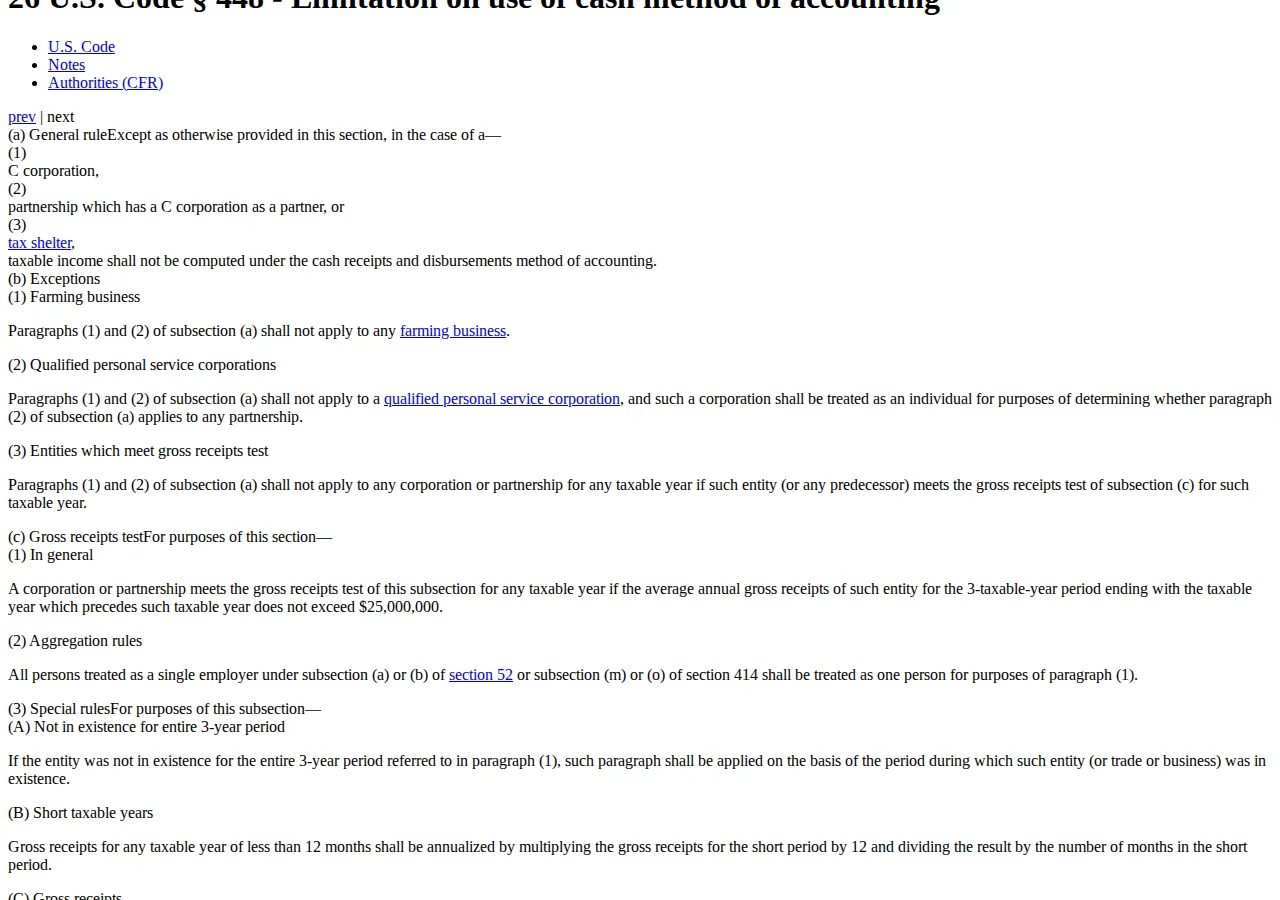
The three barred categories, exactly as the statute draws them
C corporations. Section 448(a)(1) covers every C corporation. The bar applies because the cash method in a corporation separates the tax year from the economic year most aggressively: a corporation can bill in December, collect in January, and push a whole month of revenue into the next tax year, year after year.
Partnerships with a C corporation partner. Section 448(a)(2) catches the structure that would otherwise dodge paragraph (1): put the operating business in a partnership, give a C corporation a small partnership interest, and run the whole thing on cash.
Tax shelters. Section 448(a)(3) reaches the category Congress was most worried about in 1986. Section 448(d)(3) defines a tax shelter by reference to section 461(i)(3).
Two exceptions in subsection (b) sit beside the gross receipts test. A farming business is exempt under section 448(b)(1). And a qualified personal service corporation is exempt under section 448(b)(2): substantially all its activities must involve health, law, engineering, architecture, accounting, actuarial science, performing arts, or consulting, and substantially all its stock must be held by employees performing those services, retired employees, or their estates. A law firm or an engineering consultancy organized as a C-Corp keeps the cash method on that ground alone. Whether the employer is an S-Corp, a C-Corp, or an LLC taxed as a corporation, the category decides — not the label.
The gross receipts test, worked with real numbers
Section 448(c)(1) states the test in one sentence: a corporation or partnership meets the gross receipts test for any taxable year if the average annual gross receipts of the entity for the three-taxable-year period ending with the taxable year which precedes such taxable year does not exceed $25,000,000. Three mechanics hide inside that sentence.
The look-back. The three years are the ones before the year being tested, not including it. Testing eligibility for 2026 means averaging 2023, 2024, and 2025. A single big year does not fail the test, and a single small year does not save it — only the average counts.
The base and the index. The $25,000,000 is the statutory base from the Tax Cuts and Jobs Act. Section 448(c)(4) adjusts it annually for inflation for tax years beginning after December 31, 2018, rounding to the nearest $1,000,000. The IRS publishes the adjusted figure each year in its annual inflation-adjustment revenue procedure. The figure climbed $26 million → $27 million → $29 million → $30 million across 2019–2024; the current figures were verified against the revenue procedures themselves: $31,000,000 for 2025 under Rev. Proc. 2024-40 § 4.31, and $32,000,000 for 2026 under Rev. Proc. 2025-32 § 4.30, with $33,000,000 already published for 2027 under Rev. Proc. 2026-35.
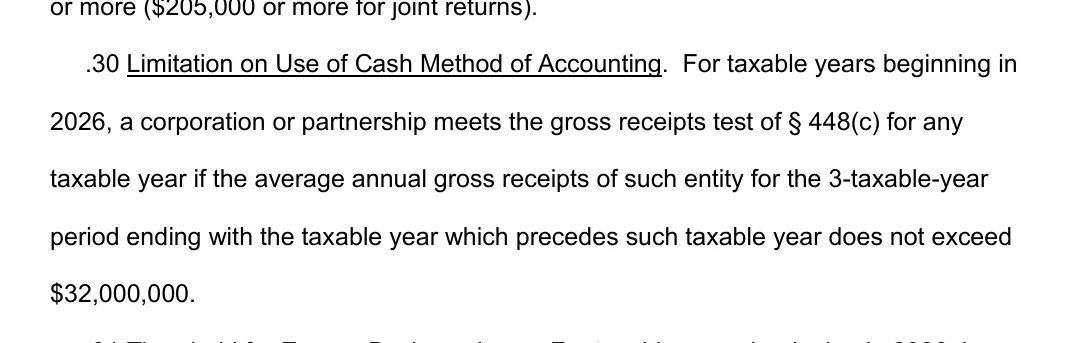
The average. The formula is the whole test:
Work it with a company testing 2026. Gross receipts were $28,000,000 in 2023, $33,000,000 in 2024, and $35,000,000 in 2025. The average is $(28 + 33 + 35) / 3 = 96 / 3 = $32,000,000 — exactly at the 2026 threshold, so the company passes for 2026, by zero dollars. Now test 2027, when the threshold is $33,000,000: if 2026 receipts come in at $36,000,000, the three years are 2024, 2025, and 2026, and the average is $(33 + 35 + 36) / 3 = 104 / 3 = $34,666,667 — above $33,000,000, so the company fails for 2027 and must use accrual from that year. The cliff is visible a year ahead, which is the point of running the test every year instead of discovering it on the return.
The adjustments. Section 448(c)(3) supplies four of them. Gross receipts are reduced by returns and allowances made during the year, so the test runs on net receipts, not gross billings. A short taxable year is annualized: multiply the short-period receipts by 12 and divide by the number of months in the period — an eight-month first year with $20,000,000 of receipts counts as $20,000,000 × 12 / 8 = $30,000,000. An entity not in existence for the whole period is tested on the period it existed, and a predecessor counts as the entity itself. And section 448(c)(2) aggregates: all persons treated as a single employer under section 52(a) or (b) or section 414(m) or (o) are treated as one person, so splitting the business across two corporations does not split the receipts.
One test, four exemptions
The gross receipts test is worth running even in a year you are nowhere near the line, because section 448(c) is not only the cash-method gate. Other Code sections borrow the same test, and one computation answers several questions at once.
The business-interest exemption. Section 163(j) caps deductible business interest at 30 percent of adjusted taxable income — but a company that meets the section 448(c) gross receipts test is exempt from the limit altogether. For most companies under $32 million this is a rule to know exists rather than one that bites, and the exemption is the reason the test shows up in financing discussions long before it shows up in accounting-method discussions. Our section 163(j) business interest limitation playbook works the cap itself; the point here is that the same average that keeps you on cash also keeps you out of the cap.
The inventory relief. Section 471(c) lets a small business taxpayer that meets the gross receipts test under section 448(c), and is not a tax shelter, treat inventory as non-incidental materials and supplies instead of keeping full inventory accounts under section 471(a). For a manufacturer or a reseller, that is the difference between tracking cost of goods sold item by item and expensing inventory as it is consumed. Publication 538 lists the relief in exactly those terms, and our section 174 software capitalization guide shows the neighbouring question — what happens to research costs once the method question is settled.
What the cash method is actually worth
The cash method is a timing deferral, not a tax cut. The tax is deferred, not eliminated, and the value of the deferral is the time value of the money held back. Work it for a C corporation with $2,400,000 of receivables outstanding at year-end — billed in December, collected in January — at the 21 percent corporate rate:
At a 5 percent cost of capital, holding $504,000 of tax for one extra year is worth about $25,200. The number scales linearly with the receivables balance: $1,000,000 of receivables defers $210,000 of tax and is worth about $10,500 a year at the same rate. Run your own balances through our pricing calculator before deciding the method is worth defending — the deferral is one year's interest on the tax, not the tax itself.
Losing the test: the forced switch
Failing the test is not a penalty event. It is a method change, and the statute scripts it. Publication 538 states the rule without hedging: a corporation or partnership that fails to meet the gross receipts test for any tax year cannot use the cash method and must change to an accrual method, effective for the tax year in which the entity fails the test, and must file Form 3115 to request the change.
The switch moves every open balance across the boundary in one year, and section 481(a) is the mechanism that keeps the move honest: the adjustment prevents income from being counted twice or omitted entirely when the method changes. Work it for the same company, switching to accrual with $800,000 of receivables, $300,000 of inventory on hand, and $200,000 of payables outstanding:
The $900,000 is the income that was earned but never taxed under cash — the receivables and the inventory, net of the payables that were never deducted. It is taken into account under section 481, and section 448(d)(7) treats any change made under section 448 as initiated by the taxpayer and made with the consent of the Secretary, so the switch does not need a separate consent fight. Our Form 3115 accounting method change playbook carries the filing mechanics.
Bring the workpapers before the switch is filed, because the adjustment is built from the books, not from the return. Your CPA will want the EIN and the entity file, the Form 1120 for a C-Corp or the Form 1065 with its Schedule K-1s, the GAAP trial balance with receivables and payables aged, the ASC 740 deferred-tax workpapers, and the FICA payroll registers. An S-Corp or a single-member LLC taxed as a disregarded entity never files this switch — the section never reached it.
The decision, in one table
| Entity | Three-year average | Method available | Authority |
|---|---|---|---|
| Sole proprietor | Any size | Cash or accrual, free choice | § 448(a) never applies |
| S corporation | Any size | Cash or accrual, free choice | § 448(a) never applies |
| C corporation | ≤ $32M for 2026 | Cash under § 448(b)(3) | § 448(c), Rev. Proc. 2025-32 |
| C corporation | > $32M for 2026 | Accrual only | § 448(a)(1) |
| Partnership with C corporation partner | ≤ $32M for 2026 | Cash under § 448(b)(3) | § 448(c), Rev. Proc. 2025-32 |
| Partnership with C corporation partner | > $32M for 2026 | Accrual only | § 448(a)(2) |
| Qualified personal service corporation | Any size | Cash under § 448(b)(2) | § 448(d)(2) fields and ownership test |
| Tax shelter | ≤ $32M for 2026 | Cash under § 448(b)(3) | § 448(c), § 461(i)(3) definition |
| Tax shelter | > $32M for 2026 | Accrual only | § 448(a)(3) |
For the full comparison of what each method does to a growing business, read our cash vs accrual accounting guide — the operational companion to this statute guide.
The annual routine
- Identify the category: C corporation, partnership with a C corporation partner, or tax shelter — otherwise section 448 does not apply.
- Check the escape hatches first: farming business or qualified personal service corporation — either one ends the inquiry.
- Pull the three prior years: gross receipts net of returns and allowances, predecessors included, related entities aggregated.
- Annualize any short year: receipts × 12 ÷ months in the period.
- Average and compare: three-year average against the revenue procedure figure for the year being tested — $32,000,000 for 2026.
- Calendar the autumn release: the next year's figure publishes in the revenue procedure each autumn; never carry last year's number forward.
- If failing, file Form 3115: accrual effective for the failure year, section 481(a) adjustment computed from the balance sheet.
Founder & CEO Insight — Enow A. Jovial