IRS Form 3115: The Accounting Method Change Playbook
Most tax forms report what already happened; Form 3115 asks the IRS for permission to change how the numbers are computed. A business moving from cash to accrual, a company fixing years of wrong depreciation, a firm unwinding its research capitalization — each files the same form. Get it wrong and the business pays tax twice on the same income, or files a change the IRS never consented to.
Section 446(e) provides that a taxpayer who changes the method of accounting on which it regularly computes its income must, before computing taxable income under the new method, secure the consent of the Secretary. Without it the change has no legal effect. Form 3115 is the vehicle for that consent. This playbook covers the change, the adjustment, the list, the research rules, and the filing sequence.
What counts as a change — and what does not
A change in method of accounting changes when an item of income or expense is taken into account, not whether it is income or a deduction. Moving from cash to accrual is the classic example: the same revenue is taxed, but in a different year. Changing a recovery period, how advance payments are recognized, or how inventory is valued are all method changes. The test is timing plus consistency.
Three things are mistaken for method changes and are not: adopting a method for the first time — a new business choosing cash or accrual on its first return; correcting a mathematical or posting error; and a change in the underlying facts, such as earlier customer payment. The distinction matters because the IRS treats an unapproved method change as no change at all. Our editorial analysis found the most common failure is treating a real method change as a bookkeeping update, with no Form 3115 filed.
> [!KEY TAKEAWAY]
> If the change moves income or deductions between tax years, it needs consent. If it only fixes a number within one year, it is probably an error.
The section 481(a) adjustment: the catch-up that makes the change honest
Every method change creates the same problem. Under the old method, some income is not yet taxed and some expenses not yet deducted; under the new method, those items would be counted again, or never counted at all. Section 481(a) stops both outcomes: it requires the adjustments necessary solely by reason of the change to prevent amounts from being duplicated or omitted. The adjustment is a single net number: everything the old method left uncounted, less everything it counted too early.
It is an income-tax adjustment only: FICA and SECA wages are untouched, and a GAAP book method can stay put while the tax method changes.
Under Rev. Proc. 2015-13, the adjustment period is one taxable year for a negative adjustment and four — the year of change and the next three — for a positive adjustment, taken ratably. A positive adjustment is income pulled forward, so it spreads; a negative one releases deductions, so the taxpayer takes it at once. The procedure's own worked example: a $60,000 positive adjustment is taken as $15,000 per year for four years.
Take a service business ending its last cash-basis year with $180,000 of accounts receivable and $60,000 of accounts payable — neither has touched the return under the cash method; both belong in the year they accrued:
$
\text{§ 481(a) adjustment} = \$180{,}000\ \text{receivables} - \$60{,}000\ \text{payables} = \$120{,}000\ \text{positive}
$
$
\text{Annual inclusion} = \frac{\$120{,}000}{4\ \text{years}} = \$30{,}000\ \text{per year, year of change + next 3 years}
$
At the 21 percent corporate rate in section 11(b), each $30,000 inclusion adds $6,300 of tax per year — $25,200 across four years, exactly 21 percent of the adjustment.
Negative adjustments and the $3,000 rule
A negative adjustment is the outcome every filer hopes for: the new method finds deductions understated, and the catch-up reduces taxable income. Suppose a change to a permissible depreciation method produces a section 481(a) adjustment of negative $48,000. The whole amount is taken in the year of change:
$
\text{Year-of-change inclusion} = -\$48{,}000\ \text{in full};\qquad \text{tax effect at 21\%} = \$48{,}000 \times 0.21 = \$10{,}080\ \text{reduction}
$
Section 481(b) separately caps the tax on a large adjustment above $3,000 at a three-year allocation.
> [!WARNING]
> A negative adjustment is not a refund machine. It is the exact amount the old method left uncounted, supported by the books. Inflating receivables or inventing deductions turns a catch-up into a false statement, and a denied change leaves the old method in place.
Automatic versus non-automatic: two doors, very different keys
Rev. Proc. 2015-13 is the rulebook for both routes: procedures, eligibility bars, audit protection, and the adjustment period. Rev. Proc. 2025-23 is the menu — the current List of Automatic Changes, effective for Forms 3115 filed on or after June 9, 2025, for a year of change ending on or after October 31, 2024, superseding the Rev. Proc. 2024-23 list.
| Route | What it requires | Cost | Timing | Authority |
|---|---|---|---|---|
| Automatic change | Form 3115 for a listed change, with the correct DCN; original attached to the timely filed return; signed duplicate copy to the IRS National Office | No user fee | Duplicate copy between the first day of the year of change and the original's filing date | Rev. Proc. 2015-13 §§ 6.02–6.03; Rev. Proc. 2025-23 |
| Non-automatic change | Form 3115 plus a letter-ruling request; user fee through PAY.gov | User fee required (schedule in Rev. Proc. 2023-1, App. A) | During the year of change; IRS normally acknowledges within 60 days | Rev. Proc. 2015-13 § 6.03(2); Instructions for Form 3115 (Rev. Dec. 2022) |
Three eligibility bars in section 5.01(1) end more automatic filings than any other rule: the year of change must not be the final year of the trade or business; no overall method change in the five taxable years ending with the year of change; and no change for the same item in those five years. A business that changed its inventory method three years ago cannot change it again automatically. Some changes carry waivers — the research changes below are one example — but a waiver must be written into the governing procedure. Automatic changes generally carry audit protection for prior years, denied to a taxpayer under examination under section 8.
The designated change numbers that matter
Every automatic change carries a designated change number, and the DCN goes on the form — using the wrong one is a common reason a filing gets questioned. The numbers below come from Rev. Proc. 2025-23 as modified by Rev. Proc. 2025-28 and Rev. Proc. 2026-32.
The overall cash-to-accrual change is section 15.01 of Rev. Proc. 2025-23. The general DCN is 122. Two special cases carry their own numbers: a change made in the mandatory section 448 year is DCN 257, and a change for a taxpayer subject to section 447 is DCN 258. Over the section 448 threshold, accrual is required, not chosen. For the basis decision itself, the cash vs accrual accounting guide works through when each basis fits a scaling business.
Depreciation corrections are the highest-volume Form 3115 filings. A change from an impermissible to a permissible depreciation method for property still owned is DCN 7 (section 6.01), requiring that the impermissible method was used in at least two taxable years immediately before the year of change. The catch-up — depreciation that should have been claimed minus what was claimed — is a negative section 481(a) adjustment taken in the year of change, which is why a cost segregation study on a building already owned often produces a large deduction. The Form 4562 depreciation playbook runs the MACRS conventions and section 280F caps that decide what the correct method was.
The research numbers are DCN 265 for the TCJA section 174 change (section 7.01), DCN 273 for the domestic section 174A change (section 7.02), and DCN 274 for foreign research (section 7.03). Construction has its own pair after Rev. Proc. 2026-32: DCN 236 for the small-taxpayer exception from section 460 (section 19.01) and DCN 275 for residential construction contracts entered into in taxable years beginning after July 4, 2025 (section 19.03), both on a cut-off basis with no section 481(a) adjustment.
> [!TIP]
> Before choosing a DCN, read the section of Rev. Proc. 2025-23 it sits in. Each section states its own exclusions — section 15.01 excludes foreign income taxes under Treas. Reg. § 1.901-2(a) — and a filing that ignores one is a filing for a change the list does not offer.
The section 174A interaction: the research change that rewrote the playbook
Under the Tax Cuts and Jobs Act, section 174 required research expenditures paid or incurred after December 31, 2021 to be capitalized and amortized — five years for domestic, fifteen for foreign, from the midpoint of the year paid or incurred. The One Big Beautiful Bill Act (Pub. L. 119-21, § 70302) ended that regime for domestic research: new section 174A makes domestic research deductible when paid or incurred, for years beginning after December 31, 2024, while section 174 now amortizes foreign research only, over fifteen years from the midpoint. The Section 174 software capitalization guide runs the deduction and the foreign schedule in full.
For most taxpayers it is a straight automatic change under section 7.02, DCN 273: change to the section 174A deduction method, or elect the section 174A(c) method and amortize over not less than 60 months. At $300,000 of domestic research it produces $5,000 a month for sixty months, beginning with the month benefits are first realized.
The stranded 2022–2024 balances get their own treatment. Under OBBBA section 70302(f)(2), a taxpayer may elect to take any remaining unamortized domestic research capitalized under TCJA section 174 in full in the first year beginning after December 31, 2024, or ratably over the two years beginning with that year. A company that capitalized $600,000 in 2022–2024 and has amortized $240,000, leaving $360,000, may deduct the full $360,000 in the first post-2024 year or $180,000 a year for two years. The election is treated as a method change for section 481 purposes, is deemed made with consent, and applies on a cut-off basis with no section 481(a) adjustment
Small businesses get a further door. Under OBBBA section 70302(f)(1), an eligible taxpayer — one meeting the section 448(c) gross receipts test for its first year beginning after December 31, 2024 — may elect to apply section 174A retroactively to amounts paid or incurred after December 31, 2021, generally by filing amended returns. For a taxable year beginning in 2025 the threshold is $31,000,000. The election is due one year after enactment; because July 4, 2026 is a Saturday, section 7503 moves it to Monday, July 6, 2026. A taxpayer making this election and filing its first post-2024 return on the section 174A method needs no separate method change that year. Rev. Proc. 2026-32 (effective for Forms 3115 filed after September 4, 2026) folded these changes into the automatic list, waived the section 5.01(1)(d) and (f) bars for the first or second taxable year beginning after July 4, 2025, and gave a transition rule for duplicate copies filed on or before November 15, 2026 — check that date first for any draft research Form 3115.
> [!FOUNDER]
> "A method change is the moment a business stops arguing with its own books. The old method was a decision made with old information; the new method is a decision made with the whole picture. File the form, take the adjustment in the open, and let the return tell the truth about when the money was really earned."
> — Enow A. Jovial, Founder & Chief Executive Officer
Form 3115 asks for the applicant’s identifying number — an EIN for an LLC, S-Corp, or C-Corp, an SSN for a sole proprietor — and the preparer’s signature; a CPA review is the norm on a first filing.
The filing sequence
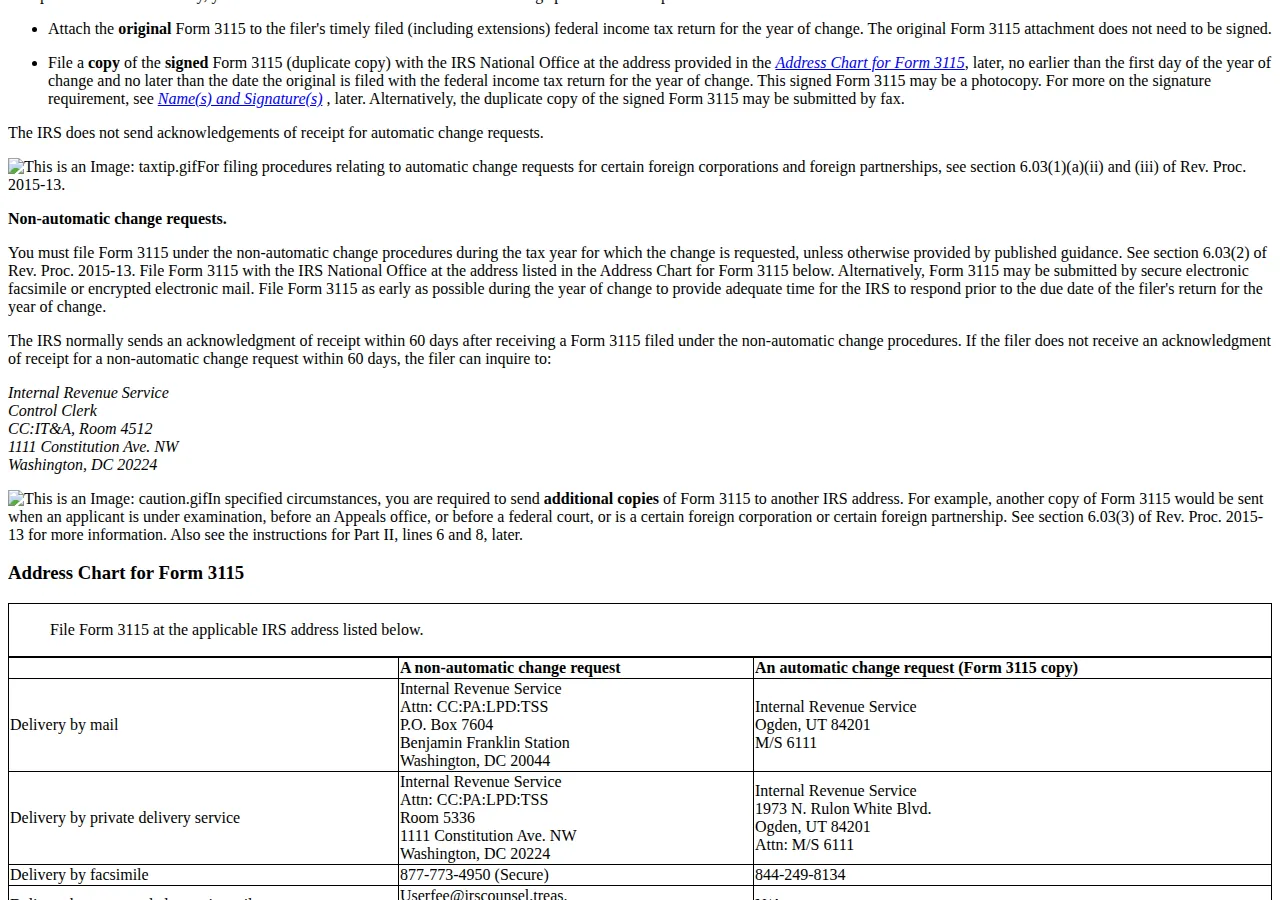
!Form 3115 instructions on filing the original and the duplicate copy
1. Decide the new method and prove it is permissible under the statute and the governing section of Rev. Proc. 2025-23. An impermissible method has no procedure to save it.
2. Check eligibility. Apply the five-year lookback, the final-year bar, and the examination rule in sections 5 and 8. Confirm the change is on the automatic list; if not, start the non-automatic route in the year of change.
3. Compute the section 481(a) adjustment as of the first day of the year of change, item by item — receivables, payables, inventory, prepaid items, deferred revenue — and keep the workpapers. Attach the computation statement the instructions require.
4. Complete Form 3115 (Rev. December 2022). Enter the DCN, the year of change, the adjustment and its spread, and the required statements. One form per change, unless the procedure permits a single form for concurrent changes.
5. Attach the original, unsigned, to the timely filed return for the year of change. A late return breaks the automatic procedure.
6. File the signed duplicate copy with the IRS National Office — for an automatic change, Internal Revenue Service, Ogden, UT 84201, M/S 6111, or fax 844-249-8134 — no earlier than the first day of the year of change and no later than the original's filing date. The IRS sends no acknowledgement for automatic requests, so keep proof of mailing.
7. Apply the new method and take the adjustment on schedule — positive ratably over four years, negative at once — and track the remaining spread until exhausted.
8. Price the result before filing: run the adjustment through the tax estimator at the owner's real rate, so the cash cost is known before the return is signed.
Who this is for — and who must not do this
This playbook is for an owner, controller, or preparer who has already decided the new method is correct and needs the mechanics and the filing sequence.
It is not for a taxpayer under examination, who must work through the examination team and section 8 first. It is not for a business in its final year, which the automatic procedures exclude. It is not for a change the list does not contain — that needs a letter ruling, a fee, and counsel. It is not a substitute for a preparer on a first filing: the adjustment computation is the return position, and a wrong one is a wrong return. Consent is subject to review; a denied change leaves the old method in place.
Choose the right method, prove the adjustment from the books, pick the right DCN, and file both copies on time. Form 3115 rewards that order. It punishes everything else — silently, years later.