Inventory Valuation: FIFO vs LIFO vs Weighted Average — The Complete Playbook
A distributor buys the same widget four times in one year at four different prices and sells most of the stock. The warehouse holds 150 identical units. What are they worth? The law gives three different answers. On the small ledger in this guide, the choice between FIFO and LIFO moves gross profit by 700 dollars and the federal tax on it by 147 dollars. The physical stock never changes — only the cost-flow assumption does.
Inventory valuation decides which purchase cost attaches to each unit sold and which stays on the balance sheet. The units are interchangeable, so no unit can be matched to a specific cost. Publication 538 gives the answer: use FIFO or LIFO when items cannot be specifically identified with their costs. Every dollar assigned to cost of goods sold is a dollar removed from ending inventory.
> [!FOUNDER] "Inventory is the one asset a founder can watch grow on the shelf while the tax return says it shrank. The method you elect decides which story the books tell, and the IRS lets you pick the story once — then holds you to it. Choose with the statute open, not with the spreadsheet closed." — Enow A. Jovial, Founder & CEO
Why the balance sheet feels the choice first
Lenders, buyers, and auditors read inventory before they read the income statement. A distributor reporting inventory at the most recent purchase prices looks stronger on a borrowing-base certificate, because the collateral value is higher. The same distributor on LIFO reports older, cheaper layers, which can make the balance sheet look thin while the warehouse is full.
The cash conversion cycle makes the same point from the operating side: days inventory outstanding measures how long cash sits in stock, and the inventory value in that ratio comes straight from the valuation method. The cash conversion cycle playbook runs the full cycle math. Consistency is also a legal requirement: Publication 538 requires inventory practices to be consistent from year to year.
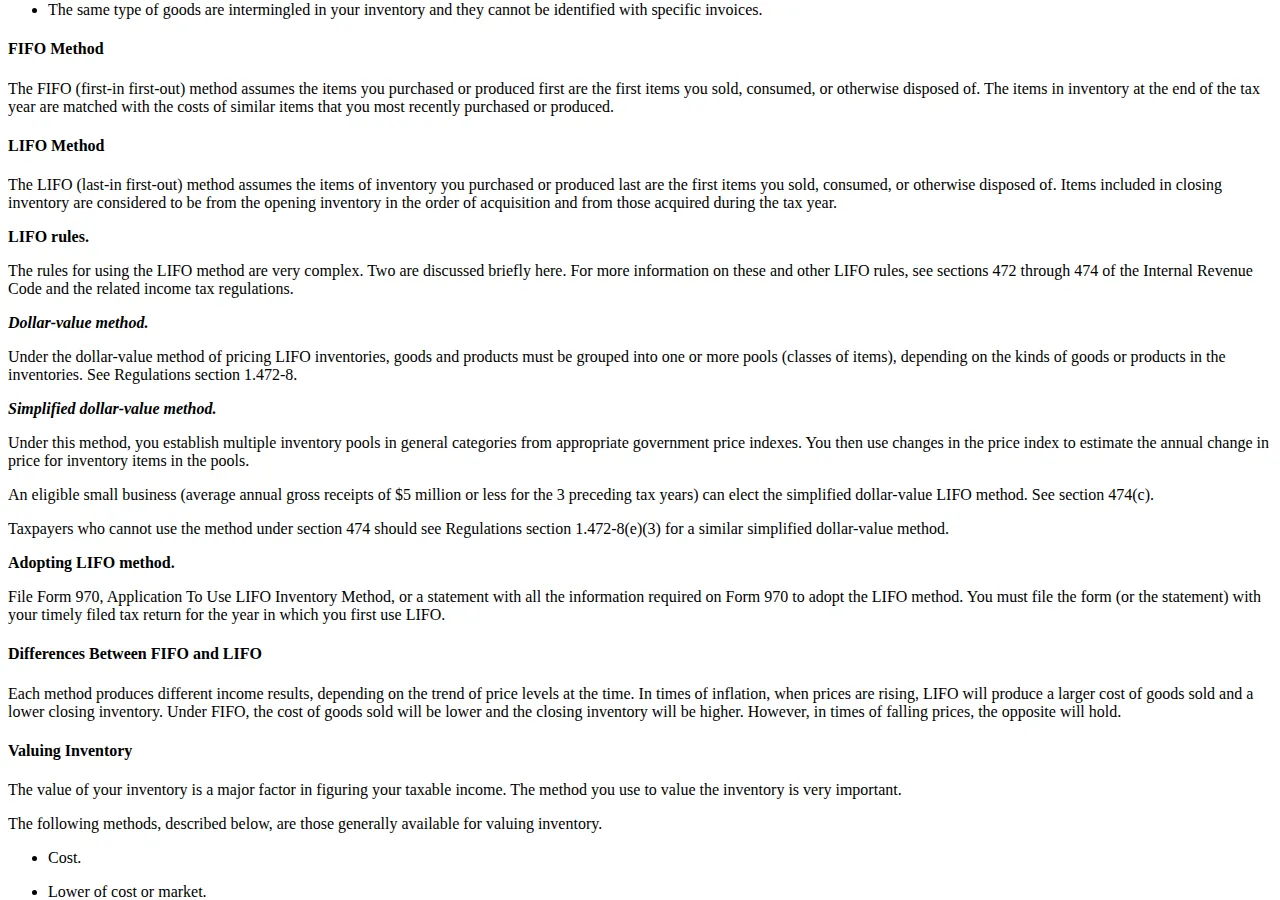
!IRS Publication 538 inventory section showing the FIFO and LIFO definitions
The three cost-flow methods, in plain mechanics
FIFO assumes the oldest units sell first, so ending inventory is priced at the most recent purchase costs. In rising prices, FIFO reports the lowest cost of goods sold and the highest ending inventory.
LIFO assumes the newest units sell first, so ending inventory is priced at the oldest costs. In rising prices, LIFO reports the highest cost of goods sold and the lowest ending inventory. Per Publication 538: in inflation, LIFO produces a larger cost of goods sold and a lower closing inventory.
Weighted average collapses the period into one unit cost: total cost of goods available for sale divided by total units available. That average prices both the units sold and the units remaining, but it hides the price trend.
> [!KEY TAKEAWAY] FIFO, LIFO, and weighted average never change the cash spent or the revenue collected. They change only the split of one fixed total — goods available for sale — between cost of goods sold and ending inventory.
The worked ledger: one purchase history, three answers
The example below is deliberately small: a distributor with no opening inventory buys one product four times at rising prices and sells 250 units at 25 dollars each.
| Purchase | Units | Unit cost | Total cost |
| --- | --- | --- | --- |
| January | 100 | $10 | $1,000 |
| March | 100 | $12 | $1,200 |
| June | 100 | $14 | $1,400 |
| September | 100 | $16 | $1,600 |
| Goods available for sale | 400 | — | $5,200 |
Units sold: 250. Units remaining: 150.
FIFO
Oldest units treated as sold: 100 January, 100 March, 50 June.
$
ext{COGS (FIFO)} = 100 imes $10 + 100 imes $12 + 50 imes $14 = $2{,}900
$
Ending inventory: the rest.
$
ext{Ending Inventory (FIFO)} = 50 imes $14 + 100 imes $16 = $2{,}300
$
Gross profit: 6,250 minus 2,900 = 3,350 dollars.
LIFO
Newest units treated as sold: 100 September, 100 June, 50 March.
$
ext{COGS (LIFO)} = 100 imes $16 + 100 imes $14 + 50 imes $12 = $3{,}600
$
Ending inventory: the rest.
$
ext{Ending Inventory (LIFO)} = 50 imes $12 + 100 imes $10 = $1{,}600
$
Gross profit: 6,250 minus 3,600 = 2,650 dollars.
Weighted average
Average unit cost: 5,200 divided by 400 = 13.00 dollars per unit.
$
ext{COGS (WA)} = 250 imes $13.00 = $3{,}250
$
$
ext{Ending Inventory (WA)} = 150 imes $13.00 = $1{,}950
$
Gross profit: 6,250 minus 3,250 = 3,000 dollars.
The reconciliation every method must pass
Each method must satisfy one identity: cost of goods sold plus ending inventory equals goods available for sale, 5,200 dollars.
| Method | COGS | Ending inventory | Gross profit | Federal tax at 21% on gross profit |
| --- | --- | --- | --- | --- |
| FIFO | $2,900 | $2,300 | $3,350 | $703.50 |
| Weighted average | $3,250 | $1,950 | $3,000 | $630.00 |
| LIFO | $3,600 | $1,600 | $2,650 | $556.50 |
The tax column is illustrative: it applies the flat 21 percent federal corporate rate in 26 U.S.C. section 11(b) to gross profit alone. FIFO reports 700 dollars more gross profit than LIFO here, and at 21 percent that is 147 dollars more federal tax.
Run the three gross profit figures through the Business Profit Margin Calculator to see the margin spread.
> [!TIP] Before trusting any inventory report, check the identity: cost of goods sold plus ending inventory must equal opening inventory plus purchases.
The decision table: method, outcome, and authority
| Decision | Rising prices | Falling prices | Authority |
| --- | --- | --- | --- |
| FIFO: lowest COGS, highest ending inventory | Yes | Reverses | Pub. 538 |
| LIFO: highest COGS, lowest ending inventory | Yes | Reverses | Pub. 538 |
| Weighted average: middle COGS, middle inventory | Yes | Yes | ASC 330 |
| Specific identification: actual cost per unit | Identifiable units | Identifiable units | Pub. 538 |
| LCNRV write-down (FIFO, average cost) | NRV below cost | NRV below cost | ASU 2015-11 |
| LCM test retained (LIFO, retail) | Market below cost | Market below cost | ASU 2015-11 |
| LIFO election by Form 970 | First LIFO year | First LIFO year | 472(a); Reg. 1.472-3 |
| LIFO conformity | Required | Required | 26 U.S.C. 472(c) |
| LIFO permanence | Yes | Yes | 26 U.S.C. 472(e) |
| LIFO under IFRS: prohibited | Always | Always | IAS 2.25-26 |
Lower of cost or net realizable value: the write-down test
Cost-flow assumptions decide which cost attaches to each unit; a separate test decides whether that cost is recoverable. Under U.S. GAAP, FIFO and average-cost inventory is carried at the lower of cost and net realizable value: estimated selling price less reasonably predictable costs of completion and disposal. Per FASB ASU 2015-11.
Take the FIFO ending inventory: 150 units at 2,300 dollars. If net realizable value falls to 12 dollars per unit, the recoverable value is 1,800 dollars.
$
ext{Write-down} = ext{Cost} - ext{NRV} = $2{,}300 - $1{,}800 = $500
$
The business recognizes a 500 dollar loss and carries the inventory at 1,800 dollars. Under U.S. GAAP the write-down sets a new cost basis with no reversal. Under IFRS, IAS 2 requires reversal when the reason no longer exists.
LIFO and retail-method inventory still use the older lower of cost or market test: replacement cost bounded by a ceiling of net realizable value and a floor of net realizable value less a normal profit margin. The IRS Publication 538 example shows the item-by-item rule: items costing 300, 200, and 450 dollars, with market values of 500, 100, and 200 dollars, are valued at 300, 100, and 200 dollars — 600 dollars total. Compare each item separately, never the totals.
The LIFO election: Form 970, conformity, and the reserve
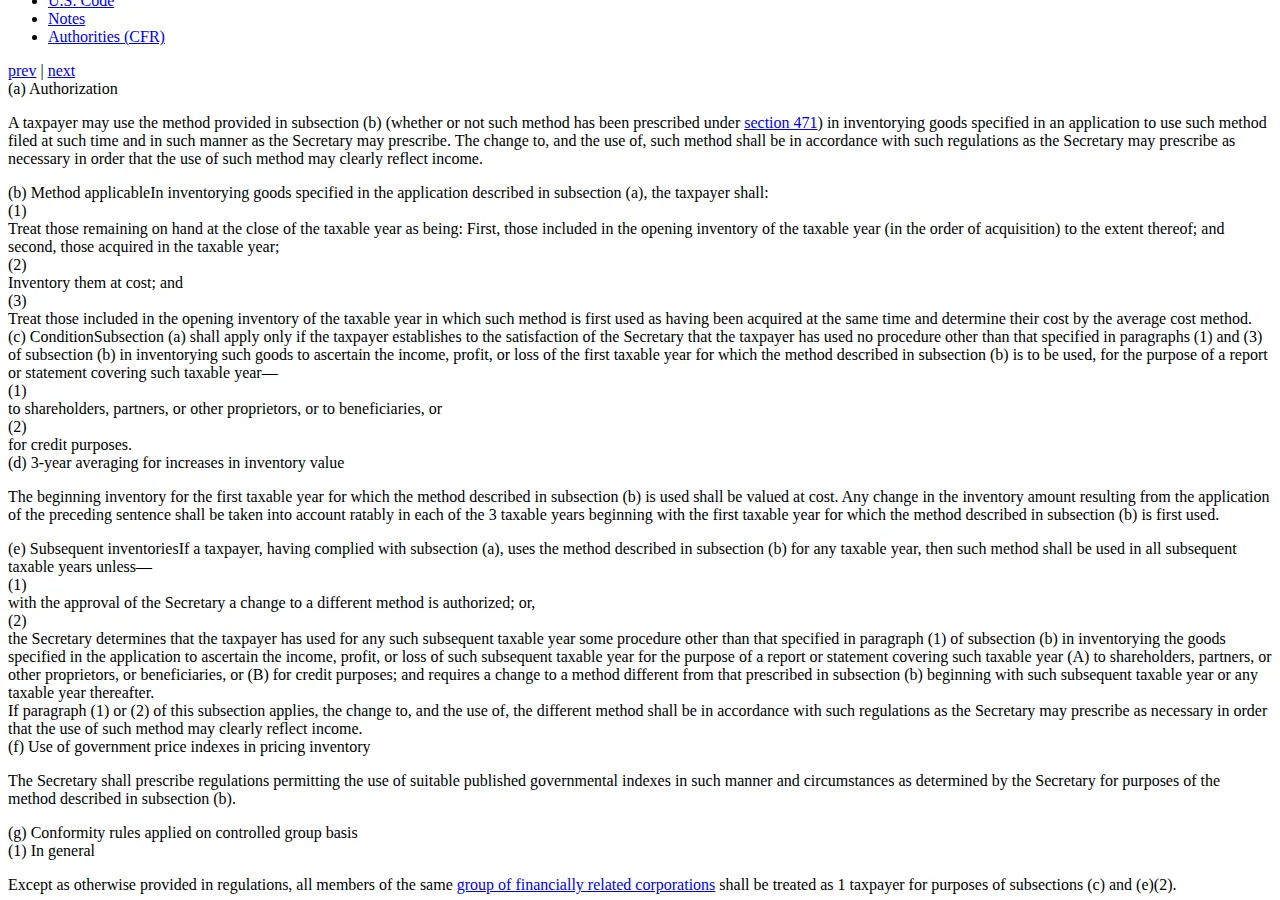
LIFO is a statutory election under 26 U.S.C. section 472, in four parts.
First, authorization. Section 472(a) permits LIFO for goods specified in an application filed as the Secretary prescribes. The application is Form 970, or a statement with all Form 970 information, filed with the timely filed return for the first LIFO year.
Second, conformity. Section 472(c) conditions the election on the taxpayer using no procedure other than LIFO to ascertain income, profit, or loss for the first LIFO year, in any report to shareholders or for credit purposes. A business cannot report FIFO profits to its bank and LIFO profits to the IRS; section 472(g) extends the test across a controlled group.
Third, permanence. Section 472(e) requires the method in all subsequent taxable years unless the Secretary authorizes a change. A business that elects LIFO for a tax saving in an inflationary year keeps LIFO when prices fall.
Fourth, the transition. Section 472(d) requires beginning inventory for the first LIFO year to be valued at cost, with any resulting change taken into account ratably over the three following taxable years.
The dollar-value method, under Regulation 1.472-8, groups goods into pools and measures price change with indexes. The simplified dollar-value method under section 474 is available to a small business with average annual gross receipts of 5 million dollars or less for the three preceding years.
The LIFO reserve is the difference between ending inventory under FIFO and under LIFO: on the worked ledger, 2,300 minus 1,600 = 700 dollars. Analysts add it back for peer comparison.
> [!WARNING] A LIFO election made for a tax saving in a rising-price year cannot be quietly dropped when prices fall. Section 472(e) locks the method in until the IRS permits a change, and breaking section 472(c) conformity can cost the election entirely. File Form 970 only after modeling the falling-price year as well as the rising one.
The risk layer: where inventory valuation draws audit attention
Inventory is one of the largest balance sheet items for a seller of goods. The risks cluster in five places.
Inconsistent method changes. Publication 538 requires consistent practice from year to year. The month-end close checklist catches drift early: record the method, the count date, and the valuation test every month.
Unsupported valuation. Cost must include all direct and indirect costs: invoice price minus trade discounts plus transportation and acquisition charges, and for produced goods all costs capitalized under section 263A.
Item-by-item write-downs. Taxpayers aggregate the comparison and take the lower of two totals; the rule is per item.
Missing physical counts. Publication 538 permits a perpetual or book inventory, but requires a physical inventory at reasonable intervals, with the book amount adjusted to the actual count.
LIFO conformity failures, with the harshest penalty: loss of the election. A report to a lender showing FIFO numbers while the return shows LIFO numbers violates section 472(c).
The automated bank reconciliation playbook covers the cash side of the same discipline.
Cross-border note: the LIFO wall at the IFRS border
A group that reports under IFRS faces a hard boundary: IAS 2 permits only FIFO, weighted average cost, or specific identification. LIFO is prohibited. The Board removed LIFO in its 2003 improvements to IAS 2, effective for periods beginning on or after January 1, 2005.
The consequence is a two-method group. A U.S. subsidiary on LIFO must convert to FIFO or weighted average for the IFRS consolidation, and the conversion runs through the LIFO reserve — 700 dollars on the worked ledger, but for a company with thirty years of LIFO layers the reserve can exceed a year of profit. IFRS also requires reversal of a write-down when net realizable value recovers.
A business that sells only in the United States and reports only under U.S. GAAP can ignore this section. A business with a foreign parent, foreign investors, or an eventual IFRS conversion cannot.
Execution checklist: electing and operating a valuation method
1. Confirm inventory is required where merchandise is an income-producing factor (section 471; Publication 538).
2. Decide, line by line, whether specific identification is possible; otherwise choose one cost-flow assumption per line.
3. Build the purchase ledger; verify opening inventory plus purchases equals goods available for sale.
4. Run all three methods on the same ledger and reconcile each to the 5,200 dollar identity.
5. Apply the write-down test item by item: cost against net realizable value, or against market for LIFO stock.
6. If LIFO is under consideration, model the falling-price year and the liquidation year.
7. File Form 970, or a statement with all Form 970 information, with the timely filed return for the first LIFO year.
8. Take a physical inventory at reasonable intervals and adjust the book amount to the count.
9. Disclose the LIFO reserve as a separate line.
10. Re-run the method choice annually, but change it only with IRS consent — never by quiet drift.