The decision nobody can price from a rate card
A small business comparing Google Ads and Meta Ads hits the same wall in the first hour: there is no rate card to compare. Google does not sell clicks at a listed price, and Meta does not sell results at a listed price. Both run an auction for every single impression, and the price you pay is the output of that auction, not an input you choose. Any article that hands you a single "average CPC" for either platform and calls the comparison done is selling you a number neither vendor publishes.
That is the whole decision, and it is why this guide is built differently. It runs both auctions against the same budget, the same order value, and the same break-even line, with every assumption stated so you can replace it with your own numbers. The worked scenario below uses illustrative rates, labelled as such, because the platforms publish mechanics, not prices.
> [!KEY TAKEAWAY]
> Google charges for intent and Meta charges for attention, and both auctions let quality beat bid. At the illustrative rates in this guide, $3,000 buys a $62.50 CPA on Google Search and a $60.00 CPA on Meta against a $72.00 break-even — but a Meta click-through rate of 0.8% instead of 1.2% pushes Meta to $90.00 and flips the winner. The platform choice matters less than the assumption you failed to test.
Who this guide is for, and who should stop here
This guide is for a founder or marketing lead spending their own money — roughly $1,000 to $10,000 a month — who must choose where the first paid dollar goes, and who will read the auction mechanics instead of outsourcing the decision to a dashboard. It assumes a product with a known order value, a working checkout, and conversion tracking that actually fires. It is written for a B2B or consumer business selling through its own site, where CPA and ROAS can be computed from first-party data.
How the Google auction actually decides the winner
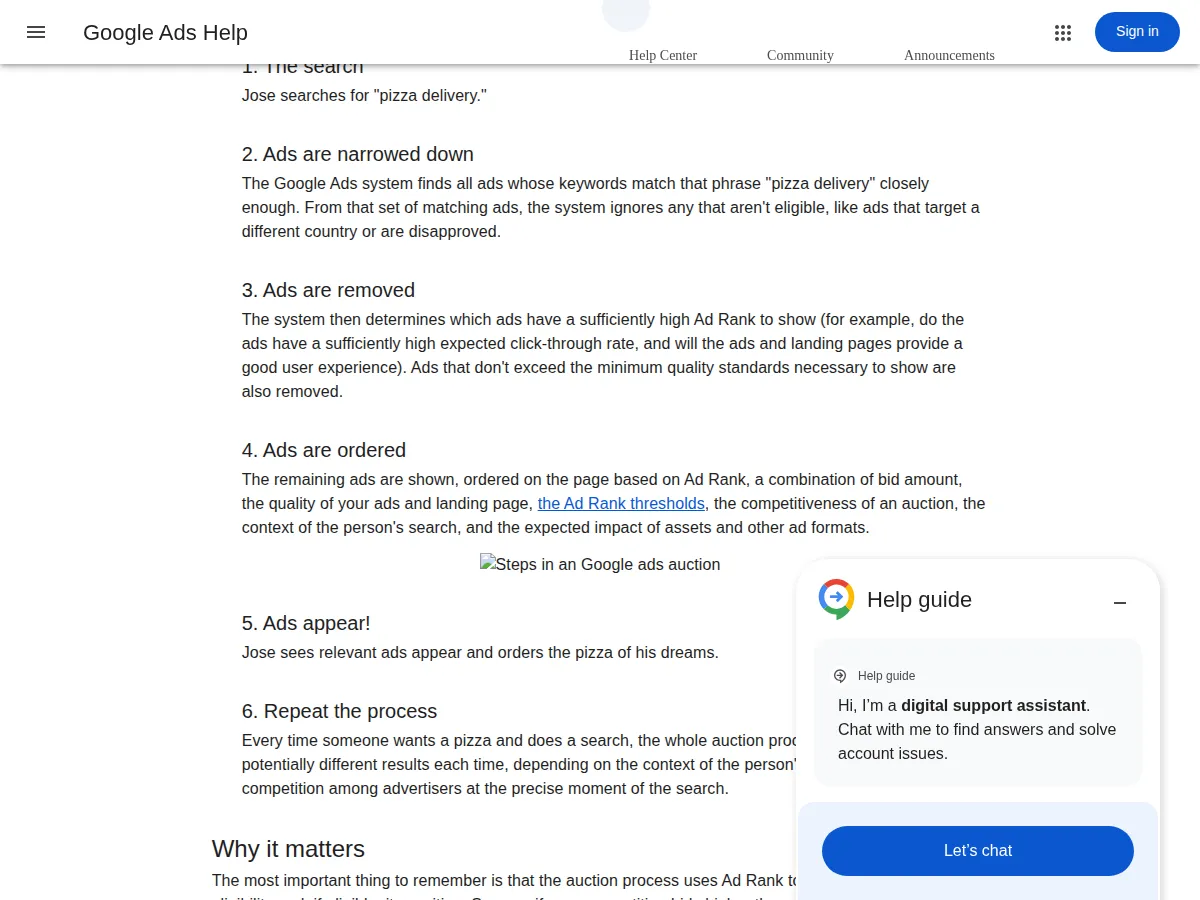
Google's own help documentation walks through the auction in six steps. First, a person searches. Second, Google narrows the field to ads whose keywords match the phrase closely enough, discarding ineligible ads, such as ads targeting a different country or disapproved ads. Third, ads are removed if they do not clear the minimum Ad Rank thresholds — the quality floor covering expected click-through rate and the user experience of the ad and landing page. Fourth, the survivors are ordered by Ad Rank. Fifth, the ads appear. Sixth, the whole process repeats on the next search, with potentially different results each time, because competition and search context change from one query to the next.
Ad Rank itself is the price lever most advertisers ignore. Google lists its components as bid amount, the quality of the ads and landing page, the Ad Rank thresholds, the competitiveness of the auction, the context of the person's search, and the expected impact of assets and other ad formats. The consequence is stated plainly in Google's documentation: even if a competitor bids higher than you, you can still win a higher position at a lower price with high-quality ads and landing pages. Bid is one input among six, and quality is the input you control without spending more.
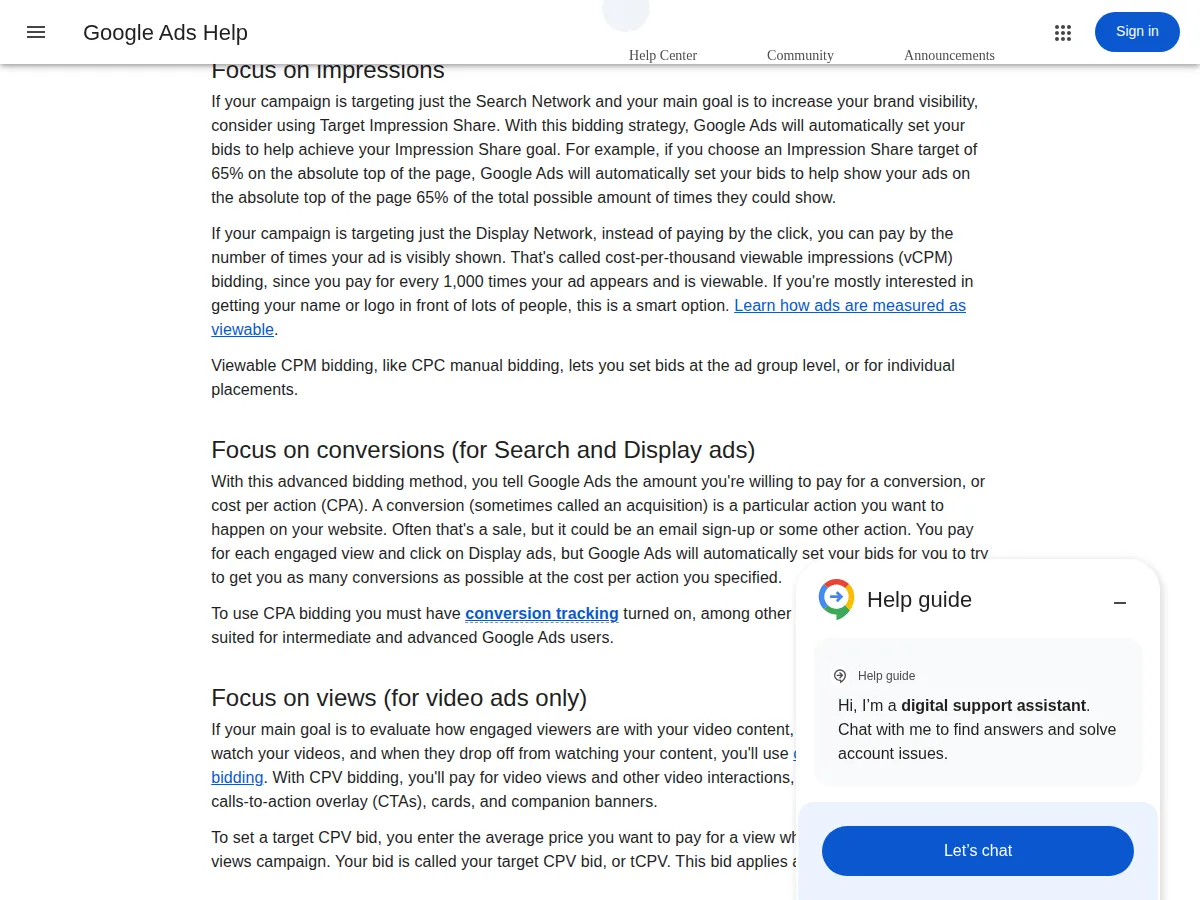
Google's bidding basics page then defines what you are actually buying. With cost-per-click bidding, you pay only when someone clicks through to your site. With viewable cost-per-thousand-impressions bidding on the Display Network, you pay per 1,000 viewable impressions. With conversion-focused bidding, you tell Google the amount you are willing to pay for a conversion — a cost per action, or CPA — and Google sets bids automatically to get as many conversions as possible at that cost, provided conversion tracking is turned on. Target Impression Share is the brand-visibility variant: Google sets bids automatically to show the ad on the absolute top of the page a chosen share of the time, with 65% given as the worked example in Google's own documentation.
How the Meta auction actually decides the winner
Meta's current advertiser page states the auction in one line that is easy to under-read: ads succeed based on their bids, budget, and how relevant the ad is to its audience, and over time the auction narrows the audience to focus on people more likely to engage. Budget is not a bid, and relevance is not a slogan. Meta's help material describes the winner as the ad with the highest total value, which combines three factors: the advertiser's bid, the estimated action rate — Meta's prediction that this person will take the advertiser's chosen action — and ad quality. The last two together measure relevance, so a more relevant ad can beat ads with higher bids.
One honest sourcing note belongs here, because it changes how you should read every Meta formula you find online. Meta's current help pages list the three factors but do not publish a formula or the weight of each term. An earlier Meta explainer described the logic as bid multiplied by estimated action rate, plus an ad quality score, and Meta's bid-cap documentation shows the same multiplication from the bid side. Treat the formula as a description of the logic, not as arithmetic you can replicate, and note that a price floor can also stop an ad from showing or change the price paid. The old Meta help article that once carried this explanation no longer exists at its former address; it returns a not-found page, which is why this guide cites Meta's current auction page alongside a secondary explainer that documents the factors and the missing weights.
Meta's bid strategies change only the bid term. Spend-based bidding, such as highest volume, aims for the most results from the budget and does not optimise for cost per action. Goal-based bidding, such as a cost per result goal or a ROAS goal, holds the average near a target that Meta does not guarantee, and performs best with roughly 50 to 100 or more conversions a week. Manual bidding through a bid cap sets the maximum bid per estimated action in every auction, and a tight cost goal or bid cap can hold an ad set in learning-limited status. Ad relevance diagnostics — quality, engagement rate, and conversion rate rankings — describe past auctions, need 500 impressions before they appear, and are not inputs into the auction.
Worked math: the same $3,000 on both auctions
Scenario: a small SaaS and services business with a $120 average order value, a 60% gross margin, and a $3,000 monthly test budget split evenly for measurement. The rates below are illustrative inputs, not platform averages — neither vendor publishes them — and every result is derived from them so you can substitute your own measured rates.
First, the break-even line that governs everything:
$
ext{Break-Even CPA} = ext{Average Order Value} imes ext{Gross Margin} = $120 imes 0.60 = $72.00
$
$
ext{ROAS} = rac{ ext{Revenue}}{ ext{Ad Spend}} = rac{ ext{Conversions} imes $120}{ ext{Ad Spend}}
$
Google Search scenario: an illustrative $2.50 CPC, a 4% click-through rate, and a 4% landing-page conversion rate. At $1,500 of spend, clicks equal $1,500 divided by $2.50, which is 600 clicks. Conversions equal 600 multiplied by 0.04, which is 24 orders. CPA equals $1,500 divided by 24, which is $62.50. Revenue equals 24 multiplied by $120, which is $2,880, so ROAS equals $2,880 divided by $1,500, which is 1.92. CPA sits $9.50 below the $72.00 break-even, which is the headroom that pays for fulfilment, refunds, and overhead.
Meta scenario: an illustrative $18 CPM, a 1.2% click-through rate, and a 2.5% landing-page conversion rate. At $1,500 of spend, impressions equal $1,500 divided by $18 multiplied by 1,000, which is 83,333 impressions. Clicks equal 83,333 multiplied by 0.012, which is 1,000 clicks, so the effective CPC is $1.50. Conversions equal 1,000 multiplied by 0.025, which is 25 orders. CPA equals $1,500 divided by 25, which is $60.00. Revenue equals 25 multiplied by $120, which is $3,000, so ROAS equals 2.00. Meta wins this scenario by $2.50 of CPA — a margin so thin that a single assumption change erases it.
Sensitivity is the real comparison. If Meta click-through falls from 1.2% to 0.8% while CPM and conversion rate hold, clicks fall to 667, conversions fall to 17, and CPA rises to $88.24 — above break-even, and Meta loses. If Google CPC rises from $2.50 to $3.00 while conversion holds, clicks fall to 500, conversions fall to 20, and CPA rises to $75.00 — also above break-even. Both platforms sit within one assumption of losing money on the first order, which is why the launch protocol below measures click-through and conversion separately instead of judging the platform by CPA alone. A CPA problem caused by click-through is a creative and targeting problem; a CPA problem caused by conversion rate is a landing-page problem.
| Attribute | Google Ads | Meta Ads | Authority |
| :--- | :--- | :--- | :--- |
| What the auction sells | Intent at the moment of search | Attention inside a feed, narrowed to likely engagers | Google Ads Help, ad auction; Meta auction page |
| Winner rule | Highest Ad Rank: bid, quality, thresholds, competitiveness, context, asset impact | Highest total value: bid, estimated action rate, ad quality | Google Ads Help; Meta help material as documented by the secondary explainer |
| Bid units you control | CPC, viewable CPM, CPA target, Impression Share target | Bid cap, cost per result goal, ROAS goal, spend-based volume | Google bidding basics; Meta bid-strategy guidance |
| Price floor | Ad Rank thresholds remove ads below the quality floor | A price floor can stop an ad showing or change the price paid | Google Ads Help; Meta help material |
| Illustrative CPA at stated rates | $62.50 at $2.50 CPC and 4% conversion | $60.00 at $18 CPM, 1.2% CTR, 2.5% conversion | Derived in this guide from stated illustrative inputs |
| Break-even CPA at $120 order, 60% margin | $72.00 | $72.00 | Derived: $120 multiplied by 0.60 |
| Automation volume gate | Conversion tracking required for CPA bidding | Goal-based bidding best at roughly 50 to 100+ conversions a week | Google bidding basics; Meta bid-strategy guidance |
| Diagnostics trap | Position fluctuates per query by design | Relevance diagnostics describe past auctions, are not auction inputs, need 500 impressions | Google Ads Help; Meta diagnostics guidance |
Operator boundaries: who should not run which
Do not run Google Search if nobody is searching for what you sell in those words. A new category with no search demand cannot be bought into existence with CPC bidding; Meta's feed can create demand that search then harvests later, which is a sequencing argument, not a reason to run both at once. Do not run Meta if your conversion event is a phone call, a showroom visit, or any outcome Meta cannot observe, because the estimated action rate then optimises for a proxy that is not your sale. Do not run either platform on a landing page that loads slowly, hides the price, or asks for an account before showing the offer, because both auctions punish weak landing experience — Google through Ad Rank quality, Meta through ad quality — and you will pay the quality tax on every click.
> [!FOUNDER]
> "Founders ask me which platform is cheaper, and the question gives the auction away. Neither platform has a price. You are buying a prediction — Google predicts the click, Meta predicts the person — and the cheaper prediction is the one your landing page deserves. Fix the page before you blame the platform, because both auctions charge you for the page you actually built."
> — Enow A. Jovial, Founder & Chief Executive Officer
> [!WARNING]
> Never scale on a ROAS headline alone. A ROAS of 1.92 on a $120 order at 60% margin leaves only $9.50 per order above the $72.00 break-even CPA, and fulfilment, refunds, payment fees, and overhead can erase $9.50 quickly. Break-even ROAS is 1 divided by 0.60, which is 1.67, so 1.92 clears it by only 0.25. Compute break-even CPA before raising any budget, or the scale-up will scale the loss.
Launch protocol: measure the assumption, not the logo
1. Fix the break-even line first. Write down average order value, gross margin, and break-even CPA, and pin them above the Ads Manager. No budget moves without that line.
2. Install and verify conversion tracking. Fire a test conversion end to end on each platform, and confirm the event, value, and deduplication before spending.
3. Run one platform for two full weeks at a fixed budget. Change nothing mid-flight except pausing a broken ad. Two weeks of stable data beats two months of edited history.
4. Read click-through and conversion separately. A low CTR is a creative and targeting verdict; a low conversion rate is a landing-page verdict.
5. Test the sensitivity, not the average. Model the click-through or CPC move that breaks break-even, and set a kill rule: pause the ad set if CPA exceeds break-even for three consecutive days at stable volume.
6. Scale the winner by 20% a week, not by doubling. Doubling a budget doubles auction pressure overnight and resets the learning that earned the CPA.
> [!TIP]
> Start with the platform where your customer shows the buying signal. If search volume exists for your offer, start on Google and let Meta retarget search visitors; if nobody searches yet, start on Meta and let search harvest demand later. Sequence is the strategy.
Related reading: the Klaviyo vs Mailchimp vs Kit email pricing guide, the cold email deliverability guide, and the Shopify vs WooCommerce vs BigCommerce fee guide. Test your own break-even line with the ROI calculator. For the B2B fork, the LinkedIn Ads versus Google Ads lead-cost playbook runs both auctions on the same 3,000 dollar budget. For the TikTok fork, the TikTok versus Meta ecommerce ROAS playbook prices both social auctions on the same $10,000 month.