Two auctions, two kinds of buyer
A B2B founder with 3,000 dollars a month for lead generation faces a real fork: LinkedIn puts the ad in front of a CFO at a named company, Google puts it in front of a person typing a buying query right now. Both run auctions and both charge per click. But the buyer on LinkedIn is scrolling a feed and the buyer on Google is asking a question, and that difference decides which platform returns a lead at a price the business can afford. The choice is which auction matches the way your buyer actually buys.
> [!KEY TAKEAWAY]
> LinkedIn sells the audience and Google sells the intent. At 3,000 dollars a month, LinkedIn delivers about 43 leads at roughly 70 dollars each when the form is native, while Google delivers about 37 leads at roughly 81 dollars each on an illustrative 4 dollar click. The gap is not the click price. It is the conversion rate: a native lead form converts at 8 percent where a cold landing page converts at 5 percent.
Who this guide is for, and who should stop here
This guide is for a B2B founder or demand-generation lead spending 1,500 to 10,000 dollars a month on paid lead generation, selling a product priced high enough that a 70 dollar lead can pay for itself.
It is not for a consumer business, an ecommerce store, or a local service. If your buyer is a consumer, read our Google Ads versus Meta Ads playbook instead. It is also not for a business whose sales cycle closes in a single call, because a 70 dollar lead that closes at 20 percent is a 350 dollar customer acquisition cost, and if your deal size is below that, neither platform pays.
> [!FOUNDER]
> "Every founder asks which platform is cheaper. That is the wrong question. The real question is which platform gives you the buyer you cannot reach anywhere else. If the CFO title is the targeting, LinkedIn is the only answer. If the search query is the intent, Google is the only answer."
> — Enow A. Jovial, Founder & Chief Executive Officer
The two auctions, side by side
Google decides every ad placement with Ad Rank, a set of values that determine whether an ad is eligible to show and where on the page it shows relative to other advertisers. Ad Rank is calculated twice for every search: once for eligibility, and a second time for position. It rests on six factors: your bid, the quality of your ads and landing page, the Ad Rank thresholds, the competitiveness of the auction, the context of the search, and the expected impact of your ad assets. Quality is summarized in a Quality Score, and higher quality ads can lead to lower cost per click.
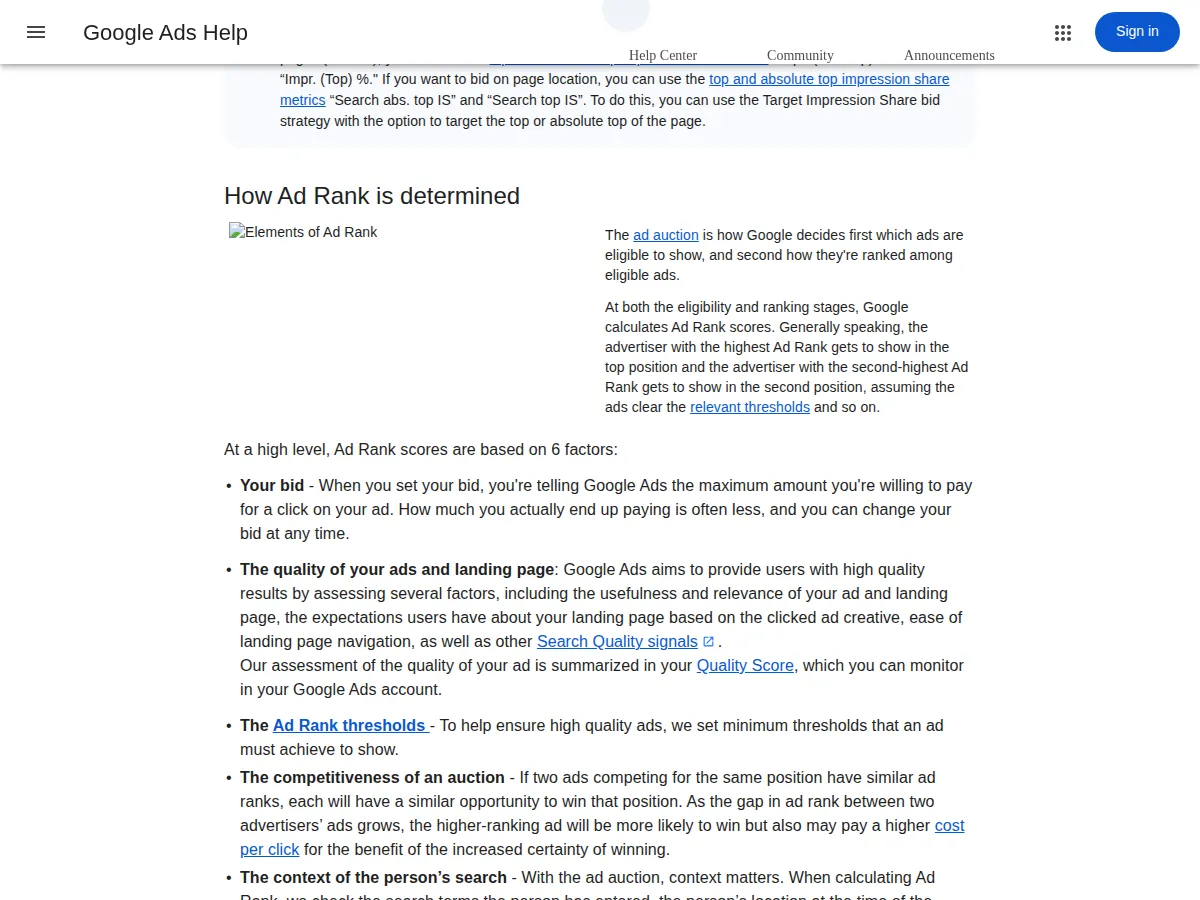
Google illustrates the mechanism with a simplified example. Seven advertisers hold Ad Rank scores of 80, 50, 30, 10, minus 10, minus 30, and minus 35. If the minimum Ad Rank to show anywhere is 0, the last three are ineligible in any position. If the minimum for the top location is 40, only the first two can show above the search results, while the advertisers at 30 and 10 show lower down the page. A high bid with poor quality can lose to a lower bid with strong quality, because Ad Rank multiplies the two together.
LinkedIn runs a second-price auction with the same shape and a different lever. You set a maximum bid and if you win, you pay just above the second-highest bid. The competition for your specific audience, seniority level, industry, and job function, determines how fierce other advertisers bid against you. Relevance acts as a quality multiplier: ads with high engagement get better placement at lower costs. The platform floors are public and small. LinkedIn requires a minimum daily budget of 10 dollars per campaign, a minimum lifetime budget of 100 dollars for a campaign that has not yet launched, and a minimum bid of 2 dollars for CPC and CPM campaigns. Those minimums let you launch. They do not let you learn. Two independent 2026 advertiser guides agree on the floors to the dollar, and both put the realistic monthly budget for meaningful results at 1,500 to 3,000 dollars.
| Dimension | LinkedIn Ads | Google Ads | Authority |
| :--- | :--- | :--- | :--- |
| What you buy | Job title, company, industry, seniority | The search query, typed now | Platform documentation |
| Auction type | Second-price; pay just above the second-highest bid | Ad Rank; bid times quality, calculated twice | Stackmatix 2026; Google Ads Help |
| Minimum daily budget | 10 dollars per campaign | No fixed minimum | Nuoptima 2026 cost guide |
| Minimum bid | 2 dollars for CPC and CPM | Your maximum CPC bid | Nuoptima 2026 cost guide |
| Average CPC, 2026 | 5.50 dollars, range 4.50 to 8.00 | No rate card; illustrative 4.00 used here | Stackmatix 2026 benchmarks |
| Average cost per lead | 75 dollars, range 35 to 150 | Depends on landing-page conversion | Stackmatix 2026 benchmarks |
| Native conversion path | Lead Gen Forms, pre-filled | Landing page, full form | Stackmatix 2026 benchmarks |
| Bidding automation | Automated and manual bidding | Target CPA, Target ROAS, Maximize conversions | Google Ads Help, Smart Bidding |
The cost math at 3,000 dollars a month
All rates below are worked from stated inputs. LinkedIn inputs are 2026 benchmarks from Stackmatix: 5.50 dollar average CPC, 75 dollar average cost per lead, and a 35 to 150 dollar range. Google publishes no rate card, so the 4.00 dollar CPC used here is an illustrative input, not a benchmark, and the comparison is honest only if you re-run it with your own account CPC. Conversion rates are illustrative operating assumptions.
LinkedIn first. At 3,000 dollars a month and a 5.50 dollar CPC, the budget buys 545 clicks. Lead Gen Forms pre-fill from the member profile, so assume an 8 percent click-to-lead rate. That yields 43 leads, and the cost per lead is 69.77 dollars.
$
\text{LinkedIn clicks} = \frac{3,000}{5.50} = 545
$
$
\text{LinkedIn leads} = 545 \times 8\% = 43
$
$
\text{LinkedIn CPL} = \frac{3,000}{43} = 69.77
$
Google second. At 3,000 dollars a month and an illustrative 4.00 dollar CPC, the budget buys 750 clicks. A cold landing page converts worse than a pre-filled native form, so assume a 5 percent click-to-lead rate. That yields 37 leads, and the cost per lead is 81.08 dollars.
$
\text{Google clicks} = \frac{3,000}{4.00} = 750
$
$
\text{Google leads} = 750 \times 5\% = 37
$
$
\text{Google CPL} = \frac{3,000}{37} = 81.08
$
The three-point conversion gap is worth more than the 1.50 dollar click-price gap. LinkedIn clicks cost 37.5 percent more than the illustrative Google click, yet LinkedIn leads cost 14 percent less, because the native form converts at 8 percent against 5 percent. If an average deal is worth 500 dollars and 20 percent of leads close, each lead is worth 100 dollars. The LinkedIn margin is 30.23 dollars per lead. The Google margin is 18.92 dollars per lead. Both pay at this budget and these inputs, and LinkedIn pays more.
$
\text{Value per lead} = 500 \times 20\% = 100
$
$
\text{LinkedIn margin per lead} = 100 - 69.77 = 30.23
$
$
\text{Google margin per lead} = 100 - 81.08 = 18.92
$
The learning phase changes the answer. Stackmatix reports that a new campaign in its learning phase may see CPCs 30 to 50 percent above benchmark, and that campaigns with strong quality scores typically settle 20 to 30 percent below the industry average CPC after four to six weeks. Apply the 30 percent uplift to LinkedIn: the CPC becomes 7.15 dollars, the clicks fall to 419, the leads fall to 33, and the cost per lead rises to 90.91 dollars. That is still below the 100 dollar value per lead, but the margin is 9.09 dollars. Budget the first month as learning, not as performance, and judge the platform on month two.
Smart Bidding and the June 2026 relabeling
Google automated bidding is the other half of the comparison, because a B2B team rarely bids manually for long. Smart Bidding uses Google AI to optimize for conversions or conversion value in every auction, a feature called auction-time bidding. The strategies are Target CPA, Target ROAS, Maximize conversions, and Maximize conversion value. Starting in June 2026, Google is updating the labels: Maximize conversions with a Target CPA becomes Target CPA, and Maximize conversion value with a Target ROAS becomes Target ROAS. The names change. The underlying behavior remains exactly the same, and no action is needed in the account.
Smart Bidding needs conversion volume to learn, and a campaign spending 3,000 dollars a month at 37 leads is at the low end of what Target CPA can optimize. LinkedIn has no equivalent volume requirement published, but the same logic applies: an audience of 5,000 CFOs will not generate enough conversions for the algorithm to learn anything, and the campaign will spend its budget exploring instead of converting. Keep audiences above 50,000 for prospecting, and let the algorithm see at least 30 conversions before judging the strategy.
When LinkedIn wins, when Google wins
LinkedIn wins when the targeting is the product: account-based marketing against 200 named accounts, a launch to CTOs at mid-size companies. No other platform can assemble that audience, and the 70 dollar lead is cheap against a 10,000 dollar deal. Google wins when the query is the product: a buyer typing a competitor name or a commercial-intent category term is telling you they are ready to evaluate. That intent is worth more than any demographic, and Google is the only place it is expressed. Lead scoring decides which of those leads sales calls first, and our AI lead scoring guide ranks them.
The two platforms also fail differently. LinkedIn fails by audience: too narrow and the campaign never delivers, too broad and the 5.50 dollar click buys students and job seekers. Google fails by match: broad match on a category term buys clicks from researchers, students, and competitors. Both failures are preventable.
> [!WARNING]
> A 70 dollar lead is not a 70 dollar customer. At a 20 percent close rate, the customer costs 350 dollars, and at a 10 percent close rate it costs 700 dollars. Before scaling either platform, measure the close rate from paid leads separately from every other channel. A campaign that looks profitable at the lead level and loses money at the customer level is the most expensive mistake in B2B paid media.
The launch sequence for both platforms
Step 1 — Set the measurement before the spend
1. Define a lead in writing. A form submit is not a lead. A form submit from a company in your ICP, with a work email and a job title you sell to, is one.
2. Wire conversion tracking to the CRM, not the ad platform. The ad platform counts form submits. The CRM counts closed deals.
3. Set the value per lead: deal value times close rate, from your own history. If you have no history, run one month as measurement and set the number then.
Step 2 — Launch LinkedIn with one audience and one offer
1. Build an audience above 50,000. Job title plus company size plus industry, no more than three targeting layers.
2. Use Lead Gen Forms, not a landing page. The pre-filled form is the conversion advantage.
3. Set the daily budget at 100 dollars: the 3,000 dollar monthly budget, which clears the 10 dollar floor by an order of magnitude. The floor is not the plan.
4. Let the learning phase run four weeks. Do not judge the CPC in week one.
Step 3 — Launch Google with exact and phrase match only
1. Start with exact match on 20 to 30 commercial-intent keywords: competitor names, category terms with buying modifiers, problem phrases.
2. Set Target CPA only after 30 conversions. Before that, use Maximize conversions with a daily budget cap.
3. Send traffic to a page that matches the query. Ad Rank rewards landing-page relevance, and a generic homepage is the fastest way to pay more per click.
Who should not buy either platform
Do not buy LinkedIn if your deal size is under 2,000 dollars, because a 70 dollar lead at a 20 percent close rate is a 350 dollar customer. Do not buy Google if your category has no commercial search volume, because an auction with no bidders and no searchers is a budget with nowhere to go. Do not buy either if your CRM cannot report the close rate from paid leads. Do not split a 1,500 dollar monthly budget across both platforms: one platform at 1,500 dollars learns, two at 750 dollars each starve.
> [!TIP]
> Run the two platforms as a sequence, not a split. Spend month one on Google, because search intent tells you which queries convert and what they cost. Spend month two on LinkedIn, targeting the job titles of the people who searched those queries.
The monthly lead-cost checklist
The decision is not permanent: a platform that loses at 3,000 dollars a month can win at 10,000. What does not change is the test: value per lead minus cost per lead, measured at the CRM. Run that test on one platform at a time, and let the margin decide. Work the final numbers through our ROI calculator before you scale, because a lead that costs 70 dollars is only cheap if the customer is worth more than 350 dollars.