On February 21, 2019, Kraft Heinz announced non-cash impairment charges of $15.4 billion against goodwill and intangible assets in reporting units led by U.S. Refrigerated and Canada Retail, producing a $12.6 billion net loss and a diluted loss per share of $10.34. The brands had not changed overnight. What changed was the accounting verdict: the fair values of those units had fallen below their carrying amounts, and ASC 350 forced the difference onto the income statement in a single quarter.
This guide runs the test the way a controller runs it: identify the reporting units, work Step 0, measure fair value, apply the one-step test, and record the loss with the cap applied. ## What goodwill is, and where the number comes from
Goodwill is the premium a buyer pays above the fair value of the identifiable net assets it acquires — the residual value of a brand, a customer base, and expected synergies. Under ASC 805 it is measured at the acquisition date as:
$
\text{Goodwill} = \text{Purchase Price} - \text{Fair Value of Identifiable Net Assets}
$
A buyer pays $42,000,000 for a company whose identifiable net assets are worth $30,000,000 at fair value:
$
\text{Goodwill} = \$42{,}000{,}000 - \$30{,}000{,}000 = \$12{,}000{,}000
$
Goodwill is $12,000,000, or 28.6% of the purchase price.
Reporting units: the test happens here, not at group level
ASC 350 does not test goodwill at the consolidated entity level for public companies. It tests it at the reporting-unit level — an operating segment, or one level below (a component) if the aggregation criteria are met. Goodwill from each acquisition is assigned to the units expected to benefit from the synergies, and each unit is tested separately. A strong unit cannot shelter a weak one: Kraft Heinz impaired U.S. Refrigerated and Canada Retail while its other segments carried on untouched.
Assignment is a judgement call with consequences. Assign goodwill to a unit that is too broad and a failing product line hides inside a healthy segment for years; assign it too narrowly and a routine downturn triggers a needless test. ## When the test happens: once a year, and whenever something breaks
Public companies test goodwill at least annually, at the same date each year. Between annual dates, a triggering event forces an interim test: a sustained fall in the share price below book value, the loss of a major customer, an adverse regulatory change, a sharp rise in discount rates, or results that fall materially short of the last forecast.
> [!KEY TAKEAWAY]
> The annual test is a calendar appointment. The interim test is a tripwire. Set the tripwire in writing — share price below book value for a full quarter, loss of a customer worth more than 10% of a unit's revenue — and the decision to test stops being a debate and becomes a procedure.
Step 0: the qualitative assessment that can end the test early
Before any valuation work begins, ASC 350 permits an optional qualitative assessment, universally called Step 0 (ASC 350-20-35-3A). The question is narrow: is it more likely than not — a greater than 50% likelihood — that the fair value of the reporting unit is less than its carrying amount? The factors are the same forces that trigger an interim test: macroeconomic conditions, industry deterioration, margin squeeze, and a falling share price.
If the answer is no, the quantitative test is skipped for that unit that year. If the answer is yes — or if the company elects to skip Step 0 — the quantitative test runs. ## The quantitative test: one comparison, one cap
Since ASU 2017-04, the quantitative test is a single step. The old two-step test — which required a hypothetical purchase-price allocation to compute the implied fair value of goodwill — is gone. Public SEC filers apply the single-step model for fiscal years beginning after December 15, 2019. The test compares the fair value of the reporting unit with its carrying amount, including goodwill. If the carrying amount exceeds the fair value, the difference is the impairment loss, capped at the goodwill allocated to that unit (ASC 350-20-35-8B):
$
\text{Impairment Loss} = \min(\text{Carrying Amount} - \text{Fair Value}, \text{Goodwill Allocated to the Unit})
$
Fair value is measured under ASC 820 as an exit price reflecting market-participant assumptions, typically through an income approach (discounted cash flow), a market approach (multiples), or a blend. Here is the discounted cash flow in full for the reporting unit above, assuming free cash flow of $4.2 million in Year 1, $4.5 million in Year 2, and $4.9 million in Year 3, a discount rate of 11%, and terminal growth of 2%:
$
\text{PV of Years 1–3} = \frac{\$4.2}{1.11} + \frac{\$4.5}{1.11^2} + \frac{\$4.9}{1.11^3} = \$3.784 + \$3.652 + \$3.583 = \$11.019\text{ million}
$
$
\text{Terminal Value} = \frac{\$4.9 \times 1.02}{0.11 - 0.02} = \frac{\$4.998}{0.09} = \$55.53\text{ million}
$
$
\text{PV of Terminal Value} = \frac{\$55.53}{1.11^3} = \$40.61\text{ million}
$
$
\text{Fair Value} = \$11.019 + \$40.605 = \$51.62\text{ million}
$
The unit's carrying amount is $58.00 million, including $12.00 million of goodwill:
$
\text{Impairment Loss} = \$58.00 - \$51.62 = \$6.38\text{ million}
$
The $6.38 million loss is below the $12.00 million goodwill balance, so the cap does not bind. Goodwill falls from $12.00 million to $5.62 million, and the loss hits operating income. Under US GAAP it can never be reversed — even if the unit's fair value recovers, the written-down goodwill stays written down.
Suppose the same unit's fair value had fallen to $40.00 million instead:
$
\text{Excess} = \$58.00 - \$40.00 = \$18.00\text{ million} > \text{Goodwill of } \$12.00\text{ million}
$
$
\text{Impairment Loss} = \$12.00\text{ million (capped)}; \quad \text{Goodwill after} = \$0
$
The remaining $6.00 million shortfall is not charged anywhere. The unit's other assets are left alone; ASC 350 caps the loss at goodwill. That is the most misunderstood feature of the modern test: a catastrophic decline writes goodwill to zero and stops.
> [!WARNING]
> A goodwill impairment loss is permanent under US GAAP. There is no reversal in a better year. Before booking a large loss, confirm the fair-value measurement twice: the discount rate, the terminal growth assumption, and the cash-flow forecast decide the number.
Three ways to carry goodwill: pick your regime
Book and tax law treat the same $12,000,000 three ways:
| Treatment | Annual book charge | When impairment is tested | Authority |
| :--- | :--- | :--- | :--- |
| Public company, impairment-only | $0 — no amortization | Annually at the same date, plus on triggering events | ASC 350-20; ASU 2017-04 |
| Private company, amortization elected | $1,200,000 per year (straight-line, 10 years) | Only when a triggering event occurs | ASU 2014-02, ASC 350-20-35-62–64 |
| Tax, all acquirers | $800,000 per year (15-year straight line) | Not applicable — amortization is mandatory, not tested | 26 U.S.C. § 197(a) |
The private-company alternative: amortize over ten years
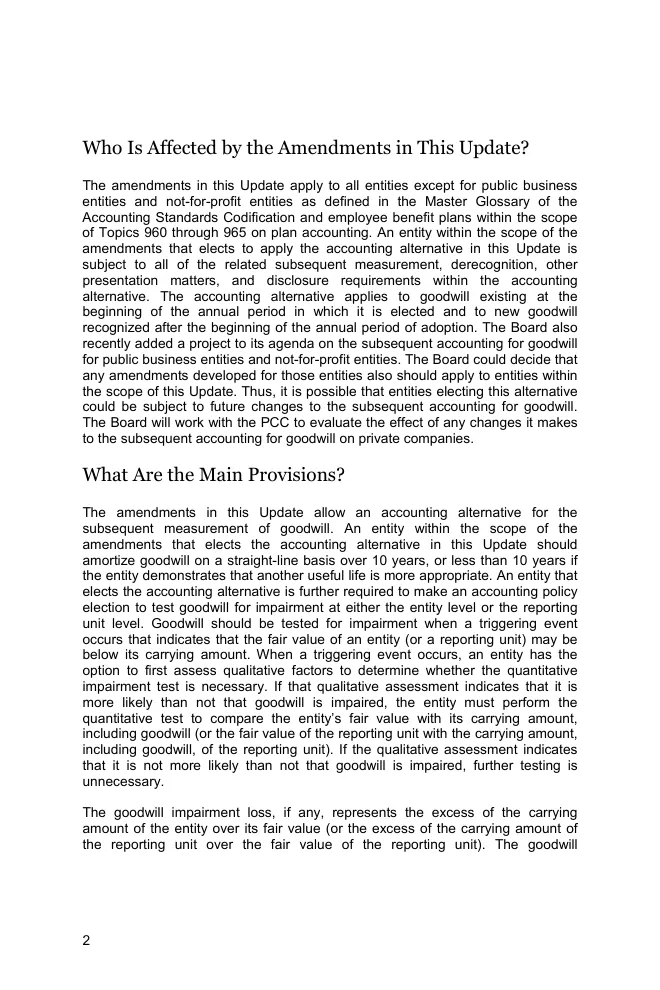
ASU 2014-02, issued in January 2014 as a consensus of the Private Company Council, lets a private company elect a different deal: amortize goodwill straight-line over 10 years — or less, if the company can demonstrate that a shorter useful life is more appropriate — and test for impairment only when a triggering event occurs. The cumulative amortization period cannot exceed 10 years.
!ASU 2014-02: amortize goodwill over 10 years
For the $12,000,000 of goodwill in the running example:
$
\text{Annual Amortization} = \frac{\$12{,}000{,}000}{10} = \$1{,}200{,}000\text{ per year}
$
After three years, accumulated amortization is $3,600,000 and goodwill stands at $8,400,000. Suppose a triggering event then arrives — the unit's largest customer leaves — and the test at the entity level (which the alternative permits instead of the reporting-unit level) shows an entity fair value of $30,000,000 against a carrying amount of $34,000,000:
$
\text{Impairment Loss} = \$34{,}000{,}000 - \$30{,}000{,}000 = \$4{,}000{,}000
$
The $4,000,000 loss is below the remaining goodwill of $8,400,000, so the cap does not bind, and goodwill falls to $4,400,000. What the election bought: three years of predictable charges, no annual valuation, and a test only when something actually happened. What it cost: the annual charge reduces reported earnings every year, which matters when a lender covenant or an earn-out is written against EBITDA or net income.
> [!FOUNDER]
> "Every founder I know treats goodwill as a number the accountants invented at closing. It is not. It is the price you paid for a future that has not happened yet, and ASC 350 is the annual appointment where that future gets marked to market. Run Step 0 honestly, and never let a reporting unit get so broad that a dying product line hides inside a healthy segment."
> — Enow A. Jovial, Founder & Chief Executive Officer
The tax side: § 197 amortizes what GAAP will not
Federal tax law ignores the book debate entirely. Under 26 U.S.C. § 197(a), an amortizable section 197 intangible is amortized ratably over the 15-year period beginning with the month in which the intangible was acquired — 180 equal monthly instalments, regardless of the asset's actual useful life. Goodwill is the first item on the statute's list (§ 197(d)(1)(A)), and § 197(b) bars any other depreciation or amortization deduction for the same intangible. The deduction is claimed on IRS Form 4562, Part VI, while buyer and seller both report the purchase-price allocation on Form 8594.
For the same $12,000,000:
$
\text{Monthly Deduction} = \frac{\$12{,}000{,}000}{180} = \$66{,}666.67; \quad \text{Annual Deduction} = \$66{,}666.67 \times 12 = \$800{,}000.00
$
If the acquisition closed in March, the first year runs March through December — 10 months:
$
\text{First-Year Deduction} = \$66{,}666.67 \times 10 = \$666{,}666.67
$
After 10 years the tax return has recovered $8,000,000, leaving a $4,000,000 basis for the final five years. Compare the book treatments: a public company charges $0 a year and waits for impairment; a private company electing amortization charges $1,200,000 a year for 10 years; the tax return deducts $800,000 a year for 15 years. The $400,000 annual gap is the book-tax divergence the CPA reconciles on the M-1.
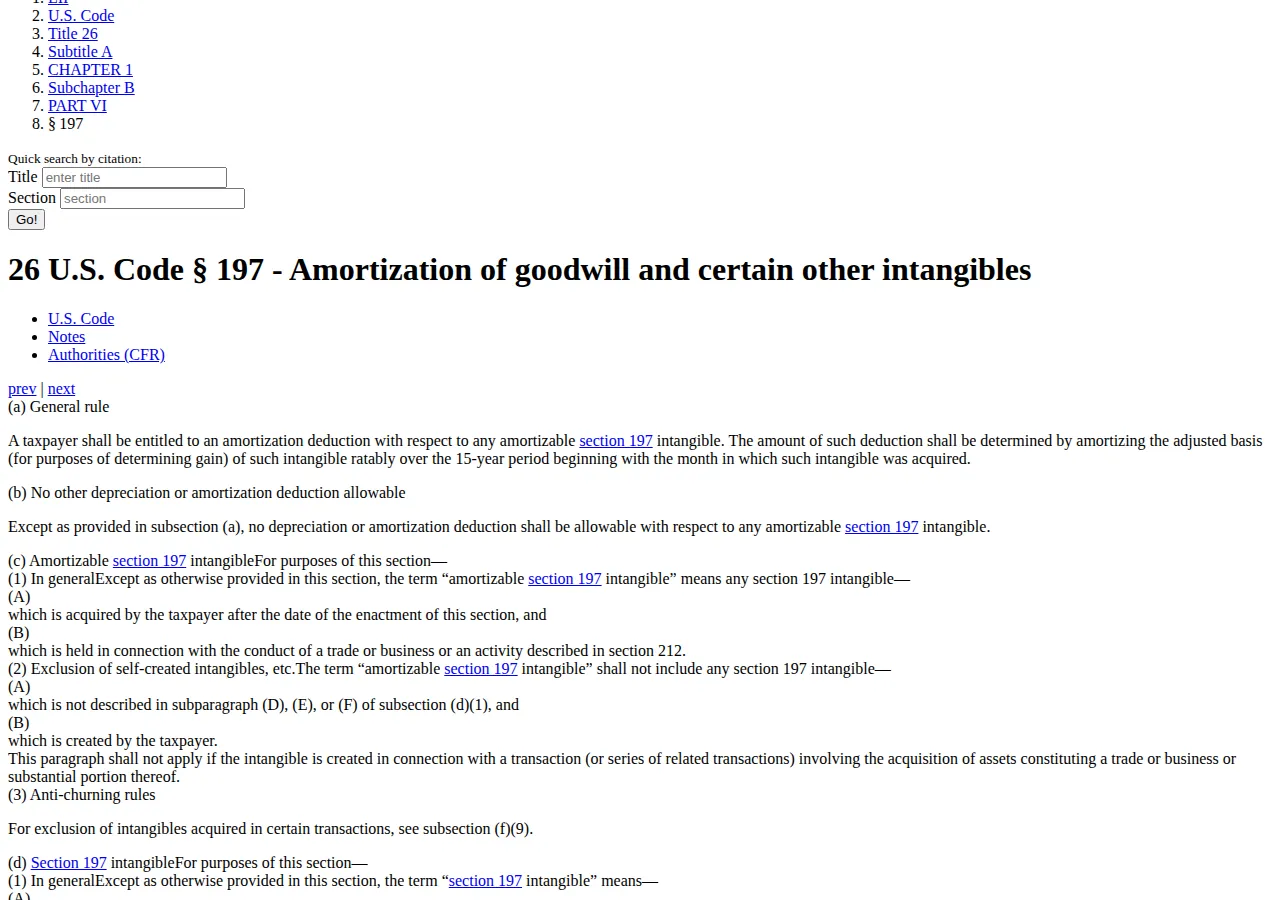
Two limits catch buyers who do not read the statute. First, § 197(c)(2) excludes self-created intangibles: goodwill a business builds itself has no amortizable basis, because there was no acquisition cost to recover. Second, the anti-churning rules in § 197(f)(9) block amortization where related parties shuffle pre-1993 intangibles.
The paperwork trail is where the identifiers live. The acquisition is reported under the buyer's Employer Identification Number (EIN) on Form 8594; the amortization lands on Form 4562, Part VI, and flows to Form 1120 for a C-Corp or through Form 1065 or Form 1120-S for a partnership, LLC, or S-Corp, where it passes to the owners. A CPA prepares the allocation, and the GAAP treatment follows ASC 350 while the tax treatment follows § 197 — two different rulebooks for one asset. One boundary founders get wrong: the § 197 deduction lowers taxable income, but it does not lower FICA wages or SECA net earnings.
> [!TIP]
> Price the § 197 deduction into the offer before signing. A $12,000,000 goodwill allocation is worth $800,000 a year in deductions for 15 years. Negotiate the allocation in the purchase agreement, not after closing, when both sides must agree on Form 8594.
What Kraft Heinz teaches about waiting too long
The company carried tens of billions in goodwill from the 2015 Kraft-Heinz merger. In the fourth quarter of 2018, factors developed that pushed the fair values of certain goodwill and intangible assets below their carrying amounts, and the company recorded $15.4 billion of non-cash impairment charges, primarily against goodwill in U.S. Refrigerated and Canada Retail and the Kraft and Oscar Mayer trademarks. The company's own release states the $15.4 billion as a combined goodwill and intangible charge and does not split it between the two.
!Kraft Heinz: $15.4 billion impairment, $(10.34) EPS
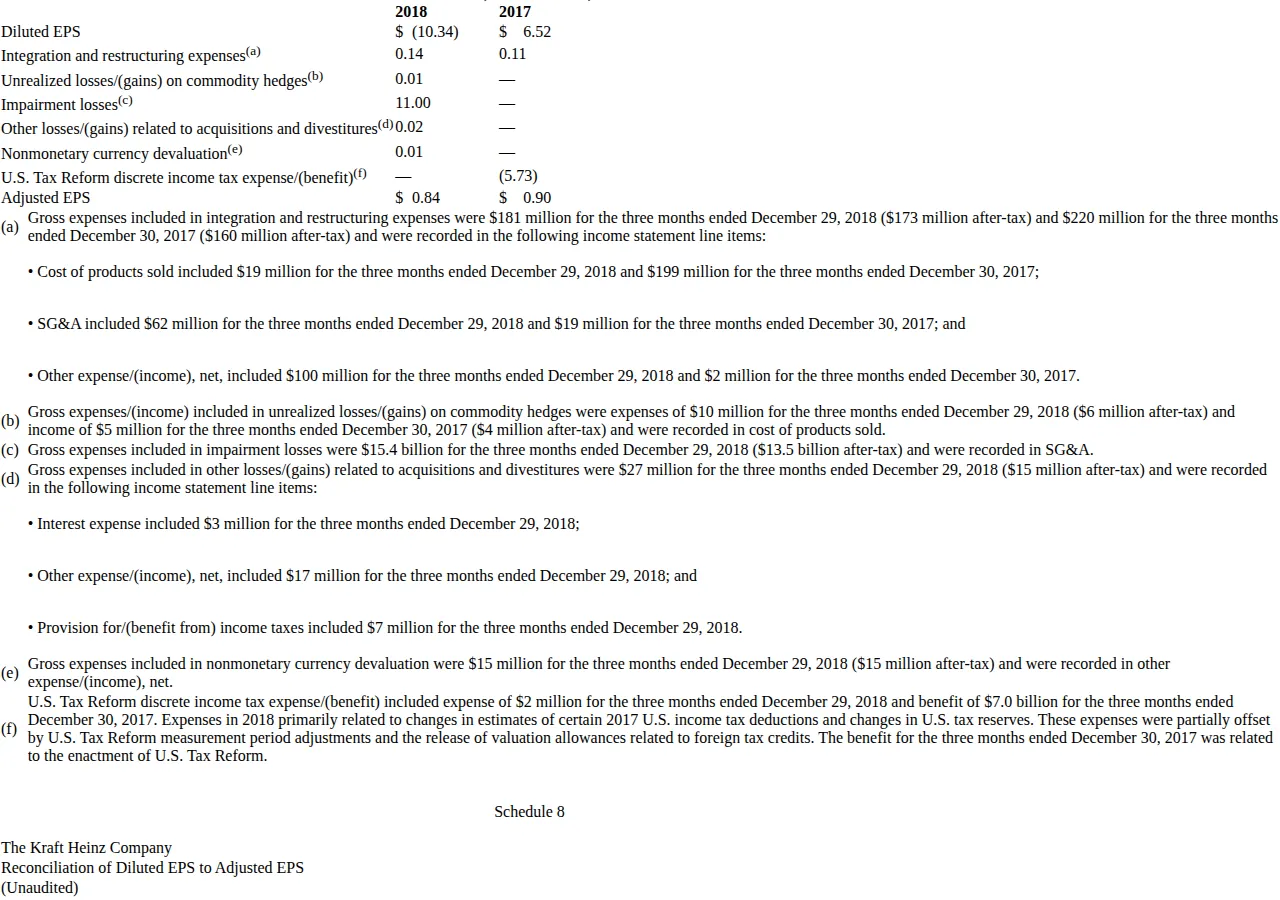
Three lessons survive the headlines. First, the triggering events were visible before the test: deteriorating brand performance, higher input costs, and promotional pressure had been building through 2018. Second, the market reaction was immediate and severe: the share price fell by more than a quarter in a day. Third, the charge was non-cash but it still moved the headline: a $15.4 billion impairment produced a $12.6 billion net loss and a $10.34 diluted loss per share in the same quarter.
The SEC angle: disclosure is part of the test
In CF Disclosure Guidance: Topic No. 9 (March 25, 2020), the Division of Corporation Finance asked companies to consider: do you anticipate any material impairments — with respect to goodwill, intangible assets, long-lived assets, and others — that have had or are reasonably likely to have a material impact on your financial statements? The guidance also urged companies whose auditors would need experts to determine the impact on assets, including impairment of goodwill, to engage those experts promptly.
Who must not use this playbook as written
This playbook assumes a company that acquired goodwill in a business combination and reports under US GAAP. It does not cover IFRS reporters, where IAS 36 measures a cash-generating unit against its recoverable amount and the loss cascades pro rata across the unit's assets rather than stopping at goodwill. It does not cover a company with no goodwill, or goodwill never assigned to reporting units — assignment comes first. For capitalizing what a business builds rather than buys, see our Section 174 software capitalization guide; for the liability side of the same balance sheet, see the deferred revenue SaaS playbook; and for how an impairment loss flows through operating performance, see the cash flow statement indirect method playbook. To model what a write-down does to margins, run the figures through our profit calculator.
Execution checklist: run the annual test in order
1. Confirm the assignment. Verify every dollar of goodwill is assigned to a reporting unit.
2. Fix the test date. Use the same date each year.
3. Scan for triggering events. Check share price against book value, customer concentration, and forecast variances.
4. Run Step 0. Document the qualitative factors and the more-likely-than-not conclusion. If no impairment is likely, stop here and file the memo.
5. Measure fair value. Commission the valuation: discounted cash flow, market multiples, or a blend, under ASC 820 assumptions.
6. Apply the one-step test. Compare carrying amount with fair value; the excess is the loss, capped at goodwill.
7. Book and disclose. Record the loss in operating income, write goodwill down, and disclose the facts and the amount.
8. Reconcile book to tax. Update the M-1 workpapers: the book loss does not change the § 197 schedule.
9. Check the covenants. Confirm the loss does not breach a debt covenant or earn-out threshold.
10. Set next year's tripwire. Record the triggering-event thresholds for next year.