A licence and a franchise can look identical on a term sheet: a brand, a fee, a territory, a contract. The law does not care what the contract calls the relationship. Under the Federal Trade Commission's Franchise Rule, a deal is a franchise when it meets three elements — a trademark licence, significant control or assistance, and a required payment — whatever the parties named it. Call it a licence, a partnership, or a distribution agreement: the same three elements still make it a franchise, with the same disclosure document, 14-day wait, and enforcement exposure. The choice is a legal classification with a price tag on each side, and the operator who gets it wrong pays twice: in fees they did not plan for, and in disclosure they never gave.
The three-element test decides the label
Section 436.1(h) defines a franchise as any continuing commercial relationship in which the offer or contract specifies, or the seller promises or represents, that the franchisee will obtain the right to operate a business identified with the franchisor's trademark, that the franchisor will exert or has authority to exert a significant degree of control over the franchisee's method of operation or provide significant assistance in it, and that the franchisee makes a required payment as a condition of obtaining or commencing operation. All three must be present. Remove any one and the relationship is not a franchise under the Rule — but removing one is harder than it looks, because the control element is satisfied by authority alone, not by control actually exercised.
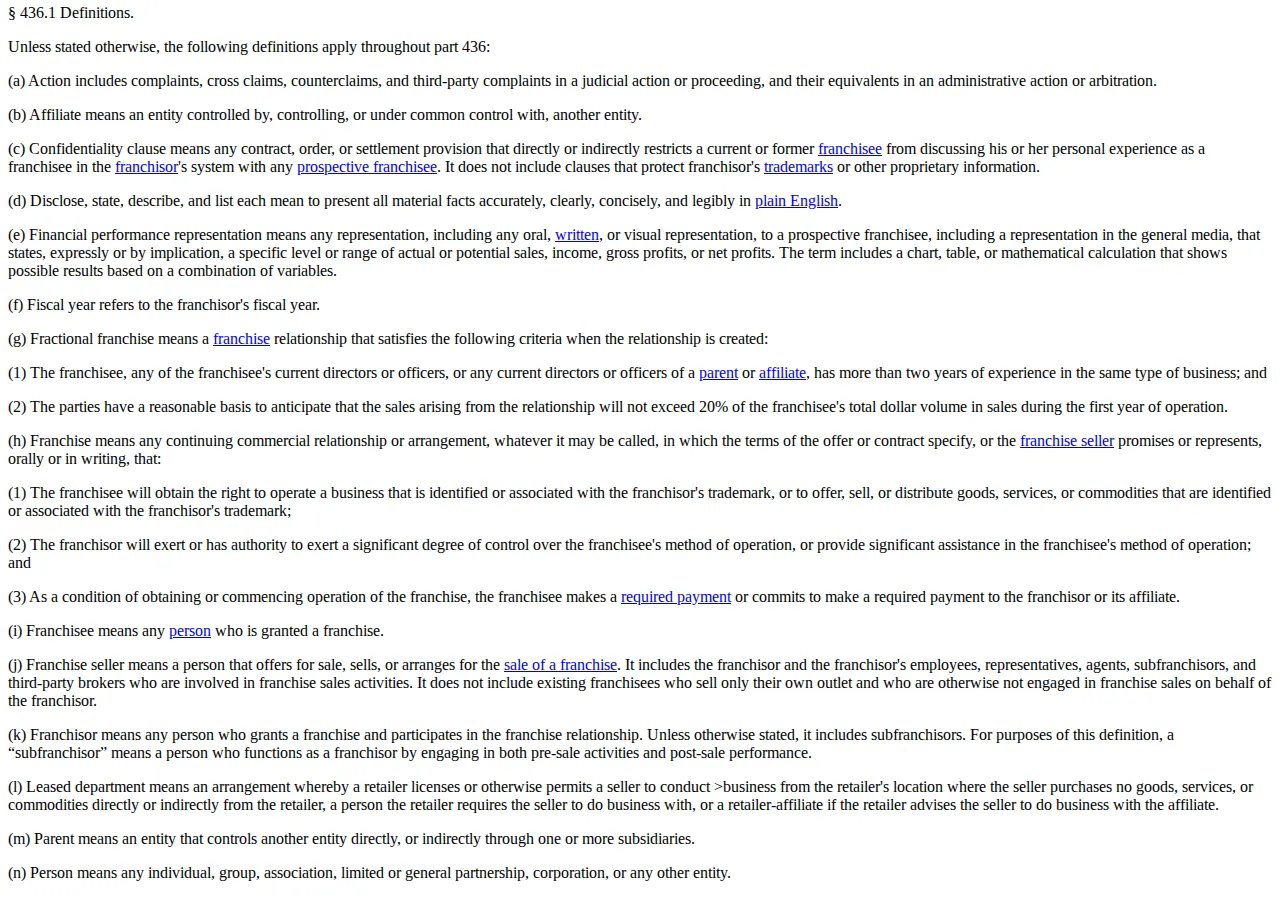
Any right to use the brand to operate the business, or to sell goods identified with it, satisfies it. A pure product licence — a manufacturer letting a distributor put its logo on a shelf — does not, because the distributor is not operating a business identified with the mark. The control element is where most "licences" fail. A franchisor that dictates store layout, operating hours, approved suppliers, pricing, or training exercises significant control; a licensor that merely hands over a brand manual and a logo file does not. The line is not how much control the contract claims but how much the franchisor can impose: a contract reserving the right to inspect, approve, and audit the operator's methods gives the franchisor the authority the Rule asks about, even if it never uses it.
The required-payment element is defined in section 436.1(s) as all consideration the franchisee must pay the franchisor or an affiliate, by contract or by practical necessity, as a condition of obtaining or commencing operation. The one carve-out matters: payments for reasonable amounts of inventory at bona fide wholesale prices for resale or lease are not required payments. A distributor that buys stock at wholesale and resells it is paying for goods, not for the business; a licensee that pays a $25,000 "brand fee" before opening is making a required payment, and the element is met.
What each model costs, worked on one unit
The economics separate cleanly once the classification is settled. Take one illustrative unit with $1,000,000 of annual unit volume — a figure chosen for the arithmetic, not taken from any real system. A franchise version charges a $45,000 initial fee, a 6 percent royalty, and a 2 percent brand-fund contribution; a licence version charges a $25,000 upfront fee and a 3 percent royalty, with no brand fund and no mandated marketing spend.
The franchise costs $50,000 a year more, plus $20,000 extra upfront — $520,000 over ten years before discounting. That premium buys three things the licence does not: a proven operating system with training and field support, national brand marketing funded by the 2 percent contribution, and a protected territory. Whether it pays depends on the lift. If the system lifts unit volume by 10 percent, to $1,100,000, the extra $100,000 at a 20 percent margin is $20,000 of profit — not enough to cover the $50,000 premium. The break-even lift is the fee premium divided by the margin on the extra volume: at 20 percent the system must add $250,000, a 25 percent lift, before the franchise beats the licence on cash alone.
The licence side is the cost of independence. The licensee keeps the $50,000 a year and spends it on their own marketing, training, and supplier negotiations — or spends nothing and keeps the margin. What the licensee does not get is the franchisor's Item 19 performance data, negotiated supply pricing, or brand recognition on the door. A licensee in a market where the brand is unknown is buying a logo nobody recognizes; a franchisee in the same market is buying recognition the franchisor already built. Run the ROI calculator on the fee premium against the volume lift your market actually supports before signing either document: the model that wins is the one whose lift you can evidence, not the one whose fees are lower.
The disclosure machinery the franchise carries
A franchise sale carries a disclosure obligation a licence sale does not. Under section 436.2(a), the franchisor must furnish the prospective franchisee with its current disclosure document — the Franchise Disclosure Document, or FDD — at least 14 calendar days before the prospect signs a binding agreement or pays. If the franchisor materially revises the basic franchise agreement or a related agreement, section 436.2(b) requires the revision at least seven calendar days before the prospect signs it. The 14-day clock runs from delivery, not from signing, and a franchisor that collects a deposit on day 10 has violated the Rule even if the prospect was happy to pay.
The FDD has 23 items under section 436.5, and the items that decide a purchase are Item 5 (initial fees), Item 6 (other fees), Item 7 (estimated initial investment), Item 11 (assistance, advertising, computer systems, and training), Item 12 (territory), Item 17 (renewal, termination, transfer, and dispute resolution), Item 19 (financial performance representations), and Item 21 (financial statements). Item 21's statements are prepared under GAAP and reviewed by the franchisor's CPA, and the franchisee entity — usually an LLC, sometimes a C-Corp — puts its EIN on the application that follows. Item 19 is the one buyers read first and sellers fear most: a franchisor may give financial performance information only with a reasonable basis and written substantiation, and only if it is included in the FDD. A franchisor that makes no representation must say so in the FDD, in the words the Rule prescribes — and a sales representative who quotes a number that is not in Item 19 has made an unlawful representation, whatever the FDD says.
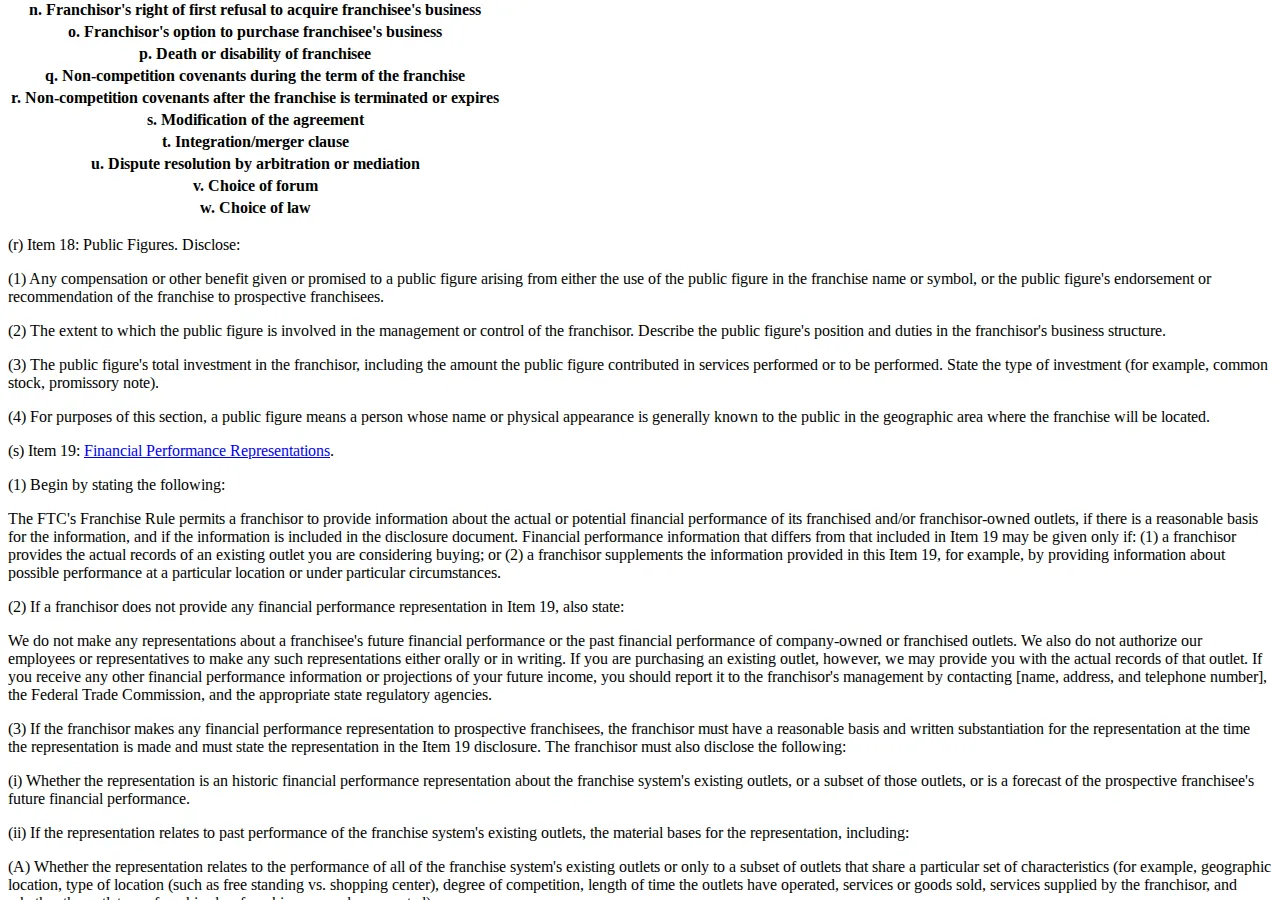
A licence sale carries none of this machinery: no prescribed disclosure document, no 14-day waiting period, no Item 19. The licensor's obligations are the contract's obligations and the general law against deceptive earnings claims. That is a real saving — no FDD to prepare, audit, and update annually, no state registration filings, no 14-day delay — but also a real loss of protection: no audited financial statements, no litigation history, no outlet counts. The franchise disclosure document playbook works all 23 items and the delivery rules, and it is the document a buyer should read before the franchise agreement, not after it.
The misclassification trap
The dangerous deal is the licence that is legally a franchise. A licensor that grants a trademark, dictates operating methods, and collects an upfront fee has sold a franchise under section 436.1(h) and owes the FDD, the 14-day wait, and the Item 19 discipline — whatever the contract calls it. The exposure is not theoretical: failure to furnish the FDD is an unfair or deceptive act or practice under Section 5 of the FTC Act, and a number of states require the FDD to be registered before any offer is made, with their own enforcement. A franchisee who discovers the misclassification after signing can seek rescission and damages, and the licensor's defence — "the contract said licence" — is the one argument the Rule's definition was written to defeat.
Three exemptions in section 436.8 keep small or insider deals outside the Rule. If the total of required payments made from before to within six months after commencing operation is less than $735, the Rule does not apply. A fractional franchise — an experienced operator in the same type of business whose sales from the relationship will not exceed 20 percent of total dollar volume in the first year — is exempt. A large franchise is exempt where the franchisee's initial investment, excluding franchisor financing and unimproved land, totals at least $1,469,600, or where the franchisee entity has been in business at least five years with a net worth of at least $7,348,000. The thresholds are adjusted every fourth year for the Consumer Price Index. None of these is a drafting trick: the $735 threshold is measured on real payments, the fractional test on real sales, and the large-franchise test on a real investment with a signed acknowledgment.
The third path: the business opportunity
A licence that avoids the franchise definition can still fall under the FTC's Business Opportunity Rule, 16 CFR Part 437: a business opportunity is a commercial arrangement in which the seller solicits a prospective purchaser to enter a new business, the purchaser makes a required payment, and the seller represents that it will provide locations for equipment or displays, provide outlets, accounts, or customers, or buy back the goods or services the purchaser produces. A licence that promises customers, vending-machine placement, or a buy-back is a business opportunity, and the Rule requires its own disclosure document. There are three doors, not two — franchise, licence, and business opportunity — and the door you walk through is decided by what you promise, not by what you call the agreement.
| Dimension | Franchise | Licence | Authority |
|---|---|---|---|
| Brand use | Business identified with the mark | Mark use, usually goods only | 16 CFR § 436.1(h)(1) |
| Control | Significant control or assistance | Minimal; dictating methods is franchise risk | 16 CFR § 436.1(h)(2) |
| Payment | Initial fee, royalty, brand fund | Upfront fee, royalty; wholesale inventory excluded | 16 CFR § 436.1(s) |
| Disclosure | 23-item FDD, 14 days before signing or payment | No prescribed disclosure document | 16 CFR §§ 436.2, 436.5 |
| Earnings claims | Item 19 only, reasonable basis required | General law against deceptive claims | 16 CFR § 436.5, Item 19 |
| Exemptions | Under $735; fractional; large franchise $1,469,600 / $7,348,000 | None — licence promising locations or buy-back is a business opportunity | 16 CFR §§ 436.8, 437.1 |
| Exit | Renewal, termination, transfer under Item 17 | Governed by the licence term; usually no renewal right | 16 CFR § 436.5, Item 17 |
The business valuation playbook prices what either model is worth at exit: a franchise with a protected territory and a transferable agreement sells for a different multiple than a licence that ends with its term. The buying a small business due diligence playbook runs the acquisition checks — quality of earnings, SBA financing, LOI-to-close — that apply whichever model the target uses. And the LLC versus Delaware C-Corp playbook settles the entity that will hold the franchise or the licence — the model choice and the entity choice are decided together, not in sequence.
Execution checklist
- [x] Step 1 — Run the three-element test on the real deal: List the trademark grant, every control or assistance the seller reserves, and every payment required before or at opening. All three present means franchise.
- [x] Step 2 — Price both models on one unit: Work the fee premium against the volume lift at your real margin. If the franchise cannot evidence the lift, the licence wins.
- [x] Step 3 — Demand the FDD before any payment: The franchisor must deliver it 14 calendar days before you sign or pay. A deposit asked for first means the Rule is already broken.
- [x] Step 4 — Read Item 19 before Item 7: Financial performance representations need a reasonable basis and written substantiation, or the FDD must state none are made. A number quoted in a sales call but absent from Item 19 is an unlawful representation.
- [x] Step 5 — Check the exemptions honestly: Under $735 in required payments, a true fractional franchise, or the $1,469,600 large-franchise investment are the only exits. Measure them on real figures, not a restructured fee.
- [x] Step 6 — Test the business-opportunity door: If the deal promises locations, customers, or a buy-back, it may be a business opportunity under 16 CFR Part 437 with its own disclosure duties.
- [x] Step 7 — Price the exit before the entry: Read Item 17 on renewal, termination, and transfer, and the valuation multiple each model commands, before signing a term you cannot renew or sell.
Founder & CEO Insight — Enow A. Jovial