What you are actually buying
A small business for sale is a stream of cash with a job attached. The price is set by two numbers: the cash the business produces for one working owner, and the multiple the market pays for it. The first is seller's discretionary earnings (SDE): net income plus the owner's salary, perks, interest, taxes, depreciation, amortisation, and one-time expenses. The second is the multiple: price divided by SDE. Confusing the two is the most expensive mistake in the purchase. At 4 times instead of 2.61, the same $290,000 of SDE costs $1,160,000, the business did not change, the multiple did, and the multiple is where the seller's optimism lives.
The dividing line between SDE and EBITDA is enterprise value, not revenue. Businesses selling for under about $3 million are almost always priced on SDE: the buyer is an individual owner-operator, and SDE measures what one working owner receives. Above $3 million, EBITDA is the standard: the buyer is no longer the operator, and the business must pay a manager and still produce a return. Valuing a $400,000 Main Street business on EBITDA without adding back a replacement manager's salary values a job as if it were free; the underwriter will notice first.
The market price: what businesses actually sold for
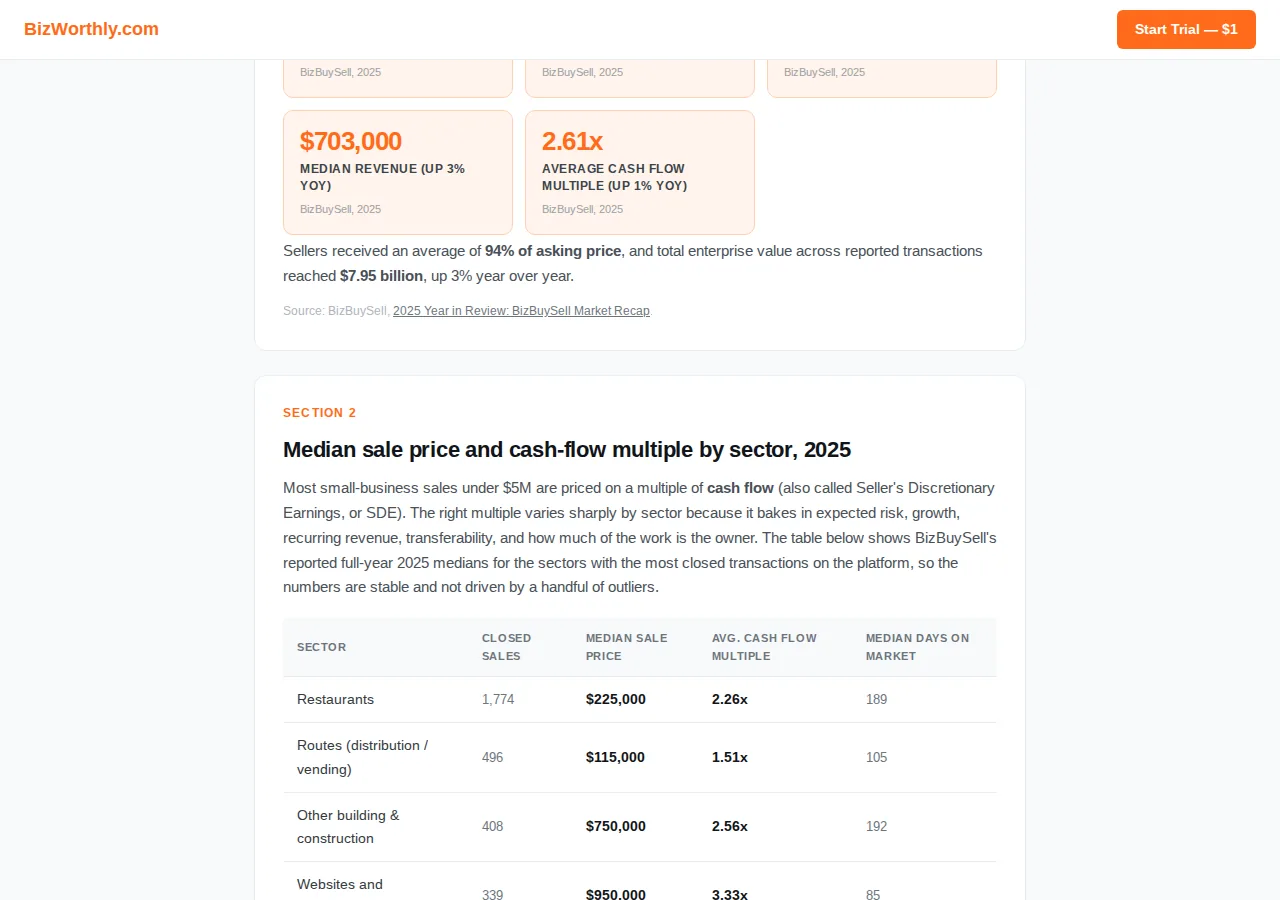
BizBuySell's 2025 Year in Review, the best public data on the Main Street market, covers 2025 closed US transactions: 9,586 closed, median cash flow $158,950, median revenue $703,000, sellers receiving 94% of asking on average, and total enterprise value $7.95 billion. The IBBA and M&A Source Q4 2025 Market Pulse Survey, of 350 business brokers and M&A advisors, adds the financing picture: sellers averaged 76% to 89% cash at close, with the rest bridged after closing, most commonly through a seller note.
The multiple is not one number: it varies sharply by sector, pricing risk, growth, recurring revenue, transferability, and owner time:
| Sector | Sales | Median sale price | Avg. cash-flow multiple | Median days on market |
|---|---|---|---|---|
| Restaurants | 1,774 | $225,000 | 2.26x | 189 |
| HVAC businesses | 123 | $800,000 | 2.80x | 181 |
| Laundromats | 169 | $287,000 | 4.12x | 138 |
| Gas stations | 113 | $826,000 | 3.70x | 75 |
| Software and app companies | 49 | $820,000 | 3.41x | 180 |
| Source | BizBuySell Insight Report 2025 |
A laundromat sells at 4.12 times cash flow and a restaurant at 2.26 times for the same reason: the laundromat runs with limited hands-on time and produces predictable cash, while the restaurant needs the owner on-site daily. The multiple is a price on the owner's time, and a seller asking 4 times cash flow for a restaurant in a sector that closed at 2.26 times in 2025 must prove the premium with three years of tax returns, not a story about next year.
The SDE math: one worked example
Take an HVAC company in a mid-size city, listed at $812,000, quoting $290,000 of SDE. Before you believe either number, rebuild the SDE from the tax returns: every add-back must tie to a document:
For this business, the three-year average from the returns is: net income $180,000, the owner's $90,000 salary, a $12,000 personal vehicle run through the company, and a one-time $8,000 legal expense that will not recur. Interest, taxes, depreciation, and amortisation are already inside net income, so they are not added twice:
Now price it three ways. At the 2025 all-sector average of 2.61 times, the business is worth $756,900. At the HVAC sector average of 2.80 times, it is worth $812,000, exactly the asking price, so the seller priced it on the sector table. At the restaurant multiple of 2.26 times, the same earnings are worth $655,400. The $156,500 gap is the entire negotiation, decided by which sector's risk the business carries: recurring maintenance contracts and a dispatchable crew, or a dining room that empties when the owner takes a holiday.
An add-back you cannot tie to a bank statement, an invoice, or a tax return should not be capitalised at that multiple. The common inflations are a family member on payroll who does no work, a "one-time" expense that recurs every year under a new label, and a trailing-twelve-months SDE quoted without the three-year profit and loss beside it; a listing quoting only the trailing twelve months often hiding a decline. Insist on three years of profit and loss and tax returns before you sign a letter of intent, and reconcile the SDE to the bank deposits: if the deposits do not support the earnings, the earnings do not exist.
The financing math: what the loan actually costs
Most first-time buyers do not pay cash. They pay with a structure: buyer equity, a seller note, and an SBA 7(a) loan; the SBA guarantees a participating lender's loan; it does not lend the money. The program's current terms, from the SBA's own 7(a) page: a maximum loan of $5,000,000, a guarantee of 85% on loans of $150,000 or less and 75% above, and interest-rate caps by loan size. Maximum maturities depend on use: up to 10 years for working capital, inventory, and equipment, up to 25 years for commercial real estate (SBA SOP 50 10 8).
Run the HVAC deal through that structure at the $756,900 price, the 2.61 times anchor. The buyer puts in 10% equity, $75,690; the seller carries a 10% note, $75,690; the SBA 7(a) loan covers the remaining 80%, $605,520. At an illustrative all-in rate of 10% over 10 years (an assumption, since the actual rate is the base rate at closing plus the capped spread), the monthly payment is:
Annual debt service is $96,023.90. The coverage test is the debt-service coverage ratio: cash available for the loan, divided by annual debt service. The cash available is not the SDE: the SDE includes the owner's salary, and the buyer still has to eat, so subtract a replacement manager's $70,000 salary:
A DSCR of 2.29 times means the business produces $2.29 of normalised cash for every $1.00 of debt service: the number the underwriter underwrites, not the asking price or the multiple. At the seller's $812,000 ask with the same structure, the loan would be $649,600, the monthly payment $8,584.70, and the DSCR 2.14 times; still financeable, but with $7,000 a year less slack, every year, for ten years. The multiple is not an abstraction.
For an SBA 7(a) acquisition, practitioners report 60 to 90 days from signed letter of intent to wired funds; plan on 90 days, and treat a broker demanding a 14-day close as a warning sign.
Asset purchase versus stock purchase: the tax fork
How the deal is structured changes the tax bill more than the price does. In an asset purchase, the buyer takes the assets and the seller keeps the entity. In a stock purchase, the buyer takes the entity itself, history, contracts, and liabilities. The tax code treats the two differently where it matters most: the allocation of the purchase price.
Section 1060 governs the asset purchase. When assets constituting a trade or business change hands and the buyer's basis is the consideration paid, the price is allocated under the residual method of section 338(b)(5): seven asset classes in order, the rest into goodwill. A written allocation agreement binds both sides unless the Secretary determines otherwise. Both sides report it on Form 8594 whenever goodwill or going-concern value attaches.
The allocation is a negotiation: the two sides want opposite things. The buyer wants as much as possible in assets that depreciate or amortise quickly: equipment, a non-compete, a customer list. The seller wants as much as possible in goodwill, generally taxed as capital gain. Take the $756,900 HVAC price: $10,000 to cash, $40,000 to accounts receivable, $150,000 to equipment, $56,900 to a non-compete, and $500,000 to goodwill. The arithmetic closes exactly, and the tax consequence follows from section 197: goodwill and other acquired intangibles amortise ratably over 15 years from the month acquired. The goodwill line alone gives the buyer:
That is $33,333.33 a year of deductions for fifteen years, existing only because the deal was an asset purchase with the price allocated to goodwill. In a stock purchase there is no step-up and no new amortisation: the buyer takes the entity's carryover basis and the $33,333.33 a year never appears. The stock purchase has its own advantages: contracts, licences, and customer relationships transfer without re-signing, but paying an asset-purchase price for a stock-purchase structure overpays by the present value of fifteen years of deductions. Run the allocation through your CPA before the letter of intent fixes the structure: after it is fixed, the allocation is an argument, not a choice.
A second tax tripwire belongs in diligence, not at closing. If the target carries net operating losses, section 382 limits how much the buyer can use after an ownership change; the limit turns on the loss company's value and the long-term tax-exempt rate, and it can reduce a seven-figure NOL to a trickle. The section 382 NOL ownership-change limitation playbook runs the full calculation; read it before paying for losses you cannot use.
The diligence sequence that actually works
Step 1 — Rebuild the SDE from the returns. Three years of profit and loss and tax returns, side by side; reconcile every add-back to a bank statement, an invoice, or a return. An add-back with no document comes out, and the deal is re-priced.
Step 2 — Price it on the sector table, not the listing. Apply the BizBuySell sector multiple for the target's actual sector to the verified SDE; an ask over 15% above the sector price needs proof in contracts, not adjectives.
Step 3 — Test the customer concentration. Ask for the revenue breakdown of the top five and top ten customers: when one customer is more than a fifth of revenue, the day that customer leaves is the day the multiple resets; underwriters flag it explicitly.
Step 4 — Read the lease before the letter of intent, not after. For a location-dependent business, a lease expiring in 18 months, or one the landlord can refuse to assign, can kill the deal on day 80 of a 90-day clock. Confirm the assignment clause and remaining term in writing.
Step 5 — Structure the deal with the CPA, then write the offer. Decide asset versus stock, agree the section 1060 allocation in the letter of intent, and confirm Form 8594 treatment before the price is fixed. The allocation is worth $33,333.33 a year; it is not a closing detail.
Step 6 — Finance it on the DSCR, not the price. Build the structure: equity, seller note, SBA loan, and compute the coverage ratio on normalised earnings after a replacement manager's salary. Below 1.25 times, the deal does not work at that price, whatever the multiple says.
For the surrounding numbers, the business valuation EBITDA multiple playbook covers the larger-deal method above $3 million, and the franchise disclosure document playbook covers the disclosure regime for buying a franchise instead of an independent business. Run the loan structure through the business loan calculator before you make the offer.
Founder & CEO Insight — Enow A. Jovial
Buying a small business: the launch checklist
- [x] Rebuild the SDE from three years of returns: every add-back tied to a bank statement, an invoice, or a tax return; undocumented add-backs removed, deal re-priced.
- [x] Price on the sector multiple: verified SDE times the BizBuySell sector multiple; an ask more than 15% above it needs proof in contracts, not adjectives.
- [x] Check customer concentration: top five and top ten revenue breakdown; any customer above 20% flagged and priced accordingly.
- [x] Read the lease before the LOI: assignment clause confirmed in writing, remaining term verified, landlord consent established.
- [x] Fix the structure with the CPA first: asset versus stock decided, section 1060 allocation agreed in the LOI, Form 8594 treatment confirmed.
- [x] Underwrite on the DSCR: normalised earnings after a replacement manager's salary over annual debt service; below 1.25 times, the price is wrong.
- [x] Plan for 90 days: letter of intent to wired funds on an SBA 7(a) deal; do not let a broker compress diligence into 14 days.