Business Valuation: The EBITDA Multiple Playbook
Ask ten owners what their business is worth and you will get ten numbers, most of them built on revenue. Revenue is the wrong starting point. A buyer pays for the cash the business will throw off after the owner stops running it, discounted for the risk that it will not. That is why two businesses with identical revenue can sell for prices 40 percent apart.
This playbook shows the valuation operation: the legal standard, the three approaches, the SDE and EBITDA math, a discounted cash flow you can recompute, the minority discounts, and the four rooms where the number must survive an authority. Every figure comes from one fictional company, Maple Street HVAC LLC, an HVAC services business taxed as an S corporation. The company is invented; the arithmetic is real.
The legal floor: Revenue Ruling 59-60
IRS Revenue Ruling 59-60, 1959-1 C.B. 237, anchors every American business valuation for tax purposes. Its fair market value is the price at which property would change hands between a willing buyer and a willing seller, neither under compulsion, both having reasonable knowledge of relevant facts. That is the tax standard — not investment value to one buyer, and not liquidation value in a forced sale.
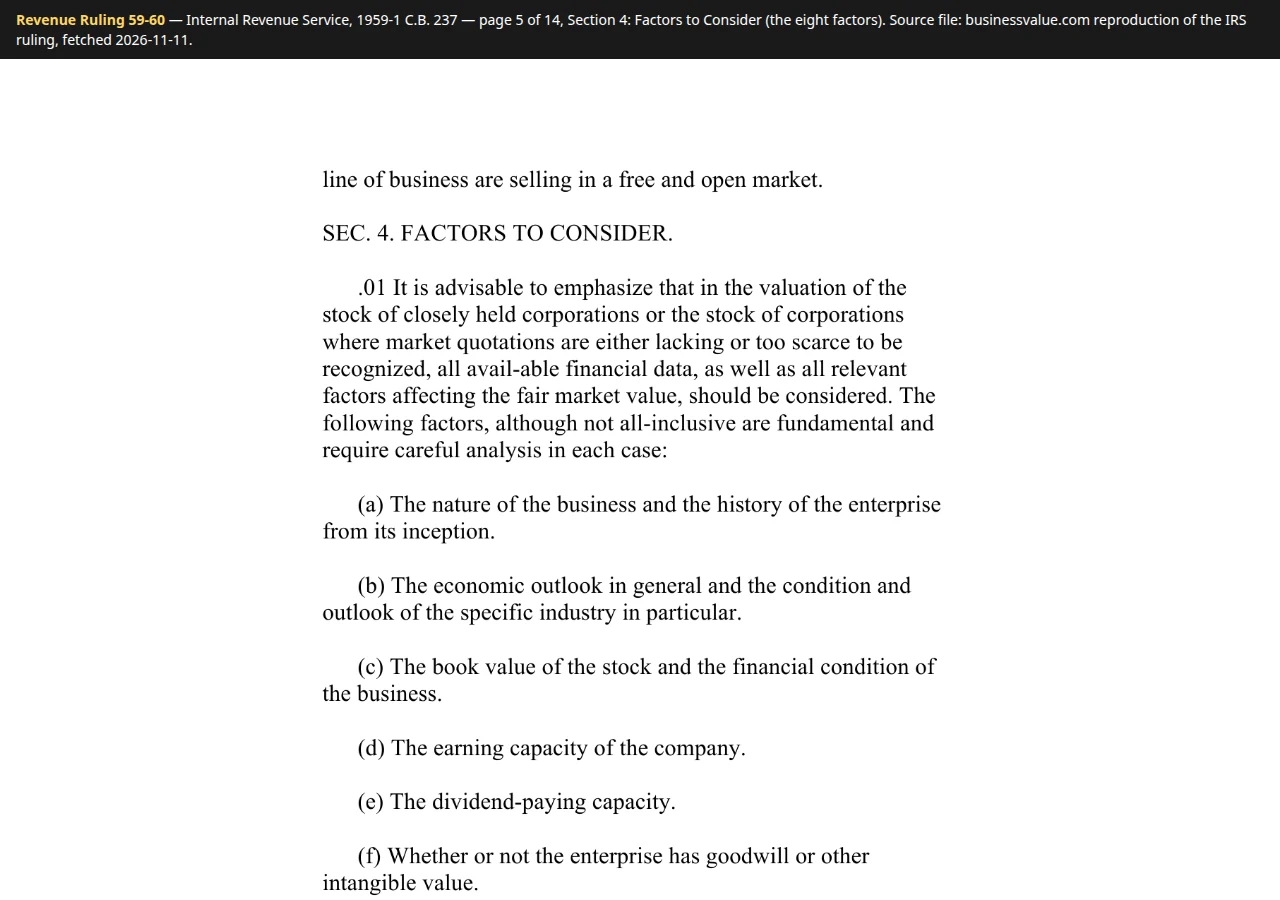
The ruling lists eight factors that "although not all-inclusive are fundamental":
(a) The nature of the business and the history of the enterprise from its inception. (b) The economic outlook in general and the condition and outlook of the specific industry in particular. (c) The book value of the stock and the financial condition of the business. (d) The earning capacity of the company. (e) The dividend-paying capacity. (f) Whether or not the enterprise has goodwill or other intangible value. (g) Sales of the stock and the size of the block of stock to be valued. (h) The market price of stocks of corporations engaged in the same or a similar line of business having their stocks actively traded in a free and open market.
Sections 5, 6, and 7 add the weighting rules: earnings control for operating companies and assets for holding companies, no standard capitalization-rate tables exist, and averaging factors is forbidden — "no useful purpose is served by taking an average of several factors (for example, book value, capitalized earnings and capitalized dividends) and basing the valuation on the result."
The three approaches, and when each one controls
AICPA Statement on Standards for Valuation Services No. 1 (SSVS No. 1), issued in June 2007 and effective for engagements accepted after January 1, 2008, requires a CPA in a valuation engagement to consider three approaches — income, market, and asset. A valuation engagement ends in a conclusion of value; a calculation engagement in a calculated value with lower assurance.
| Approach | What it measures | When it controls | Authority |
|---|---|---|---|
| Income | Present value of future economic benefits | Operating companies with provable cash flow | Rev. Rul. 59-60 Sec. 5; SSVS No. 1 |
| Market | What comparable businesses sold for | Active deal market, reliable transaction data | Rev. Rul. 59-60 Sec. 4(h); IBBA Market Pulse |
| Asset | Fair market value of net assets | Holding companies, asset-heavy firms, liquidation | Rev. Rul. 59-60 Sec. 5(b); SSVS No. 1 |
The income approach prices the business, the market approach reports what buyers paid, the asset approach prices it dead. ## SDE versus EBITDA: two earnings, two buyer universes
Small-business valuation runs on two earnings measures, and confusing them is the most common pricing error in the market. Seller's discretionary earnings (SDE) starts from pre-tax income and adds back the owner's salary, owner perks, interest, taxes, depreciation, amortization, and one-time items — what one owner-operator takes home. EBITDA does not add back the owner's salary, because it assumes a hired manager runs the business — what the business earns after paying a manager.
The market divides by size: deals under roughly $2 million are priced on SDE, and deals from $2 million to $50 million on adjusted EBITDA, the IBBA Market Pulse convention. SDE always exceeds EBITDA for the same business, so its multiple is naturally lower; never compare the two as if they were the same metric.
Add-backs are where valuations are won and lost. Every add-back must be documented, non-recurring or truly discretionary: above-market owner salary, a personal vehicle, a one-time settlement, a non-working family member on payroll. A "one-time" expense that recurs every year is not. At 3x, $60,000 of fake add-backs erases $180,000 of price — and the lender's appraiser will find them first.
The worked example: one company, three answers
Maple Street HVAC LLC averages $4,800,000 in revenue and $620,000 in pre-tax income. The owner takes a $180,000 salary and $30,000 in perks; the books carry a $40,000 one-time settlement, $80,000 of depreciation, and $25,000 of interest — stated assumptions, not market data.
First, SDE:
At the IBBA Q2 2026 median of 3.1x SDE for $1M–$2M deals:
Second, normalized EBITDA — pre-tax income plus interest, depreciation, and the one-time item, less the $150,000 market-rate salary of the replacement manager:
The IBBA band for $2 million to $5 million deals runs near 4.0x; the DealStats median was 3.5x in Q4 2025. Using 4.0x:
The methods disagree by $562,500: SDE credits the buyer with the owner's full pay, EBITDA charges a manager's salary. A valuator reconciles rather than averages — Section 7 of the ruling forbids mechanical averaging — and a 60 percent weight on SDE and 40 percent on EBITDA gives:
The DCF cross-check: what the future has to deliver
Test the multiple with a discounted cash flow: year-one free cash flow of $480,000, growing 3 percent a year for five years, discounted at an 18 percent weighted average cost of capital (WACC), with terminal growth of 2 percent after year five:
Present value of the five cash flows is $1,578,466; the terminal value of $3,444,057 is worth $1,505,429 today:
The DCF lands at 3.16x SDE and 5.01x EBITDA, bracketing the reconciled $2,797,500. The WACC does the heavy lifting, with a 3-point error moving the answer by hundreds of thousands of dollars, and the terminal value is nearly half the total, so the 2 percent terminal growth rate deserves more scrutiny than any single forecast year.
What deals actually pay: the market table
Corroborated secondary data — BizBuySell Insight Report and IBBA Market Pulse, Q2 2026 — medians, not a price for your business.
| Deal size | Earnings basis | Median multiple, Q2 2026 |
|---|---|---|
| Under $500,000 | SDE | 2.0x |
| $500,000 to $1 million | SDE | 2.8x |
| $1 million to $2 million | SDE | 3.1x |
| $2 million to $5 million | EBITDA | 4.0x |
| $5 million to $50 million | EBITDA | 5.8x |
BizBuySell Q2 2026 counted 2,117 businesses sold at an average 2.7x cash-flow multiple and 0.7x revenue multiple, median sale price $349,250, median cash flow $155,921. Multiples rise with size and vary by industry. Before applying any multiple, run the break-even calculator on the debt the price implies.
Founder & CEO Insight — Enow A. Jovial
Discounts: why a quarter of the company is worth less than a quarter of the price
The reconciled $2,797,500 values 100 percent of Maple Street. A 25 percent minority block is worth less. A discount for lack of control (DLOC) reflects no power over salaries, dividends, or a sale; a discount for lack of marketability (DLOM) reflects no public market for the shares — factor (g) of Revenue Ruling 59-60.
The discounts below are illustrative assumptions, not market rates; your appraiser must support the percentages with data for your facts:
A 25 percent block worth $699,375 pro-rata is worth $445,852 after the discounts — a 36.3 percent reduction.
The asset approach: the floor under the price
The asset approach values net assets at fair market value. For Maple Street, suppose equipment, vehicles, and working capital are worth $690,000 against $210,000 of liabilities; book equity is $410,000:
The $480,000 asset value sits far below the $2,797,500 income value; the gap is goodwill. The asset approach is the floor for an operating company.
Four rooms where the number must survive
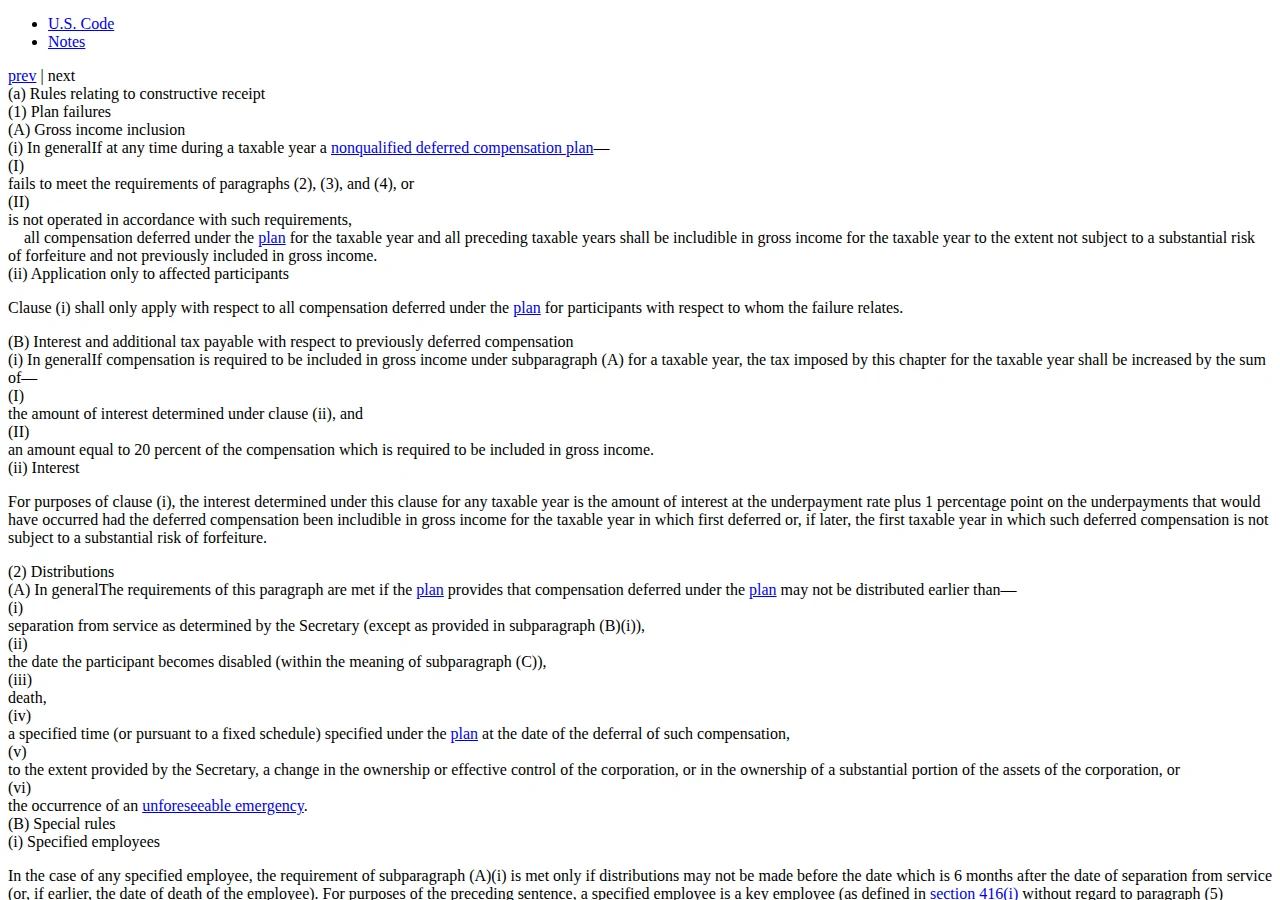
Room one: § 409A and stock options. Stock options must be granted at no less than fair market value on the grant date, or the option is nonqualified deferred compensation under 26 U.S.C. § 409A. If the plan fails § 409A, all deferred compensation becomes includible, plus interest at the underpayment rate plus one point, plus 20 percent additional tax — $20,000 on $100,000 deferred. The safe harbor, Treasury Regulation § 1.409A-1(b)(5)(iv)(B), presumes reasonable a valuation from an independent appraisal meeting § 401(a)(28)(C), dated within 12 months of the transaction.
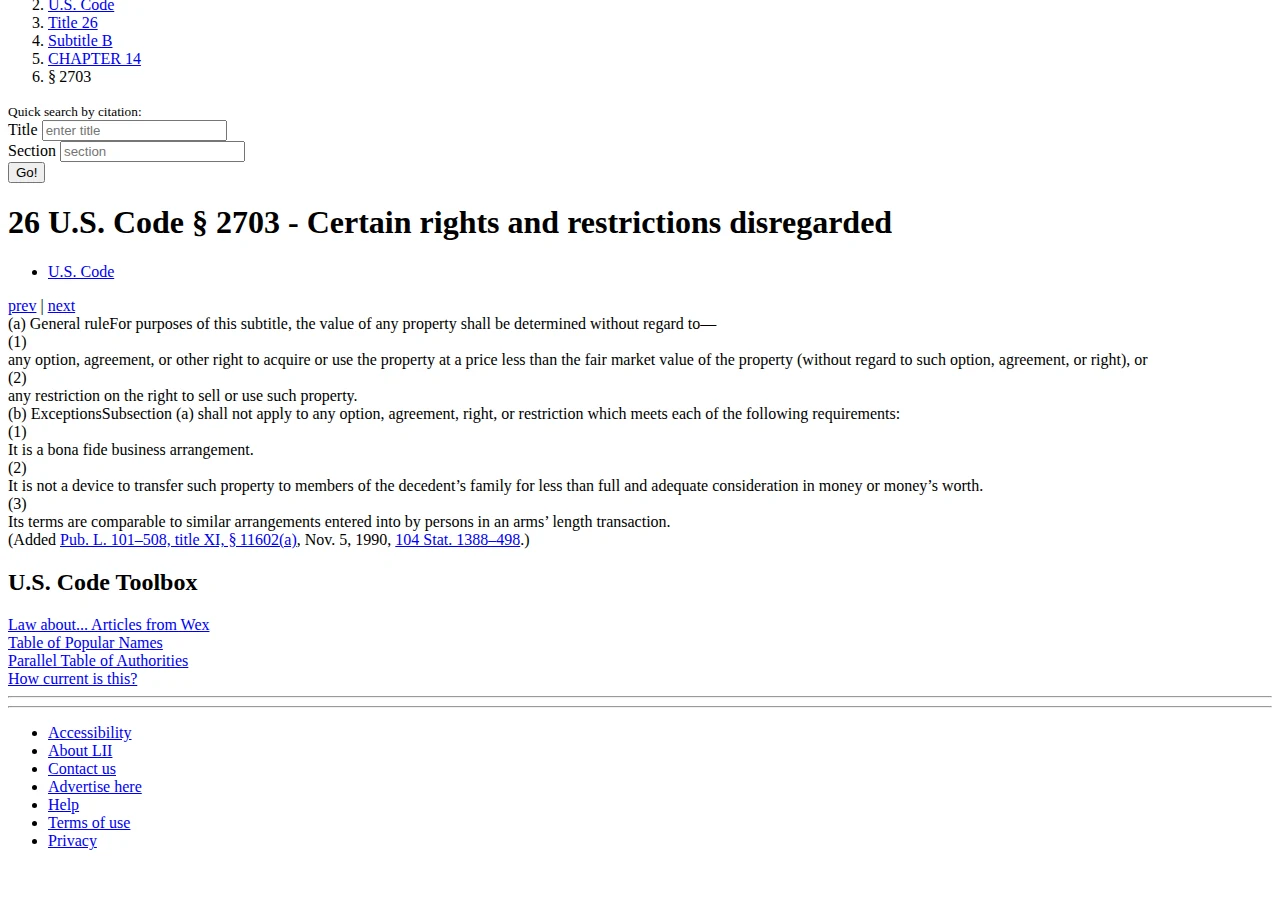
Room two: the buy-sell agreement and § 2703. A buy-sell agreement sets the price for a departing owner's shares, and 26 U.S.C. § 2703 says value is determined without regard to any below-FMV purchase option or sale restriction — unless it is a bona fide business arrangement, not a device to transfer property to family for less than full and adequate consideration, and comparable to arm's-length arrangements. Fail any one test and the agreement is ignored for estate and gift tax purposes. Revenue Ruling 59-60, Section 8, adds that an option price is usually accepted for estate tax where the agreement binds during life as well as at death — but not where the holder may sell during life and the option bites only at death. The funding side is covered in our key-person insurance buy-sell agreement funding playbook; this article is the valuation the funding must match.
Room three: the SBA 7(a) loan. Under SBA SOP 50 10 8.1, effective October 1, 2026 (SBA Information Notice 5000-880695), change-of-ownership valuation rules sit in Appendix 15: the lender must order an independent valuation from a Qualified Source when the business purchase price exceeds $350,000, and may value the business itself only at or below that threshold unless buyer and seller have a close relationship. At $3 million or more, a quality of earnings report is also required. The minimum equity injection is 10 percent of total project cost. At $2,797,500, the buyer injects $279,750, the valuation is mandatory, and no quality of earnings report is triggered. The valuation also caps total debt: a $3 million price on a $2.8 million valuation leaves the buyer to fund the gap in cash. A clean business credit score will not save a deal valued below its price. The SOP 50 10 8.1 details here — the $350,000 and $3,000,000 thresholds and the close-relationship exception — are corroborated across independent summaries; the SOP text was not fetched this cycle.
Room four: estate and gift tax. The same standard governs the gift tax return. A gift of a minority block is valued after DLOC and DLOM — which is why the $445,852 figure matters to a family transferring ownership. Form 709 mechanics are covered in our gift-tax annual exclusion Form 709 playbook. The IRS reads the valuation report first; one that cannot show its eight-factor analysis, approaches, and discount support invites an adjustment.
Who this is for, and who should stay away
This playbook is for an owner preparing to sell, a buyer testing an asking price, a founder granting options, partners writing a buy-sell agreement, and a family planning a transfer. Not for a public company, whose market price already exists; not for a distressed business, where liquidation replaces going-concern math; not for books without three clean years of tax returns. If the books are not clean, the first engagement is a CPA cleanup, not an appraisal.
The valuation execution checklist
- Fix the purpose, standard of value, and valuation date in writing first.
- Assemble three years of tax returns, GAAP statements, and a balance sheet; reconcile books to returns.
- Build the add-back schedule with documentation; delete any add-back that recurs.
- Compute SDE and normalized EBITDA from the same base year.
- Select the multiple from transaction data for your size band and industry; record source and quarter.
- Run the DCF cross-check with a stated WACC and terminal growth rate; test the sensitivity.
- Apply DLOC and DLOM only to the block being valued, with support for each.
- Reconcile the three approaches in writing — never average them.
- Match the report type to the room: independent appraisal for § 409A, Qualified Source valuation for SBA, conclusion of value for estate and gift tax.
- File the report with the agreement, return, or loan file it supports, and calendar the 12-month § 409A refresh.
A business valuation is not a guess with a multiple attached. It is a legal standard applied to real books, checked three ways, and written to survive the room where it will be used.