A franchisor that sells a franchise without first handing over a Franchise Disclosure Document has broken federal law before the first dollar changes hands. The FDD is the 23-item disclosure document the FTC Franchise Rule (16 CFR Part 436) requires every franchisor to deliver to every prospect, and the single document that decides whether a franchise purchase is an informed investment or a blind one. The Rule is a disclosure rule, not an approval rule — the FTC never reviews an FDD, never approves one, and never certifies that the business behind it is sound.
The three-part test: are you a franchisor already?
The most expensive mistake in franchising is made by companies that do not think they are franchisors. Under 16 CFR § 436.1(h), a continuing commercial relationship is a franchise when three elements are all present: the buyer operates under the seller's trademark or commercial symbol; the seller promises significant control over, or significant assistance to, the buyer's method of operation; and the buyer makes a required payment to the seller or an affiliate. A "license" or "distribution agreement" with all three is a franchise under federal law, whatever it is called, and the disclosure, timing, and registration duties attach in full.
| Element | What it means in practice | Authority |
|---|---|---|
| Trademark | The buyer operates under your brand, mark, trade name, or commercial symbol | 16 CFR § 436.1(h)(1) |
| Significant control or assistance | You set operating methods, approve the site, mandate suppliers, run training, control marketing systems | 16 CFR § 436.1(h)(2) |
| Required payment | The buyer must pay you or an affiliate — fee, royalty, rent, training, equipment, or required purchases | 16 CFR § 436.1(h)(3), (s) |
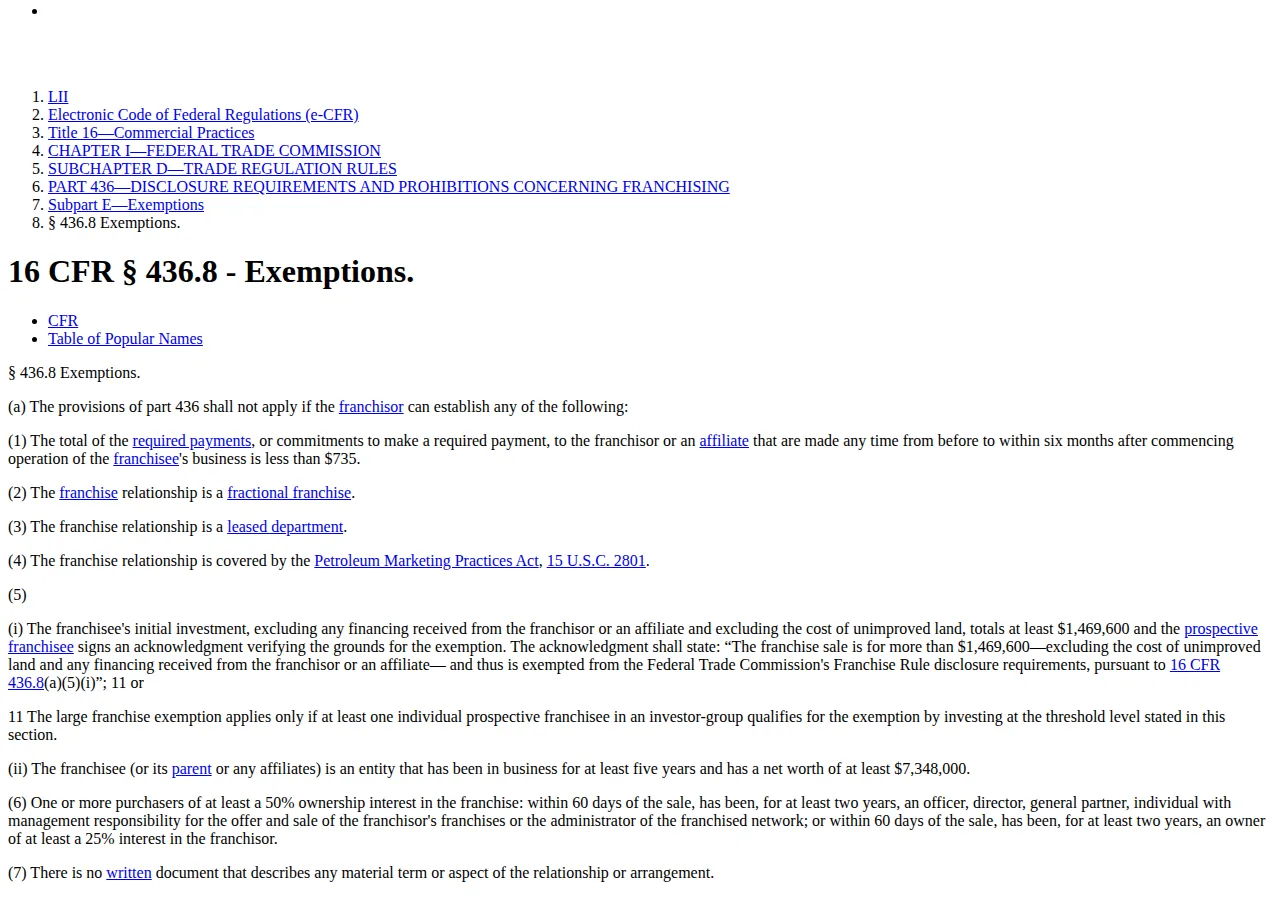
The required-payment element has a floor, and the floor moved recently. Section 436.8(a)(1) exempts a relationship where the total of the required payments, from any time before opening to within six months after commencing operation, is less than $735 — current since July 12, 2024 (89 FR 57078). Older guidance, including the FTC's own staff advisory opinions, still prints $500, the 2007 figure. Any template that still says $500 is four revisions out of date. The Commission resets the thresholds every fourth year against the Consumer Price Index for all urban consumers (§ 436.8(b)), so the next reset falls in 2028:
ext{Rule Applies if} quad sum ext{Required Payments (pre-opening to month 6)} geq $735
Two further exemptions in § 436.8(a)(5) matter for large deals. The Rule does not apply where the franchisee's initial investment, excluding financing from the franchisor or an affiliate and excluding the cost of unimproved land, totals at least $1,469,600 and the prospect signs a prescribed acknowledgement stating the sale is exempt — and, for an investor-group buyer, where at least one individual prospect qualifies by investing at that level. A separate exemption covers a franchisee (or its parent or affiliates) in business at least five years with a net worth of at least $7,348,000. These are designed for institutional buyers, not loopholes for small franchisors.
The 14-day clock, and the 7-day clock behind it
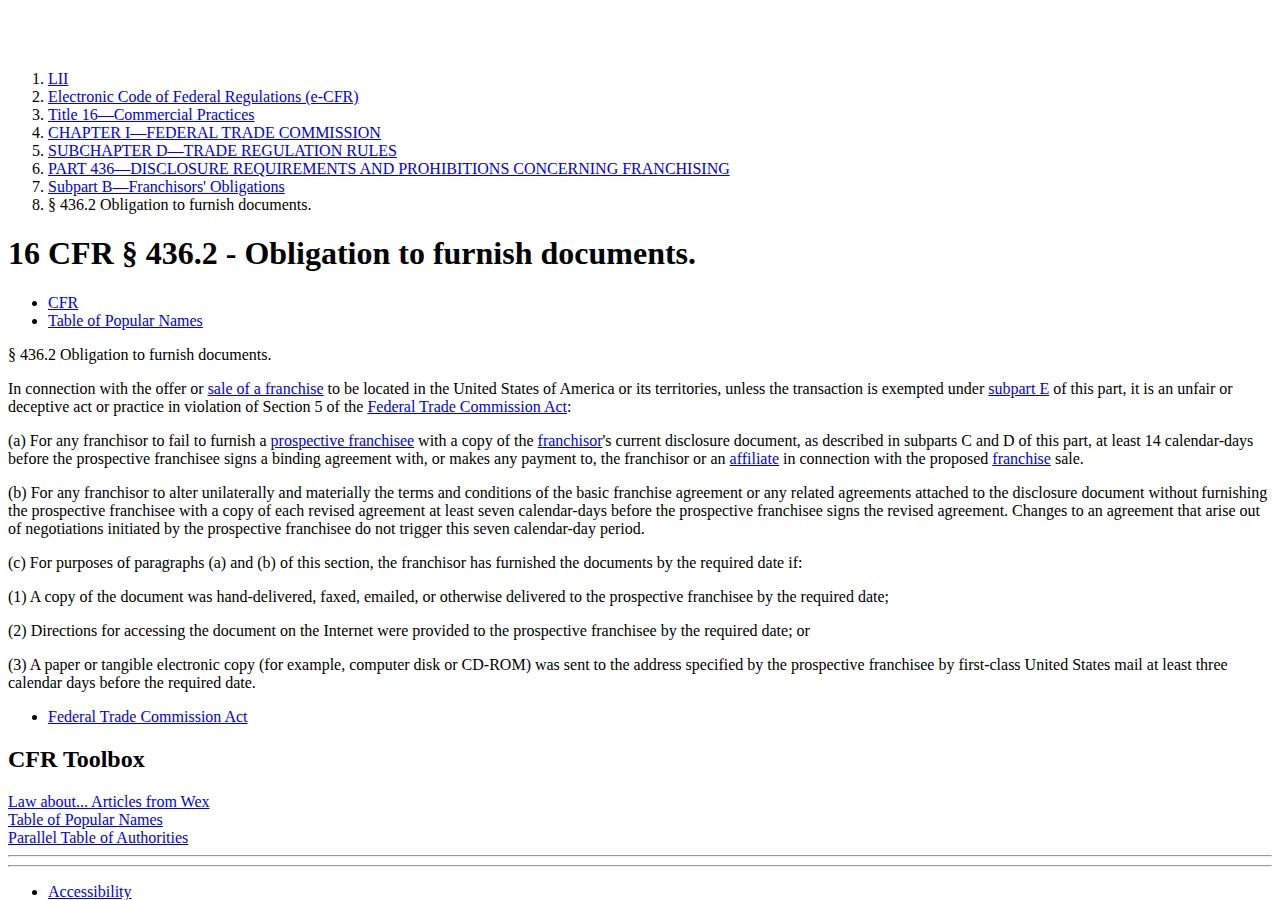
Section 436.2(a) states the timing rule in one sentence: a franchisor must furnish the prospect with its current disclosure document "at least 14 calendar-days before the prospective franchisee signs a binding agreement with, or makes any payment to, the franchisor or an affiliate in connection with the proposed franchise sale." Calendar days, not business days. Section 436.2(c) defines delivery: hand delivery, fax, email, or other electronic delivery by the required date; directions for accessing the document online, provided by the required date; or a paper or tangible electronic copy sent by first-class US mail at least three calendar days before the required date. A franchisor that mails the FDD must therefore post it 17 days before the earliest signing date, not 14.
The day-count is the part founders get wrong most often:
Deliver the FDD on November 3 and the earliest the prospect may sign or pay is November 17; by first-class mail, November 20, because the mailing rule pushes delivery three days earlier. A deposit taken on November 16 on a November 3 delivery is a violation even if the agreement is signed on November 17 — the Rule covers payment as well as signing, and a "holding deposit" is a payment.
The second clock runs after the first. Under § 436.2(b), if the franchisor unilaterally and materially alters the basic franchise agreement or any related agreement attached to the disclosure document, it must furnish each revised agreement at least seven calendar-days before the prospect signs it. Changes arising from negotiations the prospect initiated do not trigger the seven-day period — so a franchisor that re-papers a deal in the final week restarts a seven-day clock, and a buyer handed a new version the day before signing has a federal right to seven days with it.
All 23 items, and the five that decide the deal
Section 436.5 prescribes 23 numbered items, (a) through (w), in a standardised order so a buyer can compare FDDs across brands item by item:
| Items | Subject |
|---|---|
| 1–4 | Franchisor and affiliates; business experience; litigation; bankruptcy |
| 5–7 | Initial fees; other fees; estimated initial investment |
| 8–10 | Supply restrictions; franchisee obligations; financing |
| 11–13 | Assistance, advertising, systems, training; territory; trademarks |
| 14–16 | Patents, copyrights, proprietary information; operation; sales restrictions |
| 17–18 | Renewal, termination, transfer, dispute resolution; public figures |
| 19–21 | Financial performance representations; outlets; financial statements |
| 22–23 | Contracts; receipts |
Five items carry the decision. Item 5 (Initial Fees) discloses the initial fees and refund conditions; if fees are not uniform, the franchisor must disclose the range or formula used for the fees paid in the fiscal year before issuance. Item 6 (Other Fees) discloses, in a table headed "OTHER FEES" in capital bold type, every other fee the franchisee must pay the franchisor or its affiliates, or that the franchisor collects for a third party — with the formula for each fee and the formula or maximum of any increase. A royalty that "may increase" without a stated formula or cap is a defective Item 6. Item 7 (Estimated Initial Investment) discloses, in a table headed "YOUR ESTIMATED INITIAL INVESTMENT," the expenditure types, amounts, and payment method — the most-read table in the document.
A prospect should be able to add the low column and the high column and land on the franchisor's totals. Worked on a typical quick-service example:
ext{Initial Investment (low)} = $35{,}000 + $120{,}000 + $85{,}000 + $25{,}000 + $15{,}000 = $280{,}000
ext{Initial Investment (high)} = $45{,}000 + $210{,}000 + $140{,}000 + $60{,}000 + $40{,}000 = $495{,}000
The five lines are the initial franchise fee, build-out, equipment, opening inventory, and three months of working capital. If the franchisor's stated range is $250,000 to $400,000 while its own table adds to $280,000 to $495,000, the FDD is internally inconsistent — a finding, not a rounding difference. Run the addition before you sign, and run the Item 19 numbers through the break-even calculator to see what unit volume the investment actually requires.
Item 19 (Financial Performance Representations) is the item that sells franchises and creates liability. Section 436.5(s) permits information about actual or potential financial performance only if there is a reasonable basis for it and it is included in the disclosure document. Performance information that differs from Item 19 may be given only as the actual records of an existing outlet the prospect is considering buying. An earnings claim in a sales call, a brochure, or a social media post that is not in Item 19 is a violation. A franchisor that makes no Item 19 representation must say so — silence is itself a disclosure.
Item 21 (Financial Statements) requires statements prepared under US GAAP, audited by an independent CPA under US auditing standards, comparing at least two fiscal years. A franchisor whose financials are unaudited, or cover a single year, has not complied. For a buyer, Item 21 is the solvency check: a franchisor that cannot fund training, advertising, and support cannot deliver the system it is selling.
The state layer: 13 registrations, 9 filings, no federal registry
Federal law is the floor. Thirteen states require the FDD to be registered with a state regulator before any offer or sale: California, Hawaii, Illinois, Indiana, Maryland, Michigan, Minnesota, New York, North Dakota, Rhode Island, Virginia, Washington, and Wisconsin. In the full-review states — California, Hawaii, Illinois, Maryland, Minnesota, New York, North Dakota, Rhode Island, Virginia, and Washington — a state examiner reads the FDD and can issue comment letters demanding changes or state-specific addenda before registration is declared effective. Michigan, Wisconsin, and South Dakota require a filing but conduct no merits review. Nine more states require a notice or exemption filing: Connecticut, Florida, Kentucky, Nebraska, North Carolina, South Carolina, South Dakota, Texas, and Utah. Elsewhere, the federal Rule alone applies.
| Regime | What is required before selling | States |
|---|---|---|
| Registration with review | File FDD and application; examiner may issue comment letters; registration must be declared effective; annual renewal | CA, HI, IL, MD, MN, NY, ND, RI, VA, WA |
| Registration without review | File FDD; effective on filing; annual renewal | IN, MI, WI |
| Notice / filing only | Submit a notice or exemption filing and fee; no FDD review | CT, FL, KY, NE, NC, SC, SD, TX, UT |
| Federal Rule only | Deliver the FDD 14 days before signing or payment; no state filing | All remaining states |
There is no federal franchise registry, and the FTC does not review FDDs. Registration is filed through the state regulator — in eight states through NASAA's Electronic Filing Depository (EFD), and in California through the Department of Financial Protection and Innovation's FRANSES system. New York's statute gives its Department of Law 30 days to accept a filing or issue a written notice of what must be corrected (NY General Business Law § 683). Practitioner guides put state review at 20 days to three months — so a franchisor planning a launch in a registration state should file a full quarter before the first offer, not a week.
Founders choosing where to organise the franchisor entity should read our Delaware vs Wyoming vs Nevada LLC formation playbook, which prices the filing fee and the five-year state bill in all three — and founders building a multi-entity structure around the franchise system should read our single-member LLC holding company structure guide, because the franchisor, the brand IP, and the operating company are usually three different entities for a reason.
Founder & CEO Insight — Enow A. Jovial
The buyer's sequence
- Run the three-part test: trademark, significant control or assistance, required payment — if all three are present, the Rule applies whatever the agreement is called.
- Check the $735 floor: total required payments from before opening to six months after must be under $735 (16 CFR § 436.8(a)(1)); the $500 figure is superseded since July 12, 2024.
- Start the 14-day clock on delivery: hand, fax, email, or online access; first-class mail needs three extra days — and no payment of any kind before the clock runs out.
- Add the Item 7 columns yourself: low and high must equal the franchisor's stated range; a mismatch is a finding.
- Read Items 5, 6, 7, 19, and 21 first: fees, the investment table, the earnings representation and its basis, and the audited financials — then read the rest.
- Register before offering: in the 13 registration states, file and wait for effectiveness; in the 9 filing states, file the notice; renew annually.
Operator checklist
- [x] Three-part test passed or failed in writing before any offer is made.
- [x] $735 floor checked against the current § 436.8 threshold, not the superseded $500.
- [x] Delivery date recorded with the 14-day (or 7-day revised-agreement) clock computed.
- [x] Item 7 columns added and reconciled to the franchisor's stated range.
- [x] Items 5, 6, 7, 19, 21 read before any other item.
- [x] Registration or filing confirmed for every state where an offer will be made.
A franchise is a 10- to 20-year relationship signed on the strength of one document. The Rule gives the buyer 14 days with it and the franchisor a defence that only works if delivery is documented.