Lifecycle marketing is the layer above the email service provider (ESP). The ESP sends the message; the lifecycle platform decides who gets it, when, on which channel, and what happens next — email, SMS, push, in-app, and the journeys that tie them together. The three platforms in this comparison all sell that layer, and they price it on three different meters: Customer.io charges per profile, Braze charges per monthly active user (MAU) plus Action Credits, and Iterable charges per MAU on a quote-only contract. The meters are the whole comparison. A buyer who compares the headline numbers without converting them to the same volume is comparing a price per seat with a price per mile.
The three meters, in one table
| Vendor | Meter | What counts | Published dollars | Contract shape |
|---|---|---|---|---|
| Customer.io | Profiles | People plus objects in the workspace | Yes — $100/mo Essentials, $1,000/mo Premium, overage rates public | Monthly or yearly; overage billed on usage |
| Braze | MAU + Action Credits | Unique person recording a session in a calendar month; credits per message sent | No — editions and meter mechanics only | Annual contract: edition + MAU/Profiles + Action Credits + CX Services + add-ons |
| Iterable | MAU | Monthly active users on the platform | No — quote-only | Annual contract; tiers Growth / Premier / Enterprise (per Vendr) |
The meter decides which of your numbers to bring to the first call. For Customer.io, count profiles — every person plus every object type in the workspace. For Braze, count MAUs and decide in advance whether anonymous visitors count, because the buyer makes that choice and it changes the bill. For Iterable, count MAUs and bring your current email and SMS volumes, because the quote is built from them even though the vendor publishes neither the tiers nor the rates. Our Klaviyo vs Mailchimp vs Kit pricing guide covers the ESP layer underneath these platforms, where the same profile-count math decides the bill.
Customer.io: the only published price list
Customer.io's pricing page, read in full on November 16, 2026, lists three tiers. Essentials starts at $100 per month billed monthly: 5,000 profiles (people plus objects), 1,000,000 emails per month, 2 object types, AI Agent core skills, 2 workspaces, unlimited seats, and 25 inbox previews. Premium starts at $1,000 per month billed yearly: custom profile and email volume, 10 object types, elevated AI Agent limits, Daily Routines, premium chat and email support, 90-day onboarding, HIPAA, premium integrations, and unlimited workspaces. Enterprise is "Let's talk": dedicated infrastructure and customer success, migration, audit logging, a dedicated implementation specialist, shared Slack, and priority throughput. Push and in-app messages are unlimited on every tier; transactional email is included; SMS is custom and unpublished.
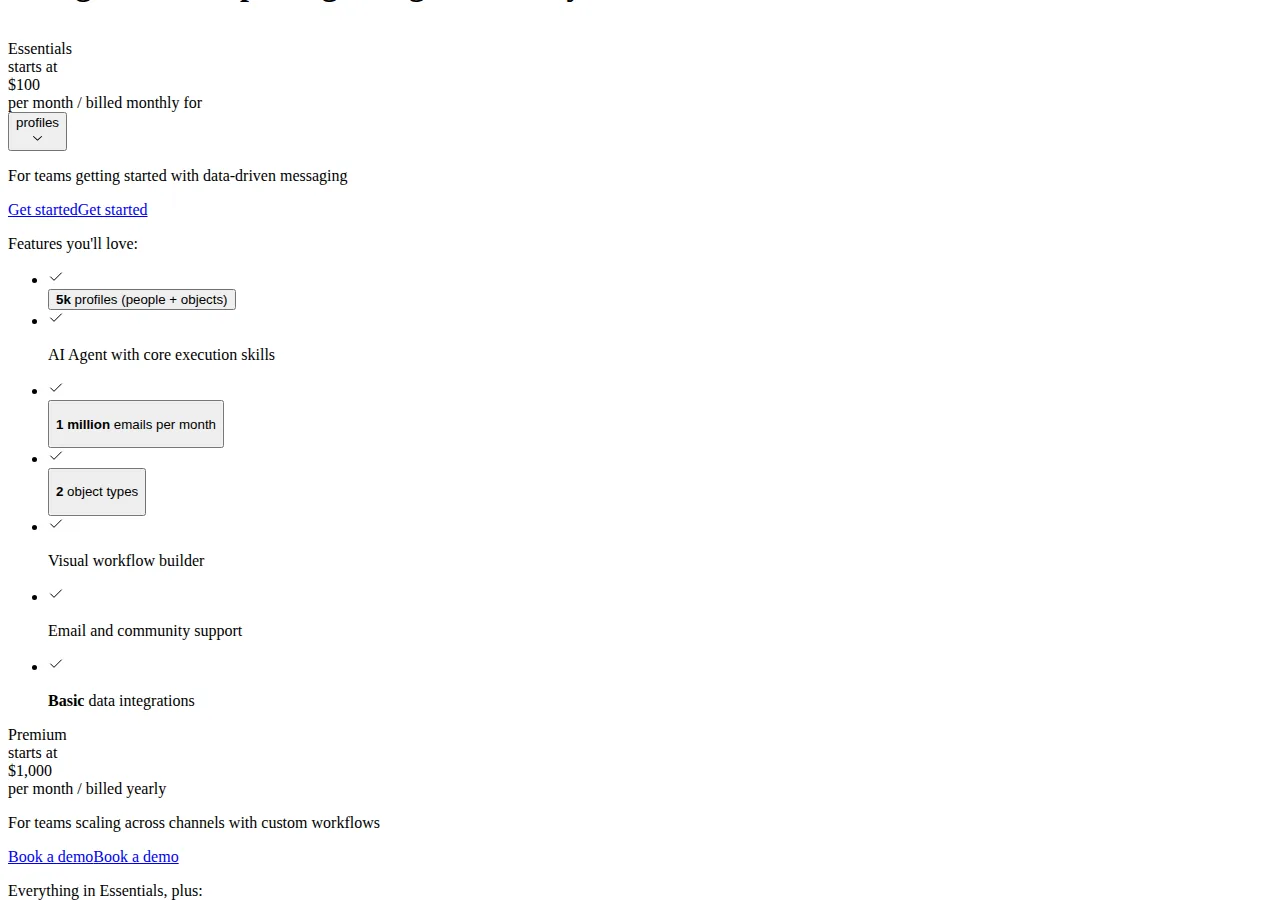
The overage rates are the reason Customer.io is the only vendor whose totals can be computed exactly. Additional profiles cost $0.009 each; additional 1,000 emails cost $0.12; additional AI credits cost $10 per 100,000. The three worked scenarios below use only those published rates — Premium and Enterprise volume pricing is custom, so it is never estimated here.
The M scenario carries the most important sentence in this section: $1,435 per month on Essentials arithmetic is above the $1,000 Premium floor, which means Premium is the quote to get at 100,000 profiles — the Essentials overage math stops being the right price once the base tier is cheaper. The L scenario is a walk-away ceiling, not a price: $11,335 per month is what Essentials arithmetic would charge at a million profiles, and it is the number to carry into the Enterprise negotiation as the maximum the published math can justify. AI credits follow the same arithmetic — one million AI credits cost $100:
The Startup Program is the other published number that matters: up to 12 months free for companies that raised under $10 million. It is the only free entry point among the three vendors, and it is the reason a funded startup should start its evaluation at Customer.io even if it ends at Braze.
Braze: four editions, two meters, no dollars
Braze's pricing page, read in full on November 16, 2026, publishes four cumulative editions. Go is the early-stage core. Select adds orchestration, security, and user provisioning. Pro adds predictive AI, AI personalized recommendations, expanded dashboard user group administration, and message prioritization. Enterprise adds enterprise orchestration, infrastructure, and governance, plus advanced experimentation with the BrazeAI Agent Console. The editions stack — every higher edition includes everything below it — so the edition question is which capability unlocks the feature you need, not which feature list is longest.
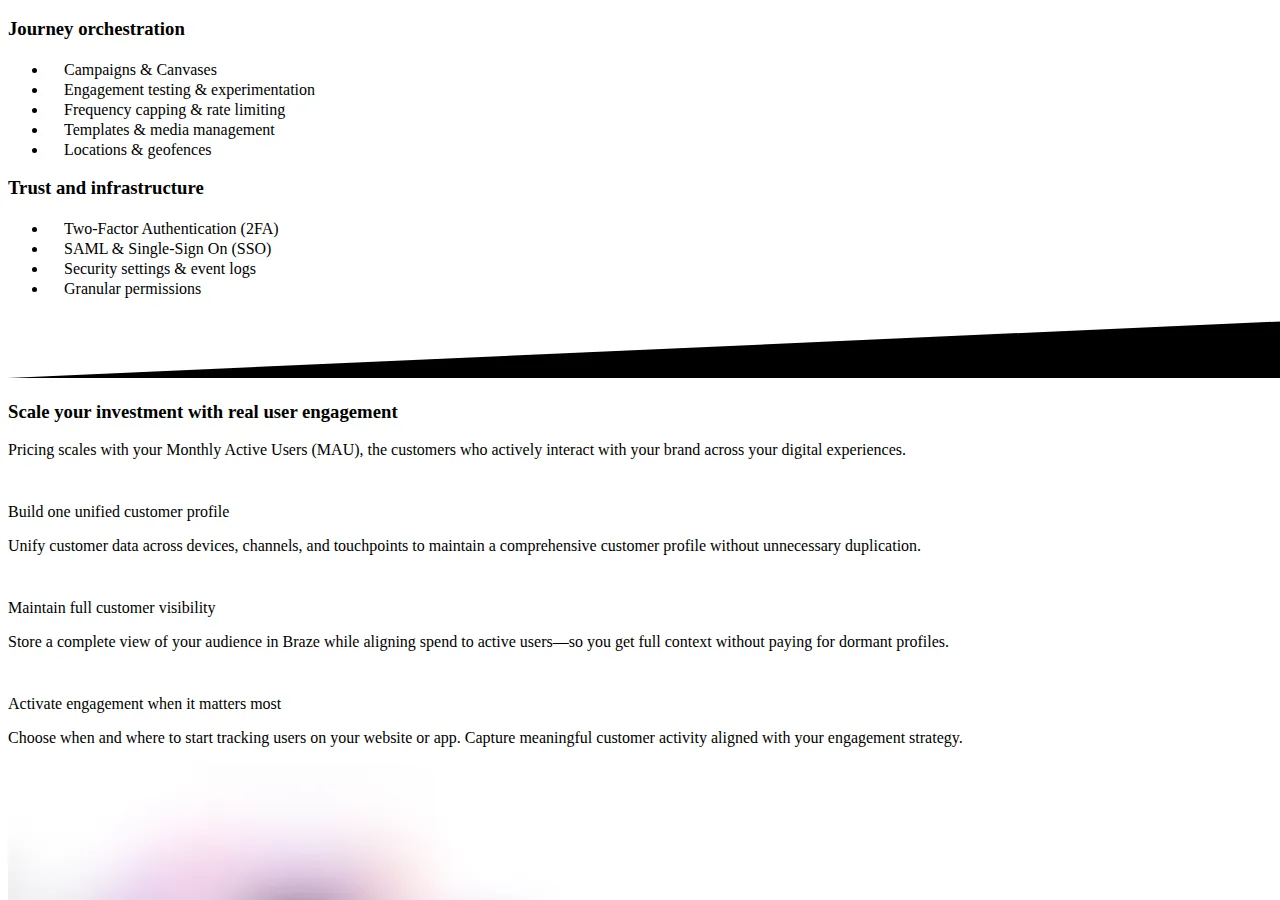
The MAU is defined on the page: a unique person who records a session on a Braze-connected app or website in a calendar month. The buyer chooses whether anonymous visitors count toward the total — a choice that can double the counted population for a content site with heavy anonymous traffic, so it belongs in the contract, not in a sales email. Every MAU includes a large allotment of User Profiles, and the contract is composed of edition plus MAU/Profiles plus an Action Credits allotment plus CX Services plus add-on SKUs. There is no free plan; trials and startup programs are available, with terms unpublished.
Action Credits are the second meter, and the only place Braze publishes per-channel rates. A single flexible currency buys messages across email, SMS, MMS, RCS, WhatsApp, LINE, KakaoTalk, Content Cards, Banners, Message Archiving, Audience Sync, Webhooks, the BrazeAI Agent Console, and Decisioning Studio Go. SMS costs 1 credit per message; WhatsApp costs 5 credits per message. The ratio is the procurement fact:
A WhatsApp-heavy mix burns five times the credits of an SMS-heavy mix at the same volume, so the channel mix you commit to in the contract is worth more than the per-credit price you negotiate. Braze's scale claims on the page — 2,200-plus leaders and 6 billion-plus data points at the 2026 Global CER, 750-plus brands, and a 4,500-plus marketer Bonfire community — are the vendor's social proof, not pricing, and they are printed here as the vendor's claims, not as verified facts.
Iterable: quote-only, with Vendr's estimates as the only public numbers
Iterable's pricing page, fetched November 16, 2026, serves the marketing homepage: no prices, no tiers, no plan names — only "Book a demo" and "Contact Sales". The page describes the platform — AI customer engagement with the Nova layer for insights, agents, and decisioning, across email, SMS, push, in-app, journeys, audiences, catalog, and analytics — and it prints two customer claims: Stanley Black & Decker reports a 7% e-commerce click increase and 80% fewer email templates, and ClickUp reports a 9% net dollar retention increase and a 5% reactivation boost. Those are the vendor's customer claims, printed as claims.
The only public dollar figures for Iterable come from Vendr, which aggregates anonymized buyer transactions. Vendr lists three tiers — Growth, Premier, Enterprise — priced on MAU and quote-only. Growth typically runs $3,000–$5,000 per month for 10,000–50,000 MAU (Vendr also states $3,000–$6,000 for the same band in another section of the same page); Premier often runs $6,000–$15,000 or more per month; Enterprise is custom, frequently $20,000 or more per month. These are estimates from other buyers' transactions, not Iterable figures, and they are printed here only with that attribution and this warning: they are a negotiation starting point, never a quote.
| Vendor | Entry point | 10K profiles / MAU | 100K profiles / MAU | 1M profiles / MAU | Authority |
|---|---|---|---|---|---|
| Customer.io | $100/mo (Essentials, published) | $145/mo (arithmetic) | $1,435/mo on Essentials math — get the Premium quote | $11,335/mo ceiling — negotiate Enterprise | Customer.io pricing page |
| Braze | No dollars published | Quote — MAU + credits | Quote — MAU + credits | Quote — MAU + credits | Braze pricing page |
| Iterable | No dollars published | ~$3,000–$5,000/mo (Vendr estimate) | ~$6,000–$15,000+/mo (Vendr estimate) | Custom, frequently $20,000+/mo (Vendr estimate) | Vendr, not Iterable |
The comparison the table forces is the honest one: Customer.io is the only vendor whose price can be verified before the first sales call, and the only vendor whose overage rates let you compute the renewal before you sign. Braze and Iterable both require a quote, and the quote is where the negotiation happens — which is why the procurement checklist below matters more for them than for Customer.io.
Who should pick what
A funded startup with under $10 million raised and under 10,000 profiles should start at Customer.io: the Startup Program gives up to 12 months free, and the $145 monthly total at 10,000 profiles is exact and small. A mid-market SaaS team sending most of its volume by email and SMS, with no WhatsApp strategy and no mobile app to drive MAUs, should stay on Customer.io past the startup stage: the published overage rates make the renewal predictable, and the Premium floor is $1,000 a month. A product company with a mobile app, heavy push and in-app traffic, and a WhatsApp strategy should evaluate Braze first — its editions and credits are built for that shape — but should negotiate the Action Credits allotment against the channel mix, not against the MAU count alone. An enterprise with a large MAU base and a dedicated lifecycle team should get both Braze and Iterable quotes and compare the full line-item contracts, because Vendr's estimates put Iterable's Growth band near $3,000–$5,000 per month while Braze publishes no band at all. Our Mailchimp vs Klaviyo vs ActiveCampaign automation comparison covers the automation ceilings inside the ESP layer, and our HubSpot vs Salesforce vs Pipedrive comparison covers the CRM layer these platforms sit beside.
Founder & CEO Insight — Enow A. Jovial
Operator boundaries
Three limits bind this playbook. First, the Customer.io totals are arithmetic on published rates, not quotes — the Premium and Enterprise volume prices are custom, and the M and L scenarios are ceilings and negotiation anchors, not prices. Second, the Braze credit math uses the only two per-channel rates Braze publishes; every other channel's credit cost is unpublished and must be quoted. Third, the Iterable figures are Vendr estimates from anonymized transactions, not Iterable prices — they will be wrong for any specific buyer, and they are useful only as a starting range for the first conversation. Run the totals for your own volumes through the pricing calculator before the first sales call, and keep the quote request in writing so the renewal has a baseline to measure against.
Execution checklist
- [x] Step 1: Count your profiles: people plus objects in every workspace; that number is the Customer.io bill.
- [x] Step 2: Count your MAUs twice: once with anonymous visitors, once without; the difference is the Braze and Iterable negotiation.
- [x] Step 3: Count messages by channel: SMS, WhatsApp, push, in-app, email; the channel mix decides the Braze credit burn.
- [x] Step 4: Run the Customer.io arithmetic: $100 base, $0.009 per extra profile, $0.12 per extra 1,000 emails; check whether the total is above the $1,000 Premium floor.
- [x] Get the full line-item quote: edition, MAU/Profiles, Action Credits allotment, CX Services, add-on SKUs — every line, in writing.
- [x] Check the startup programs: Customer.io up to 12 months free if raised under $10 million; Braze trials and startup programs exist with unpublished terms.
- [x] Put the anonymous-visitor choice in the contract: for Braze, the buyer chooses whether anonymous visitors count toward MAU — get it stated, not implied.
- [x] Set the renewal baseline: keep the first quote and the volumes it was built on, so the renewal has a number to measure against.