The per-seat meter decides the CRM, not the logo on the login screen
HubSpot, Salesforce, and Pipedrive all sell the same promise — every deal, contact, and follow-up in one place — and all three price it per seat per month. The invoice, however, moves in opposite directions as the team grows. At five seats, HubSpot's free tier costs nothing and Salesforce's Starter Suite costs $125 a month. At one hundred seats, the cheapest paid mid-tier is Pipedrive Premium at $5,900 a month, while Salesforce Core costs $19,500. The vendor that wins a five-person team can be the most expensive choice for a hundred-person team, and the only way to see that coming is to run all three price lists against the same seat counts before signing.
This guide uses the vendors' own published pages as read in November 2026: HubSpot's Sales Hub product page, Salesforce's Sales Pricing page, and Pipedrive's pricing page. Where a page quotes a "starts at" figure or a limited-time discount, this guide says so, because a comparison built on a promotional figure and presented as a list price is a comparison built to mislead.
> [!KEY TAKEAWAY]
> Per-seat price, not the feature list, is the first decision. At 25 seats, Pipedrive Premium costs $1,475 a month, HubSpot Professional costs $2,500, and Salesforce Core costs $4,875 — the same team, three invoices, a $3,400 monthly spread before any add-on. Features decide between close-priced tiers; the meter decides between vendors.
Who this guide is for, and who should stop here
This guide is for founders, revenue leaders, and operations owners choosing a CRM for a sales team of roughly five to one hundred seats, paying list price in US dollars. It compares published tiers and per-seat math, not negotiated enterprise contracts, and it treats implementation, migration, and training as a second bill that the per-seat figure never shows.
Stop here and get a quote instead if you need contractual uptime terms, single sign-on and advanced security governance, or a data-residency commitment: those live in Salesforce's Advanced and Max tiers and in negotiated HubSpot Enterprise terms, and no list-price table prices them. Stop here too if you are a solo operator: all three vendors offer a free starting point or a cheap entry tier, and the per-seat math below matters only once the second hire arrives.
The three price lists, side by side
HubSpot's Sales Hub product page lists four tiers. Free costs $0 a month and covers deal tracking, live chat engagement, and meeting scheduling. Starter shows $20 per seat per month, with a $10 starting figure tied to a limited-time discount for new customers on the same page. Professional starts at $100 per seat per month, with sales workflows and sequences, prospecting tools, and call recording and transcription. Enterprise starts at $150 per seat per month, with custom objects, complex pipeline management, and advanced analytics and reporting. The page notes that prices are in US dollars, subject to applicable tax, and that detailed packaging limits live on the pricing page — which is why this guide treats HubSpot's figures as "starts at" figures, not as a guaranteed total.
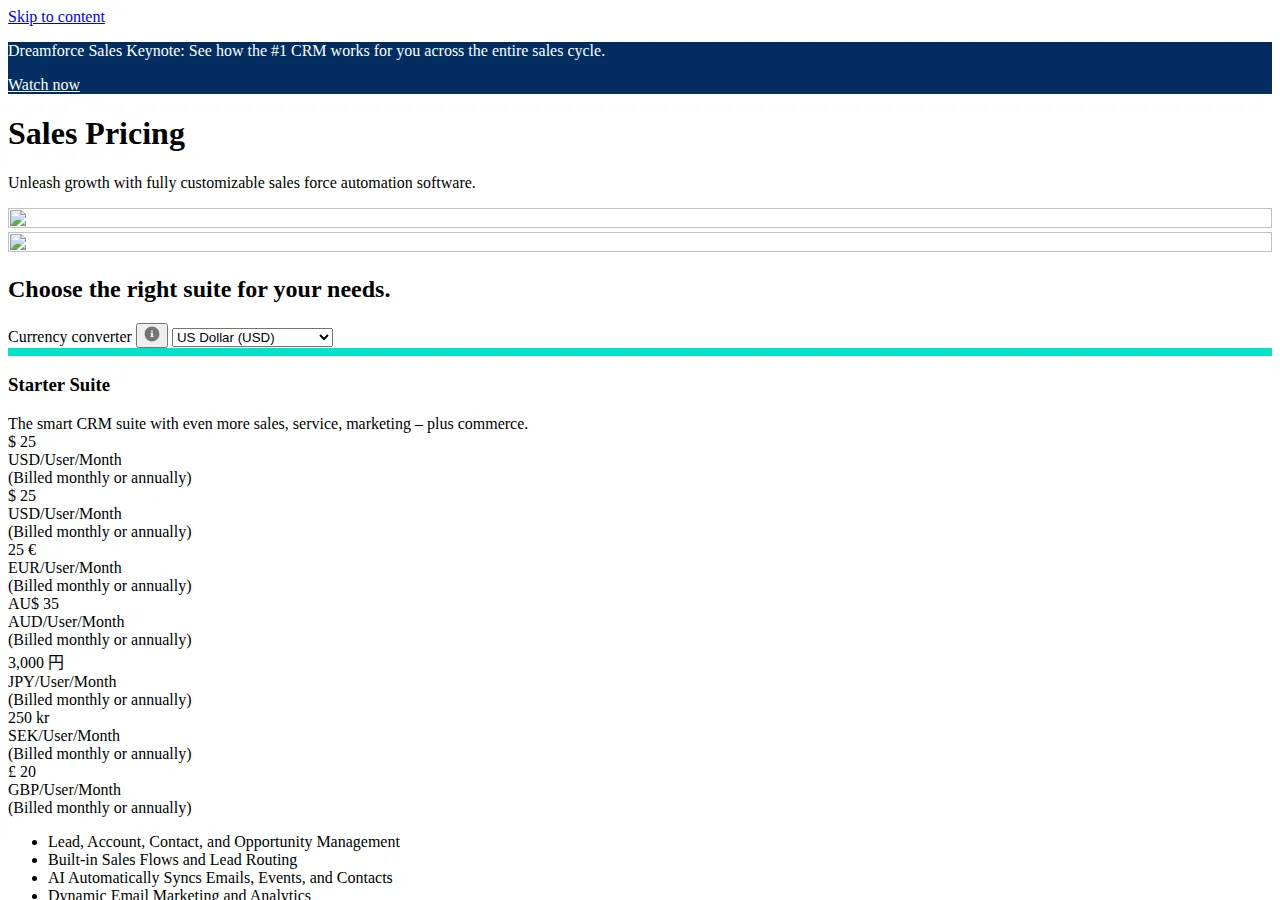
Salesforce's Sales Pricing page lists five suites. Starter Suite costs $25 per user per month, billed monthly or annually, and covers lead, account, contact, and opportunity management with built-in sales flows and lead routing. Pro Suite costs $100 per user per month, billed annually, adding more automation and customization across sales, service, marketing, and commerce. Core costs $195 per user per month, billed annually, adding built-in AI, Slack, Tableau, and Agentforce skills. Advanced costs $395 per user per month, billed annually, adding enhanced security and agents. Max costs $550 per user per month, billed annually, as the most complete sales platform. The page states that it is provided for information purposes and is subject to change, and that AI can be added to Core and above — so Core is the honest baseline for an AI-assisted Salesforce team, not Starter.
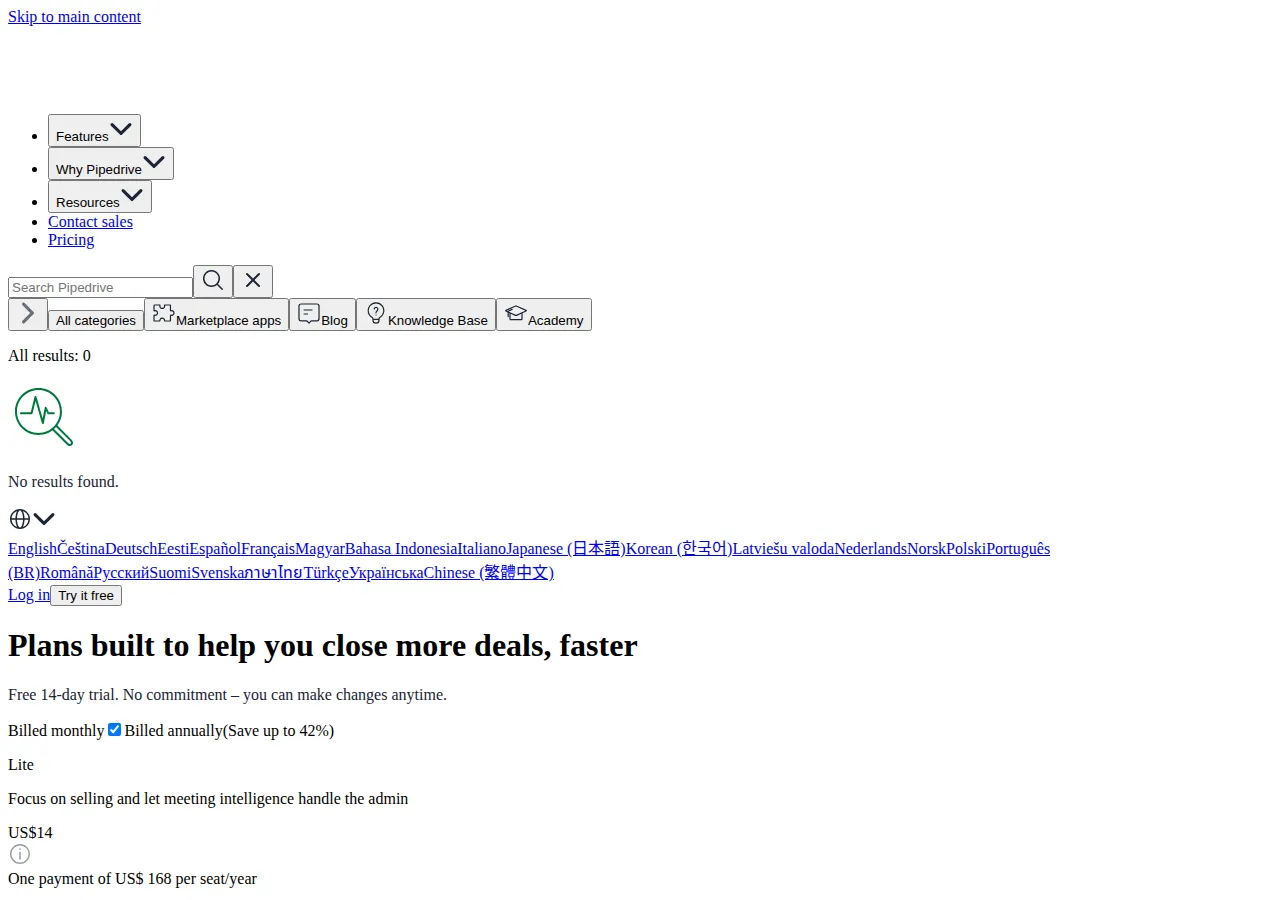
Pipedrive's pricing page lists four tiers, billed annually, with a "save up to 42 percent" note against monthly billing. Lite costs $14 per seat per month, focused on selling with meeting intelligence handling administration, at one payment of $168 per seat per year. Growth costs $39 per seat per month, automating emails and follow-ups. Premium costs $59 per seat per month, the most popular tier, with full-cycle sales tools from lead to close. Ultimate costs $79 per seat per month, with the complete suite of capabilities. Pipedrive's ladder is the narrowest of the three — $14 to $79 — and that narrowness is its pricing strategy: no $150-plus enterprise tier exists to graduate into.
| Attribute | HubSpot Sales Hub | Salesforce Sales Cloud | Pipedrive | Authority |
| :--- | :--- | :--- | :--- | :--- |
| Entry tier | Free, $0 | Starter Suite, $25 per user per month | Lite, $14 per seat per month | Vendor pricing pages, November 2026 |
| Mid tier | Professional, from $100 per seat per month | Core, $195 per user per month | Premium, $59 per seat per month | Vendor pricing pages, November 2026 |
| Top tier | Enterprise, from $150 per seat per month | Max, $550 per user per month | Ultimate, $79 per seat per month | Vendor pricing pages, November 2026 |
| Billing | Monthly; annual terms on the pricing page | Starter monthly or annual; others annual | Annual (save up to 42 percent vs monthly) | Vendor pricing pages, November 2026 |
| Price spread, low to high | $0 to $150 | $25 to $550 | $14 to $79 | Vendor pricing pages, November 2026 |
Worked math: the same team on all three meters
One formula runs every row below, because all three vendors charge per seat:
$
\text{Monthly CRM Cost} = \text{Seats} \times \text{Per-Seat Monthly Price}
$
$
\text{Annual CRM Cost} = \text{Monthly CRM Cost} \times 12
$
At 5 seats, the monthly totals are: Pipedrive Lite $70, Growth $195, Premium $295, Ultimate $395; HubSpot Free $0, Starter $100, Professional $500, Enterprise $750; Salesforce Starter Suite $125, Pro Suite $500, Core $975, Advanced $1,975, Max $2,750. A five-person team comparing mid-tiers faces $295 against $500 against $975 — Pipedrive Premium undercuts HubSpot Professional by $205 a month and Salesforce Core by $680, before any discount negotiation.
At 25 seats, the monthly totals are: Pipedrive Lite $350, Growth $975, Premium $1,475, Ultimate $1,975; HubSpot Free $0, Starter $500, Professional $2,500, Enterprise $3,750; Salesforce Starter Suite $625, Pro Suite $2,500, Core $4,875, Advanced $9,875, Max $13,750. Two facts jump out. First, HubSpot Professional and Salesforce Pro Suite tie at exactly $2,500 — the tie-breaker between them is features and ecosystem, not price. Second, Pipedrive Premium at $1,475 is $1,025 a month cheaper than either, which compounds to $12,300 a year. Annualized, 25 seats cost $17,700 on Pipedrive Premium, $30,000 on HubSpot Professional, and $58,500 on Salesforce Core.
At 100 seats, the monthly totals are: Pipedrive Lite $1,400, Growth $3,900, Premium $5,900, Ultimate $7,900; HubSpot Free $0, Starter $2,000, Professional $10,000, Enterprise $15,000; Salesforce Starter Suite $2,500, Pro Suite $10,000, Core $19,500, Advanced $39,500, Max $55,000. The ranking flips at the top: HubSpot Enterprise at $15,000 undercuts Salesforce Core at $19,500 by $4,500 a month, while Pipedrive Ultimate at $7,900 costs less than half of either. A hundred-seat team that picked Salesforce at five seats for its $25 entry price and never re-ran the math is paying Core's $19,500 against Pipedrive's $7,900 for the same headcount — a $139,200 annual gap that no feature list should be allowed to hide.
The crossover points are worth naming. Between HubSpot Professional and Salesforce Core, there is no crossover: Core costs nearly double Professional at every seat count ($195 versus $100), so a team choosing Core is paying for Salesforce's platform depth, Slack and Tableau bundling, and Agentforce skills, not for a cheaper seat. Between Pipedrive Ultimate and HubSpot Enterprise, there is no crossover either: $79 versus $150 holds at every seat count. The only true tie in the table is HubSpot Professional versus Salesforce Pro Suite at $100, and that tie is where feature trials, not spreadsheets, should decide.
Automation ceilings: what each tier actually lets you automate
Price without a ceiling comparison misleads in the other direction: the cheapest tier that cannot run your workflow is the most expensive mistake. HubSpot's ladder gates automation by tier: Starter automates personalized outreach and meeting scheduling with reporting on outcomes; Professional adds customizable sales workflows and sequences with call recording and transcription; Enterprise adds custom objects and advanced analytics for complex pipelines. A team whose workflow needs custom objects cannot buy its way there on Professional at any seat count.
Salesforce's ladder gates by platform depth: Starter covers core opportunity management with built-in flows and lead routing; Pro Suite adds automation and customization across sales, service, marketing, and commerce; Core adds AI, Slack, Tableau, and Agentforce skills; Advanced adds enhanced security and agents; Max unites AI, CRM, and data. A team buying Salesforce for Agentforce must budget at least Core, and a team needing enhanced security must budget Advanced — the $25 Starter price is not an AI price.
Pipedrive's ladder gates by sales-cycle coverage: Lite focuses on selling with meeting intelligence handling administration; Growth automates emails and follow-ups; Premium adds full-cycle tools from lead to close; Ultimate adds the complete suite. Pipedrive never claims a platform play — no service cloud, no marketing cloud, no Tableau equivalent — and its $79 ceiling is the price of that honesty. A team that later needs service or marketing automation will buy a second system, and that second subscription belongs in the comparison too.
| Team shape | Best-priced honest tier | Monthly cost at 25 seats | Why it fits, and where it breaks |
| :--- | :--- | :--- | :--- |
| Solo to 5 seats, simple pipeline | Pipedrive Lite or HubSpot Free | $350 or $0 | Cheapest honest start; breaks when sequences or custom objects are needed |
| 5 to 25 seats, outbound motion | Pipedrive Premium | $1,475 | Full-cycle tools at the lowest mid-tier price; breaks on platform depth |
| 25 to 100 seats, marketing + sales in one system | HubSpot Professional or Enterprise | $2,500 or $3,750 | Workflows, sequences, and custom objects in one system; breaks on advanced security governance |
| 100 seats, platform consolidation | Salesforce Core or Advanced | $4,875 or $9,875 | AI, Slack, Tableau, and agents in one platform; breaks any budget that prices seats alone |
| Agency managing many small clients | HubSpot Free plus Starter, or Pipedrive Lite | $0 to $500 | Per-client pipelines without per-client enterprise fees; see our agency comparison |
The second bill: seats you pay for but nobody uses
Per-seat pricing has a failure mode no tier table shows: dormant seats. A team of 25 that hires 30 and forgets to remove five departed reps pays for 30 seats on every vendor here, because all three meters count seats, not active users. At Salesforce Core rates, five dormant seats cost $975 a month, or $11,700 a year, for logins nobody opens. At Pipedrive Premium rates, the same five seats cost $295 a month. The discipline is boring and therefore skipped: a monthly seat audit tied to the HR departure checklist, with the CRM admin removing access the same week employment ends. Put the audit on the calendar the day the contract is signed, not the day the renewal invoice arrives.
> [!WARNING]
> Never sign a per-seat CRM contract on a promotional figure. HubSpot's Starter page shows a $10 starting figure beside its $20 per-seat list price, tied to a limited-time new-customer discount, and Salesforce's page states its prices are subject to change. Budget the list price, treat any discount as temporary, and get the renewal price in writing before the first term ends. A team that budgets the discount and renews at list price has not saved money; it has scheduled a price shock.
Execution checklist
For the two-vendor agency view that this three-way comparison extends, see our HubSpot vs Pipedrive for agencies, and for the lead-scoring automation that sits on top of whichever CRM wins, see our AI lead scoring and CRM integration guide. Before committing, test the winning tier's ceiling in a trial with your real pipeline, and run the final seat-count total through the pricing calculator with implementation and training added as line items, not absorbed into hope.
> [!TIP]
> Trial the tier above the one you plan to buy, then buy the tier below it if the trial never touches the higher tier's features. Teams routinely buy Professional or Core for one feature they use twice, then pay for it on every seat for a year. The trial is the cheapest experiment in the whole purchase; use it to prove the ceiling, not to admire the interface.
> [!FOUNDER]
> "A CRM invoice is a headcount tax, and headcount only grows. The founders who keep it small are the ones who re-run the per-seat math every time the team grows by ten, not the ones who negotiated hardest on day one. Day-one price is a photograph; seat-count math is the film."
> — Enow A. Jovial, Founder & Chief Executive Officer