Crypto Tax Reporting Playbook: Form 8949, Schedule D, and the 1099-DA
Crypto Tax Reporting Playbook: Form 8949, Schedule D, and the 1099-DA
Selling crypto, swapping one coin for another, or paying for dinner with it are all the same event to the IRS: a disposition of property. There is no de minimis exception and no "the exchange never sent me a form" defense. Form 8949 reports each disposition, Schedule D nets them, and since 2025 the broker reports the sale on Form 1099-DA. Keep no records and you pay tax on the broker's numbers, which are usually worse.
IRS Notice 2014-21 treats virtual currency as property, and the general tax principles for property transactions apply to it.
The property rule and the gain formula
Section 1001(a): the gain from the sale or other disposition of property is the excess of the amount realized over the adjusted basis, and the loss is the reverse. Section 1012(a) sets the starting basis at cost. The IRS digital-asset FAQ restates the same position for a sale for U.S. dollars.
Character turns on whether the asset is a capital asset: section 1221 defines capital assets broadly, and section 1222 draws the line at one year. Notice 2014-21, Q-7: a taxpayer generally realizes capital gain or loss on the sale of virtual currency that is a capital asset, and ordinary gain or loss on virtual currency that is not.
Every individual return asks the digital-asset question: "At any time during the tax year, did you: (a) receive (as a reward, award or payment for property or services); or (b) sell, exchange, or otherwise dispose of a digital asset (or a financial interest in a digital asset)?" Merely holding crypto is a "No."
What counts as a disposition: the decision table
| Transaction | Tax treatment | Authority |
|---|---|---|
| Sell crypto for U.S. dollars | Capital gain or loss on Form 8949 | 26 U.S.C. § 1001; Notice 2014-21, Q-6 |
| Swap one crypto for another | Disposition of the first asset at fair market value | Notice 2014-21, Q-6 |
| Receive crypto as pay for work | Ordinary income at fair market value; basis equals that value | Notice 2014-21, Q-3, Q-4 |
| Mine crypto | Gross income at fair market value on receipt; SE tax if a trade or business | Notice 2014-21, Q-8, Q-9 |
| Stake and receive rewards | Gross income at fair market value when dominion and control is gained | Rev. Rul. 2023-14 |
| Airdrop of new units after a hard fork | Ordinary income under section 61 at fair market value | Rev. Rul. 2019-24, Holding (2) |
A crypto-for-crypto swap is a sale: exchanging Bitcoin for Ether is treated as selling the Bitcoin for its dollar value and buying Ether with the proceeds. Paying for goods with crypto is a sale the same way. Moving coins between your own wallets is not a sale — but the receiving broker has no record of what you paid.
Cost basis: FIFO is the default, specific identification is the election
Basis is the number the whole return turns on. Section 1012(a) says basis is cost, and section 6045(g)(3)(B) says that for a covered security, basis is determined under the first-in, first-out method unless the customer notifies the broker by means of an adequate identification of the units sold.
From January 1, 2025, specific identification is done wallet by wallet: the units identified must be the units in the wallet the sale was made from, recorded no later than the sale. Revenue Procedure 2024-28 gave a one-time safe harbor to allocate unused basis per wallet as of January 1, 2025.
Stated example: a taxpayer buys 1 BTC for 30,000 dollars in January 2024 and 1 BTC for 60,000 dollars in June 2024, then sells 1 BTC for 70,000 dollars in March 2025:
The January lot was held over a year, so the FIFO gain is long-term; the June lot under a year, so the specific-identification gain is short-term. One election changes both amount and character, so identify before the sale.
Form 8949: the boxes, the columns, and the covered-security line
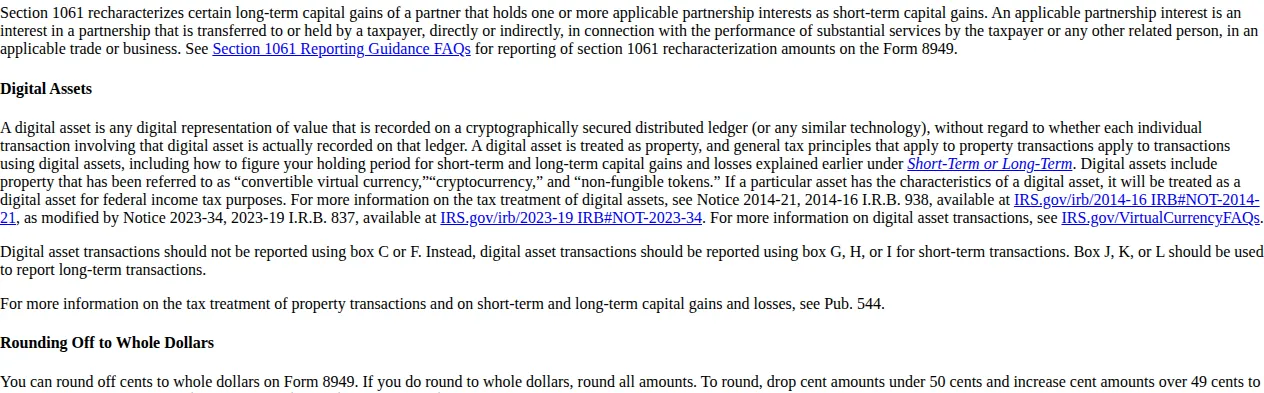
Form 8949 lists each disposition. The Instructions for Form 8949 (2025) give digital assets their own boxes: short-term transactions go in boxes G, H, or I, long-term in boxes J, K, or L — never box C or F, the boxes for other property. Column (a) takes the description — symbol, exact units, and transaction ID if available; column (b) the acquisition date, or "VARIOUS"; column (d) the proceeds; column (e) the basis; columns (f) and (g) any adjustment.
A digital asset acquired after 2025 is a covered security: the broker reports its basis in box 1g of Form 1099-DA, with the taxpayer entering that basis and adjusting it with columns (f) and (g) if wrong; if box 9 is checked, the basis comes from the taxpayer's own records.
Schedule D: netting, the 3,000 dollar limit, and the carryforward
Schedule D nets the Form 8949 totals — short-term against short-term, long-term against long-term, then the two nets combine. Stated year: short-term gains 40,000 dollars, losses 15,000 dollars; long-term gains 12,000 dollars, losses 20,000 dollars.
If the year ends in a net capital loss, section 1211(b) caps the deduction against other income at 3,000 dollars (1,500 dollars married filing separately). On a stated net loss of 8,000 dollars, 3,000 dollars is deductible this year and 5,000 dollars carries forward, keeping its character — but only if tracked year to year on the Schedule D worksheet.
Income first, gain second: mining, staking, and airdrops
Notice 2014-21, Q-8: when a taxpayer successfully mines virtual currency, the fair market value of the currency as of the date of receipt is includible in gross income. Q-9: if the mining is a trade or business and the miner is not an employee, the net earnings are self-employment income. Stated example: 0.1 BTC mined when Bitcoin is worth 95,000 dollars is 9,500 dollars of gross income and the basis in that 0.1 BTC; a later sale for 11,000 dollars produces a 1,500 dollar gain.
Revenue Ruling 2023-14 holds that a cash-method taxpayer who stakes cryptocurrency native to a proof-of-stake blockchain includes the fair market value of validation rewards in gross income when the taxpayer gains dominion and control over them. Stated example: 0.5 ETH of rewards when ETH is worth 3,200 dollars is 1,600 dollars of ordinary income and the basis in those units; a later sale for 2,000 dollars produces a 400 dollar gain.
Revenue Ruling 2019-24 holds that a hard fork alone produces no gross income if no new units are received, but an airdrop of new units following a hard fork produces ordinary income under section 61. Stated example: 500 units airdropped at 2 dollars each is 1,000 dollars of ordinary income and the basis in those units.
The 1099-DA rollout: what the broker reports, and when
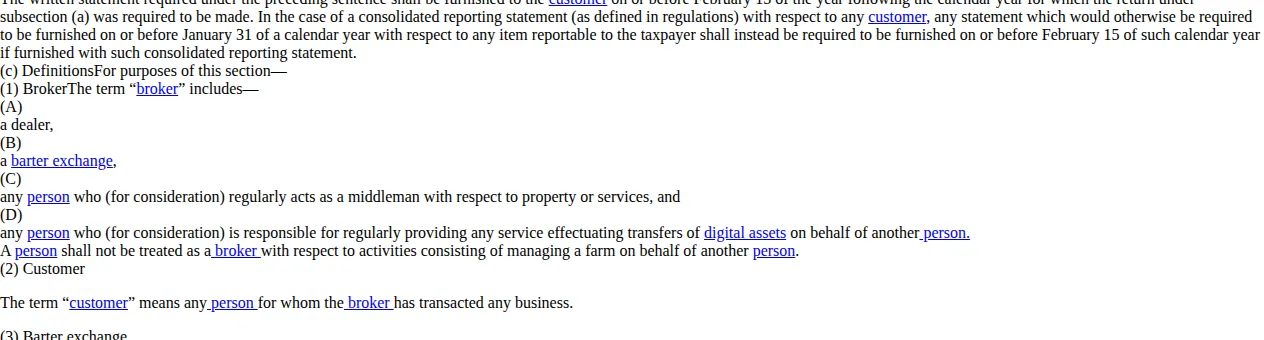
The Infrastructure Investment and Jobs Act, section 80603, amended section 6045 in 2021 to cover digital assets expressly: section 6045(c)(1) now defines a broker to include any person who, for consideration, regularly provides any service effectuating transfers of digital assets on behalf of another person. Treasury Decision 10000 (July 9, 2024) wrote the operating rules; broker reporting began with transactions on or after January 1, 2025.
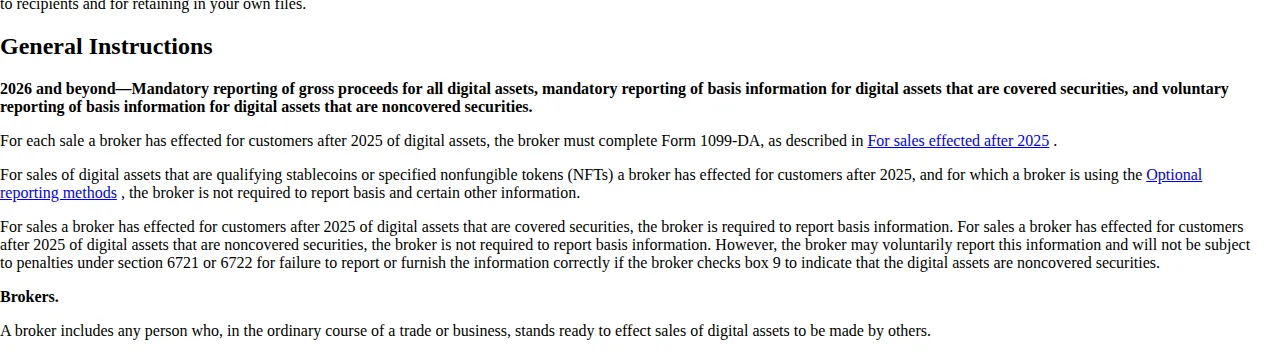
The rollout is phased. For sales in 2025, brokers had to report gross proceeds, while basis reporting was voluntary. For sales after 2025, the Instructions for Form 1099-DA (2026) state the rule: mandatory gross-proceeds reporting for all digital assets, mandatory basis reporting for covered securities, voluntary basis reporting for noncovered securities. A digital asset acquired after 2025 is a covered security, so 2026 is the first tax year most exchange sales arrive with a broker-supplied basis; box 9 marks noncovered securities.
The 1099-DA does not compute the gain. The taxpayer still reconciles it on Form 8949 and still reports sales the broker never saw — peer-to-peer sales, decentralized-exchange swaps, payments received in crypto.
The wash-sale gap: crypto is property, so section 1091 does not reach it
Section 1091(a) disallows a loss from the sale of shares of stock or securities if the taxpayer acquires substantially identical stock or securities within 30 days before or after the sale. Crypto is property under Notice 2014-21, not stock or securities, so section 1091 as written does not disallow a crypto loss on a next-day repurchase.
Take a stated example. A taxpayer buys 2 ETH for 7,000 dollars, sells them for 4,000 dollars, and buys 2 ETH the next day for 4,200 dollars. The loss is 3,000 dollars, and under the statute as written it is recognized now:
The same trade in stock would produce no deductible loss today. No statute in force extends section 1091 to digital assets. One caution: the economic-substance doctrine in section 7701(o) is a general anti-abuse rule, not a crypto wash-sale rule — but a sale with no real economic change and no market risk between sale and repurchase is the fact pattern it would examine first.
Penalties: the accuracy penalty and the information-return penalty
Section 6662(a) imposes an accuracy-related penalty of 20 percent of the portion of an underpayment attributable to negligence, a substantial understatement, or the other listed causes. Section 6662(d)(1)(A) defines a substantial understatement for an individual as an understatement exceeding the greater of 10 percent of the tax required to be shown on the return or 5,000 dollars. Stated example: a return that should have shown 100,000 dollars of tax, with a 12,000 dollar understatement from unreported crypto gains. The threshold is the greater of 10 percent of 100,000 dollars and 5,000 dollars — 10,000 dollars — so the understatement is substantial. Twenty percent of the 12,000 dollar understatement is a 2,400 dollar penalty.
Reasonable cause and good faith remain the defense; complete exchange records with a documented basis method are the evidence for it. Section 6721(a) is the broker-side penalty: 250 dollars per return not filed or filed with incorrect information, capped at 3,000,000 dollars per year — 50 dollars if corrected within 30 days, 100 dollars by August 1. The taxpayer never pays it — but benefits when a broker corrects a wrong 1099-DA before the return is filed.
The filing operation, start to finish
- Pull every exchange and wallet record: trade histories, staking logs, mining payouts, airdrop receipts, and the CSV exports behind them.
- Assign a basis method before computing anything: FIFO by default, or specific identification recorded lot by lot, no later than each sale.
- Report each disposition on Form 8949 — boxes G, H, or I short-term, J, K, or L long-term — with the symbol, the exact units, and "VARIOUS" where dates vary.
- Reconcile every Form 1099-DA against your ledger: match proceeds, check the basis in box 1g, and correct a wrong broker basis through columns (f) and (g).
- Net the totals on Schedule D, apply the 3,000 dollar loss limit, and carry any excess loss forward — then save that worksheet for next year.
- Report mining, staking, and airdrop income at the fair market value on receipt, and set the basis of those units to the same figure.
Keep the trade history as a CSV export, the PDF of every Form 1099-DA, and the wallet addresses and transaction IDs. Your SSN or ITIN goes on the Form 1040, the broker files under its EIN, and a miner through an LLC taxed as an S-Corp reports mining income on the entity return, with the SE tax analysis under FICA and SECA shifting with the structure — a question for your CPA.
Founder & CEO Insight — Enow A. Jovial
The tax-loss-harvesting-wash-sale-capital-gains-playbook works the harvesting strategy that uses the crypto wash-sale gap, the IRS Form 1040 Schedule D capital gains playbook covers the netting operation, and the IRS Form 1099-K payment app reporting threshold playbook covers the payment-app reporting often confused with broker reporting. Run the finished numbers through the tax estimator before the return is prepared.