The 529 College Savings Playbook: Contribution Limits, State Deductions, and the $35,000 Roth IRA Rollover
A 529 plan is the only savings account in the tax code that does three jobs at once: it moves money out of a donor's estate, it grows tax-free, and — since SECURE 2.0 — it has an exit that does not depend on anyone going to college. One statute, 26 U.S.C. section 529, governs it, and the operation reduces to five numbers: $19,000, $95,000, $20,000, $10,000, and $35,000.
What a 529 is, in statute terms
Section 529(b)(1) defines a qualified tuition program as a program established and maintained by a state, or an agency or instrumentality of a state, that lets a contributor prepay a beneficiary's qualified higher education expenses, or contribute to an account for paying those expenses.
Two kinds exist: a prepaid tuition plan that locks in today's tuition, and a college savings plan — portable between states and the only kind that carries the Roth IRA rollover.
The owner, not the beneficiary, controls the account: the investments, the timing of distributions, and the right to change the beneficiary to another family member without tax. There are no income restrictions on contributors, and a family may contribute to both a 529 plan and a Coverdell ESA in the same year. There is no annual federal cap: contributions cannot exceed the amount necessary to provide for the beneficiary's qualified education expenses. The real constraint is the gift tax.
The contribution operation: $19,000 and the $95,000 superfund
Every dollar contributed to a 529 plan is a gift to the beneficiary. For 2026 the annual exclusion is $19,000 per donor per beneficiary, set by Rev. Proc. 2025-32. A grandparent may give $19,000 to each grandchild's plan without filing Form 709; a married couple electing gift splitting may give $38,000 per beneficiary. Above the exclusion a gift-tax return is required, though the $15,000,000 lifetime exemption usually means no tax is owed. Our gift-tax annual exclusion and Form 709 playbook works the filing mechanics in full.
The five-year election in section 529(c)(2)(B) is the funding accelerator: if one year's contributions exceed the annual exclusion, the donor may elect to spread the excess over five years — so a single donor can put $95,000 in at once and treat it as five gifts of $19,000:
The election is made on Form 709. Two traps: the donor uses up five years of annual exclusion for that beneficiary, and section 529(c)(4)(C) pulls the unexpired portion back into the donor's estate if the donor dies first — a grandparent who superfunds $95,000 and dies in year two leaves $57,000 in the estate.
The reason to fund early is compounding: a $95,000 superfund at birth is worth about $271,000 by age 18 at 6 percent, while $500 a month for 18 years puts in $108,000 and ends with about $193,677:
State deductions: where the upfront money is
There is no federal deduction for 529 contributions. The upfront benefit lives at the state level: more than thirty states and the District of Columbia offer a deduction or credit, but most require the contribution to go into that state's own plan. Nine states — Arizona, Arkansas, Kansas, Maine, Minnesota, Missouri, Montana, Ohio, and Pennsylvania — allow a deduction for contributions to any state's plan.
New York is the worked example: a resident contributing to the New York 529 plan may deduct up to $5,000 a year from state taxable income, or $10,000 for a married couple filing jointly — only for contributions to New York's own plan, settled by December 31. At a 6.85 percent marginal state rate, a couple contributing the full $10,000 keeps $685:
Three mechanics matter. The deduction is capped per taxpayer, not per beneficiary. Several states recapture it as state taxable income if the money is later withdrawn for a nonqualified expense or rolled to another state's plan. Run the numbers on the tax estimator before choosing a plan for its deduction.
What the money can pay for — and the $20,000 K-12 change
Section 529(e)(3) covers tuition, fees, books, supplies, and equipment at an eligible postsecondary institution, plus room and board at half-time enrollment or more. Topic 313, updated November 9, 2026, adds four items: registered apprenticeship costs, up to $10,000 in a lifetime of student-loan payments, certain credentialing expenses, and K-12 costs.
The K-12 rule doubled for 2026. Qualified K-12 expenses — tuition, books, tutoring, test fees, dual enrollment, therapies for students with disabilities — are now allowed up to $20,000 per year per beneficiary from all plans combined, up from $10,000 before December 31, 2025.
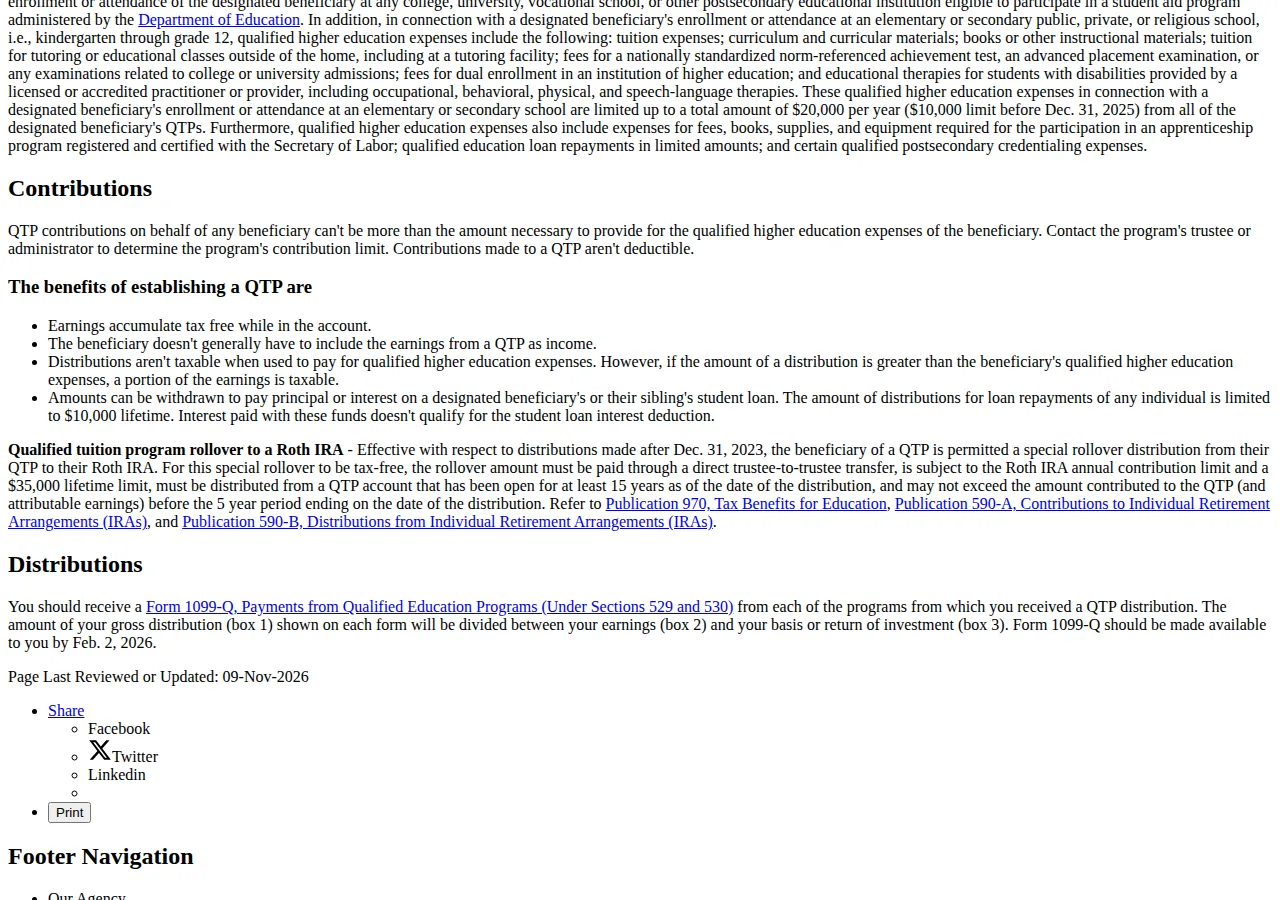
Form 1099-Q reports each distribution — box 1 gross, box 2 earnings, box 3 basis — and must be available by February 2, 2026. Only earnings can be taxed, and only to the extent the distribution exceeds adjusted qualified education expenses (AQEE): qualified expenses less tax-free assistance such as scholarships, Pell grants, veterans' benefits, and employer assistance. Publication 970 gives the formula:
Every 529 transaction leaves a paper trail the IRS can match. The plan reports each distribution on Form 1099-Q, filed with the IRS under the plan's own EIN, with the beneficiary identified by SSN or, for a nonresident beneficiary, ITIN, and the plan's EIN printed on the 1099-Q. Contributions usually move by ACH from the owner's bank account, and the year-end statement shows the basis-and-earnings split the 1099-Q will report. Have a CPA reconcile the 1099-Q against tuition receipts before filing: the earnings portion lands on Schedule 1 only when adjusted qualified expenses fall short.
A worked case: an account holds $27,000 — $18,000 of contributions, $9,000 of earnings. The family withdraws $6,000 when adjusted qualified expenses are $5,000. The earnings inside it are $6,000 × one-third, or $2,000; the tax-free share is $2,000 × $5,000/$6,000 = $1,666.67, leaving $333.33 taxable on Schedule 1, line 8z. On top, the 10 percent additional tax, figured on Part II of Form 5329 and reported on Schedule 2, line 8: a $4,000 taxable slice in the 22 percent bracket costs $880 of income tax plus $400 of additional tax — $1,280 in total.
Two timing rules: a school refund of qualified expenses may be recontributed within 60 days under section 529(c)(3)(D), and a 529-to-529 rollover must complete within 60 days and cannot repeat within 12 months.
The $35,000 Roth IRA rollover: the exit SECURE 2.0 built
Before SECURE 2.0, an overfunded 529 had only bad exits: spend it on education, change the beneficiary, or withdraw it and pay tax plus the 10 percent additional tax. Section 126 of SECURE 2.0, effective for distributions after December 31, 2023, added section 529(c)(3)(E) — a rollover to a Roth IRA, in five conditions that all must hold at once.
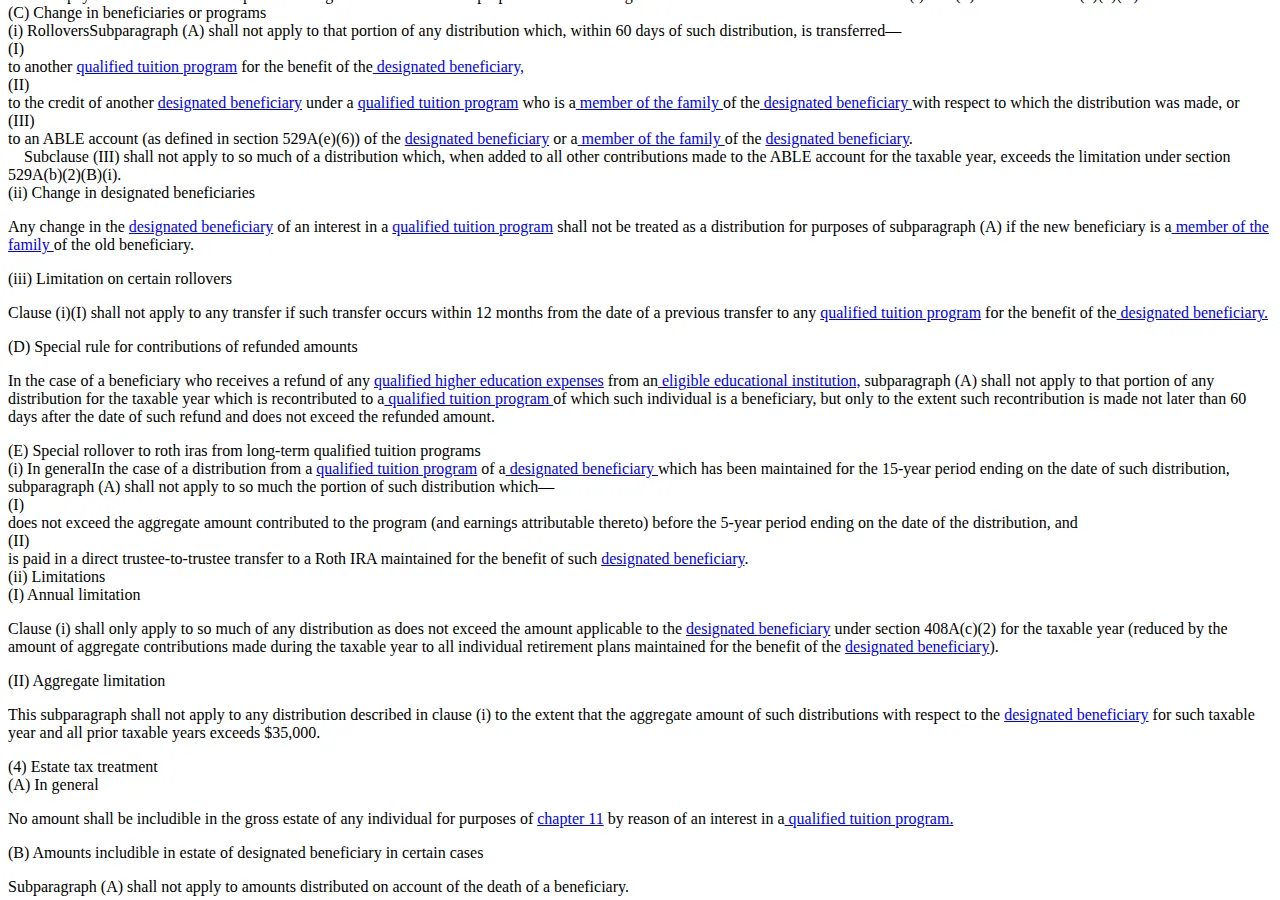
First, the 529 account must have been maintained for the 15-year period ending on the distribution date. Second, only amounts contributed — and earnings on them — before the five-year period ending on that date qualify. Third, the rollover must be a direct trustee-to-trustee transfer to a Roth IRA for the same beneficiary. Fourth, the amount rolled in any year cannot exceed the beneficiary's Roth IRA limit under section 408A(c)(2) for that year, reduced by other IRA contributions that year. Fifth, all such rollovers for the beneficiary cannot exceed $35,000 in total.
For 2026 the IRA limit is $7,500 — $8,600 at age 50 or older — or taxable compensation if less. The beneficiary needs earned income at least equal to the rollover, and any direct IRA contribution that year reduces the rollover room dollar for dollar.

At the 2026 limit, moving the full $35,000 takes five tax years:
The $7,500 limit is inflation-indexed, so in practice the schedule may complete sooner than five years.
The 15-year clock runs from the date the account was opened, and changing the beneficiary may restart it — the IRS has not issued final guidance on that question, so a family planning a rollover should not change beneficiaries late. The five-year seasoning clock means contributions from the final five years never qualify.
Founder & CEO Insight — Enow A. Jovial
529 vs Coverdell vs custodial: the decision table
Three accounts compete for education money. Our Roth IRA vs traditional IRA contribution limits playbook covers the receiving end of the rollover, and our solo 401(k) vs SEP IRA playbook covers the retirement accounts.
| Attribute | 529 plan | Coverdell ESA (§ 530) | Custodial UGMA / UTMA |
|---|---|---|---|
| Annual contribution cap | None; gift-tax exclusion $19,000 per donor (2026) | $2,000 per beneficiary per year | None |
| Contributor income limit | None | Phaseout $95k–$110k single, $190k–$220k joint | None |
| K-12 expenses | Up to $20,000/yr per beneficiary (2026) | All qualified K-12 expenses, no dollar cap | Any purpose, no education restriction |
| Age limit | None | Balance distributed within 30 days of age 30 | Child takes control at age of majority |
| Unused-balance exit | $35,000 Roth IRA rollover; beneficiary change | Beneficiary change; rollover to a 529 | None — it is the child's money |
| Who controls it | Account owner | Responsible individual | Custodian until majority, then the child |
| Authority | § 529; Topic 313; Pub. 970 ch. 8 | § 530; Pub. 970 ch. 7 | State UGMA / UTMA statute |
The Coverdell's $2,000 cap and income phaseout make it a supplement, not a rival.
Financial aid: ownership is the whole game
On the FAFSA, who owns the account matters more than how much is in it. A parent-owned 529 is a parental asset, assessed at most 5.64 percent — with the parent asset protection allowance at $0 for 2026–27; a custodial UGMA or UTMA account is the child's asset, assessed at 20 percent. The same $50,000 raises the Student Aid Index by $2,820 in a parent-owned 529 and $10,000 in a custodial account:
A grandparent-owned 529 plan is not reported as an asset on the FAFSA at all, and since the 2024–25 cycle its distributions are no longer reported as student income.
Who should not open one
A 529 plan is the wrong account in three situations: a family with high-interest debt or no emergency fund should clear those first, since a nonqualified distribution costs income tax plus 10 percent; a family whose child will almost certainly not attend college, an apprenticeship, or a credential program — and whose beneficiary will not have earned income for a Roth rollover — should fund a Roth IRA or a taxable account instead; and a nonresident family with no U.S. state tax liability and no U.S. education plans gains only the federal deferral.
Execution checklists
- [x] Step 1 — Open the plan: fees and investments first, state deduction second; name the owner, the beneficiary, and a successor owner; choose an age-based portfolio.
- [x] Fund it inside the gift-tax lane: $19,000 per donor per beneficiary for 2026; $38,000 with gift splitting; $95,000 single or $190,000 joint under the five-year election, on Form 709.
- [x] Claim the state deduction: use the home-state plan where the deduction requires it; settle by December 31; keep the confirmation; check recapture before rolling to another state.
- [x] Spend it on qualified expenses only: tuition, fees, books, supplies, equipment, half-time room and board, apprenticeship costs, up to $10,000 lifetime of student-loan payments, credentialing expenses, K-12 costs up to $20,000 a year from 2026.
- [x] Withdraw in the same calendar year as the expense: match the distribution year to the expense year, keep every receipt, reconcile Form 1099-Q against qualified expenses before filing.
- [x] Run the Roth rollover only when all five conditions hold: 15-year-old account, pre-five-year money only, direct trustee-to-trustee transfer, annual amount within the $7,500 IRA limit less other IRA contributions, $35,000 lifetime cap — and confirm the beneficiary's earned income covers it.
A 529 plan rewards one behavior above all others: funding it early. The statute gives eighteen years of tax-free compounding, a state deduction, a K-12 lane that doubled for 2026, and a Roth IRA exit for whatever is left.