Gift Tax Annual Exclusion and Form 709 Playbook: 2026 Rules, Gift Splitting, Crummey Powers, and 529 Superfunding
The federal gift tax is a lifetime ledger. Every taxable gift reduces the same 15,000,000 dollar exclusion that shelters an estate at death, and Form 709 is due whether or not tax is owed. The system rewards small, regular moves: 19,000 dollars per recipient per year disappears from the ledger entirely, and a married couple doubles that to 38,000 dollars.
> [!FOUNDER]
> "Wealth transfers fail on paperwork, not on intent. A parent who gives 100,000 dollars to a child and files nothing has created a taxable gift of 81,000 dollars. A parent who gives the same 100,000 dollars as annual exclusion gifts across five years, or as a split gift between spouses, has created no taxable gift at all. The money is identical. The discipline is the difference." — Enow A. Jovial, Founder & Chief Executive Officer
> [!KEY TAKEAWAY]
> In 2026 the annual exclusion is 19,000 dollars per recipient, the lifetime basic exclusion is 15,000,000 dollars, and the top gift tax rate is 40 percent. Gifts inside the annual exclusion never touch the lifetime credit; gifts above it consume the credit dollar for dollar.
1. The two numbers that run the whole playbook
The annual exclusion under section 2503(b) is 19,000 dollars per recipient for 2026, set by section 4.42 of Revenue Procedure 2025-32. The basic exclusion under section 2010(c)(3) is 15,000,000 dollars for 2026, raised from 13,990,000 dollars in 2025 by the One Big Beautiful Bill Act.
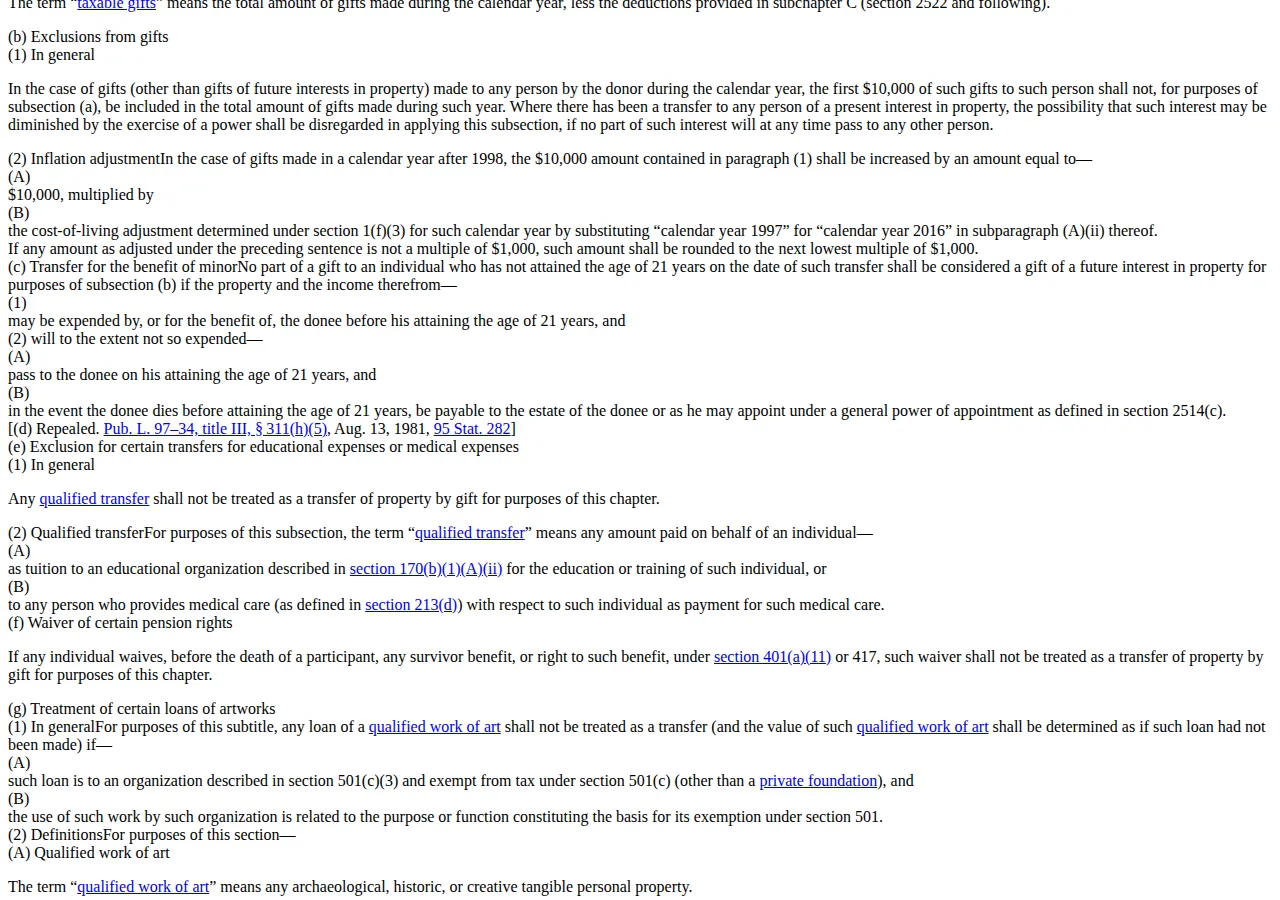
Section 2503(b)(1) starts at 10,000 dollars and adds an inflation adjustment measured from calendar year 1997, rounded down to the next lowest multiple of 1,000 dollars, which is why the exclusion held at 19,000 dollars for both 2025 and 2026. A married couple that elects gift splitting under section 2513 can give 38,000 dollars to one recipient in 2026 with no taxable gift, and there is no ceiling on the number of recipients. A donor with four children and six grandchildren has 190,000 dollars of annual exclusion capacity in 2026; a married couple has 380,000 dollars.
The lifetime number works differently. The 15,000,000 dollar basic exclusion is a single lifetime pool shared between lifetime gifts and the estate at death. Every taxable gift above the annual exclusion spends a dollar of it. The companion guide to the estate tax exemption and portability rules runs the death side of the same credit.
2. What counts as a gift, and what it is worth
The Internal Revenue Service states the rule plainly: you make a gift if you give property, or the use of or income from property, without expecting to receive something of at least equal value in return. The tax is imposed on the donor, not the recipient.
Section 2512 fixes valuation: the value at the date of the gift is the amount of the gift, and any shortfall against adequate consideration is deemed a gift. Business shares or a fractional real estate interest are valued at fair market value on the transfer date. Discounts for lack of marketability or minority interest go on Schedule A, line A.
Under section 2503(e), amounts paid directly to a school for tuition, or directly to a medical care provider, are not gifts. The payment must go directly to the school or provider: money handed to the student first is a gift. Room, board, books, and fees are not tuition.
3. The annual exclusion: present interests only
The annual exclusion applies only to gifts of a present interest. Section 2503(b)(1) excludes the first 19,000 dollars of gifts to any person during the calendar year, other than gifts of future interests. A present interest is an unrestricted right to immediate use, possession, or enjoyment of the property or its income. A gift to a trust that lets the trustee decide when a beneficiary sees the money is a future interest, with no annual exclusion.
For 2026, the first 194,000 dollars of gifts to a noncitizen spouse are excluded under sections 2503 and 2523(i)(2), up from 190,000 dollars in 2025.
4. Worked example: a 100,000 dollar gift to one child in 2026
One donor, no prior taxable gifts, gives 100,000 dollars in cash to one adult child.
$
\text{Taxable gift} = \$100{,}000 - \$19{,}000 = \$81{,}000
$
The tentative tax comes from the Table for Computing Gift Tax: the 80,000 to 100,000 dollar bracket taxes at 18,200 dollars plus 28 percent of the excess over 80,000 dollars:
$
\text{Tentative tax} = \$18{,}200 + 0.28 \times (\$81{,}000 - \$80{,}000) = \$18{,}480
$
The applicable credit is the tentative tax on the applicable exclusion amount: the tax on 1,000,000 dollars is 345,800 dollars, and everything above it is taxed at 40 percent:
$
\text{2026 credit} = \$345{,}800 + 0.40 \times (\$15{,}000{,}000 - \$1{,}000{,}000) = \$5{,}945{,}800
$
Because the 5,945,800 dollar credit exceeds the 18,480 dollar tentative tax, the tax due is zero, the credit consumed is 18,480 dollars, and the remaining lifetime exclusion is 14,919,000 dollars. That is the story of most gift tax returns: a return is filed, a taxable gift is reported, no cash tax is paid. The next gift starts from cumulative taxable gifts of 81,000 dollars, not from zero.
> [!TIP]
> File Form 709 in the year of the gift even when no tax is due: it starts the three-year assessment clock on the valuation and creates the Schedule B record the estate will need.
5. Gift splitting: doubling the exclusion, sharing the liability
Section 2513 lets a married couple treat a gift by one spouse to a third person as made one-half by each, but only if both spouses are citizens or residents of the United States at the time of the gift, both signify consent on Form 709, Part III, and the donor gave the other spouse no general power of appointment. Consent is due by April 15 of the year after the gift, and cannot be given after a notice of deficiency for that year.
Split between spouses:
$
\text{Each spouse's gift} = \frac{\$100{,}000}{2} = \$50{,}000 \quad \text{Taxable per spouse} = \$50{,}000 - \$19{,}000 = \$31{,}000
$
$
\text{Combined taxable gift} = \$31{,}000 + \$31{,}000 = \$62{,}000 \quad \text{versus} \quad \$81{,}000 \ \text{without splitting}
$
Splitting saves 19,000 dollars of lifetime exclusion on a single 100,000 dollar gift. Both spouses must file a return when splitting is elected.
> [!WARNING]
> Gift splitting creates joint and several liability for the full gift tax of both spouses for the year: under section 2513(d), each spouse is liable for the entire gift tax of both. Never split a gift involving a spouse who is not a United States citizen or resident: section 2513(a)(1) bars the election outright.
6. Crummey powers: buying a present interest for a trust gift
Gifts to an irrevocable trust are future interests by default: no annual exclusion, and a taxable gift for the full contribution. The Crummey power is the standard fix, named for Crummey v. Commissioner, 397 F.2d 82 (9th Cir. 1968), where the Ninth Circuit held that a gift to a trust qualified as a present interest to the extent each beneficiary held a real right to demand immediate distribution. The withdrawal right converts a future interest into a present interest.
A Crummey power works only if the right is real. Each beneficiary must receive timely written notice of the contribution and a reasonable window to exercise it; practitioner practice, supported by Internal Revenue Service rulings, is a 30-day window. The trust must hold cash or assets reducible to cash sufficient to satisfy a demand, and the notice must go out for every contribution, not just the first. The Tax Court has denied the exclusion where notice was waived or the trust lacked liquidity.
A donor contributes 76,000 dollars to an irrevocable trust for four children, each holding a Crummey withdrawal right of up to 19,000 dollars, with proper notice and a 30-day window:
$
\text{Annual exclusions} = 4 \times \$19{,}000 = \$76{,}000 \quad \text{Taxable gift} = \$76{,}000 - \$76{,}000 = \$0
$
The same 76,000 dollars without Crummey powers is a 76,000 dollar taxable gift. That is the entire value of the technique, and also its entire risk.
7. 529 superfunding: five years of exclusion in one contribution
Section 529(c)(2)(B) lets a donor front-load a 529 plan and spread the gift over five years. If a donor contributes more than the annual exclusion for one person, the donor may elect to treat up to five times the annual exclusion as if made ratably over the five-year period beginning with the contribution year. The 2025 figure is 95,000 dollars; for 2026 the figure is the same, because five times 19,000 dollars is 95,000 dollars.
$
\text{One donor, one beneficiary, 2026} = 5 \times \$19{,}000 = \$95{,}000 \quad \text{treated as} \quad \$19{,}000 \ \text{per year for 5 years}
$
A married couple electing gift splitting can contribute 190,000 dollars to one grandchild's 529 plan in 2026 and treat it as 38,000 dollars per year for five years, with zero taxable gift. Two traps: any additional gift to the same beneficiary during the five-year period eats into the same annual exclusion, and if the donor dies before the five-year period closes, section 529(c)(4)(B) pulls the portion allocable to periods after death back into the donor's gross estate.
8. Decision table: which technique fits which gift
| Situation | Technique | Exclusion used | Authority |
| :--- | :--- | :--- | :--- |
| Cash gift to an adult child | Direct gift, Form 709 if over 19,000 dollars | 19,000 dollars per recipient | Section 2503(b) |
| Married couple gifting to one person | Gift splitting election | 38,000 dollars per recipient | Section 2513; Form 709 Part III |
| Gift to an irrevocable trust | Crummey withdrawal powers with notice | 19,000 dollars per beneficiary | Crummey, 397 F.2d 82 (9th Cir. 1968) |
| Large education gift | 529 five-year election | 95,000 dollars per donor | Section 529(c)(2)(B) |
| Gift above all exclusions | Report on Form 709, credit shelters tax | Lifetime exclusion used dollar for dollar | Section 2505 |
Use the table as a triage step. The right technique depends on the recipient, the asset, and the donor's remaining lifetime exclusion, and the tax estimator tool can model the tentative tax on any taxable gift. For the state side, the state and local tax deduction playbook covers the 40,000 dollar SALT cap.
9. Who must file, when, and what happens if you do not
Form 709 is an annual return. The Instructions for Form 709 require it when taxable gifts were made during the year, when gift splitting is elected, when a 529 five-year election is made, and in several other cases the instructions list, including gifts of future interests and gifts to a noncitizen spouse above the exclusion. No return is required for gifts fully covered by the annual exclusion, for direct tuition and medical payments, or for gifts to a citizen spouse, unless an election forces a filing.
Form 709 is an identifiers return as much as a tax return. The donor lists a Social Security number (SSN); each donee is identified by SSN or Individual Taxpayer Identification Number (ITIN); a trust donee is identified by its Employer Identification Number (EIN). Gifts of LLC membership interests or S-Corp and C-Corp shares are valued by a CPA appraisal against the company's GAAP financial statements, not by the donor's estimate, and the appraisal is attached to Schedule A.
The deadline is April 15 of the year after the gift. For gifts made in 2026, Form 709 is due April 15, 2027. An extension is available by extending the income tax return, which also extends Form 709, or by filing Form 8892. An extension of time to file is not an extension of time to pay. Late filing and late payment penalties apply, and the return is the donor's responsibility even when a preparer handles it. Keep the filed return, the appraisal, the Crummey notices, and the splitting consent together: the estate's executor will need them, because Schedule B reconciles lifetime taxable gifts against the remaining exclusion.
10. Operator boundaries: who this playbook is for, and who it is not for
This playbook is for United States citizens and residents making lifetime gifts of cash, marketable securities, and interests in family businesses, and for married couples using gift splitting, Crummey trusts, and 529 plans to move wealth to children and grandchildren. It assumes the donor is solvent, the gifts are genuine transfers with no retained strings, and the donor's remaining lifetime exclusion exceeds the taxable gifts planned. It is not for nonresident noncitizens, who cannot claim the applicable credit; for generation-skipping transfers, which layer a second tax at a flat 40 percent rate on top of the gift tax; for gifts to foreign trusts or foreign persons above the reporting thresholds; or for valuation disputes involving closely held businesses. It is also not a substitute for counsel for family limited partnerships, grantor retained annuity trusts, or sales to intentionally defective grantor trusts.
11. Execution checklist
1. List every 2026 gift by recipient, date, asset, and value on the transfer date, and total per recipient.
2. Apply the 19,000 dollar annual exclusion per recipient; direct tuition and medical payments go in a separate column.
3. Decide on gift splitting before April 15, 2027; both spouses sign Form 709, Part III.
4. For trust gifts, confirm each Crummey notice was sent and the 30-day window ran.
5. For 529 contributions above 19,000 dollars, decide on the five-year election and record it on Schedule A.
6. Obtain a qualified appraisal for any gift of noncash property that is not publicly traded.
7. Compute taxable gifts, tentative tax, and the applicable credit.
8. File Form 709 by April 15, 2027, or extend before that date; pay any tax due electronically.
9. Keep the filed return, appraisal, Crummey notices, and splitting consent with the estate planning file.