The Business Credit Score Playbook: D-U-N-S, PAYDEX, and the Number That Decides Your Terms
Atlas Supply Co. is a two-year-old wholesale distributor, an LLC with three employees. It spends $11,000 a month with vendors — $8,000 packaging, $2,000 freight, $1,000 office supplies — all on net-30 terms. It wants a $250,000 SBA 7(a) loan for a van and a second warehouse. The owner has clean personal credit and assumes that settles it. It does not: the vendor who decides whether Atlas keeps net-30 terms and the lender who prices the loan both read the business's own credit record, scored by three bureaus that never look at the owner's FICO score. Business credit is public — Experian states that anyone can view your business credit score for any reason.
That file is this playbook: the D-U-N-S number, the PAYDEX math, Experian and Equifax, the thresholds that change vendor terms and SBA pricing, and the 90-day build. Our personal credit score playbook covers the consumer side.
Step one: the D-U-N-S number
Nothing in business credit exists before the D-U-N-S number. Dun & Bradstreet describes it as "a unique nine-digit identifier used exclusively for businesses. It's entirely separate from a personal identity and helps business entities establish credibility, improve visibility, and potentially unlock new opportunities." Getting one is free — D&B's own page says so.
The number is not a score and not a license; it is the hook the file hangs on. And it is not required for U.S. federal government contracts — federal contracting moved to the SAM.gov Unique Entity Identifier in 2022. State agencies, large corporations, and foreign buyers still ask for one in vendor onboarding. Apply free at dnb.com — never pay a third party for it — and make sure the legal name and address match the formation documents exactly, or a mismatch creates a second file.
The file is keyed to the EIN: the LLC, S-Corp, or C-Corp applies under its own EIN, the CPA reconciles tradelines to the GAAP books, and ACH records are what vendors report.
The PAYDEX: one question, dollar-weighted
The PAYDEX is the most quoted business credit score because it asks the question vendors care about: does this business pay when it said it would? Dun & Bradstreet defines it as "a dollar-weighted indicator intended to reflect a business's past payment performance," scored 1 to 100 from Trade Experiences — payment records submitted by suppliers and vendors, subject to D&B's review and approval.
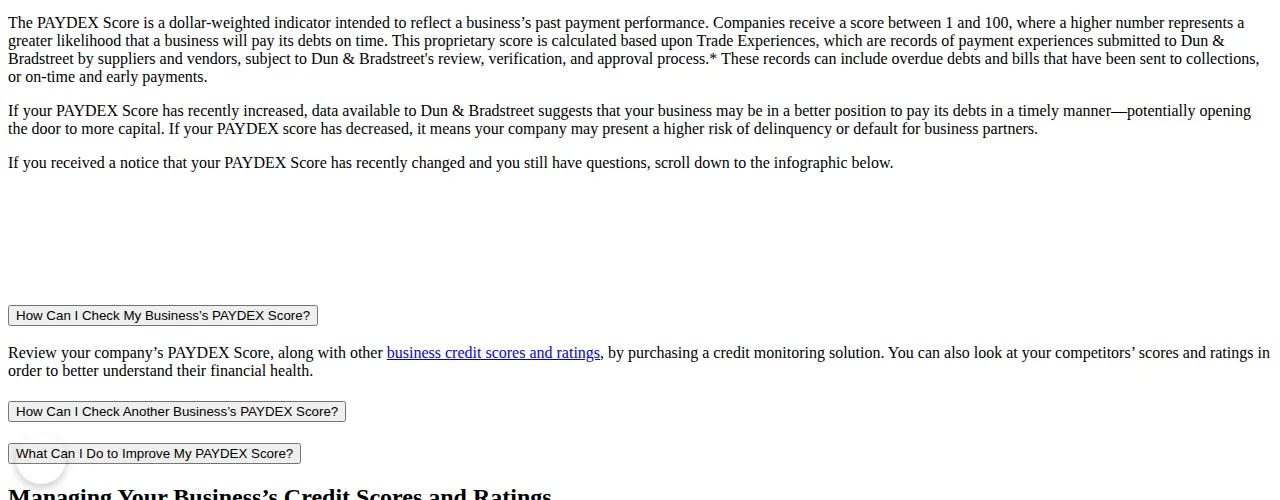
"Dollar-weighted" means a $8,000 invoice moves the score four times as far as a $2,000 invoice. "Trade Experiences" means the score is built only from what vendors report. D&B does not publish its exact formula, but this is the scale every bureau guide agrees on.
| PAYDEX | Payment behavior | Risk band |
|---|---|---|
| 100 | Pays about 30 days before terms | Lowest |
| 90 | Pays about 20 days before terms | Low |
| 80 | Pays exactly on terms | Low |
| 70 | Pays about 15 days beyond terms | Moderate |
| 50 | Pays about 30 days beyond terms | High |
| 20 | Pays about 120 days beyond terms | Severe |
The PAYDEX math: Atlas Supply Co., worked in full
Atlas has three reporting vendors, all on net-30 terms. The dollar-weighted days-beyond-terms is the weighted average of how many days early or late each payment lands:
| Vendor | Monthly invoice | Paid on | Days beyond terms | Dollar-days |
|---|---|---|---|---|
| Packaging supplier | $8,000 | Day 20 | −10 | −80,000 |
| Freight carrier | $2,000 | Day 45 | +15 | +30,000 |
| Office supplier | $1,000 | Day 30 | 0 | 0 |
| Total | $11,000 | −50,000 |
Atlas pays about four and a half days early. On the published scale, the stretch from 80 to 90 runs about half a point per day:
Atlas's number: 82, low risk — the packaging supplier is 73 percent of Atlas's spend, so paying it ten days early outweighs the freight carrier paying fifteen days late.
Now stress it: Atlas pays the $8,000 invoice on day 45 instead of day 20, while the other two vendors stay the same:
Below 80 the scale falls about two-thirds of a point per day:
One invoice, one month, eleven points gone, from 82 to 71. Our cash conversion cycle playbook covers the other side.
Experian Intelliscore Plus: the delinquency predictor
Where PAYDEX asks "do you pay on time," Experian's Intelliscore Plus asks "how likely are you to stop paying altogether." Experian states the objective: "The objective of the Experian Business Credit Score (Intelliscore Plus℠) is to predict seriously derogatory payment behavior." It runs 1 to 100, higher is safer, in five risk classes:
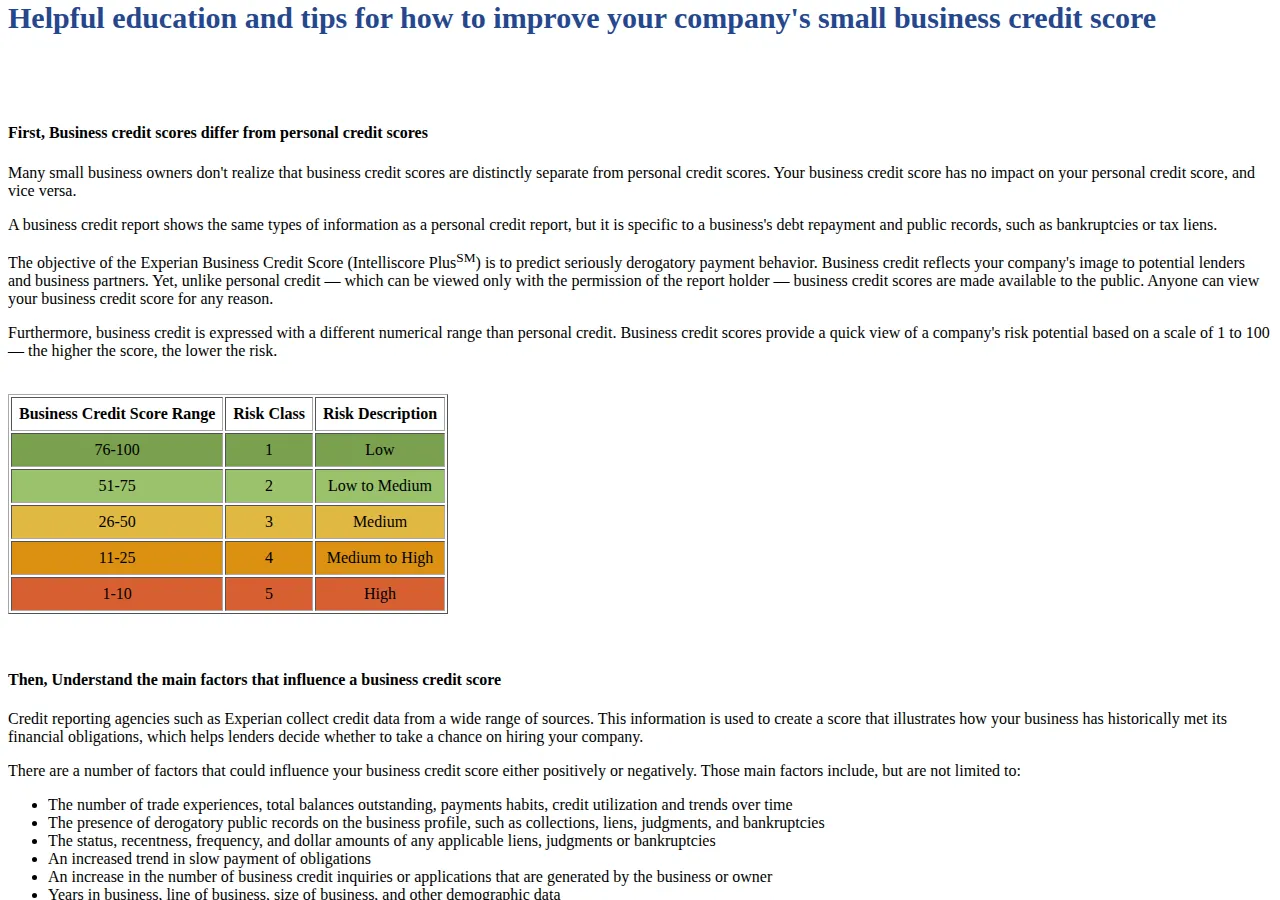
| Intelliscore Plus | Risk class | Risk description |
|---|---|---|
| 76–100 | 1 | Low |
| 51–75 | 2 | Low to medium |
| 26–50 | 3 | Medium |
| 11–25 | 4 | Medium to high |
| 1–10 | 5 | High |
The inputs are broader than PAYDEX: trade experiences, balances, payment habits, utilization and trends; public records — collections, liens, judgments, bankruptcies — with status, recency, frequency, and dollar amounts; the slow-payment trend; credit inquiries; and years in business and size. Two inputs founders control directly: utilization — a $10,000 card carrying $6,000 sits at 60 percent, and paying it to $2,000 drops it to 20 percent — and public records, where one unpaid lien or judgment anchors the score.
Newer versions exist — V2 on 1-to-100, V3 on 300-to-850 — but 76 is the line for the lowest risk class.
Equifax: three scores, three scales, one file
Equifax splits business credit into three numbers, and confusing them is the most common reading error. The ranges below are corroborated across four independent 2026 guides.
| Equifax score | Range | What it predicts | Low-risk read |
|---|---|---|---|
| Business Credit Risk Score | 101–992 | 90-plus-day delinquency in 12 months | Above 700 |
| Business Failure Score | 1,000–1,880 | Business failure in 12 months | Above 1,600 |
| Payment Index | 0–100 | Payment timing, like PAYDEX | 90 and above |
The Payment Index reads like a PAYDEX: 90 to 100 means on time or early, 80 to 89 means at least one payment landed late. The Credit Risk Score is the one lenders underwrite against, and its scale is the trap — a 500 sounds respectable until you remember it runs from 101 to 992.
What the scores decide — the decision table
| Decision | Threshold that decides it | Authority |
|---|---|---|
| Vendor extends net-30 terms | PAYDEX 80 or above | D&B PAYDEX scale |
| Lowest-risk lender band | Intelliscore Plus 76–100, risk class 1 | Experian |
| SBA 7(a) guarantee on the loan | 85% up to $150,000; 75% above $150,000 | SBA 7(a) page |
| SBA 7(a) maximum loan | $5,000,000 | SBA 7(a) page |
| SBA 504 maximum loan | $5,500,000 | SBA 504 page |
| SBA maximum interest spread | Prime + 3.0% to + 6.5% by loan size | SBA 7(a) terms |
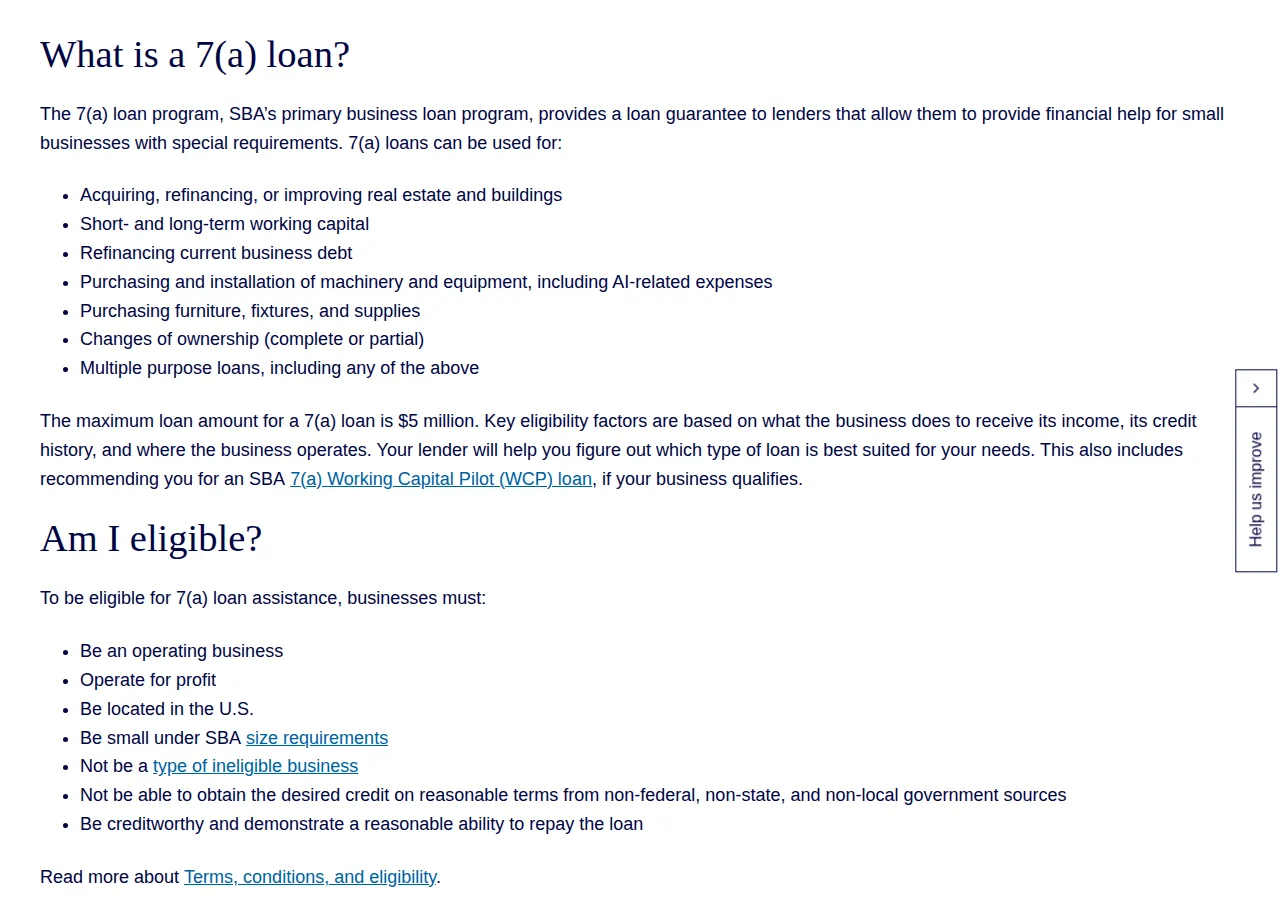
The guarantee is widely misunderstood: the 7(a) program "provides a loan guarantee to lenders" — it protects the lender, not the borrower. On a $250,000 loan the SBA guarantees 75 percent, or $187,500. It does not replace the owner's personal guarantee. Eligibility: operating, for profit, U.S.-located, small under SBA size requirements, and creditworthy.
The SBA loan math: what a weak file costs on $250,000
The SBA caps 7(a) interest as prime plus a spread that shrinks as the loan grows: plus 6.5 percent on loans of $50,000 or less, plus 6.0 percent from $50,001 to $250,000, plus 4.5 percent from $250,001 to $350,000, and plus 3.0 percent above $350,000. The Federal Reserve's H.15 release of November 10, 2026 puts prime at 7.00 percent, so a $250,000 ten-year loan prices at 10.00 percent for a strong file and 13.00 percent for a thin file:
| $250,000, 10 years | Rate | Monthly payment | Total paid | Total interest |
|---|---|---|---|---|
| Strong file | 10.00% | $3,303.77 | $396,452.21 | $146,452.21 |
| Thin file | 13.00% | $3,732.77 | $447,932.22 | $197,932.22 |
| Gap | 3.00 points | $429.00 | $51,480.01 | $51,480.01 |
Three points of rate cost $429.00 a month — $5,148.00 a year — and $51,480.01 over the life of the loan, on the same principal, the same van, the same warehouse. Run your own draw through the business loan calculator before you sign, and model the rate your file actually earns.
The CFPB §1071 rule: why lenders now ask, and what they cannot use
Section 1071 of the Dodd-Frank Act amended the Equal Credit Opportunity Act, and the CFPB's final rule of March 30, 2023 — 88 FR 35150, effective August 29, 2023 — requires covered financial institutions to collect and report data on applications for credit for small businesses, including those owned by women or minorities. The rule also shields certain demographic data from underwriters. Compliance dates were extended twice — June 25, 2024 and June 18, 2025 — amid court-ordered litigation. For the borrower, the meaning is narrow: the lender may ask for demographic information because the rule requires it, and the rule keeps that data away from the underwriter.
The 90-day build: from no file to a published score
A new business starts with nothing, and the order matters — tradelines opened before the D-U-N-S number exists cannot attach to a file that does not exist yet.
- [x] Days 1–7: Get the D-U-N-S number free and confirm the file exists.
- [x] Days 8–14: Open four reporting net-30 vendor accounts — packaging, office supplies, janitorial, fuel or fleet — and confirm in writing that they report to D&B.
- [x] Days 15–30: Place a small order on each account and pay the invoice the day it arrives — early payment pushes the first score above 80.
- [x] Days 31–60: Repeat the order-and-pay cycle on all four accounts — a PAYDEX needs at least three reported experiences from at least two vendors.
- [x] Days 61–90: Pull the D&B file and confirm the score published — then open one revolving business card and keep utilization under 30 percent.
- [x] Quarterly, forever: pull all three bureau files, dispute errors in writing, and pay the largest invoice early.
Sixty to ninety days is the corroborated estimate for a first published PAYDEX, not a D&B promise. Four vendors is insurance: if one never reports, three still do.
Who this is for — and who should stay away
This playbook is for an operating business with real vendor spend: a distributor, a contractor, a retailer, an agency buying on terms. It is for the owner who will pay the largest invoice early every month, and for the owner about to apply for an SBA loan.
It is not for a business with no vendor spend — a solo consultant paid by card has nothing to report. It is not for a business already behind on its bills: new tradelines do not outrun old delinquencies. And it is not a substitute for cash flow. A PAYDEX of 90 does not pay a $8,000 invoice; revenue does. Our line of credit versus term loan versus invoice factoring playbook prices the borrowing that covers the gap.
Founder & CEO Insight — Enow A. Jovial
Execution checklist
- Step 1: Apply for the free D-U-N-S number and confirm the file.
- Step 2: Ask every monthly vendor in writing whether it reports to D&B, Experian, or Equifax.
- Step 3: Open four reporting net-30 accounts and place a small first order on each.
- Step 4: Pay the largest invoice the day it arrives; pay the rest on or before their due dates.
- Step 5: At day 60, pull the D&B file and confirm three experiences from two vendors landed, then open one revolving business card and keep utilization under 30 percent.
- Step 6: Pull all three bureau files quarterly and dispute errors in writing.
- Step 7: Before any SBA application, price the loan at your file's actual rate.
- Step 8: Never pay a third party for a D-U-N-S number, and never buy tradelines.