A business license is not one filing, and that misunderstanding is the most expensive one in the first year of a company. Formation is one act — the state creates the entity. Licensing is a second, separate act — every layer of government that regulates what you do, where you do it, and who you do it for gets to say yes, and each yes has its own form, its own fee, and its own expiry date. An LLC that is perfectly formed can still be operating illegally on its first day, because the certificate of formation is not a license to do business.
The U.S. Small Business Administration (SBA) puts it plainly: most small businesses need a combination of licenses and permits from both federal and state agencies, and the requirements and fees vary based on what you do and where you do it. There is no single national business license. What you need depends on what you sell and where you sell it, and the only way to find out is to check each layer in turn — federal, then state, then county or city — and to keep checking, because licenses expire and the renewal calendar is yours to miss.
The three layers, and what each one actually licenses
The federal layer is the narrowest. Only activities a federal agency regulates need a federal license or permit. The SBA's list covers agriculture (U.S. Department of Agriculture), alcoholic beverages (Alcohol and Tobacco Tax and Trade Bureau, plus the local alcohol board), aviation (Federal Aviation Administration), firearms, ammunition, and explosives (Bureau of Alcohol, Tobacco, Firearms and Explosives), commercial fishing (NOAA Fisheries), maritime transportation, mining and drilling on federal lands, commercial nuclear energy, radio, TV, and broadcasting (Federal Communications Commission), and oversize or overweight vehicle transport (U.S. Department of Transportation). If your activity is not on that list, you probably need no federal license at all — and that is the first saving this playbook delivers: most founders can skip the federal layer entirely.
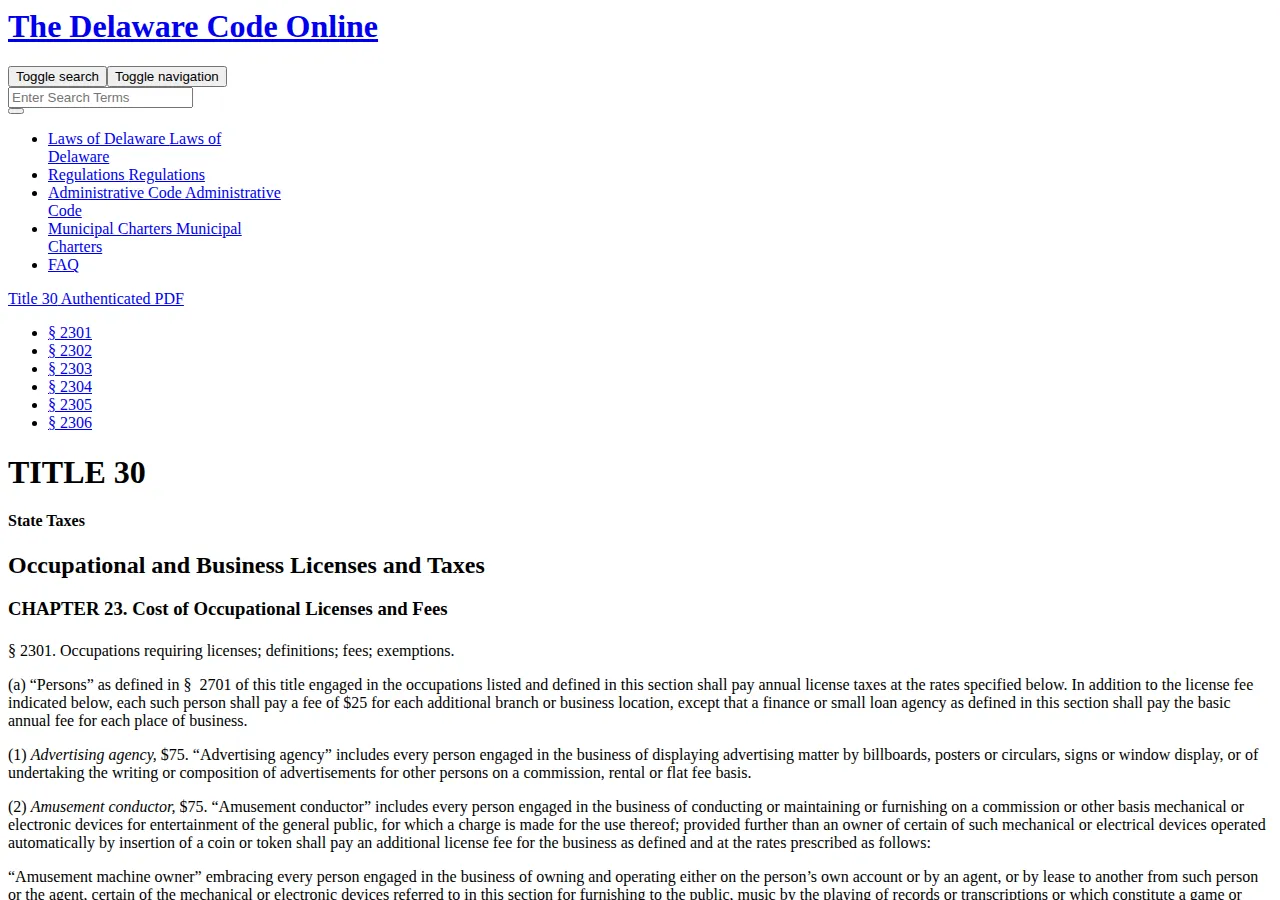
The state layer is where the money and the penalties live. States regulate a broader range of activities than the federal government, and the SBA's advice is to start at your Secretary of State's website. Two states show the whole range of what "state license" can mean. Nevada runs a single general state business license under NRS Chapter 76: every person who conducts business in the state must obtain one before conducting business, and the application must be accompanied by a fee of $200 — $500 if the applicant is a corporation organized under NRS Chapters 78, 78A, or 78B, or a foreign corporation required to file an initial or annual list. The license is in addition to any license to conduct business that must be obtained from the local jurisdiction. Delaware runs the opposite model: no general state business license, but an occupational license for each occupation under 30 Del. C. § 2301, at $75 for each listed occupation — an advertising agency pays $75, an amusement conductor pays $75 — plus $25 for each additional branch or business location, with the license expiring the following December 31 and the fee reduced according to the number of full calendar months remaining in the year.
The local layer is the one founders forget. Counties and cities issue their own general business licenses or business tax certificates, plus zoning approval, health permits, and sign permits. New York City's Department of Consumer and Worker Protection licenses more than 45,000 businesses in over 45 industries — that is the scale of a single city's licensing operation, and it is why "I formed the LLC" is never the end of the conversation. Zoning is local too: the SBA warns that neighborhoods are generally zoned for either commercial or residential use, zoning ordinances can restrict or entirely ban specific kinds of businesses from an area, and zoning ordinances can still apply even to home-based businesses.
| Layer | What it licenses | Who issues it | Authority |
|---|---|---|---|
| Federal | Regulated activities only: alcohol, firearms, aviation, broadcasting, fishing, mining | The named federal agency (TTB, FAA, ATF, FCC, USDA) | SBA, "Apply for licenses and permits" |
| State — general | The right to conduct business in the state at all | Secretary of State | NRS 76.100 ($200; $500 for Ch. 78 corporations) |
| State — occupational | Each occupation you practise, per location | State revenue department | 30 Del. C. § 2301 ($75 per occupation; $25 per extra location) |
| County / city | General business license, zoning, health, signs | County clerk / city licensing office | Local ordinance; NYC DCWP licenses 45,000+ businesses in 45+ industries |
| Professional | The person, not the company: contractor, cosmetologist, broker | State licensing board | State board rules; varies by state |
The worked example: what three layers cost in year one
Take a constructed illustration, labelled as such: a founder forms a Nevada LLC, takes a Delaware occupational license for two occupations at one location, and holds the Nevada state business license alongside it. The arithmetic is all statute, no estimation.
A second location in Delaware adds $25 per year. A mid-year Delaware start is prorated: the statute reduces the fee according to the number of full calendar months remaining in the year, so a founder who starts on July 1 with six full months remaining pays half the annual fee per occupation.
Two occupations started July 1 cost $75.00 for the rest of the year instead of $150 — and the renewal on January 1 is the full $150. The proration is a real saving only if the founder knows to ask for it; the statute states the rule, it does not volunteer it.
The same arithmetic exposes the cost of skipping the license. Nevada sets a fine of not less than $1,000 and not more than $10,000 for wilfully failing to obtain or renew a state business license, and the Secretary of State may revoke or suspend the license and deny a new one. Against a $200 fee, the fine is five to fifty times the cost of compliance.
That multiple is the whole argument for doing licensing first: no legitimate business reason makes a $200 fee worth a $1,000 minimum fine and a revoked license. The Delaware annual tax of $400 for an LLC is a separate charge from any occupational license — it is the entity's tax, not its permission to trade — and the Delaware vs Wyoming vs Nevada annual compliance guide prices that side of the ledger. Do not confuse the two: paying the tax does not buy the license, and buying the license does not pay the tax.
What a license is not: four filings founders confuse
A license is not a DBA. The fictitious business name filing lets you trade under a name that is not your legal name; it gives you no permission to do the underlying activity. File the DBA and the license as separate items — the DBA registration playbook covers the name side. A license is not an EIN. The Employer Identification Number is the tax identifier the application asks for; the EIN on the form is a field, not the approval. The EIN application playbook covers getting the number. A license is not foreign qualification. Registering to do business in a second state is a separate filing with its own registered agent; the foreign qualification playbook covers that route, and a business that qualifies in a second state usually needs that state's licenses too. And a license is not a permit in the building sense: a health permit, a sign permit, and a building permit are activity-specific approvals that sit alongside the general license, not inside it.
The operator boundary is blunt. If you sell only digital products from a laptop and never touch a regulated activity, your licensing burden may be a single city business tax certificate and nothing else. If you sell alcohol, food, or professional services, or you operate a physical location, your burden is a stack: federal agency, state license, professional board, city license, zoning, health. The stack is the price of the activity, not a bureaucratic accident, and the founders who budget for it in the first month are the ones who do not discover it in a fine letter.
The licensing sequence: three phases, one calendar
Phase 1 — Map before you file. List every activity the business will actually do in its first year, then check the SBA federal list for each one. If an activity is federally regulated, identify the issuing agency and its application before anything else, because federal timelines are the longest. Then open your Secretary of State's website and find the state license and any professional board for your trade. Then check the county and city: the general business license, the zoning map for your address, and any health or sign permit the activity needs. Write the list down as an SOP — a one-page standard operating procedure the next hire can follow — and attach the fee and the expiry date to every line.
Phase 2 — File in dependency order. Get the EIN first, because the license applications ask for it. File the state license next, because the city often asks for the state license number. File the city license and the zoning approval together where the city allows it, and file professional-board licenses in parallel — they are the slowest and they do not depend on the city. Keep a PDF copy of every issued license, and keep the confirmation numbers in the same folder as the formation documents. A CPA reviewing the first-year file should be able to see the license, the fee receipt, and the expiry date in under a minute.
Phase 3 — Run the renewal calendar. The SBA's most practical line is that some licenses and permits expire after a set period of time, and it is often easier to renew than to apply for a new one. Nevada renews at $200, due with the annual list or on the anniversary month of issuance. Delaware occupational licenses expire December 31 and renew at the full annual fee. Put every expiry on one calendar with a 60-day warning and a 30-day warning, and assign one person to own it. A renewal missed by a month is a new application, a new fee, and in Nevada a late-payment penalty on top.
- [x] Phase 1: Map the stack — federal list, state license, professional board, city license, zoning, health/sign permits; one SOP page with fee and expiry per line.
- [x] Phase 2: File in dependency order — EIN first, state license second, city and zoning together, professional board in parallel; keep a PDF of every issued license.
- [x] Phase 3: Run the renewal calendar — 60-day and 30-day warnings on every expiry; one named owner; Nevada $200 on the anniversary month, Delaware $150 by December 31.
- [x] Price the stack before launch — run the first-year total through the pricing calculator and hold the renewal total as a recurring line, not a surprise.
- [x] Check the boundary — if the activity is not federally regulated, skip the federal layer and spend the effort on the state and city layers that actually apply.
The failure modes, named in advance
The first failure mode is the formation fallacy: the founder files the LLC, frames the certificate, and assumes the business is licensed. It is not, and the first inspector, the first bank account review, or the first wholesale supplier that asks for a license number will say so. The second is the single-state fallacy: the founder licenses in the home state and sells in a second state without checking that state's rules. Nevada's statute is explicit that its license is in addition to any local license — the state license does not absorb the city one, and the home-state license does not cover the second state. The third is the expiry fallacy: the founder files once and never calendars the renewal. Licenses expire; Delaware's expire every December 31 by statute, and Nevada's renew every year on the anniversary month. The fourth is the home-based fallacy: the founder assumes a home office needs no license. Zoning ordinances can still apply to home-based businesses, and the city can require a home occupation permit on top of the general business license.
Founder & CEO Insight — Enow A. Jovial
A license stack is not a burden to resent; it is the operating permission of the business, priced in public, with the fees printed in the statute. Map it in week one, file it in dependency order, and calendar every renewal. The founders who do that never meet the fine letter, and the ones who do not meet it at five to fifty times the price.