A founder forms an LLC on Monday, needs the business bank account on Wednesday, and discovers the EIN is the gating item. The number is free from the IRS; the cost is time, and the time depends entirely on the route: minutes online, about four business days by fax, about four weeks by mail. Pick the wrong route and a Wednesday bank appointment becomes a December one.
The route decision is a filter the IRS applies before you choose. The online tool admits only domestic applicants whose responsible party holds a Social Security number or an ITIN. Everyone else — a foreign founder with no US address, an applicant whose responsible party has no US tax ID — is routed to phone, fax, or mail by rule. This playbook prices each route from the IRS's own instructions.
The four routes, priced in days
| Route | Time to EIN | Fee | Who can use it | Authority |
|---|---|---|---|---|
| Online | Minutes — issued immediately, usable immediately | $0 | Domestic entity; US principal place of business; responsible party with SSN or ITIN | IRS EIN page; Instructions for Form SS-4 (12/2025) |
| Fax (Fax-TIN) | Generally within 4 business days | $0 | Anyone; fax 855-641-6935 domestic, 855-215-1627 international | Instructions for Form SS-4 (12/2025) |
| Approximately 4 weeks | $0 | Anyone; Cincinnati, OH 45999 | Instructions for Form SS-4 (12/2025) | |
| Phone | During the call | $0 | International applicants only; 267-941-1099 | Instructions for Form SS-4 (12/2025) |
Online: minutes, but gated three ways
The online application is the fastest route the IRS offers, and the only one that issues the number inside the session. Answer the questions, submit, and if the application is approved the EIN is issued immediately online — usable immediately to file a return or make a payment. The IRS page states the price plainly: beware of websites that charge for an EIN, because you never have to pay a fee for one.
Three gates decide whether the tool admits you. All three must be true: the organization is domestic, formed or created in the United States or US territories; the principal place of business is in the United States or US territories; and you are the responsible party in control of the entity, or its authorized representative, holding the responsible party's Social Security number or ITIN. The online page adds two hard exclusions: you cannot use the tool if your principal place of business is outside the United States, and you cannot use it if you are applying with an EIN — unless you are a government entity.
The session is unforgiving: first, the application must be completed in one session; you cannot save it for later. Second, it expires after 15 minutes of inactivity, and then you start over. Have the entity type, legal name exactly as formed, responsible party's name and tax ID, and reason for applying ready before you open the tool.
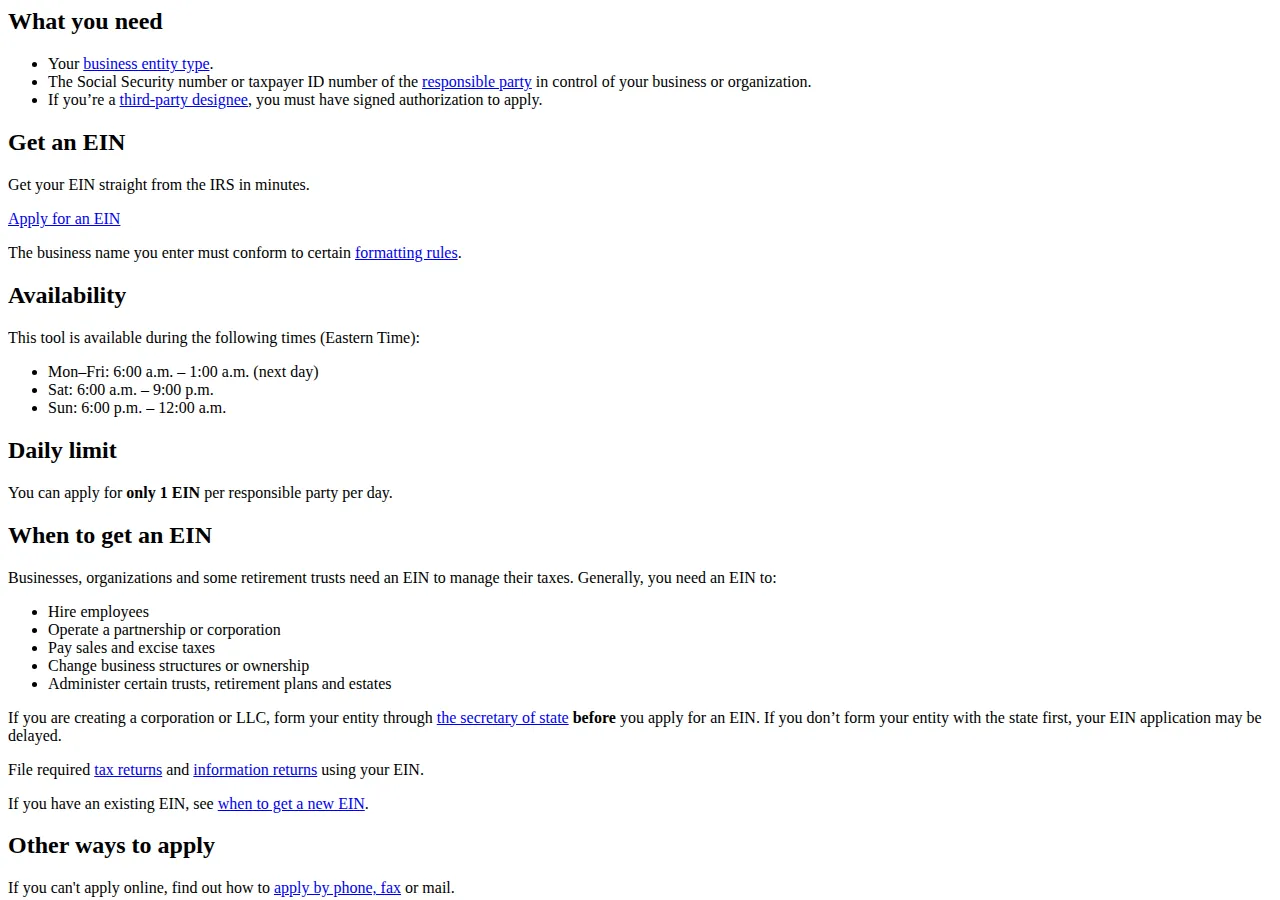
The tool is available on Eastern Time: Monday through Friday 6:00 a.m. to 1:00 a.m. the next day, Saturday 6:00 a.m. to 9:00 p.m., and Sunday 6:00 p.m. to midnight — wide, but not 24 hours.
Before you apply at all: if you are creating a corporation or LLC, form the entity through the secretary of state first. The IRS says so directly — if you do not form the entity first, the application may be delayed. The EIN is the second filing, never the first.
Fax: the four-business-day workhorse
Under the Fax-TIN program, a faxed Form SS-4 generally returns the EIN by fax within four business days. The program runs 24 hours a day, seven days a week, and the only requirement beyond the completed form is your own fax number, so the IRS can fax the number back to you.
The fax numbers are the ones that moved in the December 2025 instructions, so use the current ones: 855-641-6935 if you have a legal residence, principal place of business, or principal office or agency in one of the 50 states or the District of Columbia; 855-215-1627 if you do not — a US territory or an international location. The instructions flag the change explicitly ("new location for fax numbers and mailing addresses"), which is the IRS telling you older guides print stale numbers.
Fax is the right route in three cases: a domestic founder whose responsible party has no SSN or ITIN; a foreign founder who wants a paper trail instead of a phone call; and anyone filing several entities — the one-per-day limit still applies, but the fax queue is indifferent to it: fax one form a day and the numbers arrive four business days after each fax.
Mail: four weeks, and the IRS tells you to plan for it
Mail is the slowest route and the IRS does not pretend otherwise. Complete Form SS-4 at least four to five weeks before you will need an EIN, sign and date it, and mail it to the appropriate address; you will receive the EIN in the mail in approximately four weeks. Domestic: Internal Revenue Service, Attn: EIN Operation, Cincinnati, OH 45999. International: the same city, Attn: EIN International Operation, Cincinnati, OH 45999.
Mail is the right route in exactly one case: when no faster route is open and the deadline is more than five weeks away. The instructions lead with "applying for your EIN electronically, if possible, is recommended" — mail is the fallback, not a strategy.
If the number has not arrived and you need to check, call 800-829-4933 to verify a number or ask about the status of a mailed application. Do not file a second Form SS-4 to speed things up: the instructions say to file only one Form SS-4 per entity, and a duplicate application creates the duplicate-EIN problem the next section covers.
Phone: international only, and the domestic line is closed
The phone route is the most misunderstood, because it used to be open to everyone and now it is not: the IRS no longer issues EINs by telephone for domestic taxpayers. Only international applicants can receive an EIN by telephone.
The international line is 267-941-1099 — not toll-free — open 6:00 a.m. to 11:00 p.m. Eastern, Monday through Friday. The caller must be authorized to receive the EIN and able to answer the Form SS-4 questions. If you authorize a third-party designee, complete that section; after the call, mail or fax the signed Form SS-4, including the designee authorization, within 24 hours to the address the IRS representative provides.
The one-per-day limit: the math that breaks multi-entity filings
EIN issuances are limited to one per responsible party, per day — and the limit applies to all requests, whether online, by fax, by mail, or by phone. The IRS states the reason: to ensure fair and equitable treatment for all taxpayers. For trusts the limit is applied to the grantor, owner, or trustor; for estates, to the decedent or the debtor in a bankruptcy estate.
The arithmetic is blunt: five entities under one responsible party take five business days minimum, even online, because the second application on the same day is refused:
The workaround is a different responsible party, not a trick. Where two founders each control different entities, each can apply for one EIN per day in parallel. Where one person controls all five, the queue is five days and no route shortens it — file on a five-day stagger, the operating entity first and the subsidiaries in the order their bank accounts are needed.
The responsible party and Form 8822-B
The responsible party is the person the IRS holds accountable for the entity's tax filings: the principal officer, general partner, grantor, owner, trustor, or equivalent. That person must have a valid taxpayer identification number — an SSN, an EIN, or an ITIN — to use the online application. A responsible party with no US tax ID at all cannot use the online tool, which is the same gate that pushes foreign founders to fax, mail, or phone.
Two rules follow. First, keep Form SS-4 information current: use Form 8822-B to report changes to the responsible party, address, or location, and report changes in responsible parties within 60 days. A founder who sells the company, or a partnership that replaces its general partner, has a 60-day clock that starts on the change, not on the day someone remembers it.
Second, a sole proprietor generally files only one Form SS-4 and needs only one EIN — the EIN follows the person, not the trade name, even across several sole-proprietor businesses. A second EIN for the same sole proprietor is fixed by calling the IRS, not by filing another form.
When you need an EIN, and what it is not
The IRS lists the triggers plainly: hire employees; operate a partnership or corporation; pay sales and excise taxes; change business structure or ownership; administer certain trusts, retirement plans, and estates. A sole proprietor with no employees generally does not need one — but the first hire changes that, and the hire cannot be reported without it.
An EIN is a nine-digit number — the IRS's example is 12-3456789 — assigned to sole proprietors, corporations, partnerships, estates, trusts, and other entities for tax filing and reporting, and for business activities only. Do not use your EIN in place of your Social Security number or ITIN, and do not show your SSN as an EIN on returns.
If the number has not arrived by the time a return is due, write "Applied For" and the date you applied in the space for the number. If you do not have an EIN by the time a tax deposit is due, send the payment to the Internal Revenue Service Center for the filing area shown in the form's instructions.
The EIN sits next to filings founders confuse it with. The EIN vs ITIN vs SSN tax-ID comparison draws the line between the three numbers. A foreign-owned US LLC that has its EIN still has a separate reporting duty: our Form 5472 foreign-owned LLC filing guide covers the $25,000-penalty return that follows the EIN. And the entity that holds the EIN may also have a FinCEN duty — our FinCEN BOI reporting guide covers who must report and when. Run the tax estimator once the entity and EIN are in place, so the first estimated payment is priced before the quarter ends.
Founder & CEO Insight — Enow A. Jovial
Who should NOT use the online tool
A founder whose principal place of business is outside the United States should not waste a session on the online tool — the gate is explicit. A founder applying with an EIN rather than an SSN or ITIN should not use it either, unless the applicant is a government entity. A founder whose responsible party has no US tax ID should go straight to fax or phone. And a founder who has not yet formed the entity with the secretary of state should not apply at all yet — the IRS warns the application may be delayed.
Execution checklist
- [x] Step 1: Form the entity first: confirm the state filing (LLC articles, corporation charter) is accepted before touching the EIN application.
- [x] Step 2: Name the responsible party: the person who controls the entity, with a valid SSN, EIN, or ITIN. If that person has no US tax ID, plan for fax, mail, or phone — not online.
- [x] Step 3: Pick the route by deadline: online if the EIN is needed this week; fax if online is closed and the need is within two weeks; mail only if the need is five or more weeks away; phone only for international applicants.
- [x] Step 4: Apply in one session (online) or one fax: have the legal name, entity type, responsible party details, and reason for applying ready before you start; the online session expires after 15 minutes of inactivity.
- [x] Step 5: Save the confirmation: print or save the EIN assignment notice at the end of the online session; file the fax confirmation with the entity records.
- [x] Step 6: Calendar the 60-day rule: any change of responsible party, address, or location goes on Form 8822-B within 60 days of the change.