DBA Registration Playbook: File a Fictitious Business Name Right
Maria Chen opens a bakery and paints "Golden Crust Bakery" on the window. Harbor Ventures LLC sells software as "Northlight Analytics." Both trade under a name that is not their legal name, and both need the same filing, the DBA, known as a fictitious business name statement, assumed name certificate, or trade name registration.
This guide covers the four states where founders most often get it wrong: California, New York, Texas, and Florida.
What a DBA Is, and Is Not
A DBA is a public notice, not a legal person. It creates no entity, grants no liability protection, and confers no trademark rights. A sole proprietor who files a DBA is still a sole proprietor, personally liable for every debt. An LLC that files a DBA is still the same LLC.
That boundary is written into the statutes. Florida's Fictitious Name Act says registration is for public notice only, creates no rights to the name, and does not reserve the name against future use. New York's General Business Law says the same: acceptance of a certificate confers no right to or interest in any trade name. File a DBA when you need to operate under a name that is not your legal name.
Who Files Where: The Map
There is no federal DBA. Every state runs its own system, and the filing office depends on who you are.
| State | Sole proprietor / partnership | Corporation / LLC / LP | Authority |
|---|---|---|---|
| California | County clerk | Same | Bus. and Prof. Code §17910 |
| New York | County clerk, each county | Secretary of State | GBL §130(1) |
| Texas | County clerk, each county | Secretary of State, Form 503 | Bus. and Com. Code Ch. 71 |
| Florida | Division of Corporations (Sunbiz) | Division of Corporations (Sunbiz) | Fla. Stat. §865.09(3) |
| Georgia | Superior Court clerk | Same clerk | O.C.G.A. §10-1-490 |
The fee, the term, and the renewal clock all follow the filing office. A New York LLC pays the Secretary of State $25, while a New York sole proprietor pays the county clerk $25 outside New York City and $100 inside the five boroughs.
California: File in 40 Days, Publish in 45
California runs the strictest DBA clock in this guide. Business and Professions Code section 17910 requires a fictitious business name statement to be filed not later than 40 days from the time the registrant commences to transact business under the name. Section 17917 requires publication within 45 days after filing, in a newspaper of general circulation in the county: once a week for four successive weeks. An affidavit of publication is due with the county clerk within 45 days after publication completes.
File with the county clerk of the principal place of business. Los Angeles County charges $26 for a first-time filing, $26 for a renewal, $5 for each additional business name or registrant, $5 per name for a search, and $2 for a certified copy. The statement expires five years from filing, under section 17920. It also expires 40 days after any change in the facts, and when the registrant files a statement of abandonment. A refiling after expiry need not be published unless facts changed, if filed within 40 days of expiry.
New York: County Clerk, No Publication
New York's assumed name law is General Business Law section 130. First, the office depends on the filer: an individual, a partnership, or an unincorporated association files with the clerk of each county in which the business is conducted, while a corporation, LP, or LLC files with the Secretary of State. Second, section 130 contains no newspaper publication requirement at all. The two-newspaper rule people attach to New York DBAs belongs to Limited Liability Company Law section 206, the publication requirement for forming an LLC.
The certificate must state the name under which the business is conducted, the address within the county, the full names of the persons conducting it, including all partners. The Secretary of State charges $25 for an entity certificate. A county clerk charges $100 in counties within the City of New York and $25 in all other counties, under Civil Practice Law and Rules section 8021(b)(2). An amended certificate must be filed within 30 days after any change in the facts, and a certified copy must be conspicuously displayed on the premises.
The penalty is the sharpest in this guide. A person who knowingly fails to comply with section 130, or knowingly makes a false statement in a certificate, is guilty of a misdemeanor. Any person who fails to comply is prohibited from maintaining any action in any New York court on any contract, account, or transaction made in a name other than its real name until the certificate is filed.
Texas: One Filing, Ten Years
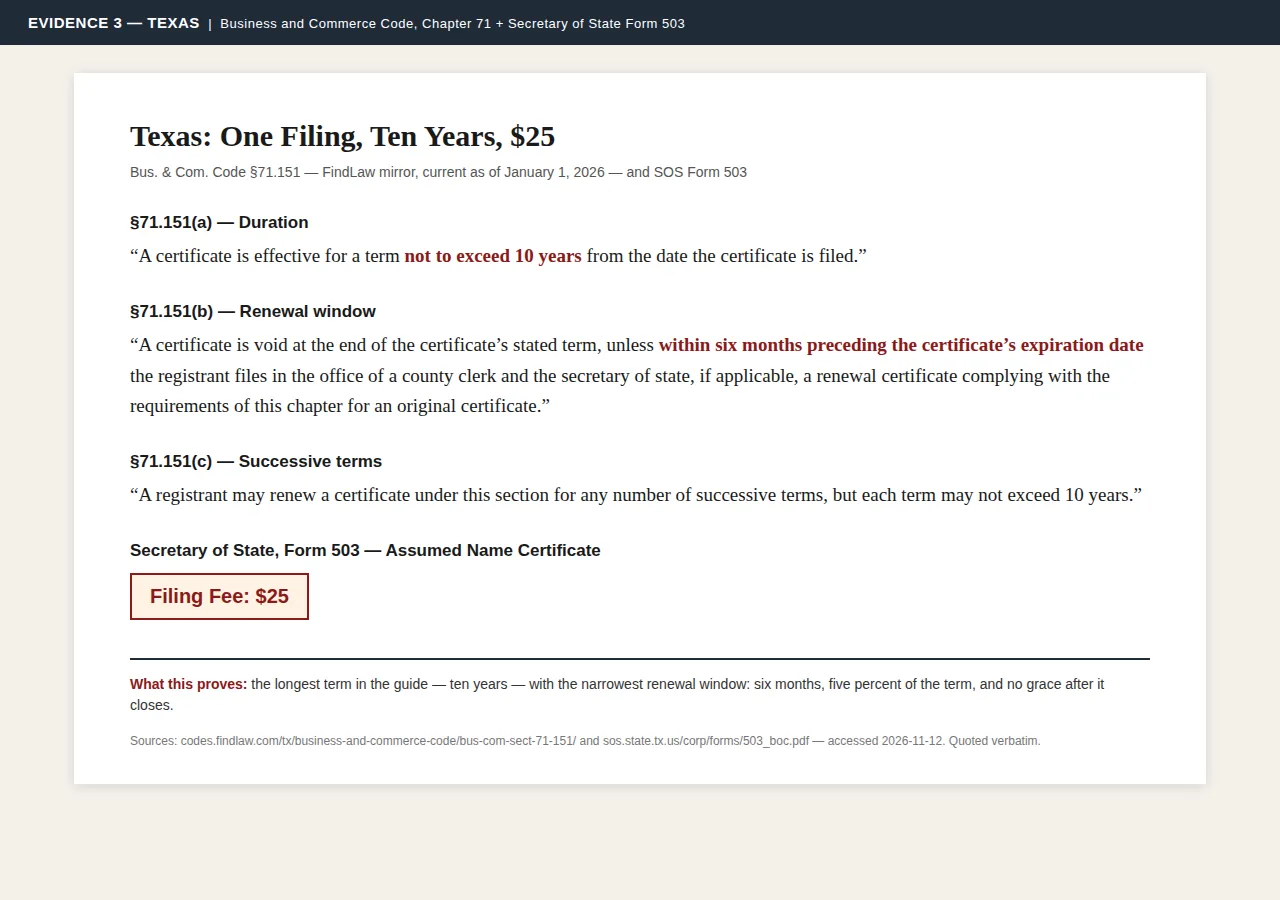
Texas calls the filing an assumed name certificate, under Chapter 71 of the Business and Commerce Code. A corporation, LLC, LP, LLP, or foreign entity must file a certificate if it regularly conducts business in Texas under an assumed name. Sole proprietors and general partnerships file with the county clerk. Registered entities file Form 503 with the Secretary of State, and the filing fee is $25.
The term is the longest in this guide: a certificate is effective for a term not to exceed 10 years from the date it is filed. It is void at the end of its stated term unless, within six months preceding the expiration date, the registrant files a renewal certificate. Renewal is allowed for any number of successive terms, each not to exceed 10 years.
Texas keeps the penalty proportionate. Failure to comply does not impair the validity of any contract or act, and it does not prevent the person from defending an action. What it prevents is maintaining an action arising out of a contract or act in which an assumed name was used, until a certificate has been filed. A court may award a plaintiff its expenses, including attorney's fees, in locating and serving a noncompliant defendant.
Florida: Advertise First, Then File
Florida's Fictitious Name Act, section 865.09, reverses the order founders expect. Before you register, you must certify that the intention to register the fictitious name has been advertised at least once in a newspaper in the county of the principal place of business. The registration is filed with the Division of Corporations and must be accompanied by the processing fee.
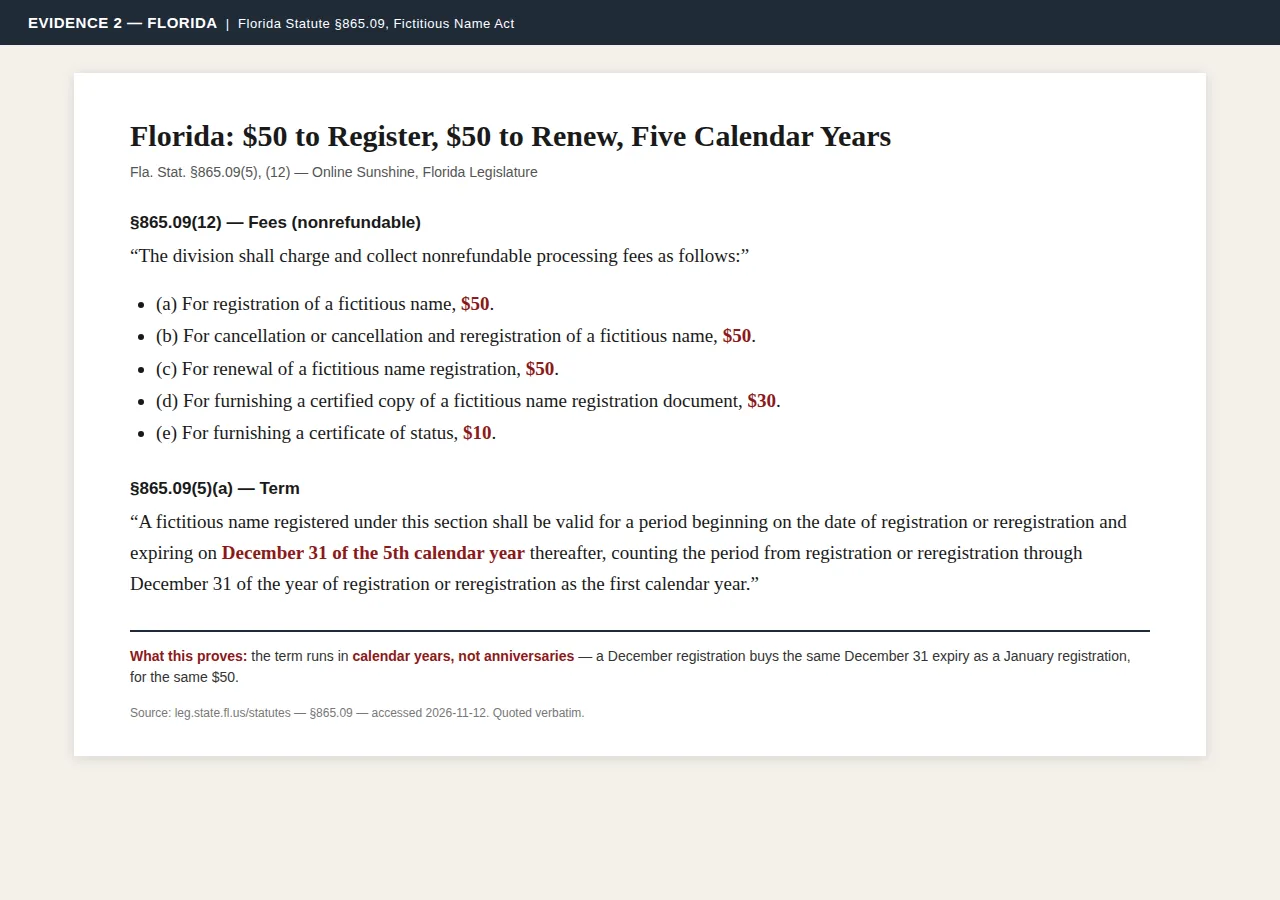
Fees are fixed by statute and nonrefundable: $50 to register, $50 to cancel or to cancel and reregister, $50 to renew, $30 for a certified copy, and $10 for a certificate of status. The term is measured in calendar years, not anniversaries: a registration is valid through December 31 of the fifth calendar year thereafter, counting the registration year as the first calendar year. Each renewal is valid for five years beginning January 1 of the year following the prior expiration. Renewal occurs on or after January 1 and on or before December 31 of the expiration year. Miss the December 31 deadline and the registration expires.
Register in January 2026 and year one is 2026; the registration expires December 31, 2030, the fifth calendar year. The renewal window is January 1 through December 31, 2030, and notice is due by September 1, 2030. A founder who registers in December 2026 gets the same December 31, 2030 expiry, which means a December registration buys eleven months less protection than a January registration for the same $50.
Georgia and the Other Forty-Five States
Georgia calls the filing a trade name, and it files at the county level: register a DBA with the Clerk of the Superior Court in the county where the business is located. A DBA is primarily used for branding and does not create a separate legal business entity or provide liability protection. The application requires the trade name, the nature of the business, the names and addresses of the owners, and notarized signatures. The fee is set by the county.
What a DBA Costs Over Ten Years
Filing fees are the smallest part of a DBA budget, and they are the only part fixed in advance.
| State | First filing | Renewal | Ten-year total | Authority |
|---|---|---|---|---|
| California | $26 | $26 at year 5 | $52 | §17920; lavote.gov |
| New York | $25 | None; no expiry | $25 | §130(5)(b)(1) |
| Texas | $25 | $25 at year 10 | $50 | §71.151; Form 503 |
| Florida | $50 | $50 at year 5 | $100 | §865.09(12) |
Florida costs four times New York over ten years, $100 against $25, and accounts for 44.05 percent of the four-state ten-year total of $227. Before you commit to a name, run the period through the Break-Even Analysis Calculator.
The Clock: How Long You Really Have
Texas gives you six months out of ten years, five percent of the term, and no grace after it closes. Florida gives you a full calendar year out of five, twenty percent of the term. California gives you 40 days after any change in the facts, so a partner added March 1 means a refiling due April 10.
The Price of Skipping It
| State | Can you sue on contracts? | Voids contracts? | Other cost | Authority |
|---|---|---|---|---|
| California | No, until filed and published | No | Dismissal risk | §17918 |
| New York | No, until certificate filed | No; third parties unaffected | Knowing failure is a misdemeanor | §130(9) |
| Texas | No, until certificate filed | No; defense preserved | Court may award service costs | §71.201 |
| Florida | No, until section complied with | No; other side recovers fees | Noncriminal violation under §775.08 | §865.09(9) |
The pattern is consistent: the contracts survive, the defense survives, and the right to sue does not. A customer who owes you money under the trade name can wait you out while you scramble to file, and in Texas the court can charge you the cost of finding you. In New York, a knowing failure is a misdemeanor on top of the court bar. The cheapest cure in every state is the filing itself, which costs $25 to $50.
DBA, EIN, Bank Accounts, and UCC Filings
First, the tax system: a DBA does not create a new taxpayer, so it does not require a new employer identification number. The IRS states the rule plainly: you do not need a new EIN if you just change your business name or address.
Second, the bank: a bank will not open an account in a trade name without the filed certificate. The certified copy is the document the bank keeps on file, which is why New York requires the certified copy to be displayed on the premises.
Third, secured lending: a UCC financing statement must name the debtor by its legal name, not its trade name. Uniform Commercial Code section 9-503 provides that, for a registered organization, a financing statement sufficiently provides the debtor's name only if it provides the name stated on the public organic record.
The entity decision sits underneath all of this. A DBA under a sole proprietorship leaves the owner personally liable; a DBA under an LLC does not change the LLC's liability shield, its tax classification, or its operating agreement. Still deciding? Read the operating agreement guide, the state comparison, and the Form 8832 guide.
Execution Checklist
- [x] Search the name in the county and state indexes first
- [x] File with the right office for your entity type
- [x] California: file in 40 days, publish in 45, affidavit in 45 after publication
- [x] Florida: advertise once, then register
- [x] New York: amend within 30 days of change, display the certified copy
- [x] Texas: calendar the renewal window six months before expiry
Founder & CEO Insight — Enow A. Jovial
A fictitious business name is a small filing with a long memory. File it in the right office, publish where the statute requires it, and refile when the facts change.