The Credit Score Playbook: FICO vs VantageScore, the Five Factors, and the Math That Moves Your Number
A credit score is a number built from your credit report — a prediction of how likely you are to pay a debt as agreed. Most scores run from 300 to 850; the higher the number, the lower the risk the lender sees. It does not measure income, job, or savings — myFICO states plainly that personal details like income, age, and where you live do not factor in. It measures one thing only: the behavior recorded in your file at Equifax, Experian, and TransUnion.
That narrowness is the whole playbook: every lever sits inside the file. This guide is for a borrower applying for credit in the next 3 to 12 months — and not for someone in active collections, where these levers do not erase a fresh charge-off.
Two models read the same file: FICO vs VantageScore
Two scoring families read the same three bureau files with different arithmetic. FICO is the incumbent: 90% of top lenders use FICO Scores, and most mortgage lenders take the middle of your three bureau scores. VantageScore is the challenger the three bureaus built together: VantageScore 4.0 is its most-used model and reads trended data — how balances move over time.
| Attribute | FICO Score 8 | VantageScore 4.0 | Authority |
|---|---|---|---|
| Scale | 300 to 850 | 300 to 850 | myFICO |
| Published factor weights | Yes: 35 / 30 / 15 / 10 / 10 | No fixed weights; influence rankings | myFICO; VantageScore |
| Who uses it | 90% of top lenders; most mortgage lenders | Lenders, most-used model | myFICO; CFPB |
| Reads trended data | Snapshot of the file | Yes (balance trends over time) | VantageScore |
| Inquiries scored | Last 12 months only; stay on report 2 years | Not verified this cycle | myFICO |
Your two scores can differ on the same day, so check which score your lender pulls.
The bands — what your number means to a lender
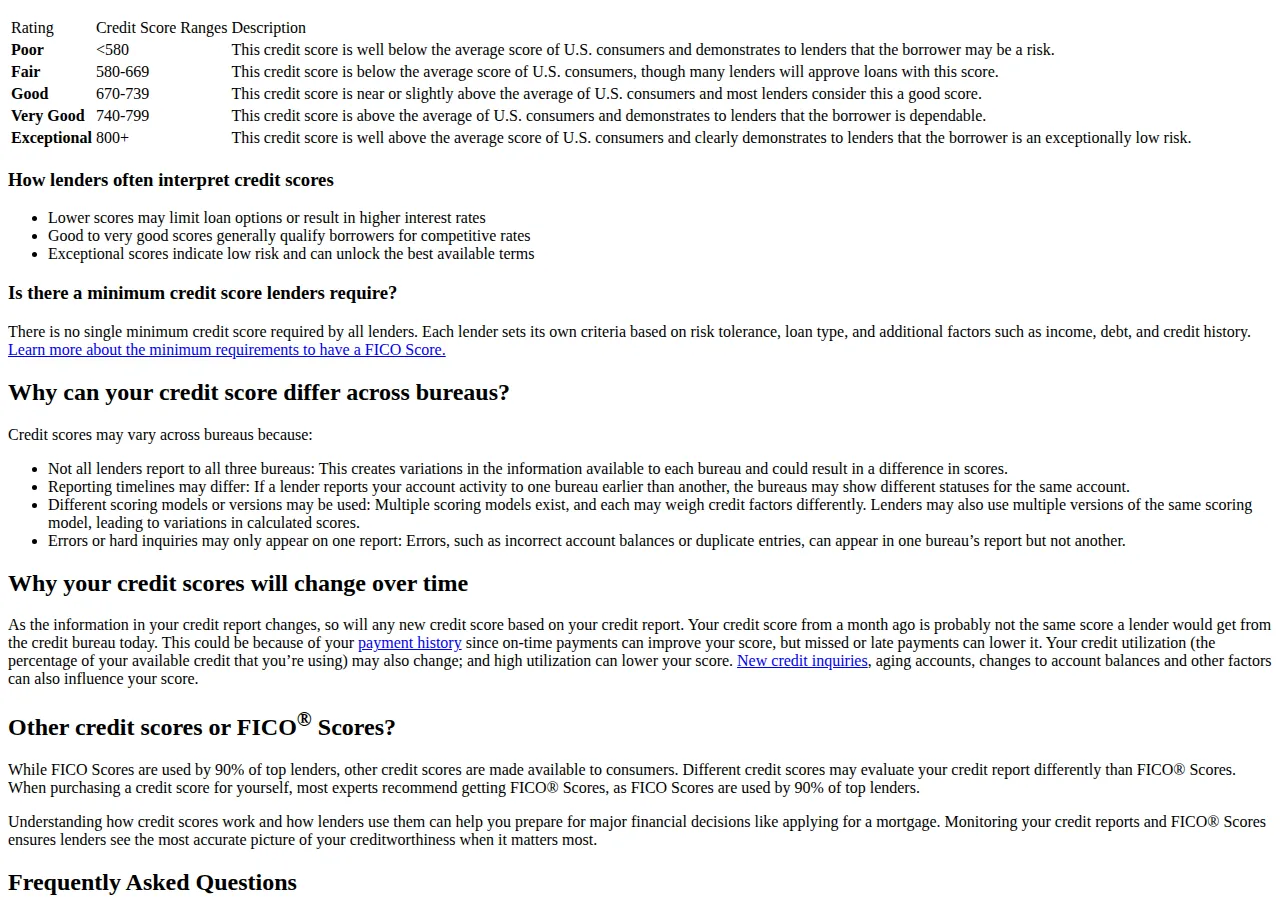
myFICO publishes five bands — the lender's shorthand for risk:
| Band | Range | What the lender reads |
|---|---|---|
| Poor | Below 580 | Well below average |
| Fair | 580 to 669 | Below average |
| Good | 670 to 739 | Near average |
| Very Good | 740 to 799 | Above average |
| Exceptional | 800 and above | Well above average |
"Good to very good scores generally qualify borrowers for competitive rates," myFICO writes. The boundary that matters most is 670: below it, approvals come with conditions and higher prices. Each lender sets its own criteria, but 670 is where the market's pricing changes.
The five factors — and why payment history dominates
myFICO states the formula verbatim: "This data is grouped into five categories: payment history (35%), amounts owed (30%), length of credit history (15%), new credit (10%), and credit mix (10%)."
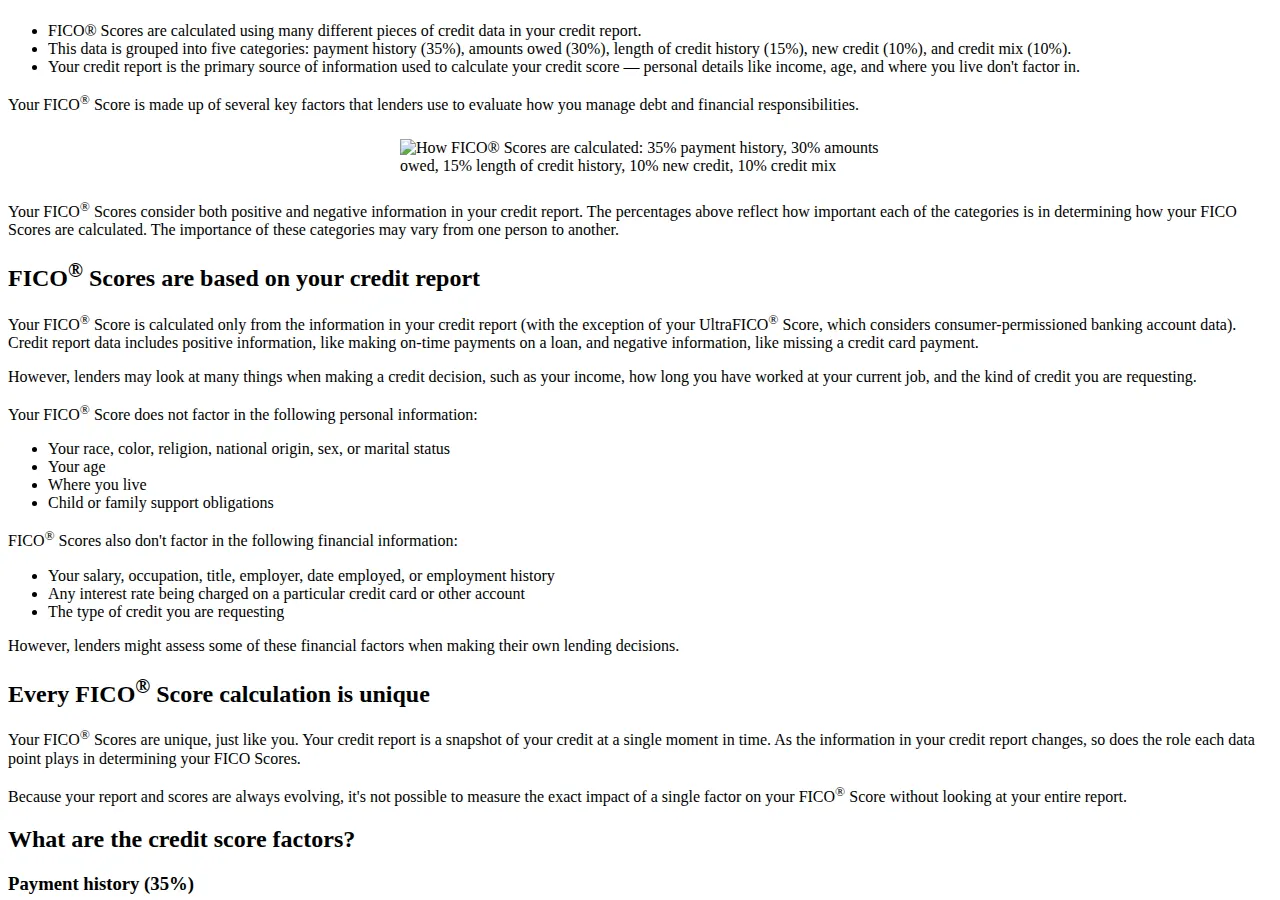
Payment history is 35% because it is the strongest predictor myFICO's research found: "your track record of payment tends to be the strongest predictor of the likelihood that you'll pay all debts as agreed." Amounts owed is 30%, and inside it the utilization ratio does most of the work. Length of history is 15% — the age of your oldest account, your newest, and the average of all. New credit and credit mix are 10% each. Payment history plus amounts owed are 65%, so paying on time and keeping utilization low wins two-thirds of the game — and a single 30-day late payment hits the heaviest factor, which no credit-mix optimisation offsets.
Worked math — utilization, the fastest lever
Utilization is the percentage of your available revolving credit you are using, and it is the fastest lever because it has no memory: the ratio is recomputed from the current statement balance:
One card, a $10,000 limit, a $4,500 statement balance:
Pay $2,000 before the statement closes:
What the lender reports is the statement balance: "even if you pay off your credit cards in full each month, your credit report may show a balance on those cards. The total balance on your last statement is generally the amount that will show in your credit report." Paying in full after the statement closes still leaves the pre-payment balance on the file — therefore pay before the statement date, not after it. On a $9,000 limit, 30% is $2,700 and 10% is $900. A small reported balance beats a zero balance — myFICO notes a low utilization ratio "will have a more positive impact on your FICO Scores than not using any of your available credit at all."
The per-card trap — the aggregate hides a maxed-out card
Models read utilization twice: in aggregate across all cards, and once per card. The aggregate can look healthy while one card is maxed out. Take two cards, each with a $5,000 limit:
| Card | Limit | Balance | Utilization |
|---|---|---|---|
| Card A | $5,000 | $4,000 | 80% |
| Card B | $5,000 | $500 | 10% |
| Aggregate | $10,000 | $4,500 | 45% |
Pay $2,000 toward Card A before its statement closes:
The aggregate fell from 45% to 25%, but the bigger win is Card A falling from 80% to 40%. Pay the card with the highest per-card ratio first, not the highest balance — the ratio is what the model reads.
Worked math — what a lower band costs on a car loan
The score does not just decide approval; it prices the loan. The example below uses illustrative APRs — assumptions that show the arithmetic, not a rate quote. A $25,000 auto loan over 60 months, 7.5% APR (good band) versus 13.5% APR (fair band). Monthly payment:
| APR | Monthly payment | Total interest | Total paid |
|---|---|---|---|
| 7.5% | $500.95 | $5,056.92 | $30,056.92 |
| 13.5% | $575.25 | $9,514.77 | $34,514.77 |
| Gap | $74.30 | $4,457.85 | $4,457.85 |
The fair-band borrower pays $74.30 more every month — $4,457.85 more over the loan, 38.06% of the principal in interest against 20.23%. That gap is the price of the score, and it repeats on every loan while the band stays low. Run the same calculation on your own figures with the business loan calculator.
Average age — closing a card does not delete its age
Length of history counts the average age of all accounts — open and closed. Three accounts aged 10, 6, and 2 years:
The correction most guides get wrong: closing the 10-year card does not delete its age. A closed account in good standing stays on the report about 10 years and keeps counting toward the average. The age cost arrives a decade later, when the account falls off — and only if its age is still above the average then.
What closing does immediately is remove the card's limit from your total available credit, raising utilization — the 30% factor, not the 15% one.
Payment history — the 35% factor has no forgiveness window
A late payment lands in the heaviest factor, and its damage is front-loaded — the fresher the miss, the harder it hits. FICO publishes no point table for a single late payment — myFICO states it is "not possible to measure the exact impact of a single factor on your FICO Score without looking at your entire report" — so "a 30-day late costs 80 points" is an invented number. What the law fixes is how long the miss stays visible.
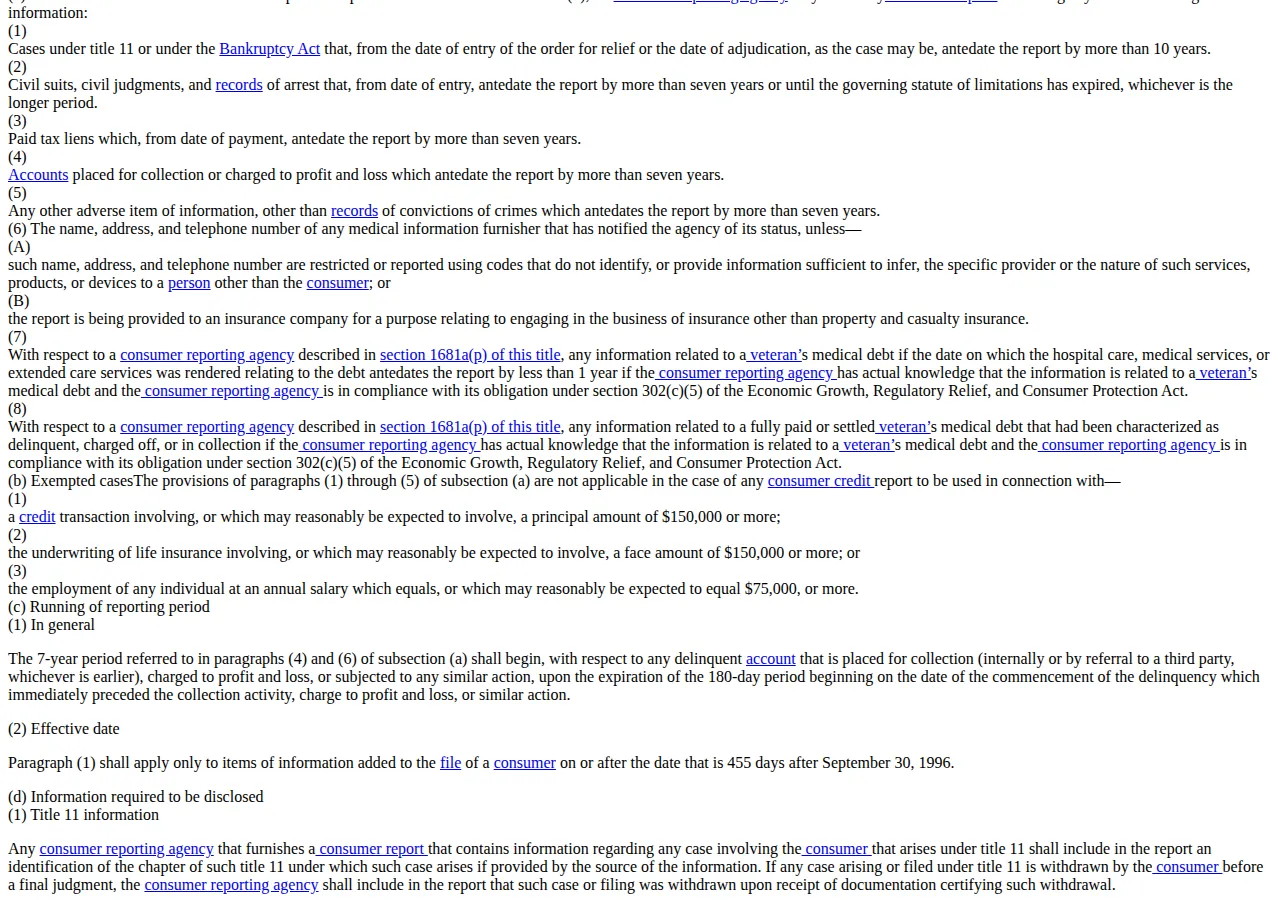
Under 15 U.S.C. § 1681c, most adverse items must leave the report after seven years: civil suits, civil judgments, arrest records; paid tax liens; collection accounts and charge-offs; and any other adverse item other than criminal convictions. Bankruptcy cases stay ten years. The clock runs from the event — paying the debt does not restart it.
The report itself — three files, one identifier, free access
You have three reports because each bureau compiles its own file independently — a lender may report to one and not the others, so an error can appear on one report and not the others.
The file is keyed to your Social Security number — the SSN opens the consumer file. Without an SSN, an ITIN keys it instead, with the same FCRA rights. Business credit is a separate file keyed to the employer's EIN: an LLC, S-Corp, or C-Corp builds its own business credit history, and the owner's personal score does not follow the company — but a personal guarantee puts the debt on the personal file, and a CPA reading a loan application checks both.
Access is free. The FCRA requires each bureau to provide one free report per year, and the only website authorised to fill those orders is AnnualCreditReport.com — myFICO warns other "free credit report" sites are impostors, some converting a trial into a paid subscription. Since late 2023 the bureaus have permanently extended free weekly access through the same site, per the FTC announcement. The reports contain the data, not the score. Checking your own reports never hurts your score. A hard inquiry counts only when you apply, and FICO scores it only from the last 12 months.
The dispute — fixing an error in 30 days
Errors are the most common complaint the CFPB receives about credit reports. The dispute has four moves:
- Pull all three reports and mark every wrong item.
- Dispute with both the bureau and the furnisher. Both must correct inaccurate information — disputing with only one leaves the other free to re-report it.
- Send it in writing, by certified mail with return receipt, keeping copies — myFICO advises copies, never originals. All three bureaus accept online disputes; Experian only online.
- Under 15 U.S.C. § 1681i the bureau must reinvestigate free of charge within 30 days — extendable by 15 days if you send relevant information — and may end it early only if the dispute is frivolous or irrelevant. In practice it takes 30 to 90 days; the bureau typically responds in 30 to 45 days.
If the item is inaccurate or unverifiable, the bureau must delete or correct it; if the furnisher re-reports it, it must include notice of your dispute. An accepted dispute often raises the score — but correcting a balance upward or removing an old account can move it the other way, because every correction reweights the file.
Founder & CEO Insight — Enow A. Jovial
What it does not do
A high score does not guarantee approval — lenders also weigh income, employment history, and the loan itself. A perfect payment history does not produce a perfect score, because the other four factors still weigh 65%. And a score cannot be bought: no payment to a bureau raises the number. Compare the products in our credit-card rewards comparison and the business credit options before choosing where the next loan comes from.
Execution checklist
- Step 1 — Pull all three reports: order all three from AnnualCreditReport.com this week; note every account, balance, and inquiry.
- Step 2 — Dispute every error: file with both the bureau and the furnisher, certified mail, copies of documents; calendar the 30-day deadline.
- Step 3 — Automate payment history: set autopay for at least the minimum on every account, then pay the statement balance in full.
- Step 4 — Pay before the statement closes: on the highest-utilization card, make an extra ACH payment before the statement date; aim under 30%, then under 10%.
- Step 5 — Keep the oldest card open: put a small recurring charge on it with autopay; close a fee card only after pricing the lost limit against the fee saved.
- Step 6 — Check the score your lender reads: a mortgage lender pulls FICO and takes the middle of three; confirm model and bureau first.
- Step 7 — Recheck after 45 days: pull the corrected reports, confirm each disputed item changed, recheck the score, repeat every three months.