A manufacturer planned to make 10,000 steel brackets in October and earn $30,000 of operating income. It made 9,000 brackets and earned $17,260. The shortfall is $12,740, and that single number tells management nothing: was purchasing overpaying for steel, was the shop wasting material, or did sales miss volume — or all three at once, with a price increase hiding part of the damage?
Variance analysis splits one miss into named pieces, each with an owner and a fix — the control phase of budgeting. This playbook runs the full method on Northgate Fabrication, a fictional bracket maker, then shows which variances deserve investigation and how the routine connects to ASC 270.
The three budgets: static, flexible, actual
Every variance is a difference between two of three columns. The static budget is fixed at the planned level before the period starts. The flexible budget restates it at the level actually achieved — variable costs recomputed, fixed costs unchanged. Actual is what happened.
| Column | Built when | Volume | Question it answers |
|---|---|---|---|
| Static budget | Before the period | Planned | Performance vs plan? |
| Flexible budget | After volume known | Actual | Costs managed well? |
| Actual results | Period end | Actual | What really happened? |
The sales-volume variance is the flexible budget minus the static budget: the volume miss and nothing else. The flexible-budget variance is actual minus the flexible budget: spending and efficiency at the real volume. The two always sum to the total.
A variance is favorable (F) when it improves operating income relative to budget, and unfavorable (U) when it reduces it. For costs, spending less is favorable; for revenue, earning more is favorable. Every variance here carries its F or U label — never report a bare dollar difference and leave the reader to guess.
The five formulas that do all the work
Standard costing gives every input a standard price and quantity per unit; each variance holds one side constant and measures the other.
AP is actual price, SP standard price, AQ actual quantity, SQ the standard quantity allowed for actual output, AH actual hours, SH standard hours allowed, AR and SR actual and standard labor rates. Note the asymmetry: the price variance uses the quantity purchased — purchasing owns the price paid on everything bought — while the quantity variance uses the quantity used, which production owns. The gap between them sits in inventory.
Worked example: Northgate Fabrication, October
Northgate makes one product, a steel bracket. October standards: 4 kilograms of steel per bracket at $6.00 per kilogram, and 0.5 direct labor hours per bracket at $16.00 per hour. Selling price $40.00; budgeted fixed costs $50,000. Planned production 10,000 brackets; actual production and sales 9,000, sold at $41.00 each.
Standard cost per bracket is $24.00 of materials plus $8.00 of labor — $32.00 of variable cost, $8.00 of contribution margin. The budgets follow:
| Line | Static budget (10,000 brackets) | Flexible budget (9,000 brackets) |
|---|---|---|
| Revenue | $400,000 | $360,000 |
| Variable costs | ($320,000) | ($288,000) |
| Contribution margin | $80,000 | $72,000 |
| Fixed costs | ($50,000) | ($50,000) |
| Operating income | $30,000 | $22,000 |
Actual: revenue 9,000 × $41.00 = $369,000. Purchasing bought 37,000 kg at $6.40 ($236,800); production used 35,100 kg. Labor: 4,600 hours at $16.50 ($75,900). Fixed costs $51,200. Variable cost $224,640 + $75,900 = $300,540; contribution margin $68,460; operating income $17,260. The total miss is $17,260 − $30,000 = ($12,740) unfavorable. Now split it.
Materials: the $14,800 price variance and the inventory bridge
The standard quantity allowed for 9,000 brackets is 4 × 9,000 = 36,000 kilograms. Production used 35,100 — 900 less than standard, a favorable quantity variance of (35,100 − 36,000) × $6.00 = ($5,400) F.
The price variance on quantity purchased is ($6.40 − $6.00) × 37,000 = $14,800 U; on quantity used it is $0.40 × 35,100 = $14,040 U. The $760 difference is the price variance on the 1,900 kilograms bought but not used, which sits in ending inventory rather than in cost of goods sold. Both are correct — they answer different questions.
The pieces reconcile: $14,040 U plus ($5,400) F equals $8,640 U. The textbook case makes the same point: at Jerry's Ice Cream the standard was $1.00 per pound and 2 pounds per unit, so 210,000 units allowed 420,000 pounds. Purchasing bought 440,000 pounds at $1.20 — an $88,000 unfavorable price variance — while production used only 399,000 pounds, a $21,000 favorable quantity variance. The two pull in opposite directions, and only the split shows it.
Labor, fixed costs and the selling price: the full reconciliation
Standard hours are 0.5 × 9,000 = 4,500; the shop worked 4,600. The rate variance is ($16.50 − $16.00) × 4,600 = $2,300 U, and the efficiency variance is (4,600 − 4,500) × $16.00 = $1,600 U. Both unfavorable — the shop paid more per hour and used more hours than standard.
The selling-price variance is ($41.00 − $40.00) × 9,000 = $9,000 F. The fixed-cost spending variance is $51,200 − $50,000 = $1,200 U.
| Variance | Amount | Owner | Authority |
|---|---|---|---|
| Sales-volume variance | ($8,000) U | Sales | The Accounting Cycle §92 |
| Selling-price variance | $9,000 F | Sales | The Accounting Cycle §92 |
| Materials price variance (used basis) | ($14,040) U | Purchasing | LibreTexts §10.4 |
| Materials quantity variance | $5,400 F | Production | LibreTexts §10.4 |
| Labor rate variance | ($2,300) U | Production | LibreTexts §10.5 |
| Labor efficiency variance | ($1,600) U | Production | LibreTexts §10.5 |
| Fixed-cost spending variance | ($1,200) U | Operations / Finance | LibreTexts Ch. 10 |
The flexible-budget variance is the sum of the six pieces: $9,000 − $14,040 + $5,400 − $2,300 − $1,600 − $1,200 = ($4,740) U. Add the ($8,000) U sales-volume variance and the total is ($12,740) U — the exact shortfall reported at the top. A report that does not tie back to the total is a list of guesses, not an analysis.
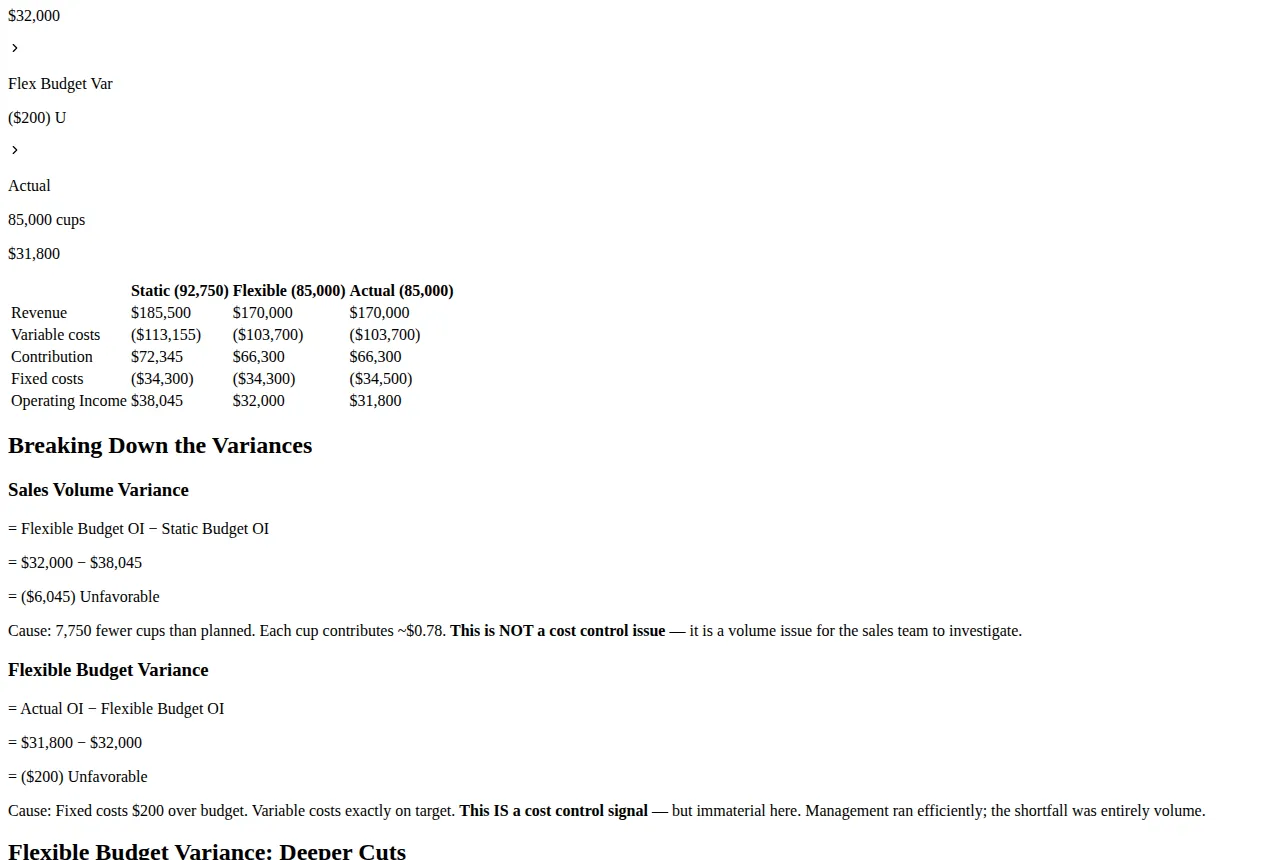
The bridge above shows the same decomposition for ABC Coffee: static budget $38,045 of operating income, flexible budget at 85,000 cups $32,000, actual $31,800 — a ($6,045) U volume variance and a ($200) U flexible-budget variance. Costs were controlled almost perfectly; the entire shortfall was volume.
Deciding what to investigate: management by exception
Investigating a variance costs money. Management by exception: set a written threshold, in dollars, in percent, or both, and investigate only what clears it. A common policy is 10 percent of the flexible-budget amount — at Jerry's Ice Cream that meant $42,000 for materials, $27,300 for labor and $10,500 for variable overhead, catching the $88,000 materials price variance and the $37,800 labor rate variance, but not the $5,500 overhead spending variance.
Apply the same rule to Northgate. Ten percent of the $216,000 flexed materials budget is $21,600, and the $14,800 price variance falls below it — no investigation. Ten percent of the $72,000 flexed labor budget is $7,200, above both labor variances; 10 percent of fixed costs is $5,000, above the $1,200 spending variance. Under a strict 10 percent rule, Northgate investigates nothing in October, even though operating income missed by $12,740. That is the rule doing its job: 63 percent of the miss is volume, a sales question. Under a 5 percent threshold, 5 percent of $216,000 is $10,800 and the $14,800 price variance clears it. The threshold is a management choice — write it down before the month starts. A threshold chosen after seeing the numbers is not a control; it is a rationalization.
Favorable variances deserve investigation too — they can hide fraud. Dow Chemical's Fraud Investigative Services, created in 1998, lists “unexplainable cost variances between budget and actual amounts” among the warning signs it looks for, and the company has said that for every $1 it spends investigating fraud it recovers nearly $4.
Who should run this, and who should not
Variance analysis earns its keep where operations repeat with measurable inputs, someone owns the standards, and the report reaches decision-makers before next month's numbers arrive. A manufacturer, a contractor tracking labor hours, or a law firm that budgets 2,000 billable hours and bills 1,700 all qualify. Skip it where the conditions fail: a pre-revenue startup has no meaningful standard to vary from, and a company that produces the pack but never discusses it has bought the cost with none of the benefit.
For anyone inheriting the pack: the variance report is a management tool, not a GAAP statement. A CPA prepares the external statements under U.S. GAAP; the controller's pack runs on standards the company sets for itself, guided by IMA and CMA managerial-accounting practice.
The quarterly boundary: ASC 270 and ASU 2025-11
Internal packs are monthly; external reporting is quarterly. ASC 270, Interim Reporting, governs the condensed interim statements public companies file each quarter on Form 10-Q — condensed statements of income, cash flows and equity, with selected footnotes. The topic traces back to APB Opinion No. 28, issued in 1973.
FASB's ASU 2025-11, issued 8 December 2025, reorganizes the topic without changing the requirements: it clarifies when the guidance applies, lists the interim disclosures GAAP requires, and adds a disclosure principle for material events since the last annual period. It takes effect for public business entities for interim periods within annual periods beginning after 15 December 2027, and for all other entities after 15 December 2028, with early adoption permitted.
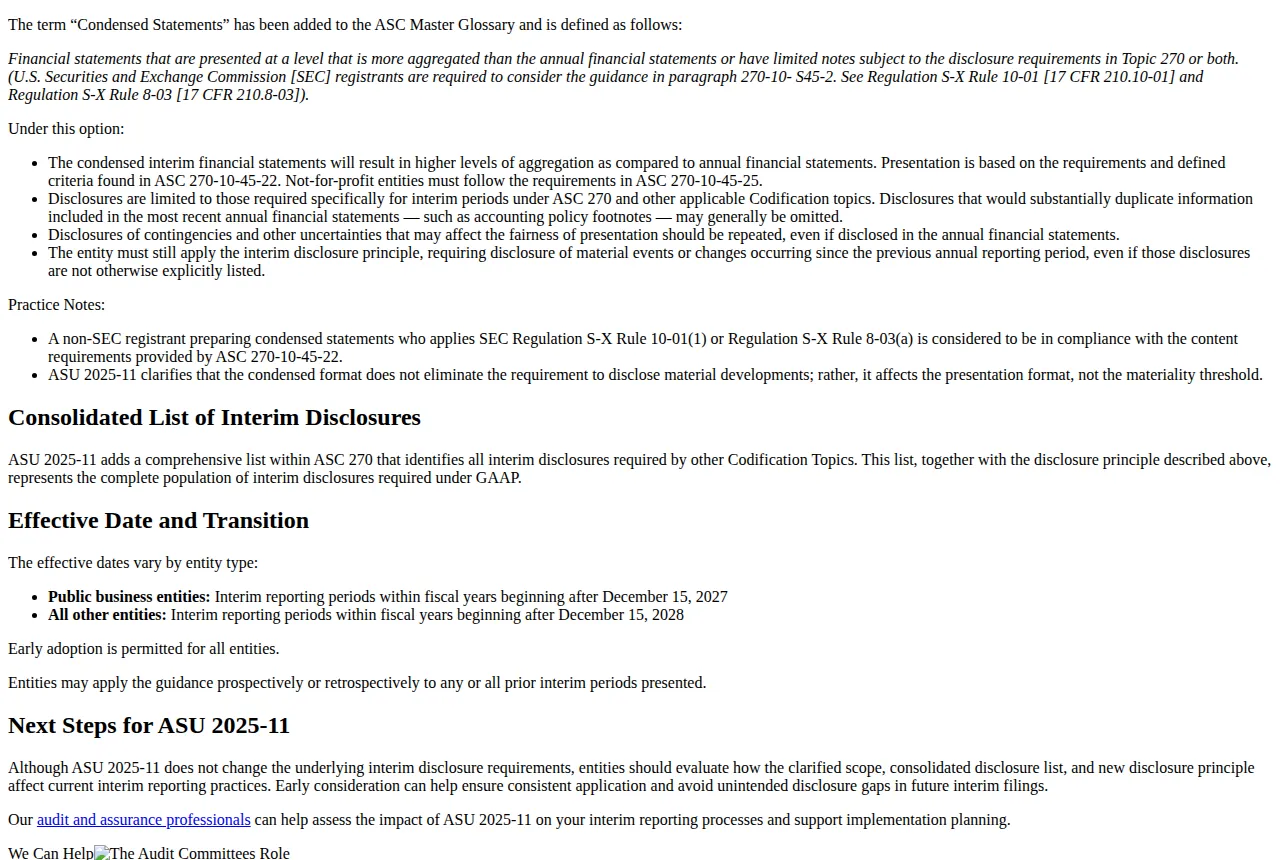
The link to variance analysis is the disclosure principle. A price variance that clears your threshold in Q1 and turns out to be a supplier failure or a plant closure is exactly the kind of event the principle is written for — and the variance pack is where it surfaces first.
Founder & CEO Insight — Enow A. Jovial
The monthly protocol
Run the same eight steps every month, in this order.
- Freeze the standards before the month starts. Prices, quantities and labor rates are locked in advance; a standard changed mid-month to flatter the variance is not a standard.
- Close the books on the same day every month. The variance pack is part of the close, not an afterthought. Our month-end close playbook runs a five-day close; the variance pack lands on day three.
- Build the flexible budget at actual volume. Restate every variable line at the actual units, hours or users achieved; carry fixed lines unchanged. This is the step that separates analysis from arithmetic.
- Compute the three variances first, in that order. If the two pieces do not sum to the total, stop — something is misclassified.
- Decompose the flexible-budget variance into price and quantity pieces. Materials price on quantity purchased, materials quantity on quantity used, labor rate and efficiency, selling price, fixed spending. Reconcile the pieces before writing commentary.
- Apply the written investigation threshold. Flag every variance that clears it, favorable and unfavorable alike. Record the threshold on the report so nobody can move it after the fact.
- Assign each flagged variance to a named owner with a due date. Purchasing owns price, production owns quantity and efficiency, sales owns volume and selling price.
- Review last month's actions before discussing this month's variances. A variance investigated but never followed up teaches the organization that the pack is theater.
For the materials side of step five, the inventory valuation method changes how the price variance flows into cost of goods sold — our inventory valuation guide works through FIFO, LIFO and weighted average. The financial statement ratios playbook shows how to read the resulting margins. And when the pack raises a pricing question, run the break-even first with our break-even calculator.
The failure modes
Three mistakes cause most of the damage: stale standards — a standard price set two years ago produces a permanent unfavorable variance that everyone learns to ignore, and the ignored variance then masks the month the price genuinely spikes. Revisit standards at least annually, and after any structural change.
Gaming. Managers judged on variances will find ways to make them favorable: buying cheap materials that fail in production, deferring maintenance, or shipping early. The defense is the split itself — a favorable price variance paired with an unfavorable quantity variance is the signature of cheap inputs. Read variances in pairs, never alone.
Investigating everything. A pack that flags forty variances is a pack nobody reads; the threshold protects management attention, and a variance below it is deliberately accepted, not ignored.
Variance analysis does not make a business profitable. It makes the reasons for profit and loss visible and assignable. The Northgate month ended $12,740 short, and the pack says why: sales missed volume by 1,000 brackets, purchasing paid $0.40 too much per kilogram of steel, the shop used more hours than standard, and the $1 price increase covered about 70 percent of the shortfall.