Backup withholding is the IRS collecting its tax at the source, from the payer's hands, before the payee ever sees the money. A contractor whose TIN is wrong gets no warning and no second chance at filing time: the payer holds back 24 percent of every reportable payment, deposits it, and reports it on Form 945, and the payee gets the remaining 76 percent plus a credit for the withheld amount. Figures as read on November 15, 2026.
The statute: four triggers, one rate
IRC § 3406(a)(1) states the rule in four clauses. If any one of them is true for a reportable payment, the payor "shall deduct and withhold" a tax equal to the product of the fourth lowest rate of tax applicable under section 1(c) and the payment. That rate is 24 percent, and IRS Topic No. 307 confirms it: the payer must withhold at a flat 24% rate.
| Trigger | § 3406 clause | What happened |
|---|---|---|
| Missing TIN | (a)(1)(A) | Payee fails to furnish a TIN in the required manner |
| Incorrect TIN | (a)(1)(B) | IRS notifies the payer the TIN furnished is incorrect |
| Underreported interest or dividends | (a)(1)(C) | Notified payee underreporting under subsection (c) |
| Certification failure | (a)(1)(D) | Payee fails to certify not subject to withholding under (c) |
One distinction decides whole cases. Subparagraphs (C) and (D) — underreporting and certification failure — apply only to reportable interest or dividend payments: a contractor who underreports interest can have withholding imposed on bank interest, but not on 1099-NEC fees, under those clauses. Triggers (A) and (B), the TIN triggers, apply to every reportable payment. Our 1099-NEC contractor reporting playbook covers the form those fees are reported on; our W-9 versus W-8BEN onboarding playbook covers the form that prevents trigger (A) in the first place.
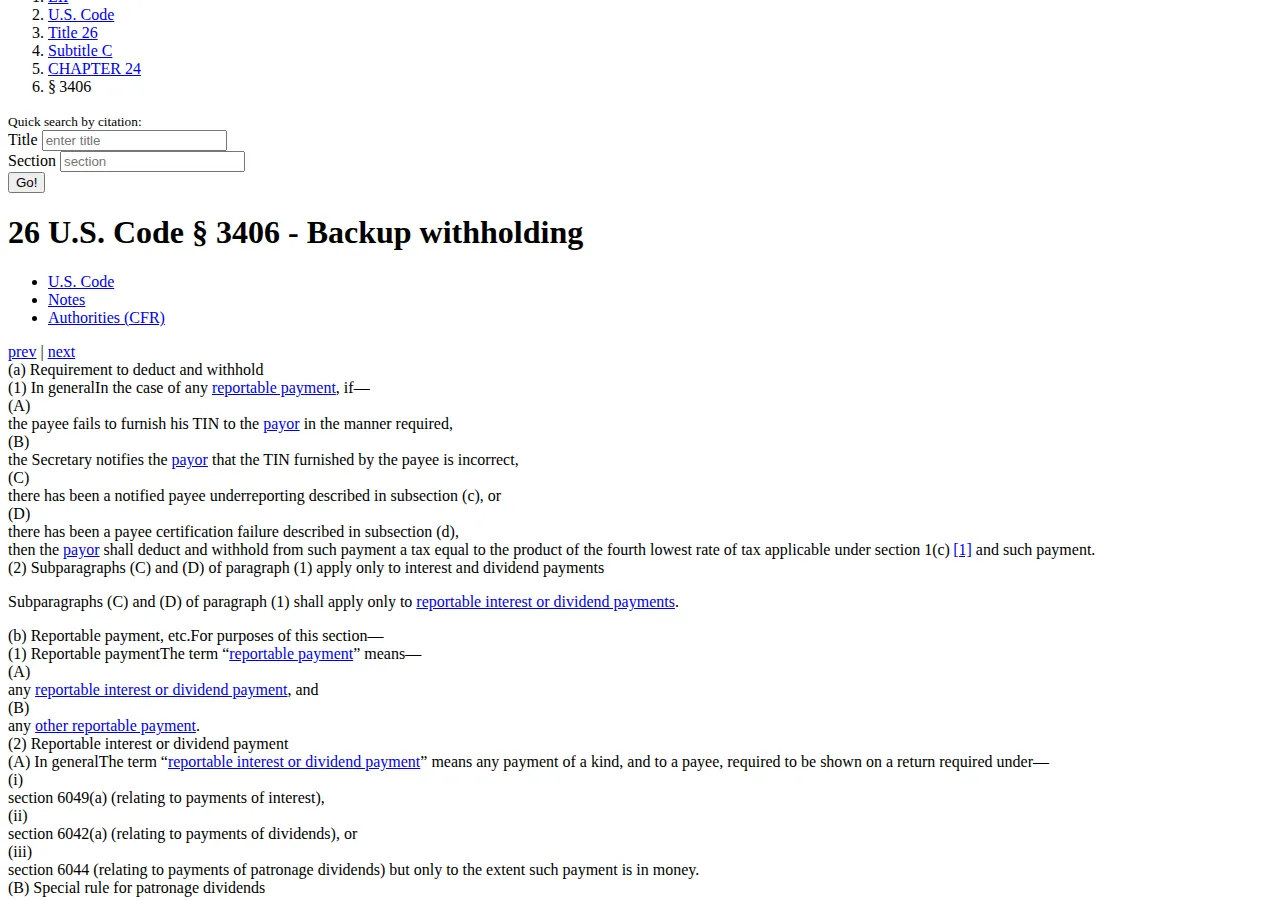
Section 3406(a)(1), above: the four triggers and the rate clause.
The IRS runs two programs: BWH-B for a missing or incorrect TIN, cured by a correct name and TIN; BWH-C for underreported interest and dividend income, cured by resolving the underreported income and paying what is owed, or filing the missing returns.
What it applies to — and what it never touches
Backup withholding can apply to most payments reported on Form 1099: interest (1099-INT), dividends (1099-DIV), patronage dividends (1099-PATR, only if at least half the payment is in money), rents and royalties (1099-MISC), independent-contractor pay (1099-NEC), attorney fees and gross proceeds paid to an attorney, broker and barter transactions (1099-B), payment-card and third-party network transactions (1099-K), original issue discount (1099-OID, limited to cash paid), certain government payments (1099-G), and gambling winnings (W-2G) not subject to regular gambling withholding.
It never touches wages: wage withholding is reported on Form 941, never on Form 945. The IRS also excludes outright: real estate transactions, foreclosures and abandonments, cancelled debts, Archer MSA distributions, long-term care benefits, retirement account distributions, employee stock ownership plan distributions, fish purchases for cash, unemployment compensation, state or local income tax refunds, and qualified tuition program earnings. One edge case proves the boundary: an H-2A agricultural worker who does not furnish a TIN is subject to backup withholding, reported on Form 1099-MISC and Form 945, line 2 — the one place wages cross into this system.
The B-notice machine: CP2100, two letters, three clocks
The machine starts with the IRS, not the payer. After information returns are filed, the IRS sends a CP2100 or CP2100A notice listing the incorrect name/TIN combinations — a CD or DVD data file for large filers, paper CP2100 for mid-size filers, paper CP2100A for small filers. The notice does not say whether it is the first or second notification for an account; Publication 1281 puts the tracking duty on the payer. Track every account for three years after the first CP2100 or CP2100A notice, because the second notice inside that window changes everything.
The first B-notice goes out within 15 business days of receiving the CP2100 or CP2100A, asking the payee to return a certified Form W-9. The cure window runs inside the same 30-business-day window the payer has to start withholding: if the certified W-9 arrives in time, withholding never starts. If it does not, the payer must begin backup withholding on all reportable payments to that payee no later than 30 business days after receiving the CP2100 notice, and must stop within 30 calendar days after receiving the required certification.
The second B-notice is a different letter with a harder cure. It goes out within 15 business days of the second CP2100 or CP2100A within three calendar years, and the payee cannot cure it with a W-9 alone: the IRS or the Social Security Administration must validate the name/TIN combination — the SSA validates a Social Security number (SSN), the IRS an EIN on Letter 147C, an ITIN on Letter 685C, an ATIN on Letter 096C. The payer must stop withholding no later than 30 days after receiving the validation letter.
Take this example calendar: CP2100 received Monday, March 2, 2026; first B-notice due Monday, March 23; withholding must start by Monday, April 13 — unless the payee cures first. A certified W-9 arriving April 6 means withholding never starts; a validation letter arriving April 20, after a second notice, means withholding stops by Wednesday, May 20 — thirty calendar days later.
The money: what 24 percent does to a payroll
The rate is flat, so the arithmetic is multiplication. Take a payer with forty contractors at $2,500 a month each — $100,000 a month in reportable payments. If every TIN were bad, the holdback would be $24,000 a month and $288,000 a year.
The realistic case is six bad TINs out of forty — the payees who moved, married, or mistyped a digit. Six payees at $2,500 is $15,000 a month subject to withholding, $3,600 a month held back, $43,200 a year.
The same 24 percent on investment income is easier to miss, because no one watches a bank account the way they watch a payroll.
The withheld amount is not lost: a payee whose Form 1099 shows backup withholding reports it as federal income tax withheld on their return for the year they received the income. A partnership or S corporation cannot claim it — only the partners and shareholders can, on their individual returns, and the amounts are not refundable to the entity. Our 1099-MISC versus 1099-NEC versus W-2 classification playbook covers which form each payment belongs on before withholding ever enters the picture.
Form 945: the annual return and the deposit rules
Form 945, Annual Return of Withheld Federal Income Tax, is where backup withholding is reported — one per calendar year, covering all nonpayroll withholding. For 2026, file by February 1, 2027, or by February 10, 2027 if you made deposits on time in full payment of the tax due. You do not have to file for a year with no nonpayroll tax liability. Corrections go on Form 945-X, filed separately.
Deposits are electronic, always: EFTPS, IRS Direct Pay, or the IRS business tax account — never a credit or debit card. Combine all Form 945 taxes for deposit purposes, but never combine them with Forms 941, 943, 944, or CT-1, either for depositing or for deciding the schedule. The schedule is decided before the year begins, from the prior-year return: for 2027, a payer is a monthly depositor if the total tax on the 2025 Form 945, line 3, was $50,000 or less, and semiweekly if it was more. The six-bad-TIN payer at $43,200 a year is monthly; at $60,000 it would be semiweekly. The $100,000 next-day rule overrides the schedule: a monthly depositor that accumulates $100,000 or more of liability on any day becomes semiweekly the next day, for the rest of that year and the following year, and must deposit the $100,000 the next business day.
Small-payer floor: if the total tax for 2026 is less than $2,500, no deposits are required — the amount is paid with the return. At 24 percent, that floor is $10,416 of payments a year; $10,500 produces $2,520 and triggers deposits.
Behind the deposit rules sit two provisions. The trust fund recovery penalty is 100 percent of unpaid trust fund taxes, imposable on every person responsible for collecting, accounting for, or paying over the tax who acted wilfully. And since July 2026 the IRS runs an Automatic Exemption from Penalty program for Form 945 filers, replacing First Time Abate relief for 2025 and later — a filer qualifies by timely filing and timely paying for the prior three years.
The penalty ladder, worked on forty forms
The B-notice solicitations exist to avoid a second bill: the penalty for filing an information return with a missing or incorrect TIN. The 2026 General Instructions state the section 6721 ladder, and section 6722 applies the same amounts to payee statements. Worked on forty forms:
Annual maxima cap the ladder: $683,000 for corrections within 30 days, $2,049,000 by August 1, and $4,098,500 after August 1 or not filed — lower for small businesses ($239,000, $683,000, $1,366,000). Intentional disregard has no maximum. The solicitations are the escape: for a missing TIN, solicit at account opening, again by December 31 of the year opened (or January 31 of the following year if opened in December), and a second time by December 31 of the following year; for an incorrect TIN, make up to two annual solicitations in response to the CP2100 notices.
Prevention: TIN matching and the W-9 at onboarding
The cheapest B-notice is the one never sent. The IRS operates a TIN Matching program that lets certain payers validate a name and TIN combination (EIN, ITIN, or SSN) against IRS records before filing. Publication 1281 points payers to Publication 2108A, and the check belongs in onboarding, not in the CP2100 response. Collect Form W-9 before the first payment, certify under penalties of perjury, and for interest and dividend accounts also collect the certification that the payee is not subject to backup withholding for underreporting. A payee that will not give a TIN does not get paid in full and fixed later — withholding starts with the first payment.
Founder & CEO Insight — Enow A. Jovial
Who should not rely on this playbook
A payer whose payments are all wages should not use Form 945 at all — wage withholding belongs on Form 941. A payer whose payments are all excluded, such as real estate closings or retirement distributions, has no exposure to manage. A payee who receives a B-notice should not send a second W-9 with the same wrong TIN; the second notice requires IRS or SSA validation. And no payer should treat the 24 percent as a substitute for fixing the TIN: it is a collection mechanism, not a cure, and it runs every month until the cure arrives.
The execution checklist
- [x] Step 1: Collect a certified Form W-9 before the first payment, and validate the name/TIN through IRS TIN Matching. A missing TIN triggers withholding from payment one.
- [x] Step 2: Open every CP2100 and CP2100A the day it arrives and file it by payee.
- [x] Step 3: Send the first B-notice within 15 business days of the CP2100, and diary the 30-business-day start deadline.
- [x] Step 4: After a second CP2100 within three years, send the second B-notice and demand IRS or SSA validation — Letters 147C, 685C, or 096C.
- [x] Step 5: Stop withholding within 30 calendar days of the certification or validation, and keep the proof.
- [x] Step 6: Deposit by EFT only, never combined with Form 941 deposits; decide monthly versus semiweekly from the prior-year Form 945 line 3.
- [x] Step 7: Price the exposure before the next payment run. Run the 24 percent on the flagged payees through the tax estimator.
Backup withholding is a lever, not a tax increase: 24 percent held back, credited to the payee, reported on Form 945, and stopped the moment the TIN is fixed. Read the notice, send the B-notice, cure the TIN — in that order, inside fifteen and thirty days.