A brand sending 50,000 texts a month can pay $717.50 or $1,400 — for the same texts, to the same list, through the same carriers. The gap is the difference between three pricing philosophies: Postscript publishes every rate on its pricing page, Klaviyo sells credits that expire monthly, and Attentive publishes nothing at all and quotes each account under an annual contract. The message is identical. The meter is not.
The three meters
Postscript is the transparent one. Its pricing page lists three SMS & RCS tiers, all for US and Canada only. Starter is $0 a month with a $49 monthly minimum spend, at $0.009 per SMS and $0.045 per MMS, plus carrier fees. Growth is $100 a month at $0.008 per SMS and $0.03 per MMS. Professional is $500 a month at $0.007 per SMS and $0.024 per MMS. Carrier fees are published alongside the rates: $0.00435 per SMS, $0.00832 per MMS, $0.0047 per text RCS message and $0.0087 per media RCS message. The delivered cost of one SMS on Starter is $0.009 plus $0.00435, or $0.01335.
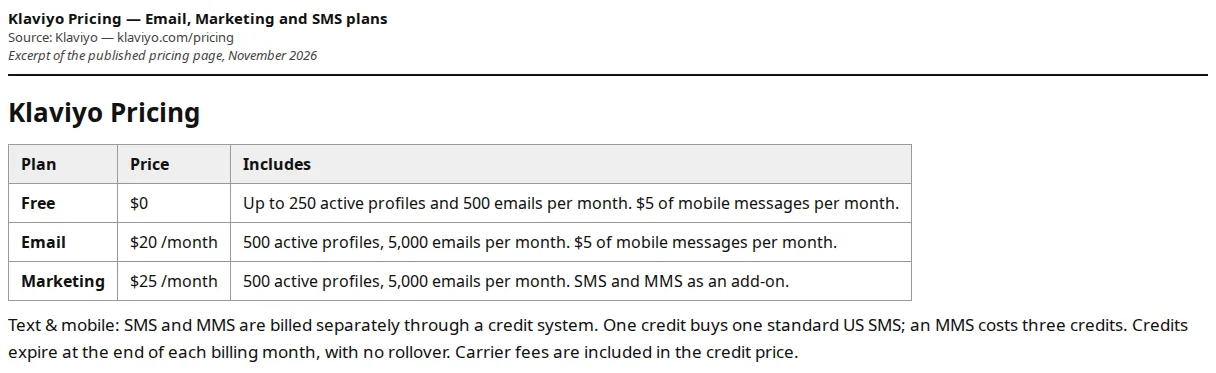
Klaviyo sells SMS as credits on top of an email plan. The free plan includes $5 of mobile messages a month; Email starts at $20 a month for 500 active profiles; Marketing at $25 a month; the combined Email + SMS plan at about $35 a month, including about 1,250 credits. One credit buys one standard US SMS of up to 160 characters; an MMS costs three. At scale the credit settles at roughly $0.009 to $0.012, and the pack ladder runs from 1,250 credits for $15 down to 10,000 credits for $90. Carrier fees are included in the credit price. Two catches decide the real cost: credits expire at the end of each billing month with no rollover, and a single emoji switches the encoding from GSM-7 to UCS-2, cutting the segment from 160 characters to 70.
Attentive publishes no rate card. Its pricing page states that pricing is based on the number of messages sent, subscriber list size, number of channels, and AI products selected, and describes the model as usage-based with no credit system. Unlike per-seat SaaS tools, none of the three vendors charges per seat. Everything else about Attentive's price comes from what brands report: roughly $0.008 to $0.012 per SMS segment, a platform fee of roughly $300 to $500 a month, quarterly minimums commonly reported at $2,000 to $3,000, and an effective monthly minimum around $1,000. Attentive bills per message and per response — inbound replies count toward the bill — and carrier fees are passed through at cost. Contracts are annual. None of those figures is Attentive-published; treat them as the range to test in the quote, not as a rate to budget against.
| Attribute | Postscript | Klaviyo SMS | Attentive |
|---|---|---|---|
| Published rate card | Yes — full ladder on the pricing page | Partial — plans published, credit ladder via packs | No — quote only |
| Entry point | $0/mo + $49/mo minimum spend | Free plan: $5 of mobile messages/mo | Annual contract, ~$1,000/mo minimum reported |
| US SMS rate | $0.009 / $0.008 / $0.007 by tier | ~$0.009–$0.012 per credit; 1 credit = 1 SMS | ~$0.008–$0.012 per segment, reported |
| US MMS rate | $0.045 / $0.03 / $0.024 | 3 credits (~$0.027–$0.036) | ~$0.02–$0.05, reported |
| Carrier fees | Added on top: $0.00435/SMS | Included in the credit price | Passed through at cost |
| Billing unit | Per message | Per credit, monthly expiry, no rollover | Per message + per inbound response |
| Sending number | Dedicated toll-free included | Toll-free / short code via plan | 10DLC / short code, brand registration |
| Contract | Month to month | Month to month | Annual, minimum spend |
| Authority | Postscript pricing page, Nov 2026 | Klaviyo pricing page, Nov 2026 | Attentive pricing page (model only); brand-reported rates, Sep–Oct 2026 |
The delivered cost at three volumes
The only honest comparison is the delivered cost: platform rate plus carrier fees, plus the base fee or minimum, at a stated volume. All three vendors send through the same US carriers — the difference is who absorbs the carrier fee and who adds a minimum on top.
At 10,000 SMS a month, Postscript Starter costs $49 minimum plus 10,000 × ($0.009 + $0.00435) — $49 plus $133.50, or $182.50 all in. Klaviyo costs the $35 Email + SMS plan, which includes 1,250 credits, plus roughly 8,750 extra credits at about $0.009 — about $113.75 all in. Attentive at reported rates costs 10,000 × $0.008 inside a roughly $1,000 monthly minimum — about $1,080 all in. At this volume Attentive is not a pricing decision; it is paying ten times the cheapest option for service and support.
At 50,000 SMS a month, Postscript Growth costs $100 plus 50,000 × ($0.008 + $0.00435), or $717.50. Klaviyo costs about 50,000 credits at roughly $0.009 — about $450, plus the plan base, with volume packs running toward $0.006 a credit. Attentive costs 50,000 × $0.008 inside the roughly $1,000 minimum — about $1,400 all in. The minimum still dominates.
At 250,000 SMS a month, Postscript Professional costs $500 plus 250,000 × ($0.007 + $0.00435), or $3,337.50. Klaviyo costs about 250,000 credits at roughly $0.009 — about $2,250, less with volume packs. Attentive costs 250,000 × $0.008 plus the roughly $1,000 minimum — about $3,000. Only at this volume does Attentive's reported rate compete, because the minimum finally stops being the whole bill — and a brand sending 250,000 texts a month has the retention team to use Attentive's conversational AI and two-tap signup units, the features that justify the quote, not the rate.
The segment trap: emojis and MMS
The per-message rate is a per-segment rate, and the segment is where budgets leak. A standard SMS in GSM-7 encoding carries 160 characters; add one emoji and the message switches to UCS-2 encoding, which caps the segment at 70 characters. A 140-character message with one smiley becomes two segments on Postscript and Attentive, and two credits on Klaviyo. An MMS costs three credits on Klaviyo and $0.045 on Postscript Starter against $0.009 for a plain SMS — roughly three to five times the price, before its higher carrier fee.
The fix is mechanical. Strip emojis from campaign copy unless the conversion lift is measured, count segments before sending, and reserve MMS for the messages where the image does the selling — a product shot in a back-in-stock alert, not a logo in a welcome text. Our email pricing comparison applies the same discipline to email. Run the segment math on your own volumes with our ROI calculator before committing to a tier: the difference between a 160-character message and a 161-character message is a second segment on every send.
Compliance: the consent that makes the send legal
No pricing comparison matters if the send is unlawful. Marketing texts to a US wireless number require the called party's prior express written consent under 47 CFR § 64.1200(a)(2), the FCC rule implementing the TCPA. The consent must be documented, name the seller, and be revocable — every message must carry a working STOP mechanism. The TCPA's private right of action, 47 U.S.C. § 227(b)(3), allows $500 in damages for each violation, or actual monetary loss if greater, and a court may treble the award — $1,500 per message — for a willful or knowing violation. At 50,000 sends, a consent failure is not a fine; it is a company-ending number.
The operational layer sits on top of the statute. US carriers require A2P 10DLC brand registration before a business can send application-to-person messages at volume; the one-time fee runs about $400, and every brand needs it. Email has its own authentication stack — SPF, DKIM and DMARC — and SMS has the same idea in a different form: 10DLC brand registration and a verified sending number, as our deliverability guide explains for the email side. Carrier guidelines also cap SMS abandonment messaging at one message per event, delivered within 48 hours — a rule that constrains the highest-ROI flow in ecommerce. All three vendors provide the tooling — two-tap opt-in, STOP/HELP handling, 10DLC registration — but the tooling does not create consent. The consent is created at the signup form, and the audit trail is the signup record, not the platform's dashboard.
Which vendor, at which size
Under 10,000 messages a month: Postscript Starter or Klaviyo. Postscript costs about $182.50 all in at 10,000 sends with no contract; Klaviyo about $113.75 if the brand already runs email on Klaviyo, because the credits ride on the existing plan. Attentive is not a rational choice at this volume — its reported minimum alone is roughly five times the entire Postscript bill. A brand choosing Klaviyo here should watch the credit expiry: buying 2,500 credits and using 800 forfeits 1,700.
10,000 to 100,000 messages a month: the contest is Postscript Growth against Klaviyo. Postscript's delivered cost at 50,000 sends is $717.50 with the carrier fee visible; Klaviyo's is about $450 plus the plan base, carrier fee included in the credit. The tiebreaker is the stack: Klaviyo wins when email and SMS share one list, one segment builder, and one flow engine — our email automation comparison shows how the email side prices at the same list sizes; Postscript wins when SMS is the primary channel and the brand wants the rate on the page. Judge both on subscriber lifetime value (LTV) against cost per acquisition (CPA), not on the rate alone. Attentive enters only when the brand wants a managed retention service with a dedicated strategist, and should be priced as a service, not compared as a rate.
Above 100,000 messages a month: negotiate. Postscript Professional at $3,337.50 for 250,000 sends and Attentive at about $3,000 reported are within 10% of each other, and Klaviyo's volume packs pull its per-credit cost toward $0.006. At this volume the per-message rate is the smallest variable — negotiate the minimum, the contract length, the AI add-ons, and the exit clause. For a subscription brand, judge the program on monthly recurring revenue (MRR) retained per subscriber against customer acquisition cost (CAC). Get the quote in writing, with the minimum, the overage rate, and the per-response billing stated, before the annual contract is signed.
Migration and exit
Switching SMS vendors is a consent migration, not a data export. The subscriber list, the opt-in records, and the 10DLC brand registration must all move; the registration is tied to the brand, not the vendor — but the sending number, the short code, and the keyword configuration are vendor-specific and take days to weeks to re-provision. For a Shopify store, the switch also touches the store stack — see our ecommerce platform comparison.
- Export the consent records first. Pull the subscriber list and every opt-in record as a CSV, with the consent timestamp, source, and wording for each number.
- Register the brand on 10DLC under the new vendor. The registration follows the brand, but the sending number and keywords do not; provision them early.
- Sync the list over the vendor API. Push the segments with API calls and JSON webhook payloads, and verify the counts match the CSV before any campaign.
- Cut over one flow at a time. Move the welcome flow first, then cart abandonment, then campaigns — and watch deliverability and reply rates for a week.
A brand on Attentive's annual contract cannot leave mid-term without paying the minimum, and a brand on Klaviyo cannot carry unused credits to the next vendor — they expire monthly anyway. Pick the vendor for the volume you will send in six months, not the volume you send today, and re-price the decision every quarter against the published ladders.
Execution checklist
- [x] Prove consent before the first send: prior express written consent on file for every number, with a STOP mechanism in every message, per 47 CFR § 64.1200(a)(2).
- [x] Register the brand on 10DLC: complete A2P brand registration before volume sending; budget the roughly $400 one-time fee.
- [x] Count segments, not messages: strip emojis, keep messages under 160 GSM-7 characters, and budget MMS at three times the SMS rate.
- [x] Price the delivered cost: platform rate plus carrier fees plus base or minimum, at your actual monthly volume — never the headline rate alone.
- [x] Mind the credit expiry: on Klaviyo, buy credits for the month you will send them in; unused credits expire with no rollover.
- [x] Get Attentive in writing: minimum, overage rate, per-response billing, contract length, and AI add-ons before signing.
- [x] Re-price quarterly: compare the ladder against your actual sends, and move tiers before the minimum costs more than the messages.
Founder & CEO Insight — Enow A. Jovial