The card is not the processor, and the fee is not the cost
A business that spends $120,000 a year on cards hands the issuers $2,400 to $3,600 in interchange. The question is how much comes back as points, cash, or statement credits — and whether the fee eats the return. The Stripe vs Square vs PayPal processing fees guide prices the other side of the same money — what the business pays to accept cards. This article prices what it earns by spending on them.
> [!KEY TAKEAWAY]
> At $120,000 the Amex Business Gold wins at $5,000.40 a year. At $600,000 the Business Platinum edges it at $19,925 against $19,670.40: the Gold's 4X caps at $150,000; the Platinum's 5X travel has no cap.
The six cards at a glance
The six: the Amex Business Gold ($375 a year, 4X on two categories) and Business Platinum ($895, 5X on Amex Travel); the Chase Ink Business Preferred ($95, 3X on four categories) and Ink Business Unlimited ($0, 1.5 percent on everything); the Capital One Spark Cash Plus ($150, refunded at $150,000 of spend) and Spark Cash ($0 the first year, then $95), both paying 2 percent on everything and 5 percent on Capital One Travel.
How the comparison is priced
Three valuation rules. Membership Rewards points are worth 1.5 cents each (Frequent Miler's transfer value). Ultimate Rewards points are worth 1.25 cents each via Chase Travel and 1.0 cent as cash back. Capital One miles and cash back are worth 1.0 cent each. These are valuations, not promises.
Two spend profiles carry the comparison. Profile A spends $120,000: $24,000 on advertising, $24,000 on software and cloud, $24,000 on travel via the issuer portal, $48,000 on general purchases, incl. $12,000 in $5,000+ single purchases. Profile B spends $600,000: $120,000 on advertising, $120,000 on software and cloud, $120,000 on travel, $240,000 on general purchases, incl. $120,000 in $5,000+ single purchases.
American Express Business Gold: the category card
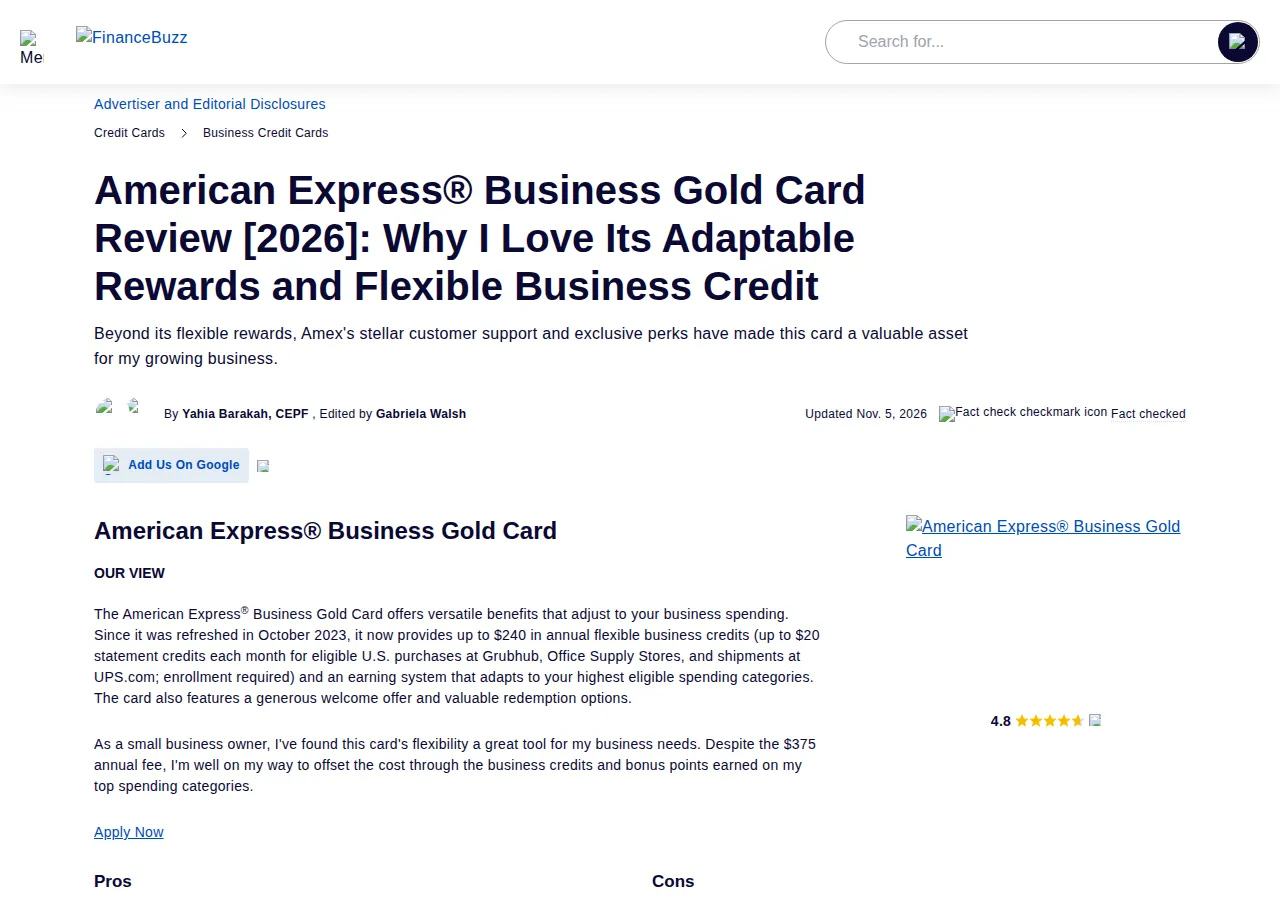
The Business Gold costs $375 a year and pays 4X Membership Rewards points on the two categories where the business spends the most each billing cycle, chosen automatically from six: U.S. advertising, gas stations, electronics and software, transit, restaurants, wireless. The 4X rate applies to the first $150,000 in combined purchases from those categories each calendar year, then 1X. Flights and prepaid hotels booked on AmexTravel.com earn 3X; everything else 1X.
Statement credits run up to $845.40 a year; the honest count is the credits the business will actually use: $240 Flexible Business Credit, $300 ChatGPT Business, $155.40 Walmart+, $150 Squarespace — $695.40 counted, the first three. From February 17, 2027, the 4X advertising and wireless categories count only at select merchants.
The welcome offer is variable: American Express's own page shows 70,000 points after $10,000 in three months; FinanceBuzz (updated November 5, 2026) reports as high as 200,000 points after $15,000 — the math uses the elevated offer. Employee cards cost $95 each for the first five. The card is a charge card with no preset spending limit.
American Express Business Platinum: the travel and large-purchase card
The Business Platinum costs $895 a year for new applicants, up from $695 (existing cardholders moved to $895 on renewal after December 2, 2025). It earns 5X on flights and prepaid hotels booked through Amex Travel, 2X at U.S. construction and hardware suppliers, electronic goods retailers, software and cloud providers and shipping providers, and 2X on each purchase of $5,000 or more. The 2X categories and $5,000-and-over purchases share a $2,000,000 cap per calendar year. Everything else earns 1X.
The welcome offer is as high as 300,000 points after $20,000 in three months — the standard public offer since the refresh is 200,000 — worth $4,500 at 1.5 cents a point. The card also pays a 35 percent points rebate on flights booked with points on one selected airline, up to 1,000,000 points back a year.
The credits counted are the three a traveling business will use without changing its habits: $600 prepaid hotel credits, $120 wireless service, $300 ChatGPT Business — $1,020 a year. The rest of the menu is upside, not counted: $1,150 a year from Dell, $250 Adobe, $360 Indeed, $200 Hilton, $209 CLEAR Plus, $200 airline fee credit. From February 17, 2027, the 2X shipping and wireless categories count only at select merchants.
Chase Ink Business Preferred: the transferable-points card
The Ink Business Preferred costs $95 a year and is the only card here whose points transfer to airlines and hotels. It earns 3X on the first $150,000 in combined purchases each account anniversary year in four categories: shipping, social media and search engine advertising, travel, and internet, cable and phone services. Past $150,000, 1X.
The welcome offer is 100,000 bonus points after $8,000 in three months, worth $1,250 via Chase Travel at 1.25 cents a point, or $1,000 as cash back. Points transfer 1:1 to fourteen airline and hotel partners, including United, Southwest, British Airways and Air Canada — except World of Hyatt, which moved to 4:3 from October 1, 2026: 1,000 points become 750 Hyatt points.
!Chase Ink Business Preferred: 100,000-point bonus, 3X categories, $95 fee
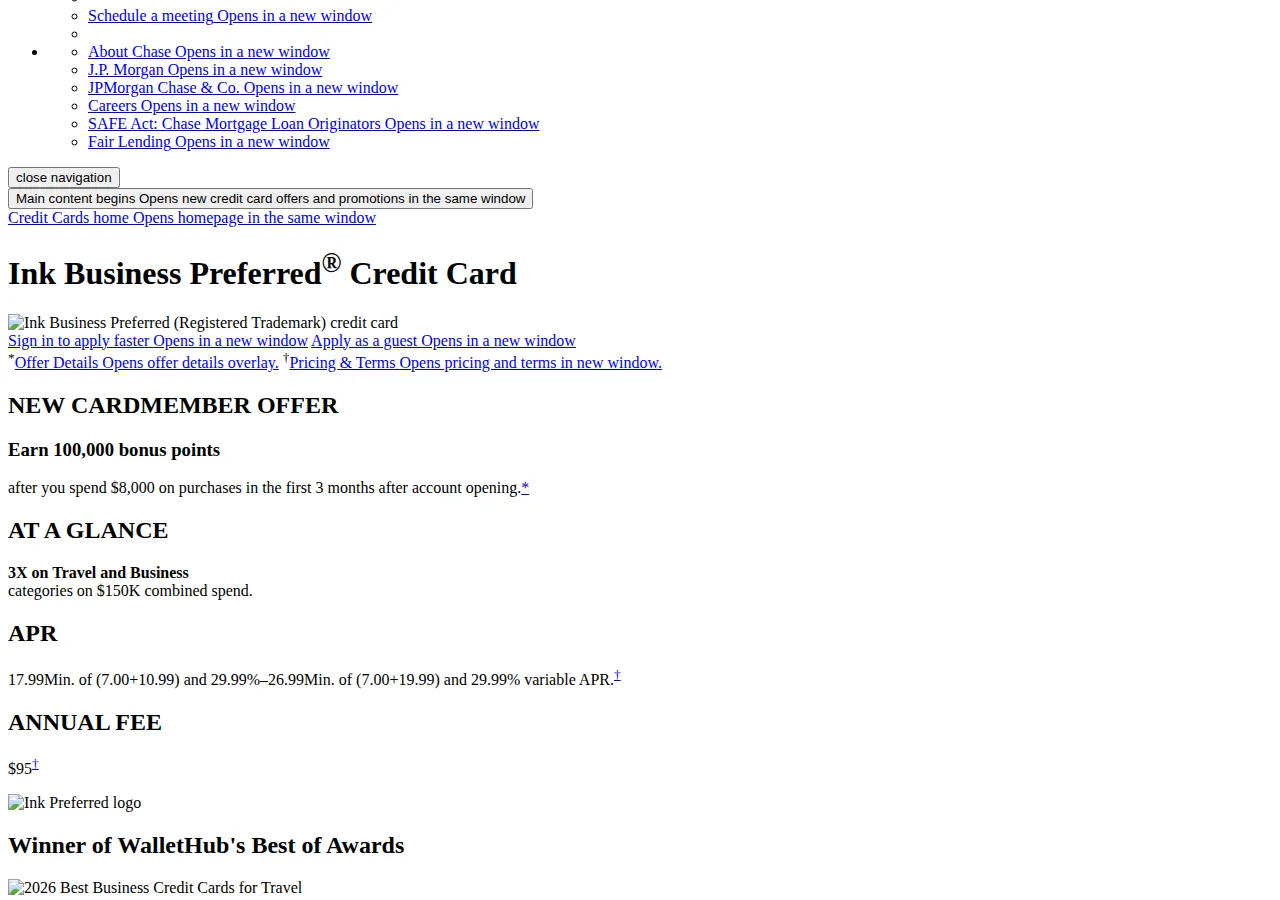
The card carries no foreign transaction fee, and employee cards cost nothing, with owner-set spending limits. Its weakness is the $150,000 cap, which binds in Profile B.
Chase Ink Business Unlimited: the flat-rate card
The Ink Business Unlimited costs nothing and pays a flat 1.5 percent cash back — 1.5X Ultimate Rewards points — on every purchase, with no caps and no categories. The welcome offer is $750 cash back, 75,000 points, after $6,000 in three months. A larger $1,000 offer ran from June 15 to September 17, 2026 and is no longer available.
The catch is the foreign transaction fee: 3 percent — a business spending abroad gives back twice the 1.5 percent it earns. The second catch is redemption: alone the points are worth 1 cent each as cash. They become worth 1.25 cents each only when pooled with an Ink Business Preferred or Sapphire card. The bonus may not be available to anyone who has held this card or another no-fee Chase business card; the card is subject to Chase's 5/24 rule.
Capital One Spark Cash Plus and Spark Cash: the cash cards
Capital One's two cash cards pay the same earn rate and differ on fee, welcome offer, and the spend threshold that erases the fee: unlimited 2 percent cash back on every purchase and 5 percent on hotels, vacation rentals and rental cars booked through Capital One Travel. The Plus has no preset spending limit and no foreign transaction fees.
The Spark Cash Plus costs $150 a year, refunded every year the business spends at least $150,000. Its welcome offer is $2,000 after $30,000 in three months, plus $2,000 more for every $500,000 spent in year one. The Spark Cash costs nothing the first year and $95 after that, with a $1,000 bonus after $10,000 in three months and a 24.74 percent variable APR.
!Amex Business Gold review: $375 fee, 4X categories
One Capital One card is missing on purpose: the Spark Miles for Business ($95 a year, 2X miles, 50,000-mile bonus after $4,500 in three months) is not on Capital One's own small-business cards page, which lists four other Spark cards and no Spark Miles card.
> [!WARNING]
> The Gold, the Platinum and the Spark Cash Plus are charge cards: the balance is due in full each month, except charges moved into Pay Over Time, which accrues interest. A business that cannot clear the statement monthly should not hold one for its earn rate.
Worked example: Profile A at $120,000 of annual spend
A card's annual net value is its rewards at the stated valuations, plus the statement credits the business will use, minus the annual fee:
$
\text{Net Value} = (\text{Points} \times \text{Value per Point}) + \text{Credits Used} - \text{Annual Fee}
$
$
\text{Net Rate} = \frac{\text{Net Value}}{\text{Annual Spend}} \times 100
$
Profile A spends $24,000 on advertising, $24,000 on software and cloud, $24,000 on travel via the issuer portal, and $48,000 on general purchases. The Gold: 4X on the $48,000 of advertising and software, 3X on travel, 1X on the rest — 312,000 points worth $4,680, plus $695.40, minus $375 — $5,000.40, a 4.17 percent net rate. The Platinum: 5X on travel, 2X on software and $12,000 of large purchases, 1X on the rest — 252,000 points worth $3,780, plus $1,020, minus $895 — $3,905. The Preferred: 3X on the $48,000 of advertising and travel, 1X on the rest — 216,000 points worth $2,700, minus $95 — $2,605. The Unlimited: 1.5 percent on $120,000 — $1,800, or $2,250 pooled. The Spark Cash Plus: 5 percent on travel, 2 percent on the other $96,000 — $3,120, minus $150 — $2,970. The Spark Cash: the same $3,120 minus $95 — $3,025 in year two; year one adds the $1,000 bonus, no fee.
Year one at Profile A: Gold $8,000.40 on the elevated offer ($6,050.40 on the 70,000-point offer); Platinum $8,405; Preferred $3,855; Unlimited $2,550; Spark Cash Plus $4,970; Spark Cash $4,120.
Profile B at $600,000 of annual spend: the caps decide
Profile B spends $120,000 on advertising, $120,000 on software and cloud, $120,000 on travel, and $240,000 on general purchases. Here the caps decide the ranking. The Gold: top two categories total $240,000, but 4X applies only to the first $150,000 — 600,000 points, 90,000 at 1X, 360,000 at 3X on travel, 240,000 at 1X on general spend: 1,290,000 points worth $19,350, plus $695.40, minus $375 — $19,670.40.
The Platinum: no cap on 5X travel — 600,000 points on travel, 240,000 at 2X on software, 240,000 at 2X on large purchases, 120,000 at 1X each on advertising and the rest: 1,320,000 points worth $19,800, plus $1,020, minus $895 — $19,925. The Preferred: 450,000 points on the capped $150,000, then 1X on the other $450,000 — 900,000 points worth $11,250, minus $95 — $11,155. The Unlimited: a flat $9,000, or $11,250 pooled. The Spark Cash Plus: 5 percent on travel, 2 percent on $480,000 — $15,600, fee refunded. The Spark Cash: $15,600 minus $95 — $15,505.
The Preferred loses $90,000 of category spend from 3X to 1X — 180,000 points, $2,250 at 1.25 cents each. The Gold loses $90,000 from 4X to 1X — 270,000 points, $4,050 at 1.5 cents each. The Platinum loses nothing to a cap, so it overtakes the Gold by $254.60 a year here after trailing by $1,095.40 at Profile A. Year one at Profile B: Platinum $24,425; Gold $22,670.40; Spark Cash Plus $19,600 (incl. $2,000 first-$500,000 bonus); Spark Cash $16,600; Preferred $12,405; Unlimited $9,750.
Which card for which business
| Business | Pick | Why | Authority |
| :--- | :--- | :--- | :--- |
| Ad-heavy agency | Amex Business Gold | 4X ads and software | Amex |
| Heavy traveler | Amex Business Platinum | 5X travel, 2X $5,000+ buys | Frequent Miler |
| Points transferrer | Chase Ink Business Preferred | 1:1 transfers, 1.25 cents | Chase |
| Flat spender | Chase Ink Business Unlimited | 1.5 percent, $0 fee | Chase |
| High-volume cash spender | Capital One Spark Cash Plus | 2 percent flat, fee refunded | Capital One |
| Cash-back business | Capital One Spark Cash | 2 percent earn, $95 fee | Capital One |
The five-step execution workflow
1. Pull twelve months of statements into a CSV export and total spend in four buckets: advertising, software, travel, everything else.
2. Run the profiles against the business's own totals: replace the $120,000 and $600,000 figures with the real annual spend. If the top two categories total more than $150,000, the Gold's 4X cap binds.
3. Apply for one card only, with the business's own identity: the Employer Identification Number, the legal name exactly as registered, and the owner's Social Security Number or Individual Taxpayer Identification Number as guarantor. A sole proprietor with no EIN applies with the SSN alone; an LLC, S-Corp or C-Corp with its EIN and formation documents.
4. Set the credits on enrollment day: the Gold's Flexible Business Credit, ChatGPT and Walmart+ credits; the Platinum's hotel, wireless and ChatGPT credits. Credits never enrolled are worth zero, and monthly ones do not roll over.
5. Move the recurring spend in the first month and set the statement to pay in full: advertising and software on the Gold, travel on the Platinum, the flat remainder on the Unlimited or Spark card. Reconcile monthly: export the CSV and check the points or cash posted against the rates here.
> [!TIP]
> Pair the cards: the Unlimited earns 1.5X where the Preferred earns 1X, and pooling lifts its points from 1 cent to 1.25 cents each — worth $450 a year at Profile A, and it costs nothing.
Set the card up as a business instrument, not a personal card
Apply with the EIN and route every charge through the business's own accounts so the CPA can reconcile it. An LLC, an S-Corp and a C-Corp each report the card differently, but all three need clean separation of business and personal spend: commingled charges turn a deductible expense into a disallowed one. The owner still signs as guarantor with an SSN or ITIN, and the issuer pulls the owner's personal credit. FICA and SECA do not change because of the card, but the rewards do change the books: treat them as a reduction of the expense they offset, not as revenue, and keep the GAAP treatment consistent. Export the statement as a CSV each month; if the system has an API, connect the feed, and keep the CSV as the audit trail.
> [!FOUNDER]
> "A rewards card is a pricing decision, not a perk. Run the ledger first — the fee, the cap, the redemption value — and the card picks itself. The business that chooses by the welcome bonus is buying a billboard; the business that chooses by the net value is buying a machine."
> — Enow A. Jovial, Founder & Chief Executive Officer
The verdict
No single card wins both profiles. The Gold wins under $150,000 of bonus-category spend; the Platinum wins above it; the Preferred wins for point transfers; the Unlimited is the best $0 second card; the Spark Cash Plus wins for cash above $150,000. Pick the card whose bonus categories match the ledger, set the credits on enrollment day, pay in full, and let the welcome bonus be the sweetener — never the reason. The line of credit versus term loan versus invoice factoring playbook prices the borrowing side for months when card rewards cannot cover a cash gap, the high-yield business savings playbook prices where to park the cash back, and the business loan calculator runs the monthly payment on any balance the business terms out.