High-Yield Business Savings Account Rates: The 2026 Playbook
A business checking account that pays nothing is a slow leak: payroll floats, tax reserves, and the quarterly cushion sit idle for weeks. The FDIC's national average rate for savings accounts was 0.38% as of October 19, 2026, and most business checking pays less, often nothing. The gap between 0.38% and the 3% range is this playbook's subject: on $100,000 of reserves it is $2,670 a year at American Express Business Savings alone.
This is the yield operation itself, not a platform comparison. The Mercury vs. Relay vs. Wise comparison weighs the platforms feature by feature and mentions APY twice in passing; this guide prices the yield. It runs the APY ladder across Mercury Treasury, Relay, American Express, Bluevine, and Capital One, states the FDIC sweep-network limit for each, names the balance and withdrawal gates, and works the math at $25,000, $100,000, and $500,000 from the vendors' own rate pages.
> [!KEY TAKEAWAY]
> Under $250,000, the best verified yields are Bluevine Premier at 3.3% APY and Relay Scale at 3.21% APY, both behind monthly fees; at $250,000 and above, Mercury Treasury's ladder pays 3.87% net of fees.
What APY actually measures
APY — annual percentage yield — is a year's earnings on a balance, assuming the interest compounds and stays in the account. The interest rate is the nominal rate applied at each compounding; the APY is what it becomes after a year. Relay publishes both: on Scale the rate is 3.16% and the APY is 3.21%, the difference being a year of daily compounding.
$
\text{APY} = \left(1 + \frac{r}{n}\right)^{n} - 1 = \left(1 + \frac{0.0316}{365}\right)^{365} - 1 \approx 3.21\%
$
Here $r$ is the 3.16% rate and $n$ is 365 daily compounding periods; the rate itself follows the Federal Funds target range. Treat every figure here as a photograph taken November 7, 2026.
FDIC insurance covers the failure of an insured bank, up to the SMDIA of $250,000 per depositor, per insured bank. A Treasury product is not a deposit: it carries SIPC protection, which does not cover market-value declines.
The rate ladder, November 7, 2026
| Account | APY, as listed | Gate to earn it | Authority |
| --- | --- | --- | --- |
| Mercury Treasury ladder, $250K–$2M | 3.87% net of fees | $250,000 across Mercury accounts | Mercury, 10/30/2026 |
| Relay Scale | 3.21% | Scale plan | Relay, 9/17/2026 |
| Amex Business Savings | 3.05% | None | Amex, 2026-11-07 |
| Amex Business Checking | 1.00% | None, to $500,000 | Amex, 2026-11-07 |
| Bluevine Premier | 3.3% | Premier plan, all balances | Bluevine, 2026-11-07 |
| Bluevine Plus | 1.75% | Plus plan, to $250,000 | Bluevine, 2026-11-07 |
| Bluevine Standard | 1.3% | Activity goal, to $250,000 | Bluevine, 2026-11-07 |
Capital One is absent from the table, and the absence is the honest gap: its page renders its promotional APY as a server-side variable, not as a number, so no Capital One rate is printed here. The structure is verified — three-month promotion, three balance tiers, 92-day expiry — and the number is not.
Mercury Treasury: the ladder for balances over $250,000
Mercury Treasury is the highest verified yield in this guide, and the least accessible. It opens only to businesses holding more than $250,000 across all Mercury accounts, it is an investment product run by Mercury Advisory, LLC, an SEC-registered investment adviser — not a bank account. The money sits in three rungs: the State Street Institutional U.S. Government Money Market Fund, Mercury Class (MRGXX), at 3.34% net of fees; ultra-short-term bonds (MCRYX) at 3.65%; and a U.S. Treasury ladder of up to 36 months at 3.87%, all at the $250,000–$2 million tier. At $20–$50 million the rungs pay 3.79%, 4.10%, and 4.32%. The fee runs 0.15% to 0.6% of monthly Treasury positions, already netted into the yields as of October 30, 2026.
!Mercury Treasury yield table showing net yields by deposit tier as of October 30, 2026
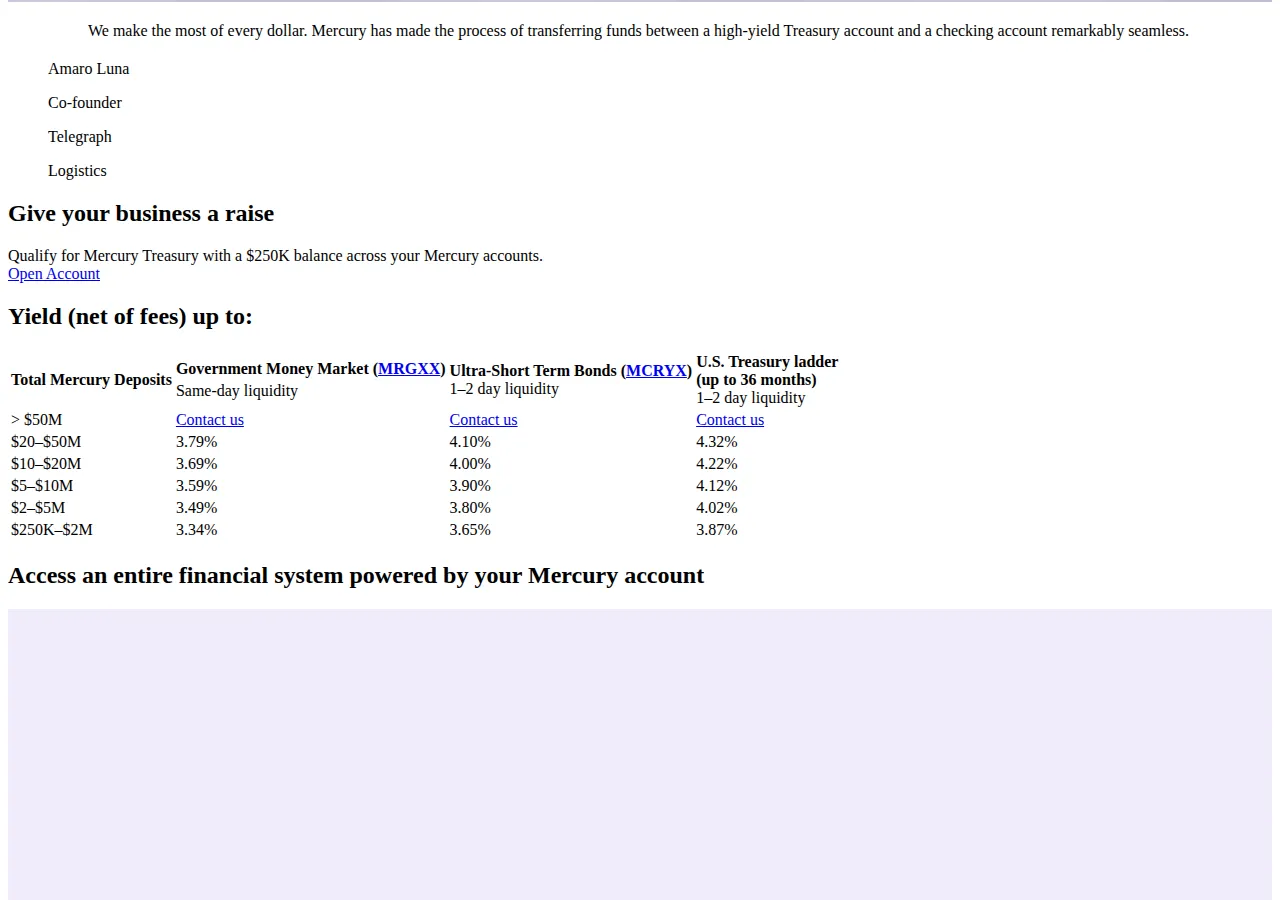
Liquidity follows the same ladder: same-day from the money market if the transfer starts by 3pm ET, one to two days from ultra-short bonds, the ladder last.
The insurance is the part operators most often misread. Treasury accounts are held in the business's name at Apex Clearing Corp, a FINRA-regulated broker-dealer, and covered by SIPC: $500,000 of securities and cash, at most $250,000 for cash. SIPC covers the brokerage firm's failure, not market-value declines. Operating cash that needs FDIC coverage belongs in Mercury's checking and savings accounts, insured up to $5 million through sweep networks.
Relay: the plan-priced yield
Relay prices its yield through its subscription plan: the APY you earn is a function of the plan you pay for. Starter costs $0 a month and pays 1.19% APY; Grow costs $30 and pays 1.87%; Scale costs $90, listed at $120, and pays 3.21%. The underlying rates are 1.18%, 1.86%, and 3.16%, accurate as of September 17, 2026 and variable with the Federal Funds target range. At $25,000, Scale's $802.50 of interest costs $1,080 in fees — it only pays for itself past about $34,000 of savings.
Relay pays interest from the first dollar, with no minimum balance, and its auto-transfer rules move excess cash into savings on a schedule the business sets. But the savings accounts are walled off: money in a Relay savings account cannot be used for card purchases or external payments. Relay is a financial technology company, not an FDIC-insured bank; deposits sit with Thread Bank, Member FDIC, insured up to $3 million, pass-through coverage subject to conditions. The cash conversion cycle and DSO reduction playbook is the companion read: faster collection creates the idle balance the auto-transfers sweep.
American Express: the no-gate 3.05%
American Express Business Savings is the simplest high yield in this guide, and the simplicity is the product. It pays 3.05% APY with no minimum balance and no monthly fee, interest compounded daily and deposited monthly. Business Checking pays 1.00% APY on balances up to $500,000, also with no minimum or monthly fee, and earns one Membership Rewards point per $2 on eligible Business Debit Card purchases. No activity goal, no tier, no fee to net out: $100,000 in Business Savings earns $3,050 in a year.
The caveats are short. The APY is variable: American Express may change the rate and APY at any time before or after the account is opened, without prior notice. The checking rate is stated only on balances up to $500,000. The figures carry no as-of date on the page — they are the values in American Express's own structured data as fetched November 7, 2026.
Bluevine: the activity goal and the fee trap
Bluevine pays interest on checking balances, so the yield sits where the operating cash already lives. Standard costs nothing and pays 1.3% APY on balances up to $250,000, but only when the business meets a monthly activity goal: spend $500 a month with the Bluevine Business Debit Mastercard, or receive $2,500 a month in customer payments. Plus costs $30 a month, pays 1.75% on balances up to $250,000, and has no activity requirement. Premier costs $95 a month and pays 3.3% on all balances, no cap, no requirement. All three carry FDIC insurance up to $3 million per depositor through Coastal Community Bank, Member FDIC, and its program banks.
The fee trap is arithmetic, not fine print. Premier's $95 a month is $1,140 a year. At $25,000, Premier earns $825 and loses $315 after the fee; at $100,000 it earns $3,300 and nets $2,160. Plus is gentler: $360 a year against $437.50 of interest at $25,000, a net $77.50. Standard cannot lose money on yield and earns $325 at $25,000 — more than Premier nets — if the activity goal is met.
> [!WARNING]
> Bluevine Premier at 3.3% APY loses $315 a year on a $25,000 balance after its $95 monthly fee; Relay Scale at 3.21% loses $277.50 after its $90 fee. Price the fee before the rate, every time.
Capital One: the promotion with a clock
Capital One Business Advantage Savings is the only product in this guide built around a promotion rather than a standing rate, and the promotion has a clock. It offers a three-month promotional rate, guaranteed for three months after opening, on three balance tiers — up to $9,999.99, $10,000 to $10 million, and above $10 million. The rate expires after three months — 92 days — at which point a variable standard rate applies, subject to change at any time without notice. New accounts only; Capital One may limit promotional accounts per business taxpayer ID number. Interest is compounded monthly; the fee is $3 a month, waived with a $300 balance; six free withdrawals per statement cycle.
The lesson is the expiry, not the rate. A three-month promotion is a 92-day window, and the business that opens the account for the promotional rate and then forgets the calendar holds a standard-rate account from day 93 onward. Use it as a timed parking spot for a known inflow.
FDIC insurance and the sweep network: what $250,000 actually means
The SMDIA — the standard maximum deposit insurance amount — is $250,000, set by 12 CFR § 330.1(o). At one bank, the rule aggregates: all single accounts owned by the same person are added together and insured up to $250,000, and a corporation's accounts are added together and insured up to the SMDIA under 12 CFR § 330.11(a). The FDIC states it the same way: a corporation's, partnership's, or unincorporated association's accounts at one bank are added together and insured up to $250,000, separately from the owners' personal accounts.
!FDIC deposit insurance coverage limits showing the $250,000 per-depositor per-bank aggregation rule

A sweep network spreads one deposit across several program banks, so the $250,000 limit applies separately at each one. The regulation that makes the pass-through work is 12 CFR § 330.7(a): funds owned by a principal and deposited in the name of an agent, custodian, or nominee are insured as if deposited in the principal's name. That is the rule behind the $5 million and $3 million coverage figures. Confirm in writing that the funds are held as the business's deposits at insured banks, with the total at any single program bank under $250,000. FDIC insurance covers the failure of an insured bank, never a money-market fund or Treasury ladder at a broker-dealer — Mercury Treasury sits on the investment side of that line, covered by SIPC instead.
The math at $25,000, $100,000, and $500,000
APY already includes compounding, so a year's earnings are the balance times the APY. The table prices the verified rates at the three balances, before fees, against the 0.38% FDIC national average; the net-of-fee figures follow it.
| Balance | Best verified gross yield | Annual earnings | Over the 0.38% FDIC average |
| --- | --- | --- | --- |
| $25,000 | Bluevine Premier, 3.3% | $825.00 | $730.00 |
| $100,000 | Amex Business Savings, 3.05% | $3,050.00 | $2,670.00 |
| $500,000 | Mercury ladder, 3.87% | $19,350.00 | $17,450.00 |
| $500,000 | Amex Business Savings, 3.05% | $15,250.00 | $13,350.00 |
$
\text{Annual earnings} = \text{Balance} \times \text{APY}
$
Net of fees, the ranking changes. At $25,000, Bluevine Premier nets −$315.00 and Relay Scale nets −$277.50, while American Express Business Savings nets the full $762.50 and Bluevine Standard nets $325.00. At $100,000, Bluevine Premier nets $2,160.00 and Relay Scale nets $2,130.00, behind American Express at $3,050.00. At $500,000, Mercury Treasury's ladder earns $19,350.00 net of its fees — the published yields are already net — while Bluevine Premier nets $15,360.00 and Relay Scale nets $14,970.00. Mercury Treasury is unavailable below $250,000.
Withdrawal gates and the liquidity ladder
Yield is priced against access, and each product gates withdrawals differently. Mercury Treasury runs three speeds — same-day, one to two days, next-day settlement — with market-value risk on early sales. Relay gates by account type: savings money cannot be spent by card or sent externally. Bluevine Standard gates by activity: miss the monthly goal and the 1.3% does not apply that month. Capital One gates by count: six free withdrawals per statement cycle.
Build a three-rung ladder: operating cash in a paying checking account, the tax reserve in a no-gate savings account, and balances above $250,000 in Mercury Treasury's ladder.
> [!TIP]
> Never fund a withdrawal gate with a credit line — the line's interest will exceed the deposit's yield by an order of magnitude.
The identifiers: what the account actually asks for
Opening any of these accounts asks for the same identifiers. The Employer Identification Number, the EIN, identifies the business to the bank and to the IRS; a sole proprietor without one uses a Social Security number instead. The formation documents name the entity type — LLC, S-Corp, or C-Corp — and the bank reads the operating agreement or articles of incorporation to confirm who may sign. Beneficial owners, anyone holding 25% or more, are identified under customer-due-diligence rules. The funding rails are ACH, wire, and debit card, and the interest is reported to the IRS as business interest income, taxable in the year it is credited. An S-Corp reports it on Form 1120-S, a C-Corp on Form 1120, a partnership on Form 1065, a sole proprietor on Schedule C. The FDIC limit follows the entity, not the tax election.
Execution checklist
1. Measure the idle balance: pull 90 days of statements; the lowest balance the account never drops below is the yield balance.
2. Price the fee before the rate: multiply the monthly fee by 12, subtract it from balance times APY — a negative result means the tier loses money.
3. Check the insurance map: list every bank where the business holds deposits, then confirm none is a program bank in the sweep network.
4. Open the no-gate account first: American Express Business Savings at 3.05% APY, or Relay Starter at 1.19% — move the tax reserve there this week.
5. Set the sweep: turn on Relay's auto-transfer rules, or a standing transfer the day after each receivables run. Price foreign-currency receivables in the currency converter first.
6. Calendar the gates: Bluevine's goal is monthly; Capital One's promotion expires in 92 days; Mercury's same-day withdrawals start by 3pm ET.
7. Re-price quarterly: re-check each vendor's rate page quarterly, re-run the fee math, and move the balance when the ranking changes.
> [!FOUNDER]
> "Idle cash is a decision, not an accident. Price the yield, net out the fee, check the insurance, and move the money — in that order, every quarter."
> — Enow A. Jovial, Founder & Chief Executive Officer