Accounts payable is the last place a growing company looks for profit and the first place its cash quietly leaks. Every vendor invoice must be read, checked against what was ordered and received, approved by the right person, scheduled, paid, and recorded. By hand, that chain takes days; automated, it takes minutes. This guide builds the operation: invoice capture, two-way and three-way matching, approval workflows, payment runs, early-pay discount capture, and duplicate-payment controls, with the pricing and tax timing that decide whether the system pays for itself.
Why it matters
Accounts payable is a working-capital lever, not a back-office chore. Pay too early and cash leaves the bank before it has to; pay too late and the company loses discounts and may pay a supplier twice for the same goods. The sister guide on the cash conversion cycle covers the receivable side of the same coin. AP automation keeps the payable side deliberate instead of accidental, and it decides the tax year of the deduction: under the accrual method, an expense is deducted in the year it is incurred, once the all-events test is met and economic performance has occurred (IRS Publication 538).
> [!FOUNDER]
> "Every founder I meet wants to negotiate harder with vendors. Almost none realise the negotiation already happened in the payment terms, and they lose it every month by paying late or paying twice. The discount line is the cheapest financing a small business will ever be offered."
> — Enow A. Jovial, Founder & Chief Executive Officer
The operation, end to end
A working AP operation has five stages. Capture: the system extracts vendor, invoice number, date, amount, and line items without retyping. Matching: the invoice is checked against the purchase order and the receiving record. Approval: the matched invoice routes to the person with authority for that amount. Payment: approved invoices are grouped into a payment run and released by rail. Reconciliation: the bank feed is matched to the payment run. The automated bank reconciliation guide covers that final stage.
Two-way matching compares invoice against purchase order. Three-way matching adds the receiving record: the goods were delivered, in the quantity stated, before money moves. It is the single most effective duplicate-payment control, because a duplicate invoice fails the match when its quantity has already been received once. Where no purchase order exists, for rent and utilities, the control shifts to approval thresholds and a vendor master file only a controller can change.
Capture: the invoice inbox
Give every vendor one address to send invoices to, backed by a system rather than a person. An AP inbox that forwards into the bill-pay platform removes the most common failure in manual AP: the invoice that sat in a personal mailbox while the discount window closed. Set three capture rules on day one: the platform must read the invoice number, vendor name, and total; the vendor master must reject a new vendor whose tax ID already exists under a different name; and any invoice over 5,000 dollars must carry a purchase-order number or a written exception from the budget owner. The invoice generator is the mirror image of this inbox: the tool a business uses when it sends the invoice.
Approval workflows that actually approve
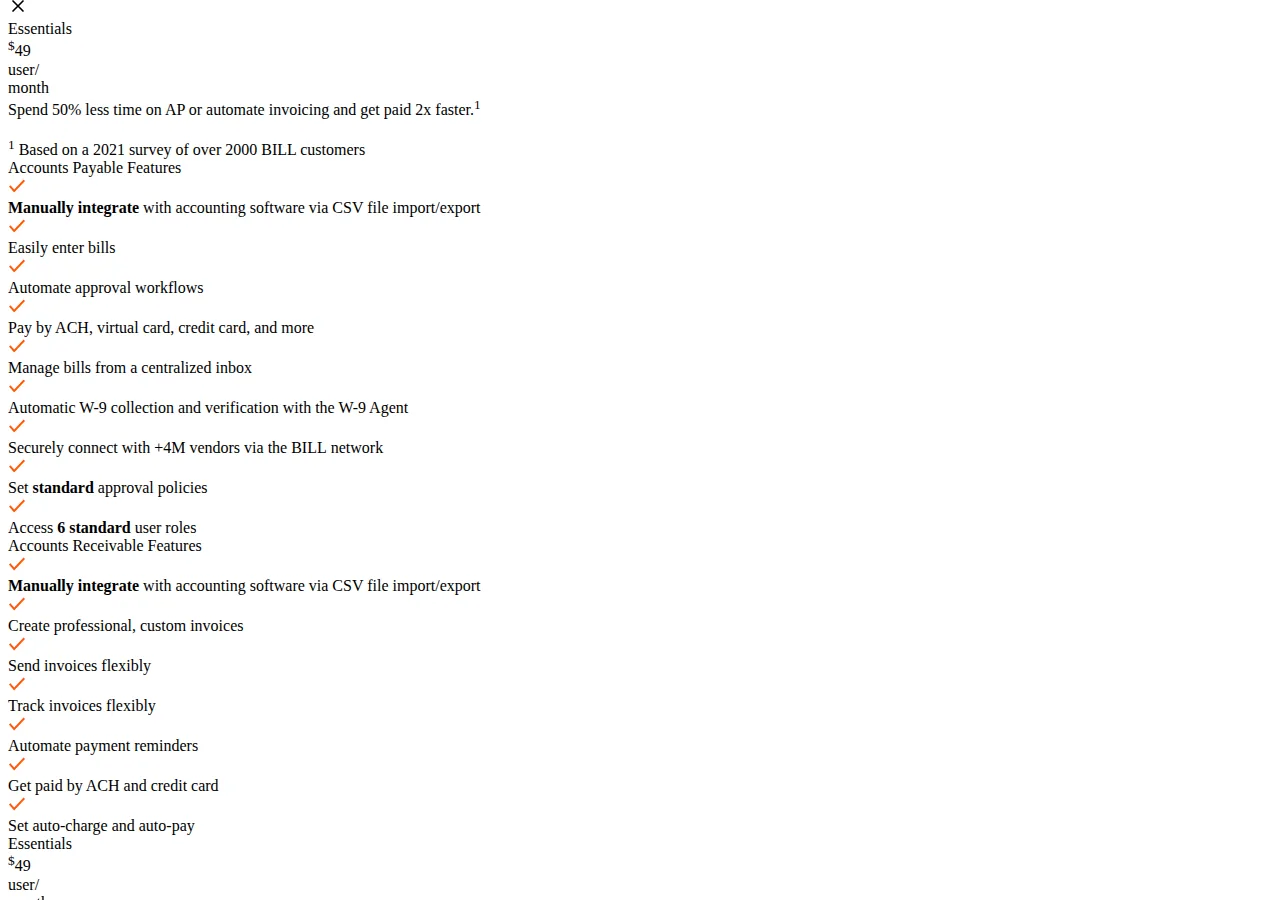
Set approval thresholds by amount and cost centre, in writing, before the first invoice arrives: the budget owner up to 1,000 dollars; the department head up to 5,000; the controller up to 25,000; anything above that needs the chief financial officer or the founder. Segregation of duties makes the matrix real: the person who enters the invoice must not approve it, and the approver must not release the payment. BILL builds this in: Essentials at 49 dollars per user per month includes standard approval policies and six standard user roles, and Team at 65 dollars adds granular controls and two-way sync. Ramp reserves payment release approvals and AI-driven recommendations for Plus at 15 dollars per user per month.
Track two numbers weekly: median hours from capture to approval, and invoices unapproved past their discount date. If the median is above 48 hours, the matrix is too tight; if invoices regularly age past their discount date, the queue costs more than the fraud control saves.
The early-pay discount: the cheapest money in the business
A 2/10 net 30 term means the vendor offers a 2 percent discount if the invoice is paid within 10 days, with the full amount due in 30 days. Most companies treat that as a small courtesy. It is the highest-return use of short-term cash a business will ever see.
$
\text{Discount captured} = \$10{,}000 \times 2\% = \$200
$
$
\text{Effective annual rate} = \frac{0.02}{1 - 0.02} \times \frac{365}{30 - 10} = 0.020408 \times 18.25 = 0.3724 = 37.24\%
$
Paying 20 days early to earn 200 dollars on a 10,000-dollar invoice is equivalent to earning 37.24 percent a year on the cash. The rule follows: if the business can borrow at less than 37.24 percent, it should borrow to take the discount; if it cannot borrow at all, it should still take the discount from operating cash whenever the balance allows. At volume the effect compounds: a company routing 50,000 dollars a month through 2/10 net 30 terms and capturing every discount keeps 1,000 dollars a month, or 12,000 dollars a year.
What automation costs, invoice by invoice
The honest comparison runs on subscription plus per-payment fees at a stated volume. Take a company processing 200 invoices a month with five AP users. BILL Team costs 5 users times 65 dollars, or 325 dollars a month, plus 200 ACH payments at 0.59 dollars, or 118 dollars: 443 dollars a month, or 2.22 dollars per invoice. Pay the same 200 invoices by paper check at 1.99 dollars each and the total rises to 723 dollars, or 3.62 dollars per invoice. Ramp Plus costs 5 users times 15 dollars, or 75 dollars a month, with free same-day ACH through Bill Pay: 0.38 dollars per invoice. Brex Premium costs 5 users times 12 dollars, or 60 dollars a month, or 0.30 dollars per invoice, with Essentials at zero dollars per user per month.
$
\text{Monthly AP cost} = (\text{users} \times \text{per-user price}) + (\text{invoices} \times \text{per-payment fee})
$
$
\text{BILL Team at 200 invoices} = (5 \times \$65) + (200 \times \$0.59) = \$325 + \$118 = \$443 \text{ per month} = \$2.22 \text{ per invoice}
$
The rail choice matters as much as the subscription. BILL charges 1.99 dollars to mail a check, 0.59 dollars for ACH, nothing for a virtual card payment, and 11.99 dollars for a Pay Faster ACH, while an instant payment costs 1.0 percent with a 9.99-dollar minimum and a 100-dollar maximum. A 10,000-dollar instant payment therefore costs the full 100-dollar cap, while the same payment by ACH costs 0.59 dollars. Reserve instant rails for genuine emergencies. Year-end 1099 filing: BILL charges 2.99 dollars per 1099 e-filed to the IRS, while Ramp charges 0.65 dollars per IRS filing with free state filing.
> [!KEY TAKEAWAY]
> The discount term is the decision. A 2/10 net 30 term pays 37.24 percent a year, so capture it first, then pick the platform and the payment rail on per-invoice arithmetic at the company's real volume, not the headline subscription price.
Duplicate payments: the control that pays for the system
A duplicate payment is an invoice paid twice, usually because the vendor sent it twice, once by email and once by portal, or because two staff members entered it on different days. The control stack is layered and cheap. First, the system must block a second invoice with the same vendor, invoice number, and amount, requiring a controller override with a written reason. Second, three-way matching must reject any invoice whose quantities have already been received. Third, the vendor master must be locked: only the controller adds or changes a vendor, and any change to bank details triggers a callback to a known number. Fourth, run a monthly duplicate report listing every pair of payments to the same vendor within 30 days for the same amount, reviewed by someone other than the AP clerk. A single caught duplicate repays months of subscription: a 4,800-dollar invoice paid twice and recovered after 60 days is 4,800 dollars of working capital absent for two months. A duplicate that is never caught is a straight loss.
Release payments on a fixed weekly schedule, not on demand. The controller checks the run total against the cash forecast, and the person who built the run cannot release it alone. Emergency payments outside the run need a written reason and a second approver.
Decision table: BILL vs Ramp vs Brex
| Factor | BILL | Ramp | Brex | Authority |
| :--- | :--- | :--- | :--- | :--- |
| Entry paid tier | Essentials, 49 dollars per user per month | Plus, 15 dollars per user per month | Premium, 12 dollars per user per month | Vendor pricing pages, 2026-11-06 |
| Free tier | Spend and Expense at 0 dollars per user per month; AP and AR are paid | Free tier at 0 dollars per user per month with approval workflows | Essentials at 0 dollars per user per month | Vendor pricing pages, 2026-11-06 |
| ACH payment fee | 0.59 dollars per payment | Free same-day ACH through Bill Pay | Not stated on the page opened this cycle | BILL and Ramp pricing pages, 2026-11-06 |
| Check payment fee | 1.99 dollars per check mailed | Not the default rail; wires and ACH are free | Not stated on the page opened this cycle | BILL and Ramp pricing pages, 2026-11-06 |
| Approval controls | Standard policies and six user roles on Essentials; granular controls on Team | Configurable workflows on Free; payment release approvals and AI recommendations on Plus | Workflows across tiers; advanced controls on Premium and Enterprise | Vendor pricing pages, 2026-11-06 |
| 1099 e-filing | 2.99 dollars per 1099 to the IRS | 0.65 dollars per IRS filing, free state filing | Not stated on the page opened this cycle | BILL and Ramp pricing pages, 2026-11-06 |
BILL is the dedicated AP platform: its vendor network of more than 4 million vendors and its W-9 collection agent suit companies with heavy vendor counts and complex accounting integrations. Ramp and Brex are spend platforms with bill pay inside them, winning when the company also wants corporate cards, procurement, and expense controls in one place. The tiebreaker is the invoice count and the rail mix at the company's own numbers. The collections side deserves the same rigour; the accounts receivable aging guide applies the same discipline to money coming in.
The tax timing rule, applied
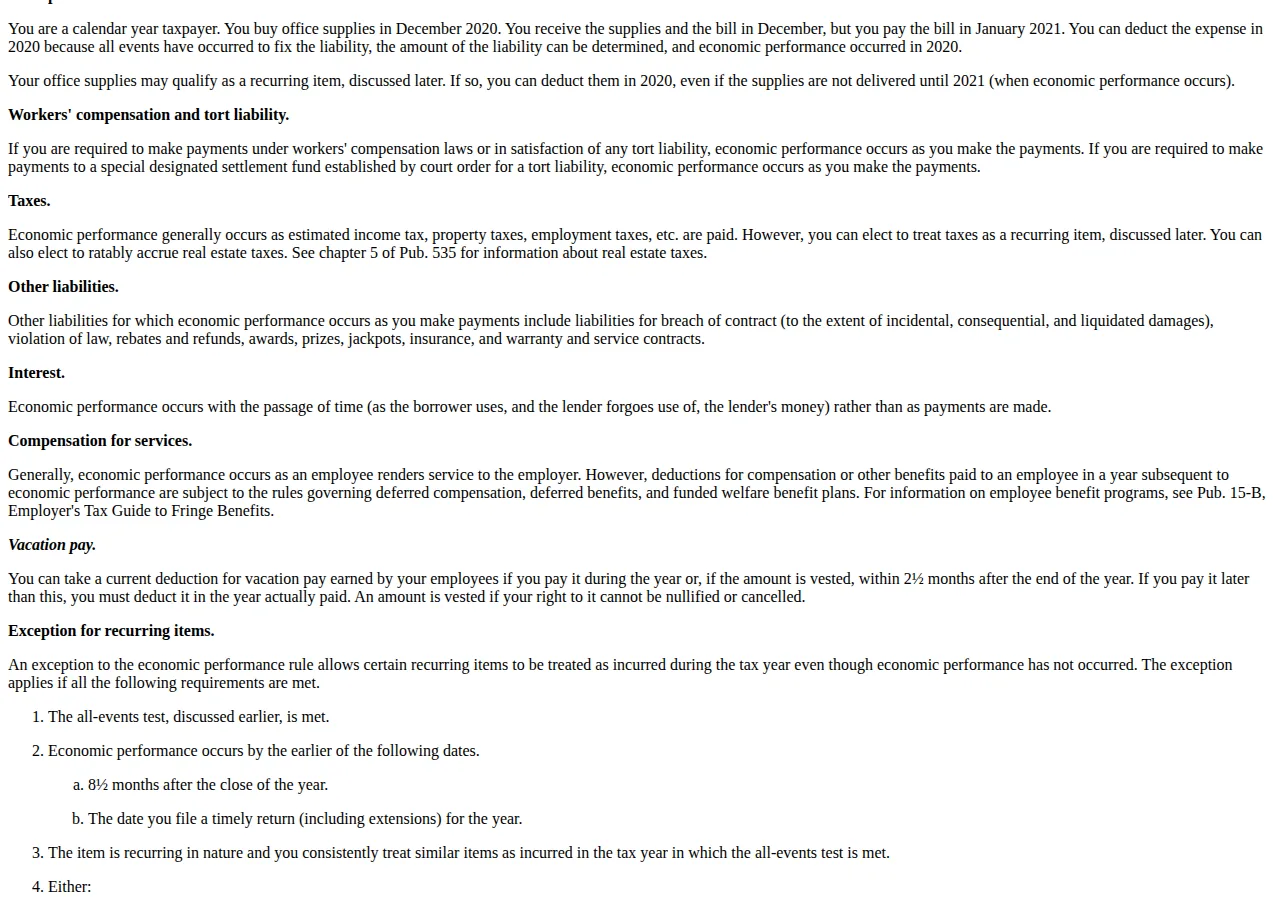
The deduction year and the payment year are different things, and confusing them is the most common AP tax error. Publication 535, the IRS guide to business expenses, was discontinued, with its last revision for 2022; the timing rules now live in Publication 538, Accounting Periods and Methods. Under the accrual method, expenses are deducted in the year they are incurred, regardless of when cash moves, once the all-events test is met and economic performance has occurred. Publication 538 gives the office-supplies case directly: supplies bought and received in December 2020, paid in January 2021, are deductible in 2020. For an AP operation, the invoice date and the receipt date are tax facts, and the payment date is not. Cash-method businesses face the opposite rule: the deduction follows the payment.
> [!WARNING]
> An AP platform does not choose the company's accounting method, and it does not fix a method mismatch. A cash-method business that deducts invoices on receipt understates income; an accrual-method business that deducts only on payment defers deductions it is entitled to. Confirm the method on the filed return first.
The weekly AP checklist
Operator boundaries: who this is for, and who should stay away
This operation fits a company processing at least 50 invoices a month with more than one person touching payments, a company that has already lost a discount or paid a duplicate, or a company whose founder still approves every payment personally and has become the bottleneck. It fits a business moving from cash to accrual accounting, because the AP system is where the accrual actually happens. It does not fit a sole trader with ten invoices a month, or a company with no purchase orders and no receiving discipline that expects software to invent controls the business refuses to adopt.
Who should NOT automate AP this quarter
A company mid-migration should not layer a new bill-pay platform on top of it; finish the migration, then connect AP. A company with no controller and no segregation of duties should not buy approval workflows it cannot staff; hire or contract the control function first. A company whose vendors are mostly one-off, low-value, and paid by card should not build an invoice pipeline for payments that never become invoices. And a company that has not fixed its vendor master should clean it first; automating payments to a dirty master accelerates payments to the wrong accounts.
> [!TIP]
> Start the discount capture before the platform purchase. Sort last quarter's paid invoices by vendor terms, add up every 2/10 discount that expired unpaid, and take that number to the founder. It is the budget for the automation, in money the company already spent.
Accounts payable automation is not a software purchase. It is a decision that invoices are tax facts on arrival, that discounts are financing to be captured, and that duplicates are losses to be prevented rather than recovered. Build the five stages and run the per-invoice arithmetic at the company's own volume.