Seven out of ten shoppers who add something to a cart leave without buying. The Baymard Institute, aggregating 50 independent studies and updating the figure in September 2025, puts the average online cart abandonment rate at 70.22%. For a store doing 1,000 carts a week, that is 702 abandoned carts a week. The question is which channel to chase them on, and in what order: email and SMS recover different shoppers at different prices, under different laws, and the wrong sequence burns the list you are trying to save.
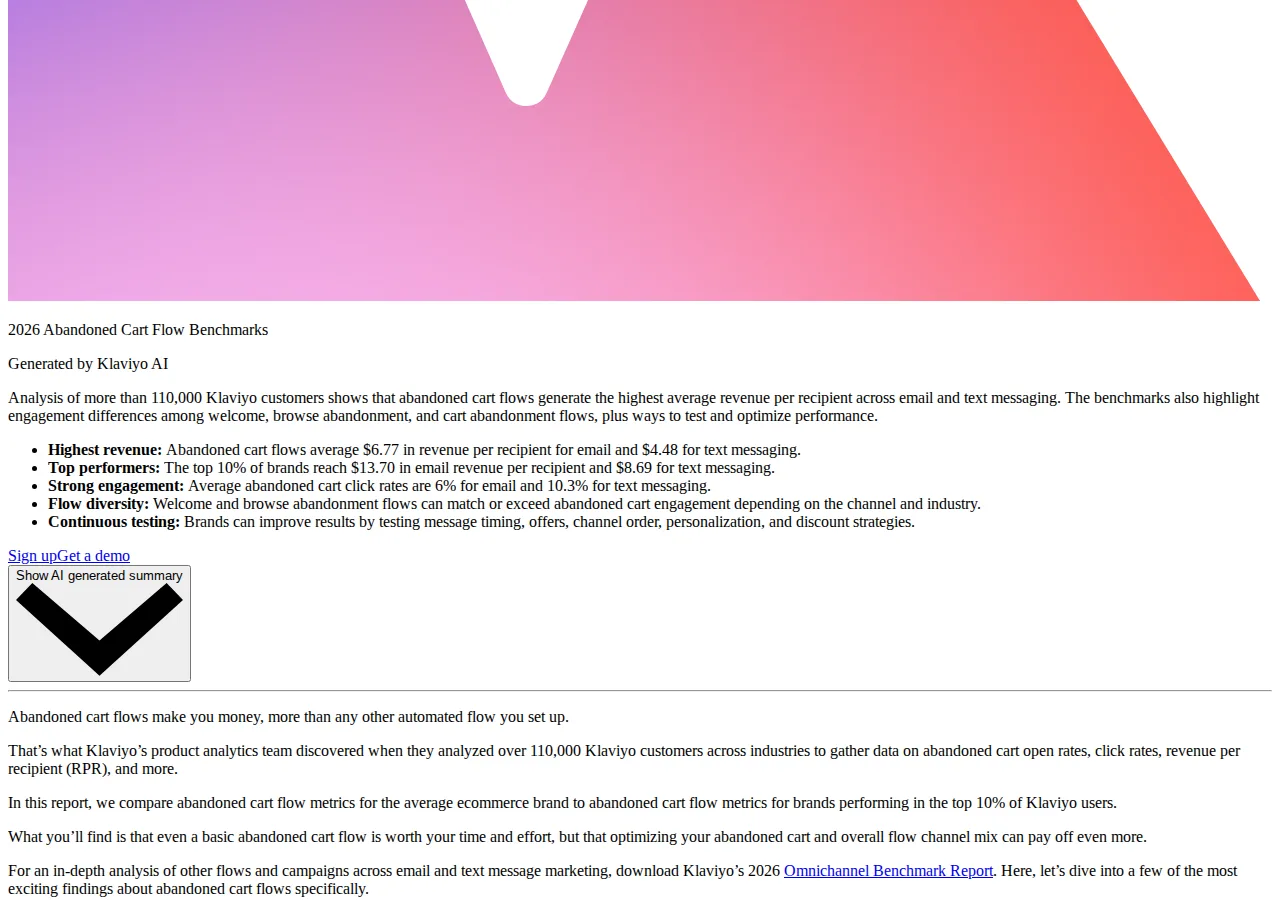
The short answer, from the largest dataset published on the question, is that neither channel wins outright. Klaviyo's 2026 abandoned cart benchmark report, built from more than 110,000 of its customers and published October 2, 2026, puts the average abandoned cart email flow at $6.77 in revenue per recipient, against $4.48 for text messaging — but the average click rate for the text flow at 10.3%, against 6% for email. The top 10% of brands widen both gaps: $13.70 per email recipient and $8.69 per text recipient. The operators who recover the most run both channels in one sequence, with one stop rule.
The abandonment baseline: 70.22% and what it means
A cart abandonment rate is the share of carts created that never become an order: one minus completed purchases divided by carts created, times 100. Baymard's 70.22% average, drawn from 50 studies with documented rates from 55% to 84%, is the number to plan against — a rough guide, not a target. Your own rate depends on your category, traffic mix, and how your analytics defines a cart:
The reasons shoppers leave are mundane, and mundane reasons are fixable. Baymard's checkout usability research identifies unnecessary form fields in the average checkout, and its most common abandonment reasons are extra costs at the final step, forced account creation, and a checkout that takes too long. Recovery flows cannot fix a checkout that surprises shoppers with shipping costs at the last screen — but they can recover the shoppers who left for a reason a message can answer: a shipping question, a discount, or a reminder while the shopper was still deciding.
A store that creates 10,000 carts a month at a 70.22% abandonment rate has 7,022 abandoned carts a month. If 60% are reachable by email — 4,213 recipients — and the store earns Klaviyo's average $6.77 per recipient, the email flow is worth about $28,500 a month. That figure is an illustration from Klaviyo's published average, not a promise: your revenue per recipient depends on your average order value, list quality, and offer.
Email vs SMS: the benchmark table
Klaviyo's 2026 benchmarks are the primary dataset here, because they measure the same flow on both channels across the same 110,000-plus customer base.
| Metric | SMS | Authority | |
|---|---|---|---|
| Revenue per recipient, average | $6.77 | $4.48 | Klaviyo 2026 |
| Revenue per recipient, top 10% of brands | $13.70 | $8.69 | Klaviyo 2026 |
| Click rate, average | 6% | 10.3% | Klaviyo 2026 |
| Placed order rate, average | 3.33% | Not published | Klaviyo 2024 |
| Open rate, average | 50.5% | ~98% (vendor-reported) | Klaviyo 2024; SMS platform reporting |
Three readings matter. First, email earns more per recipient because it carries more: a subject line, a product image, a full cart summary, and room for an objection-handling paragraph. Second, SMS wins on attention: 10.3% against email's 6%. Third, the channels reach different people: SMS lists are smaller, because texting requires explicit opt-in and each send costs money while email is nearly free. A store with 100,000 email subscribers may have 25,000 SMS subscribers — email reaches four times as many abandoners; SMS reaches a quarter of them, faster and harder.
The independent datasets agree on the shape. Omnisend's 2026 report has 1.72% of abandoned cart email recipients placing an order, against 1.51% in its 2025 report — lower than Klaviyo's 3.33%, because the samples differ in store size and category. No single recovery rate exists: it depends on who is in the sample, what counts as a recipient, and how long the attribution window runs.
The recovered-revenue math
And the cost side is:
Scenario: a store with 10,000 abandoned carts a month and a $120 average order value. Email reaches 60% — 6,000 recipients — and at Klaviyo's $6.77 average recovers about $40,620 a month. SMS reaches 25% — 2,500 subscribers — and at $4.48 recovers about $11,200 a month. Klaviyo reports that shoppers reached on both email and text during Black Friday Cyber Monday 2025 placed 11% more orders than shoppers reached on one channel, because the second channel catches the shoppers the first one missed.
Email costs a fraction of a cent per send at volume; SMS costs real money per segment, and a 160-character message with a link and a discount code can run to two segments. The break-even for adding SMS is not the click rate but the incremental revenue: the SMS step must recover more than it costs, after the email flow has already taken its share.
Email deliverability is the hidden variable in the revenue-per-recipient math: a flow that lands in spam earns $0 per recipient no matter what the benchmark says. The three DNS records that decide it are SPF, DKIM, and DMARC — SPF authorizes your sending servers, DKIM signs each message, DMARC tells receivers what to do with mail that fails either check. A store sending from a SaaS platform like Klaviyo through its API should publish all three and warm the sending IP. The same discipline applies to the CAC and LTV math: a recovered cart that cost $0.40 in SMS segments is cheap against a $120 average order value only if that customer returns — measure LTV over 90 days, not the first order, before scaling the SMS step. Run the same test on your own data, exported as CSV and joined on the customer ID, before committing budget.
For a full treatment of how the email channel itself is priced and built, see the Klaviyo vs Mailchimp vs ConvertKit comparison, and for the platform the recovery flow runs on, the Shopify vs WooCommerce vs BigCommerce comparison.
The sequence: timing, order, and the stop rule
Klaviyo's own setup guidance recommends two to three messages in an abandoned cart flow: the first two to four hours after checkout starts, the second 20 to 48 hours later. The reason is behavioural: the first message catches the shopper who was interrupted, the second catches the shopper who was deciding.
- Hour 0–4, email first — The cart reminder goes by email, which reaches the most abandoners at the lowest cost and carries the full cart. No discount in the first message.
- Hour 1–3, SMS only where opted in — One short text to subscribers who did not open or click the email. No discount, just the cart link.
- Hour 20–48, email with the objection handled — The second email answers the reason the shopper left: shipping cost, returns, or a delivery question. A discount appears here, if at all, as a fixed amount.
- Stop on purchase, always — The flow ends the moment the order is placed. A recovery message that arrives after the purchase is evidence the store does not know its own customer.
One rule governs the whole sequence: one recovery sequence per cart, not one per channel. Klaviyo's own setup guide says to turn off the abandoned cart messages sent by your ecommerce platform when you run the flow in Klaviyo, because duplicate reminders teach a shopper that your messages are noise.
The law: TCPA consent is the gate, not the fine print
SMS recovery is the most regulated marketing a store will ever send, and the regulation is the reason SMS lists are small. Under the Telephone Consumer Protection Act, 47 U.S.C. § 227, a marketing text sent with automated technology requires prior express written consent — a signed written agreement that names the seller, authorizes marketing messages to a specific number, and states that consent is not a condition of purchase, as defined in the FCC's rules at 47 CFR 64.1200(f)(9). A checkout checkbox and a phone number collected for shipping updates do not meet it. The consent must be for marketing texts, from that seller, to that number, in writing.
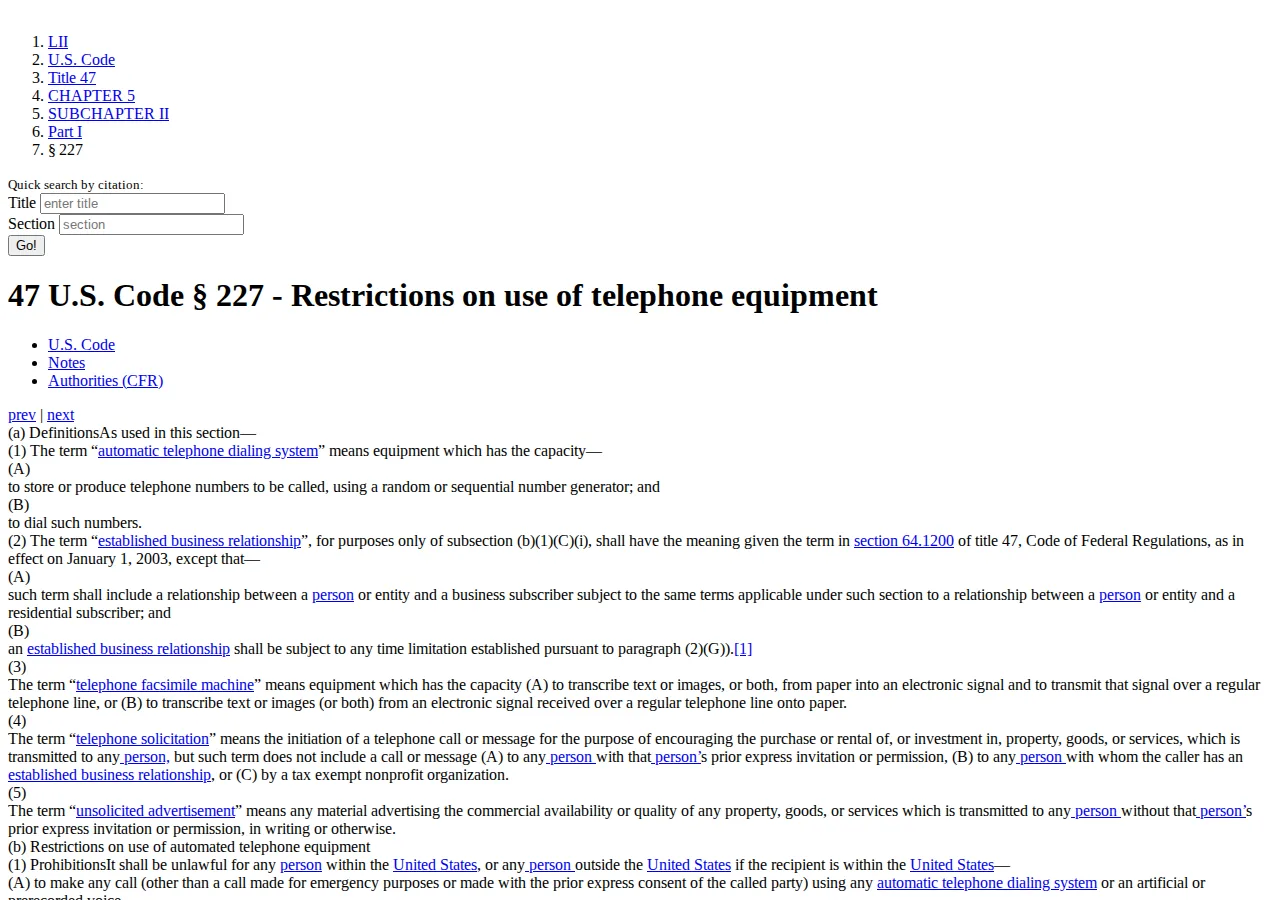
The penalties are what make the consent rule a business decision rather than a compliance footnote. The TCPA provides statutory damages of $500 per message, and up to $1,500 per message if the violation was willful or knowing, under 47 U.S.C. § 227(b)(3). One recovery sequence sent to 10,000 numbers without valid consent is a $5 million exposure. Federal rules also bar marketing texts outside 8 a.m. to 9 p.m. recipient-local time, and since April 2025 a business must honor a request to stop texts made by any reasonable method, within 10 business days, with STOP and similar keywords triggering immediate revocation.
Two recent developments change the planning. The FCC's December 2023 order would have required one-to-one consent — each consumer's consent naming one specific seller — but the Eleventh Circuit vacated that rule on January 24, 2025, in Insurance Marketing Coalition Ltd. v. FCC, so the older written-consent standard remains the federal rule. New FCC rules taking effect November 25, 2026 will let a sender designate an exclusive opt-out method, such as STOP replies, if disclosed clearly in each message.
Who should not run SMS recovery
SMS recovery is not for every store. A store with fewer than 1,000 SMS subscribers should not build a two-channel sequence. A store selling to the European Union should not run SMS recovery on the US model at all: first-party consent collected on-site is the only compliant basis for recovery SMS in EU markets under GDPR. And a store whose email flow is not yet working — open rates below 30%, no stop rule, duplicates still firing — should fix email first: SMS amplifies whatever the email sequence already does wrong, at a higher cost per mistake.
The same discipline applies to discounting: a 15% code in the first recovery message trains shoppers to abandon every cart and wait for the code. The discount belongs in the second message, as a fixed amount — if the flow's revenue depends on the discount rather than the reminder, the store has a pricing problem, not a recovery problem.
Founder & CEO Insight — Enow A. Jovial
The operator sequence
- Measure the baseline — Count carts created and abandoned for 30 days; split abandoners into emailable, SMS-subscribed, and unreachable.
- Build the email flow first — Two to three messages: a reminder at 2–4 hours, an objection-handling message at 20–48 hours, no discount in message one.
- Add the SMS step second — One text, 1–3 hours after abandonment, only to opted-in subscribers who did not engage with email one.
- Prove the consent record — Hold the timestamp, form, and disclosure text for every SMS subscriber, satisfying 47 CFR 64.1200(f)(9).
- Turn off the duplicates — Disable the platform's own abandoned cart messages and any second recovery app.
- Set the stop rule — Purchase ends the sequence on both channels, immediately. Test it with a real order first.
- Price the sequence monthly — Run the recovered-revenue formula per channel, subtract the per-message cost, and publish the net figure.
Operator checklist
- [x] Baseline measured — 30 days of carts created and abandoned, with the abandonment rate and the emailable/SMS/unreachable split.
- [x] Email flow live — Two to three messages, first at 2–4 hours, second at 20–48 hours, no discount in message one.
- [x] SMS step segmented — One text, 1–3 hours, only to opted-in subscribers who did not engage with email one.
- [x] Consent records held — Timestamp, form, and disclosure text for every SMS subscriber, meeting 47 CFR 64.1200(f)(9).
- [x] Stop rule tested — A real order ends the sequence on both channels before go-live.
- [x] Net revenue published — Monthly recovered revenue minus channel cost, per channel.
The recovery flow is the cheapest revenue a store can buy, because the shopper has already done the expensive part: choosing the product. The 70.22% who leave are not lost; most were interrupted, deciding, or waiting for one answer. Email reaches the most for the least money, SMS reaches the fastest while they are still deciding, and one sequence across both channels — with a stop rule and a consent record — recovers more than either channel alone. Build email first, add SMS second, and let your own numbers decide how much of each your store needs. For the landing-page work that lowers the abandonment rate before recovery ever fires, see the landing page conversion rate optimization playbook, and to price the recovered revenue against your own costs, run the numbers through the ROI calculator.