A $10,000 transfer to London can cost $23 or $200, and the fee line will not tell you which. Wise shows a fee and a clean mid-market rate; OFX a zero fee and a rate of its own; Xe fees from $0 and a rate that appears only when you build the transfer. The price is a fee plus a margin buried in the rate plus rail charges. This playbook prices all three on the same transfers, from the vendors' own pages.
The cost formula: three lines, not one
Every transfer has three cost lines: the explicit fee on the quote, the FX margin (the gap between the rate you receive and the mid-market rate), and the rail cost — what the banks along the way deduct. Total cost is the sum of all three, and the only number that matters is what lands.
Wise charges the first line and sets the second to zero; OFX and Xe charge the second and set the first to zero. Comparing fee lines is meaningless: a $0 fee with a 1.5% margin costs $150 on $10,000, while a $43 fee with no margin costs $43.
The break-even rule: OFX beats Wise only when its quoted margin is smaller than Wise's effective fee percentage. At $10,000 to GBP, Wise costs $43 to $59 at the reported corridor range, so OFX must quote below roughly 0.43% to 0.59% to win — and its reported range starts at 0.4%, so the live quote decides.
Wise: the fee is the price, and the rate is the market
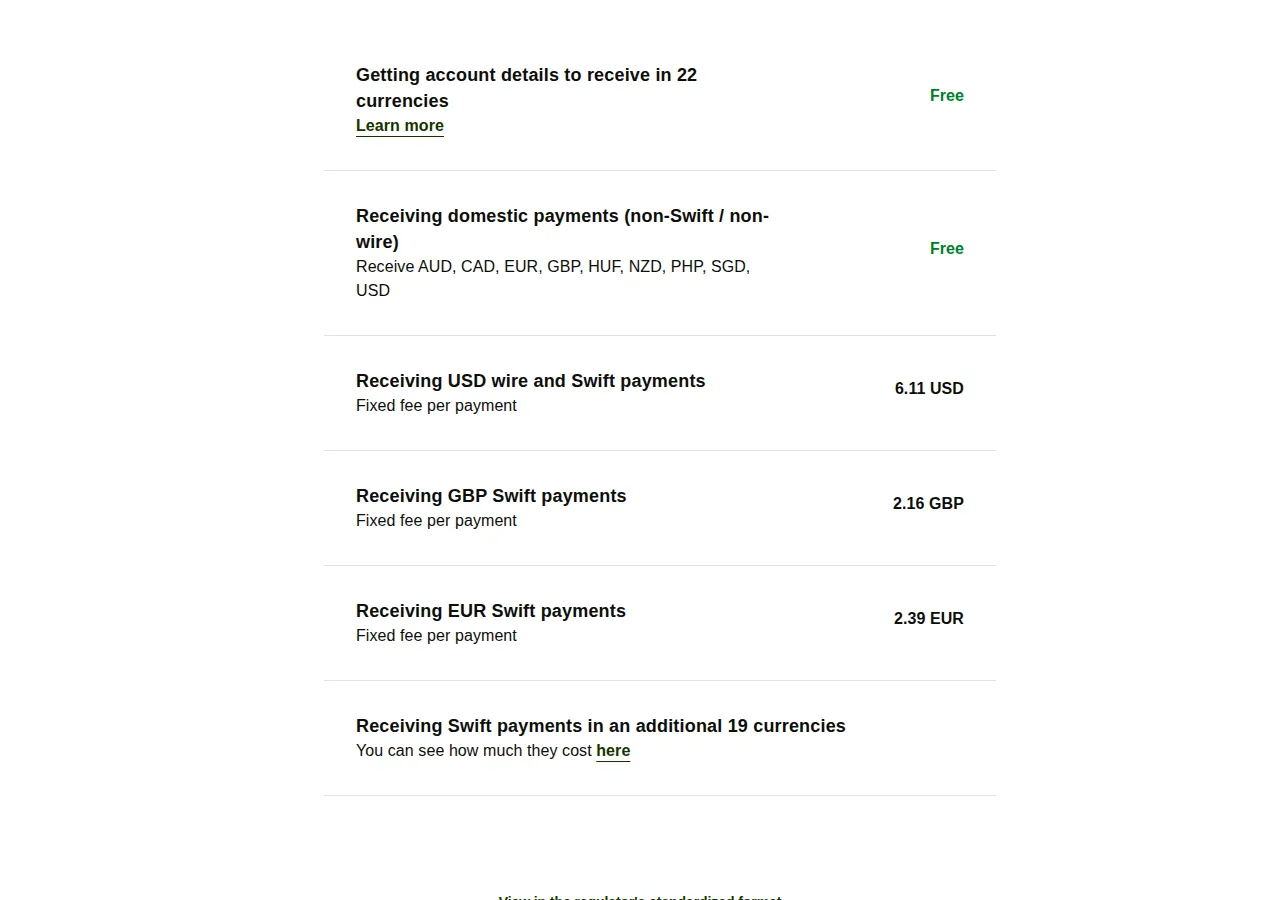
Wise's US pricing page states its model in one line: "We only use the mid-market rate — the one you can check on Google." The fee is charged separately, from 0.23% for sending and converting money. Registration and domestic receipts in nine currencies are free, as are account details in 22 currencies. The page also publishes the fees most comparisons miss: a USD wire or SWIFT receipt costs a fixed $6.11 per payment, a GBP SWIFT payment £2.16, and a EUR SWIFT payment €2.39.
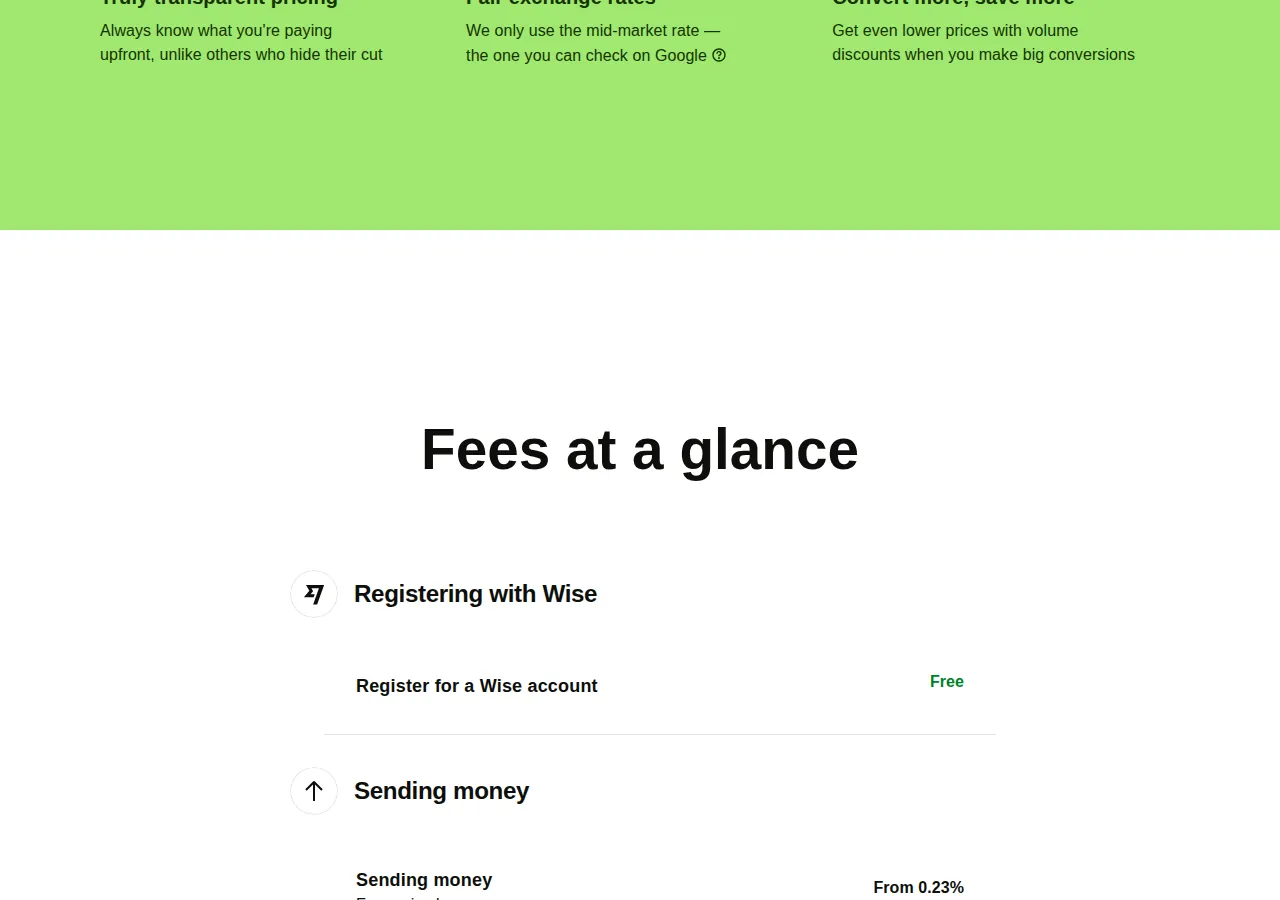
The corridor matters. Wise's published floor is 0.23%, but the actual USD to GBP fee reported by third-party analyses of live quotes runs about 0.43% to 0.59%. USD to EUR runs about 0.41% to 0.55%. Those are third-party reported ranges, not Wise-published tables; Wise quotes the exact fee live before you confirm. The math below runs at both.
The $6.11 wire-in fee is the easiest way to overpay Wise: a $1,000 transfer funded by SWIFT wire carries $6.11 before conversion — 0.61% on top of the fee. Funded by domestic ACH, the receipt is free.
OFX: zero fee, and the price lives in the rate
OFX's own personal page shows its model in a working example: on a $10,000 USD transfer the widget displays an OFX fee of $0.00, an amount to be converted of $10,000.00, a customer rate of 0.8888, and a converted amount of €8,888.00. The $0.00 fee line is the structural fact the widget proves. The 0.8888 rate needs a caveat: it is the rate on the page's example widget, not a live quote. Against the ECB reference rate of 0.90481 EUR per USD for 13 November 2026 it sits 1.77% below mid-market — the example's own arithmetic, not a measured margin.
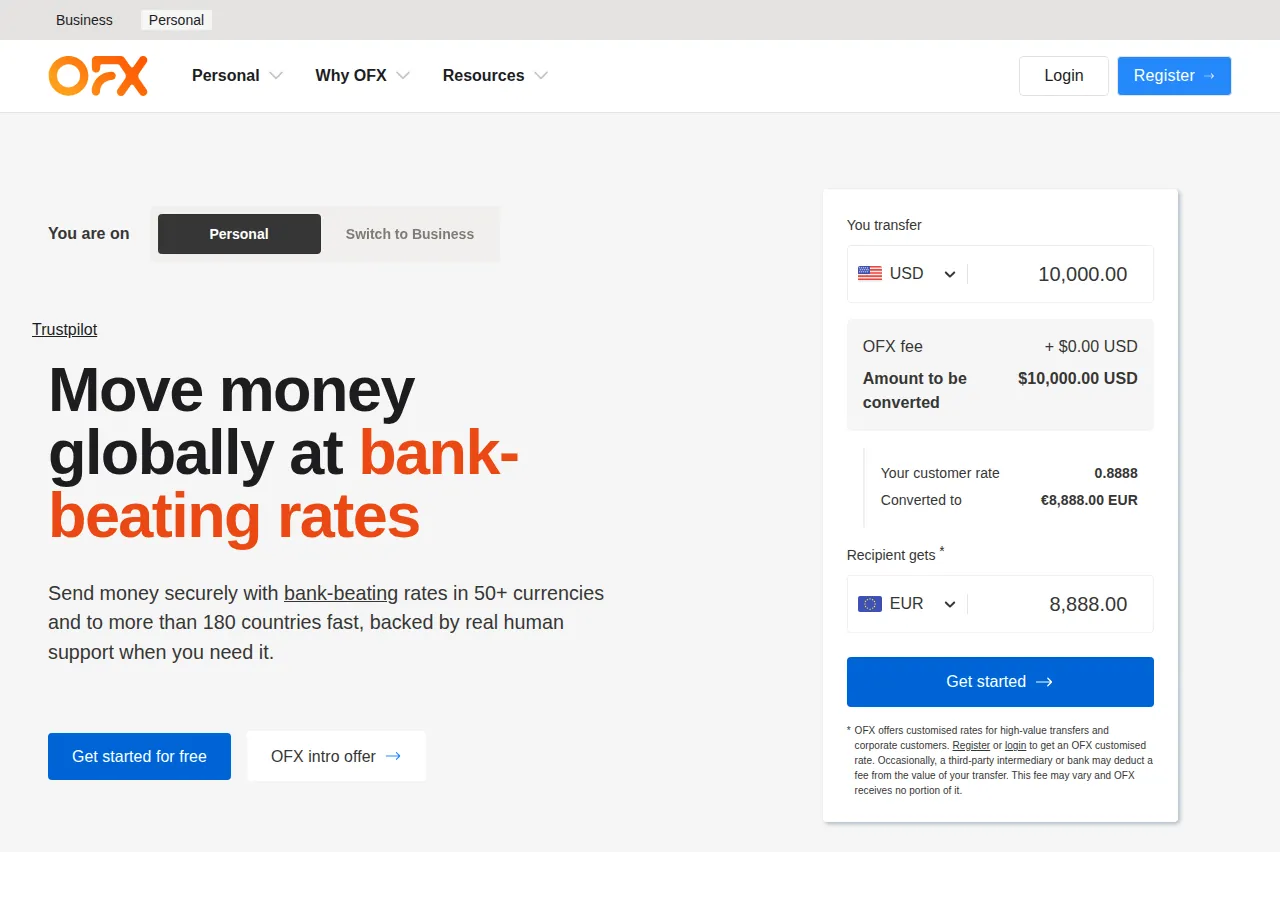
What OFX does publish is the rest of its structure: forward contracts fix a future rate for up to 12 months, limit orders execute at a target rate, and the service covers 50-plus currencies and 180-plus countries with over 1 million customers and A$293 billion moved. OFX is regulated by FinCEN and US state regulators, NMLS 1021624, and states that a third-party intermediary or bank may deduct a fee that OFX receives none of.
The margin is where OFX makes its money, and it is not published. Third-party reporting puts it typically at 0.4% to 2%, narrowing as the transfer amount grows. An October 2026 comparison measured OFX about 2.2% below interbank at $1,000 and 1.4% at $10,000 on an Australian corridor — a datapoint, not US pricing. OFX also has a minimum transfer of $1,000, reported by third parties: it is not built for small remittances. There is no maximum; transfers often exceed $500,000.
Xe: the broadest payout network, and an unpublished margin
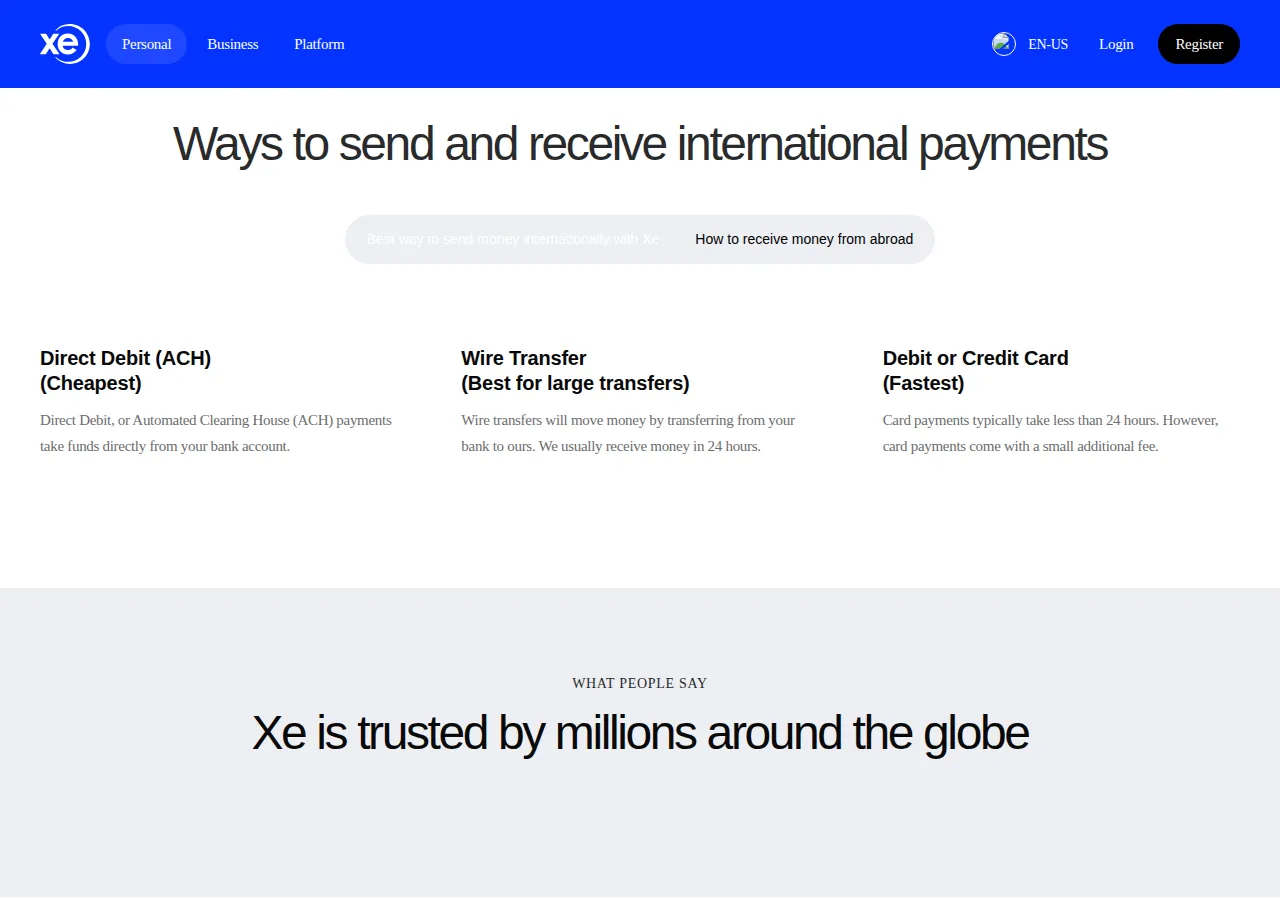
Xe's send-money page leads with reach: transfers to over 170 countries in more than 100 currencies, including mobile wallets, bank accounts, and cash pickup. Fees start at $0. Most transfers arrive in minutes, though bank-account delivery typically takes 1 to 3 business days after Xe receives your payment. Direct Debit, or ACH, is marked cheapest; wire transfer is marked best for large transfers, with Xe usually receiving the money in 24 hours; debit or credit card is marked fastest, typically under 24 hours with a small additional fee. Bank-account delivery has no additional fees. Cash pickup runs through 500,000-plus locations; mobile wallet delivery can land in minutes.
Xe reports over $115 billion processed across 25-plus years, as part of Euronet Worldwide, and is licensed by the FCA, FinCEN, FINTRAC and ASIC, among others; its US licence is NMLS ID 920968. What Xe does not publish is its margin. The rate appears only when you build a transfer, so no honest comparison can print an Xe margin figure. Use break-even math: compute the margin at which Xe would beat Wise, then read it off the live quote before confirming.
Worked math: $1,000, $10,000 and $50,000 on the same day
All figures use the ECB reference rates for 13 November 2026: 1 euro equals 1.1052 US dollars and 0.83559 pounds, giving USD to EUR 0.90481 and USD to GBP 0.75605. Wise's fee comes off the send amount; OFX is a margin with no fee. Reproducible reference figures, not live quotes.
$1,000 USD to GBP: £756.05 before fees
| Provider | Cost | Delivered |
|---|---|---|
| Wise 0.23% | $2.30 | £754.31 |
| Wise 0.43%–0.59% (third-party) | $4.30–$5.90 | £752.80–£751.59 |
| OFX 0.4% (third-party) | $4.00 | £753.03 |
At $1,000 the spread is about £3, and OFX is at its $1,000 minimum — the smallest transfer it will accept.
$10,000 USD to GBP: £7,560.53 before fees
| Provider | Cost | Delivered |
|---|---|---|
| Wise 0.23% | $23.00 | £7,543.14 |
| Wise 0.43%–0.59% (third-party) | $43.00–$59.00 | £7,528.02–£7,515.92 |
| OFX 0.4% (third-party) | $40.00 | £7,530.29 |
| OFX 1.4% (measured Oct 2026) | $140.00 | £7,454.68 |
At $10,000 the providers cross: Wise delivers £7,515.92–£7,528.02 at its corridor range; OFX delivers £7,530.29 at 0.4% and £7,454.68 at 1.4%. The live quote decides. To EUR: Wise €9,027.33 at the floor, €9,011.04–€8,998.37 at the corridor; OFX €9,011.94 at 0.4%, €8,867.17 at 2%.
$50,000 USD to EUR: €45,240.68 before fees
| Provider | Cost | Delivered |
|---|---|---|
| Wise 0.23% | $115.00 | €45,136.63 |
| Wise 0.41%–0.55% (third-party) | $205.00–$275.00 | €45,055.19–€44,991.86 |
| OFX 0.4% (third-party) | $200.00 | €45,059.72 |
The GBP route repeats the pattern at $50,000: Wise £37,715.71 at the floor, £37,640.11–£37,579.62 at the corridor; OFX £37,651.45 at 0.4%, £37,046.61 at 2%. A margin scales with the amount, so Wise usually wins on price here and OFX's case rests on the forward contract and the dealer, not the rate.
The OFX example-rate check: how to read any quote
OFX's displayed example — $10,000 at 0.8888 to €8,888.00 — shows how to extract a margin from any quote: divide the customer rate by the mid-market rate; the shortfall is the margin:
That 1.77% is the example's arithmetic, not a measured margin — run the same division on any live quote and you have the true price.
Speed and rails: ACH, SEPA, FPS and SWIFT
Price is half the comparison. Wise connects local rails: a US sender funds by domestic ACH and the UK recipient is paid through Faster Payments, which is why major-corridor Wise transfers are reported at instant to 1 business day; SEPA works the same way for euros. SWIFT only enters when you fund or receive by wire — when the $6.11, £2.16 and €2.39 fixed fees appear.
OFX is bank-to-bank only: no cash pickup, no mobile wallet, no instant transfer. Typical settlement is 1 to 2 business days, some corridors up to 5. That is the dealer model's price: a specialist and a forward contract beat same-day settlement for a property deposit with a 12-week window, and mean nothing for rent due tomorrow.
Xe's speed depends on funding: card is fastest, typically under 24 hours with a small additional fee; wire usually reaches Xe in 24 hours; ACH and direct debit are cheapest but take up to 2 business days to reach Xe, and bank delivery then takes 1 to 3 more. Once Xe has the money, wallet and cash payouts land in minutes — the slow part is getting the money to Xe.
The decision table
| Factor | Wise | OFX | Xe | Authority |
|---|---|---|---|---|
| Explicit | From 0.23%, quoted live | $0.00 on OFX's $10,000 example | From $0 | Vendor pricing pages |
| FX | 0% — mid-market only | 0.4%–2%, third-party | Unpublished — read the quote | Wise page; third-party |
| Minimum | None published | $1,000, third-party | None published | Third-party |
| Rate lock | 2–48 hour quote guarantee, third-party | Forwards to 12 months; limit orders | Not advertised | OFX page; Finder |
| Typical speed | Instant–1 day, third-party | 1–2 days, third-party | Minutes–3 days by method | Xe page; third-party |
| Payout methods | Bank account, Wise account | Bank account only | Bank, mobile wallet, cash pickup | OFX reporting; Xe page |
| Regulator / licence | FCA, FinCEN and others | FinCEN, US states; NMLS 1021624 | FCA, FinCEN, FINTRAC, ASIC; NMLS 920968 | OFX page; Xe page |
Who each one is for — and who should avoid it
Wise is for the sender moving money regularly in the $1,000 to $50,000 range who wants the cheapest transparent price with the least friction: freelancers paid in dollars, founders paying a UK contractor, anyone converting a salary. Avoid Wise if your bank can only fund by SWIFT wire on small transfers — the $6.11 receipt fee can exceed the conversion fee — and if you need to lock a rate, because its guarantee is measured in hours.
OFX is for the sender moving $10,000 or more who values a negotiated rate and a human dealer over the lowest price: a property purchase, tuition months out, a business moving payroll. The forward contract is the real product, not the transfer. Avoid OFX below $1,000 — it will not take the transfer — and when speed matters, because settlement is measured in days.
Xe is for the sender whose recipient cannot receive a bank transfer: cash pickup at 500,000-plus locations, or a mobile wallet that pays out in minutes. Avoid Xe as a default for large bank-to-bank transfers until you have read the implied margin off the live quote — the margin is unpublished.
For contractor payouts, see Wise vs Airwallex vs Payoneer cross-border payout fees. For business accounts, read Mercury vs Relay vs Wise business banking and Wise Business vs Revolut cross-border; for rate locks, the cross-border FX hedging playbook runs the forward-contract mechanics.
Founder & CEO Insight — Enow A. Jovial
Execution checklist
- [x] Take all three quotes the same day, for the same amount and corridor.
- [x] Compare the delivered amount, not the fee.
- [x] Fund Wise by domestic ACH or bank transfer, never by SWIFT wire on small amounts — the $6.11 receipt fee is 0.61% on $1,000.
- [x] Check the OFX minimum first. At $1,000 you are exactly at its floor; below it, OFX is not an option.
- [x] If the payment has a future date, price OFX's forward contract.
- [x] Read the final confirmation screen after funding — the funded figure is the only one that counts.
- [x] If the transfer is business income, estimate the tax first with the Self-Employed Tax & Quarterly Estimator so the conversion creates no surprise liability.