A wire transfer is final the moment the receiving bank accepts it. That single fact decides everything about wire fraud: the crime is not the transfer, it is the instruction, and the defence is not a reversal but a verification that happens before the money moves. A business that wires $120,000 to a fraudster's account has not made a mistake it can undo with a phone call. It has made a payment the law treats as settled, and the only remedies left are a polite request to the receiving bank, a law-enforcement freeze, or a lawsuit under the law of mistake and restitution. The companies that survive business email compromise are the ones that understood this before the first wire, not after it.
The scale of the crime
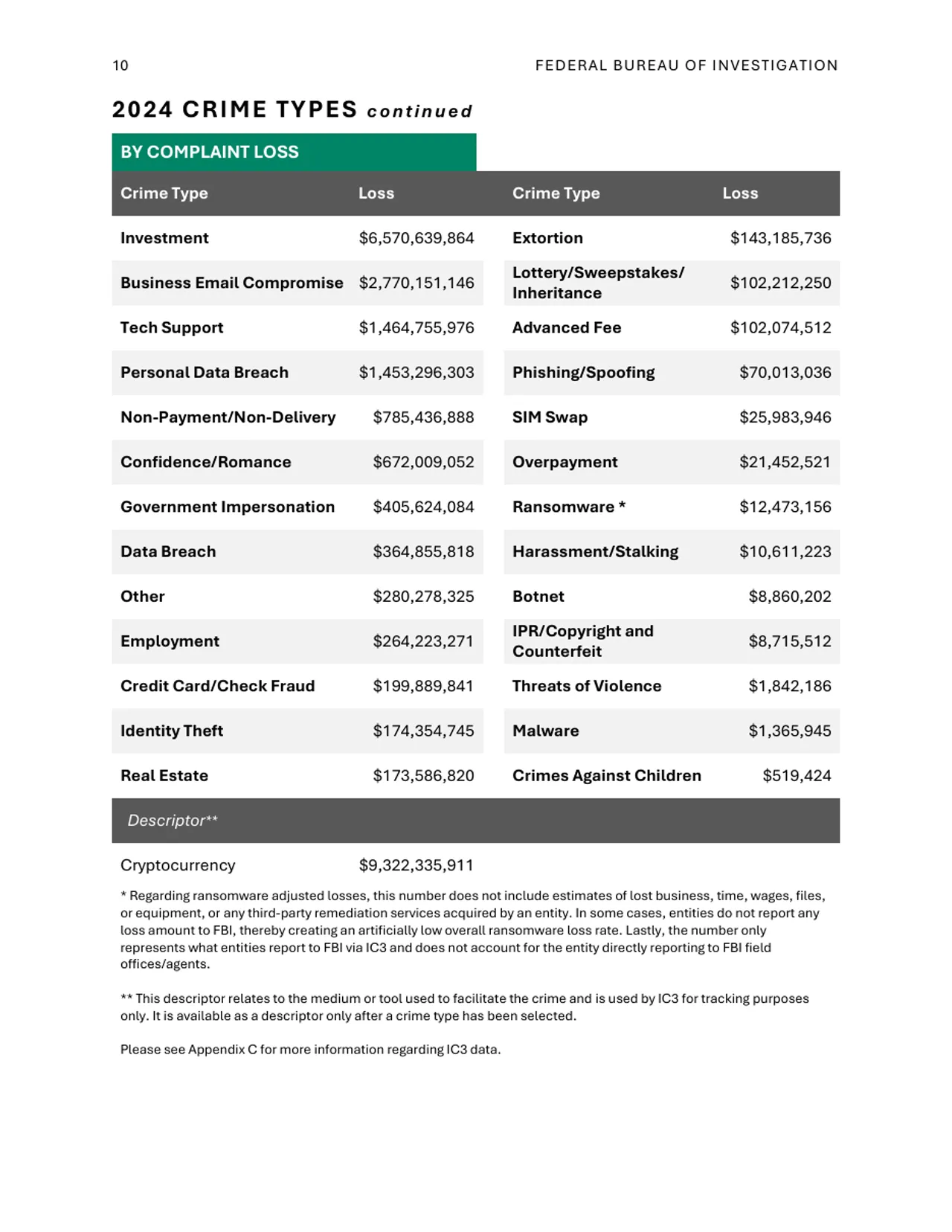
The FBI's Internet Crime Complaint Center reported 21,442 business email compromise complaints in 2024, with reported losses of $2,770,151,146. The year before, losses were $2,946,830,270; the year before that, $2,742,354,049. Three years, roughly $8.5 billion, and the pattern is stable: BEC is the second-largest crime type by reported loss in the IC3's 2024 table, behind only investment fraud at $6,570,639,864. The complaints are not consumers falling for a lottery email. They are businesses — finance teams, real-estate closers, procurement officers — wiring real money on instructions that arrived in a spoofed email or a compromised mailbox.
The typical BEC follows one of three scripts. In the vendor-impersonation script, the fraudster poses as a supplier and sends new bank details, usually with an invoice attached and a note that the old account is closed. In the CEO-fraud script, the fraudster poses as the chief executive and orders an urgent, confidential wire, often to a new payee, with instructions not to check with anyone. In the real-estate script, the fraudster intercepts a closing and sends the buyer wiring instructions for the down payment. The IC3's 2024 report records a Denver case from March 2024 in which buyers received a spoofed email from their supposed real-estate agents requesting a $956,342 wire to a domestic bank to finalize a closing. Two days after the wire, the victims realized the instructions were spoofed; the IC3 Recovery Asset Team froze the recipient account and $955,060 was stopped and returned. The recovery was nearly complete — and it depended entirely on the two-day gap and the funds still sitting in the account.
Why the wire cannot simply be undone
The finality of a wire is a design feature, not a bug. Domestic wires are governed by Article 4A of the Uniform Commercial Code, adopted in some form by every state. Under UCC section 4A-211, a sender can cancel or amend a payment order only if the receiving bank receives the cancellation notice at a time and in a manner affording it a reasonable opportunity to act before it accepts the order. Once the receiving bank has accepted, cancellation is not effective unless the bank agrees or a funds-transfer system rule allows it. The beneficiary's bank has narrow exceptions — the order was unauthorized, a duplicate, to a beneficiary not entitled to receive payment, or for more than the beneficiary was entitled to — and even then the bank recovers from the beneficiary only to the extent allowed by the law governing mistake and restitution.
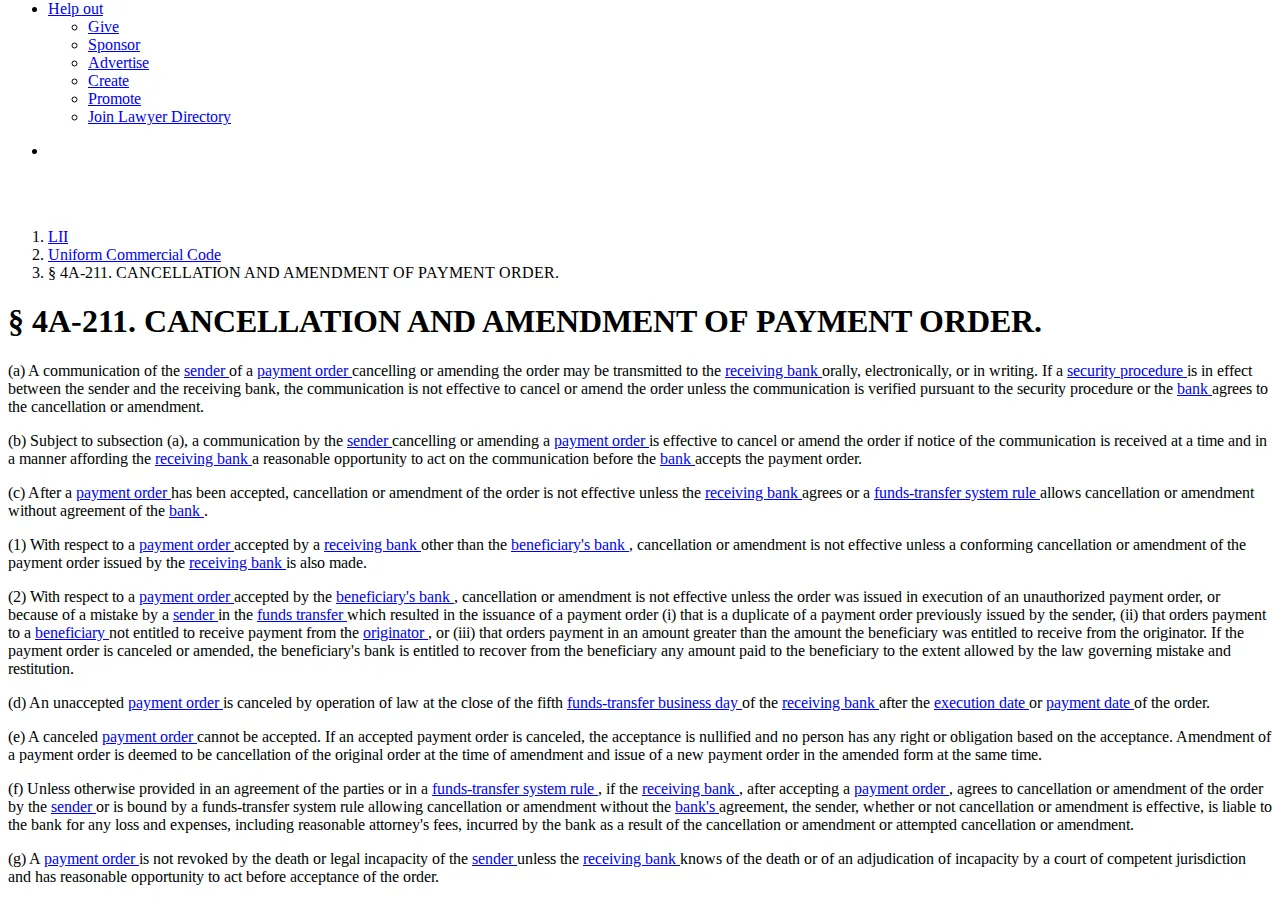
The settlement layer adds a second lock. Under Regulation J, 12 CFR section 210.31, payment by a Federal Reserve Bank to a receiving bank occurs at the earlier of the time the amount is credited to the receiving bank's account or the time the payment order is sent to the receiving bank. Fedwire settles each transfer individually and immediately between reserve accounts, so there is no end-of-day batch in which a transfer can be unwound. An unaccepted payment order cancels by operation of law at the close of the fifth funds-transfer business day after its execution or payment date, under section 4A-211(d) — but that is the fate of an order that never settled, not a rescue for one that did. And the sender's own notice duty is short: under Regulation J section 210.28(c), a sender has 30 calendar days after receiving notice that a payment order was accepted or executed to notify the Federal Reserve Bank of an unauthorized or erroneously executed order.
One narrow exception is worth knowing and not over-reading. Under Regulation E, 12 CFR section 1005.34, a sender of a remittance transfer — a consumer sending money abroad — has the right to cancel within 30 minutes of payment and receive a full refund within three business days, provided the funds have not been picked up or deposited. That right covers consumer remittance transfers. A business-to-business Fedwire transfer is not a remittance transfer, and no 30-minute right attaches to it. The Fedwire versus ACH versus RTP playbook works the rails themselves — speed, cost, and finality — and the finality column is the reason this article exists.
The recovery ladder, priced in hours
When a fraudulent wire has gone out, the response is a race against the fraudster emptying the receiving account. The ladder has four rungs, and each rung is weaker than the one before it.
The first rung is minutes: call the wire department directly, by phone, not through a portal. The bank sends a cancellation if the order has not yet been accepted, or a recall request — for a domestic Fedwire transfer, a request-for-return message; for a SWIFT transfer, an MT192 — if it has. The receiving bank has no legal obligation to comply with a recall request. If the funds are still in the account and the recipient cooperates, the money comes back. If the recipient has moved it, the recall fails.
The second rung is hours: the FBI's IC3 Recovery Asset Team, established in 2018, runs the Financial Fraud Kill Chain — a coordinated request to financial institutions and FBI field offices to freeze fraudulent funds. Most kill-chain incidents the team initiates are BEC. The team also runs the international kill chain, coordinated through FinCEN's Rapid Response Team and FBI legal attaché offices. In September 2024, the team received a request from the FBI's Singapore office about a $6,661,650 BEC transfer to a US domestic recipient bank. The team initiated the kill-chain request, the recipient bank blocked the account and froze $5,100,000 for recovery; the balance had already been wired out to accounts in Spain and China. The lesson is in the split: $5.1 million frozen, $1.56 million gone in the time between the wire and the freeze.
The third rung is days: law-enforcement intervention and a court order. A bank will freeze an account on a law-enforcement request or a court order where it will ignore a polite recall. The fourth rung is months: a civil action under the law of mistake and restitution against the recipient, if the recipient can be found and still holds assets. File the IC3 complaint the same day — the Recovery Asset Team can only act on a complaint it has received, and the kill chain starts from that filing.
What prevention costs against what fraud costs
Prevention is cheap against the loss because the loss is a whole wire and the control is a few minutes of staff time. Worked example: an illustrative company that sends 40 wires a month with an average value of $85,000 — $3.4 million a month moving by wire. Suppose one BEC succeeds per year at $120,000. The expected annual loss without controls is $120,000. The control stack is three procedures: a callback to the vendor on a known number before any new or changed bank details are used, dual approval on every wire above $10,000, and a 30-day hold on first payment to a new vendor account. At 15 minutes of staff time per wire for the callback and the second approval, at a loaded cost of $45 an hour, the control costs $450 a month, or $5,400 a year.
One prevented fraud pays for 22 years of the control. The arithmetic is so lopsided that the honest question is not whether to run callbacks but why a company would wire six figures on an email instruction at all. The answer is usually that the callback was "too slow" for a closing deadline — and the Denver case shows what the fast version costs: two days of delay would have saved $956,342. Run the currency converter on any cross-border wire before it is sent, so the amount the recipient expects and the amount the bank will send are the same number in the same currency, and a mismatch between the invoice and the wire is visible before the wire is released.
| Control | What it stops | Annual cost (illustrative) | Residual risk | Authority |
|---|---|---|---|---|
| Callback on a known number | Spoofed bank-detail changes | $5,400 for 40 wires/month | A compromised vendor phone line | UCC § 4A-211 (cancellation window) |
| Dual approval above $10,000 | Single compromised mailbox authorizing a wire | Included in the $5,400 | Collusion between two approvers | Company policy; bank dual-control |
| 30-day hold on new payee accounts | First-payment diversion to a fraudster account | Delayed settlement only | Fraudster waits out the hold | Company policy |
| IC3 complaint within 24 hours | Nothing — it starts recovery | Staff time only | Funds already moved offshore | FBI IC3 Recovery Asset Team |
| Crime / social-engineering insurance | Transfers the loss, does not prevent it | Premium varies; read the sublimit | Social-engineering sublimits are often $100,000–$250,000 | Policy wording |
The high-risk merchant processing playbook covers the card side of the same problem — MATCH listing, reserve holdbacks, and the VROL programme — because a company that fixes its wires and ignores its card processing has moved the fraud, not removed it. The fraud-prevention pricing playbook prices the vendor tooling for transaction screening, and the chargeback insurance playbook works the insurance question the table above only summarizes: a social-engineering endorsement with a $100,000 sublimit does not cover a $956,342 closing wire.
Execution checklist
- [x] Step 1 — Freeze bank-detail changes: No vendor bank details change on an email instruction. The change is verified by a callback to a number the company already holds for that vendor, never a number printed in the email requesting the change.
- [x] Step 2 — Require dual approval above $10,000: Two people approve every wire above the threshold, and the second approver checks the payee, the amount, and the bank details independently of the first.
- [x] Step 3 — Hold first payments to new accounts: The first payment to a new vendor account waits 30 days or is sent as a small test amount, and the vendor confirms receipt by phone before the full amount follows.
- [x] Step 4 — Segregate the wire function: The person who creates a wire cannot approve it, and the person who approves it cannot release it. One compromised mailbox must never be enough.
- [x] Step 5 — Rehearse the first hour: The wire department's direct number, the fraud department's number, and the IC3 complaint portal are printed and posted. The first call is made by phone within minutes, not by portal ticket within hours.
- [x] Step 6 — File the IC3 complaint the same day: The Recovery Asset Team's kill chain starts from the complaint. A complaint filed on Monday for a Friday wire starts a recovery that is already too late.
- [x] Step 7 — Read the insurance sublimit: Confirm the crime policy's social-engineering endorsement and its sublimit before a loss, not after. A $100,000 sublimit on a $956,342 wire leaves $856,342 uninsured.
Founder & CEO Insight — Enow A. Jovial