Three B2B SaaS vendors sell the same product — a machine that decides, in milliseconds, whether an online order is real — and none of them will tell you what it costs. Sift's pricing page returns a 404. Forter's is a contact form. Riskified's hides behind a challenge screen, and its homepage would not load at all from this network. That is the finding: fraud prevention in 2026 is quote-only. This playbook does not invent the missing prices. It prices what the fraud itself costs, line by line, then tests the one published guarantee model — Riskified's, disclosed in its SEC filing — against that cost, so the quote has to beat a number you already know.
The quote-only finding: what each vendor actually publishes
| Vendor | Pricing page | What it publishes | Authority |
|---|---|---|---|
| Sift | sift.com/pricing | HTTP 404 — no rate card, no tiers, no starting price | Sift pricing page, Nov 15, 2026 |
| Forter | forter.com/pricing | Contact Sales form only — no rates, no tiers | Forter pricing page, Nov 15, 2026 |
| Riskified | riskified.com/pricing | Challenge page — no prices readable | Riskified pricing page, Nov 15, 2026 |
Three vendors, one message: the price is a conversation. Sift does not even keep a pricing page alive, and the only numbers on its homepage are customer outcomes: more than 700 brands, Patreon holding 99% new-user acceptance, Paula's Choice reporting 6x return on investment, Tutory cutting manual review by 83%, and a community of more than 1,500 Sifters. Forter's homepage tells the same story in outcomes: a 1% completion-rate increase, a 3.4% bank-decline reduction, and a 25% chargeback reduction for one merchant; a 4.5% approval increase and a 90% chargeback reduction for another; a 3.9% approval increase and $3.15 million saved from bot attacks for a third. Riskified's site would not load at all — a Cloudflare challenge page on both the pricing page and the homepage — so its numbers here come from its SEC filing, not its website.
The law that sets the stakes
Before the math, the liability. When a stolen card is used online, the cardholder is not the one who pays. Under 15 U.S.C. § 1643(a), a cardholder's liability for unauthorized credit-card use is capped at $50 — and the networks' zero-liability policies usually bring that to nothing. For debit, 15 U.S.C. § 1693g caps liability at $50 if the loss is reported within two business days, and at $500 if reported later. Either way, the fraudulent order's cost lands on the seller, not the buyer and not the bank.
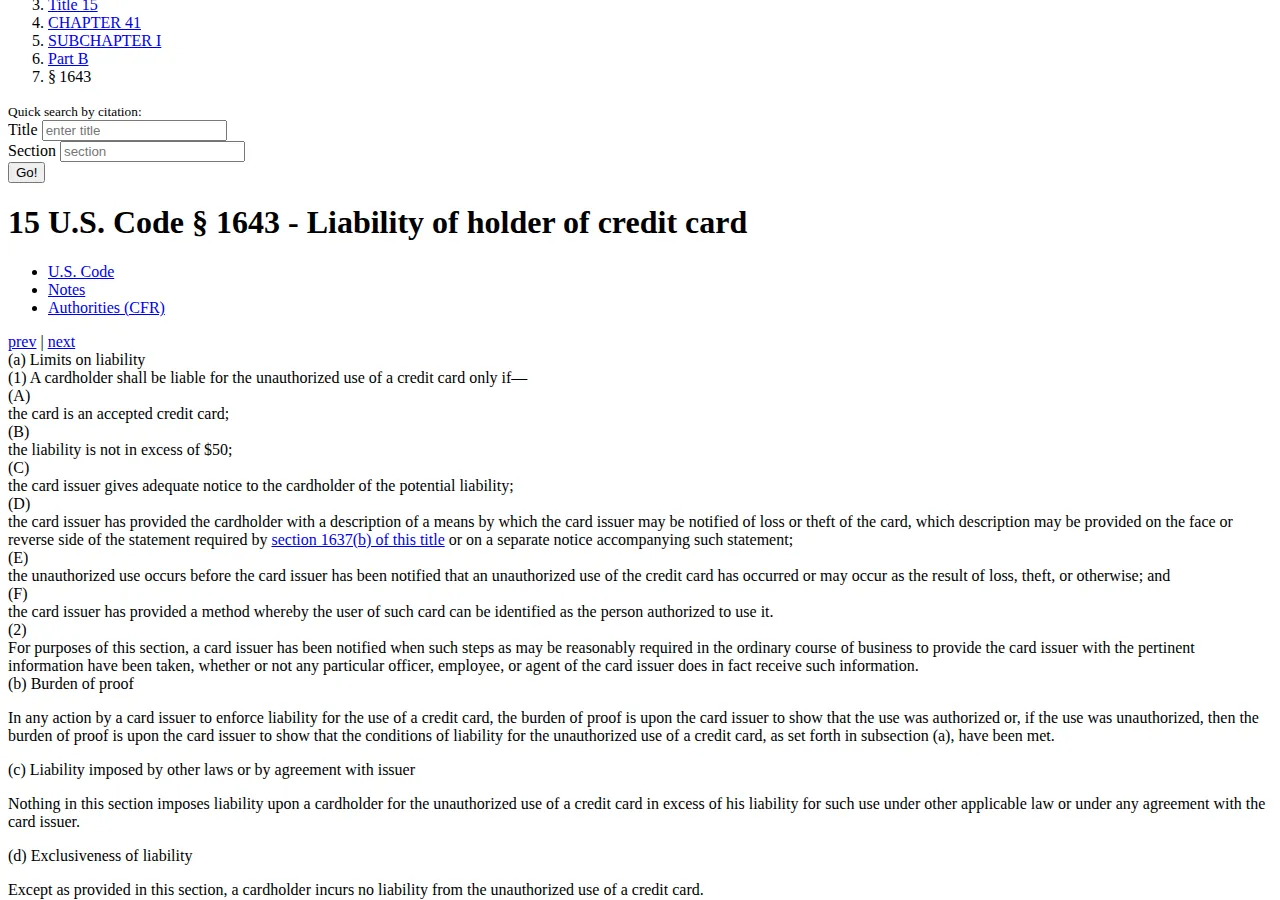
That is why the math below starts from the merchant's side of the ledger: the cardholder loses at most $50; the merchant loses the goods, the shipping, the fees, and the staff time. Our chargeback insurance vs self-insurance fraud liability playbook covers the same liability from the insurance side; this playbook prices the prevention side.
What one fraud chargeback actually costs
Take an $85 order — an ordinary basket. A fraudster buys it with a stolen card. The merchant ships it. The real cardholder disputes it. The chargeback arrives, and the merchant loses the goods, the shipping, the processing fee, and the chargeback fee, and pays staff to handle the dispute:
The lines: $34 in goods, $8 in shipping, $2.77 in processing — 2.9% plus $0.30 on the $85 order, charged when the order is taken and not refunded when the chargeback lands — a $15 chargeback fee, the standard fee at Stripe, Shopify, and PayPal in the US, and $24 of labour: 45 minutes at $32 an hour to pull the order, file the representment or accept the loss, and update the records. That is $83.77 out of pocket on an $85 order — 98.6% of the order value gone — and the merchant also loses the sale itself, which was never real money. Change any input and the total moves, but the shape does not: a fraud chargeback costs roughly the whole order.
The 10,000-order month
Scale it to a store doing 10,000 orders a month at $85 average order value — $850,000 of monthly GMV — with a 0.5% fraud rate, meaning 50 orders in 10,000 charge back:
That is the number every vendor quote has to beat — before any platform fee, any review labour beyond the 45 minutes per chargeback, and any Visa programme consequences. A store at 0.1% fraud pays about $838 a month on the same volume; a store at 1% pays $8,377.
Sift: packaged tiers, no rate card
Sift sells packaged tiers with usage components, according to third-party comparisons — the company itself publishes no prices, and its pricing page returns a 404. Its Score API returns a JSON risk score per order. What Sift does publish is outcomes, and the one that matters for the math is Tutory's 83% decrease in manual review: review labour is a priced cost, and an 83% cut is worth real money on a team that reviews hundreds of orders a day. Patreon's 99% new-user acceptance and Paula's Choice's 6x return are the other two numbers to carry into the sales call — not as promises, but as questions: what does Sift guarantee in writing, and what happens to the price if it misses?
Forter: quote-only, with the guarantee as an add-on
Forter's pricing page is a form, and its guarantee is an optional add-on module priced separately from the base platform, according to third-party comparisons — the company publishes no terms or price for it. Forter's ML models score each order in milliseconds. The number that matters for the math is the 4.5% approval increase on its homepage: on 10,000 orders a month, that is 450 more orders kept instead of declined:
The 30% gross margin is a planning assumption, not a Forter figure — substitute your own margin and the answer moves with it. The point stands at any margin: an approval lift pays in revenue, a chargeback reduction pays in avoided cost, and Forter's homepage claims both — a 90% chargeback reduction alongside the 4.5% approval lift for one merchant, a 25% reduction with a 1% completion-rate increase for another. Ask the sales call to put both numbers in the contract. Our Stripe Radar chargeback prevention Chargeflow Midigator guide prices the same problem one rung down, at the payment-gateway level.
Riskified: the only published percentage
Riskified's AI-powered platform is the only one of the three whose price structure is published anywhere — not on its website, which would not load, but in its Form 20-F for fiscal 2024, filed with the SEC. The filing states the model plainly: Riskified charges a percentage of every dollar of GMV it approves, risk-adjusted, set at contract inception, varying with merchant type, order population, historical fraud, end-market risk, the share of GMV reviewed, and the guaranteed approval rate. If an approved, guaranteed transaction results in an eligible chargeback, Riskified reimburses the merchant for the amount of the lost sale. The filing also reports the scale: $141.2 billion of GMV reviewed in 2024, $327.5 million of revenue, and an annual CTB Ratio held between 37% and 41% for the past four years — a ratio the filing calls a key driver of gross profit margin.
A third-party comparison describes Riskified's starting fee at roughly 0.4% per approved transaction, with no setup or monthly fees. That figure is third-party, not vendor-verified — the filing publishes no rate — but it is the only starting point on the record, so this playbook tests it. On the model store, approved GMV is 95% of $850,000, or $807,500:
$3,230 a month is 77.1% of the $4,188.50 fraud bill — the guarantee costs less than the fraud it replaces, with $958.50 a month of headroom. The break-even rate is:
Any negotiated rate under about 0.52% of approved GMV beats eating the fraud on this model; any rate over it does not. The filing itself implies a lower blended figure: 2024 revenue of $327,516,000 against 2024 GMV reviewed of $141,198,000,000 is a blended 0.232% — a rough editorial derivation, not a quote, because the fee applies to approved GMV and the filing does not split approved from reviewed. At that blended rate the same store would pay about $1,972 a month. The gap between 0.4% and 0.23% is the negotiation.
Visa VAMP: the ratio that ends the argument
Fraud prevention is not only about the chargeback bill. Visa's VAMP programme sets a line a merchant must not cross. From April 1, 2026, a merchant is excessive when its VAMP ratio exceeds 1.5%, or 150 basis points, down from 2.2% — and only once it has 1,500 or more fraud and dispute items in a month. The ratio counts TC40 fraud reports plus TC15 disputes, divided by settled card-not-present transactions:
At 50 fraud and dispute items a month on 10,000 card-not-present transactions, this model store sits at 50 basis points — a third of the line. The line bites at 150 items a month. A guarantee that approves more good orders keeps the denominator up and the ratio down; a rules engine that declines good orders shrinks the denominator and pushes the ratio toward the line. That is the second reason approval rate matters, after revenue: every declined good order makes the VAMP ratio worse.
The decision table
| Question | Sift | Forter | Riskified | Authority |
|---|---|---|---|---|
| What is published | Nothing — pricing page returns 404 | Nothing — lead form only | Fee model in SEC filing; no rate on site | Pages read Nov 15, 2026; Riskified Form 20-F FY2024 |
| Guarantee | No terms published | Optional add-on, priced separately (third-party comparison) | Core product; % of approved GMV; reimburses the lost sale | Riskified Form 20-F FY2024 |
| Strongest published number | 83% manual-review reduction (Tutory) | 4.5% approval lift, 90% chargeback cut | $141.2B GMV reviewed in 2024 | Sift homepage; Forter homepage; Form 20-F |
Who should use each — and who should not
| Vendor | Use it if | Avoid it if |
|---|---|---|
| Sift | Your review queue is the bottleneck and Tutory's 83% review reduction is the number to reproduce | You need a published price or a written guarantee before the sales call — neither exists on the record |
| Forter | You decline good orders today and the 4.5% approval lift is worth more than the chargeback saving | You want the guarantee in the base price — it is a separately priced add-on |
| Riskified | You want the fraud cost transferred in writing, with a fee you can test against the 0.52% break-even | Your fraud rate is 0.1% or lower, where the $838-a-month fraud bill beats a $3,230 guarantee fee |
Founder & CEO Insight — Enow A. Jovial
The buying sequence
- Measure your fraud rate honestly. Pull the last 90 days of orders, count the chargebacks, and divide by total orders. Use your ledger, not the vendor's benchmark.
- Price one chargeback your way. Replace the $34 goods, $8 shipping, and $32-an-hour labour lines with your own costs and recompute the $83.77.
- Multiply by your volume. Orders a month times fraud rate times your per-chargeback cost is the fraud bill — the number every quote has to beat.
- Check your VAMP ratio. Add TC40 fraud reports and TC15 disputes, divide by settled card-not-present transactions, and compare with 150 basis points. Under 1,500 items a month the programme does not apply — yet.
- Ask each vendor for three numbers in writing: the approval rate they will hold, the chargeback rate they will stay under, and the price if they miss either.
- Run a 30-day pilot on your own traffic through the vendor's REST API or SDK: measured approval rate, chargeback rate, and review hours. Compare the pilot's numbers with the homepage's case studies.
- Sign the guarantee only below your break-even — about 0.52% of approved GMV on this model. Recompute it on your numbers and walk away above it. Run the comparison in the pricing calculator before you sign.
The verdict in one paragraph: Sift and Forter will not publish a price, and Riskified publishes a model but no rate — so the buyer who prices the fraud first holds the only number that matters. One chargeback costs $83.77, a 10,000-order month at 0.5% fraud costs $4,188.50, and the guarantee only earns its fee under about 0.52% of approved GMV. Get the three numbers in writing, run the pilot, and let the quote beat your ledger.