A merchant doing $250,000 a month in card-not-present sales faces a binary choice about fraud losses: pay a vendor a percentage of every approved order to take the liability, or keep the liability and fund the losses from a reserve. The first option is sold as a guarantee; some vendors call it insurance. It is not insurance — Riskified says so on its own learning pages: chargeback insurance is a myth and does not exist. What is for sale is a contract in which a fraud vendor reimburses approved orders that turn out to be fraudulent. The decision is a pricing decision with an exact answer, and this playbook computes it.
The product has no price list
Every guarantee vendor in this market prices the same way and discloses the same amount: the model, not the rate. Signifyd's own pricing page states that it charges a percentage of the order total when an order is approved, varying with products purchased, merchant vertical, order volume and average ticket price, with no charge when an order is declined due to fraud; the exact percentage follows an assessment of operating efforts, chargeback losses and order declines. ClearSale prices the same way — performance-based, approved orders only, no long-term contracts, no setup or onboarding fees — and Riskified publishes no rate at all, describing only a performance-based fee on approved transactions.
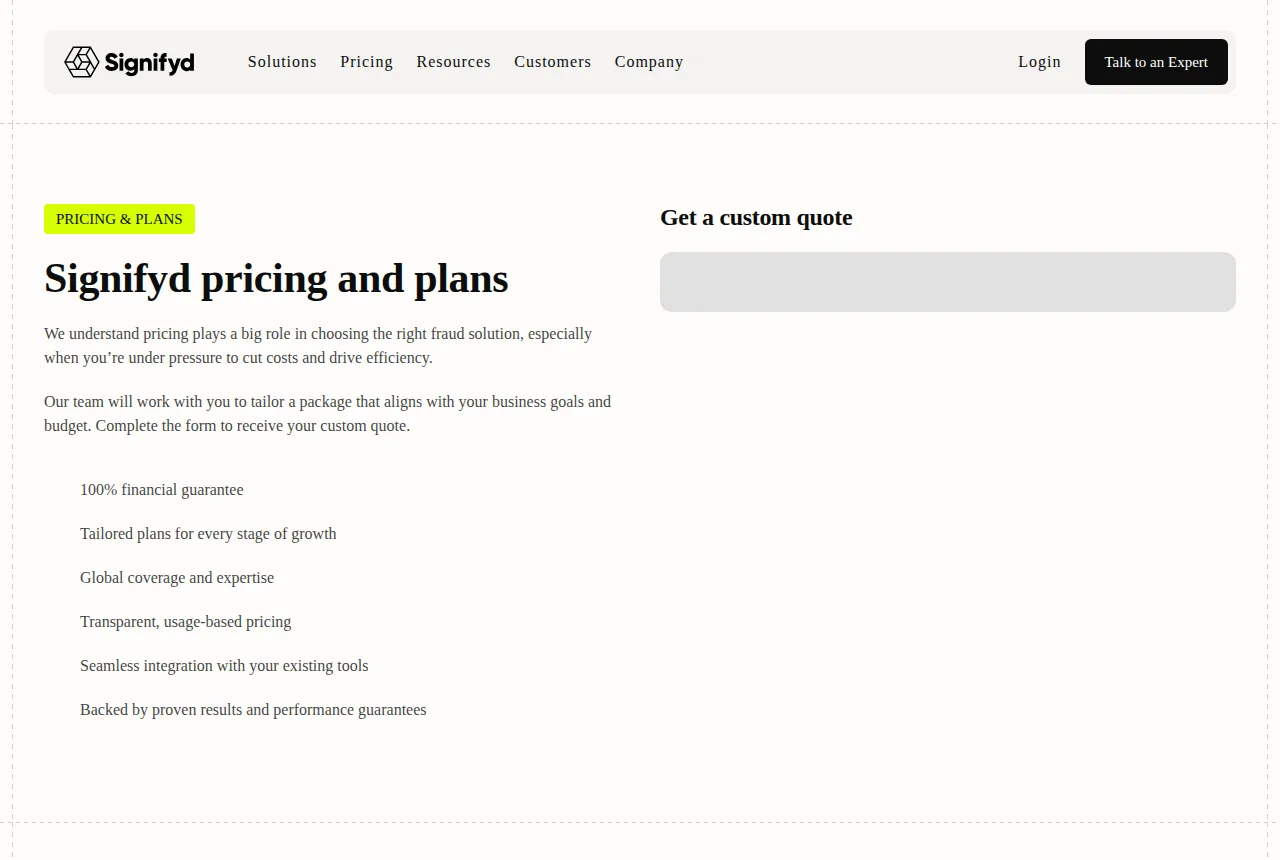
The only public rate comes from a marketplace listing, not a vendor's own price page. BigCommerce lists Signifyd's standard pricing as $1,500 per month, with all approved orders charged at 0.8% of the total order amount, a 14-day free trial, and reimbursement within 48 hours including chargeback fees and shipping — last updated April 2, 2025, and the only hard number a merchant can quote without a sales call. ClearSale publishes a floor rather than a rate: Growth plans with the guarantee start from $250 per month.
Accountable versus non-accountable vendors
Riskified draws the distinction that decides whether a vendor's recommendation is worth anything: an accountable fraud provider pays chargeback costs and carries liability for approval rates; a non-accountable vendor offers a recommendation it is not financially liable for, and earns the same revenue whether its decisions produce chargebacks or not. The accountable model has three characteristics. First, an approval-rate service level agreement sets a floor on the share of orders the partner will approve — Riskified's example is 98% of orders over two years. Second, a chargeback guarantee shifts the costs of chargebacks with a fraud reason code from the merchant to the partner. Third, a performance-based fee structure rewards the partner only for approved transactions, which discourages over-declining.
Signifyd's guarantee is configurable along the same axis. Its pricing page states that the guarantee ranges from fraud-only protection to a total chargeback liability shift, unlike a performance SLA guarantee, which promises an approval rate without the built-in incentive to surpass it. Its published case studies report the upside: Hot Topic approving over 99% of orders, Cymbiotika cutting chargebacks by 93% with $1.2 million in savings at 98% approval, and Ferguson at 98.5% approval with zero fraud loss. Those are vendor-published claims, not independent benchmarks — but they show the mechanism: the guarantee lets a merchant approve orders it would otherwise decline, because the cost of a wrong approval now sits on the vendor's balance sheet.
What the guarantee covers, and what it never covers
The coverage question is a reason-code question, and the contract's reason-code list is the whole product. A fraud-only guarantee covers disputes filed under fraud reason codes — Visa condition 10.4 and the Mastercard fraud equivalents. Signifyd's broader tier, Complete Chargeback Protection, covers fraud and non-fraud chargeback categories on approved orders, including credit not processed, item not received, subscription cancelled and unrecognised transactions. The distinction matters because most merchants' dispute queues are not mostly fraud.
| Dispute family | Fraud-only guarantee | Broad guarantee (Signifyd Complete) | Self-insurance | Authority |
|---|---|---|---|---|
| True fraud, stolen card (Visa 10.4) | Covered | Covered | Merchant pays | Riskified guarantee page; Visa 10.4 |
| Item not received | Not covered | Covered | Merchant pays | Signifyd Complete Chargeback Protection; Chargeflow 3DS guide |
| Not as described / defective | Not covered | Covered | Merchant pays | Signifyd Complete Chargeback Protection; Chargeflow 3DS guide |
| Credit not processed | Not covered | Covered | Merchant pays | Signifyd Complete Chargeback Protection; Chargeflow 3DS guide |
| Subscription cancelled | Not covered | Covered | Merchant pays | Signifyd Complete Chargeback Protection; Chargeflow 3DS guide |
| Monitoring-program ratio (VAMP) | Dispute still counts | Dispute still counts | Dispute still counts | Riskified: guarantee does not prevent chargebacks |
Two rows in that table decide most purchases. First, the broad tier is the only one that touches the non-fraud majority of a typical dispute queue — and it is also the tier whose price is least likely to be published, because the vendor is underwriting service failures as well as fraud. Second, no tier touches the monitoring ratio: a guarantee reimburses money; it does not stop a dispute from being filed, and Visa's VAMP program counts filed disputes. The ratio problem is answered by prevention and representment — see our Visa VAMP dispute-ratio threshold defense playbook — with the evidence standard in our chargeback defense and representment guide.
The guarantee math
The guarantee bill has two parts on the only published rate: a monthly platform fee and a percentage of approved order value:
For the worked merchant — $250,000 monthly GMV, $85 average order value, 98% approval — approved GMV is $245,000 and the monthly guarantee cost is $1,500 plus 0.008 times $245,000, which is $1,500 plus $1,960, or $3,460.
The self-insurance math
Self-insurance has no platform fee and no percentage. Its cost is the fraud that actually lands, and each fraud chargeback costs more than the order value: the refunded sale, plus the chargeback fee, plus the shipping already spent, plus the product that is gone. Using an illustrative assumption for the worked example — $20 of chargeback fees plus $15 of shipping, or $35 per fraud chargeback on top of the $85 order value — the expected monthly fraud loss is:
where $f$ is the fraud chargeback rate, the share of approved orders that become fraud chargebacks. For the worked merchant, approved orders are $250,000 divided by $85, times 98%, or about 2,882 orders a month. At a fraud chargeback rate of 0.6%, that is about 17.3 fraud chargebacks a month (2,882 × 0.6%), each costing $120, for a monthly expected loss of about $2,076 — $1,384 a month cheaper than the $3,460 guarantee.
The comparison flips at exactly one rate. Setting the guarantee cost equal to the self-insured cost and solving for the fraud chargeback rate:
At a fraud chargeback rate above about 1.0% of approved orders, the guarantee is cheaper than absorbing the losses; below it, the reserve is cheaper. Recompute the formula with the merchant's own numbers — the 1.0% figure belongs to the worked example, not to the market.
The worked example carries one surprise worth stating plainly: at a $25 average order value and $1 million of monthly GMV, even a 0.6% fraud rate makes the guarantee cheaper, because the fee stack per dispute is larger than the order itself. Low-ticket merchants are the guarantee's natural buyers; high-ticket merchants with disciplined fraud controls are its natural skeptics.
3-D Secure: the liability shift that costs nothing per order
Before either option is priced, a merchant should take the free liability shift. 3-D Secure 2.0 lets the issuer verify the cardholder during checkout, and when authentication succeeds — a valid Electronic Commerce Indicator and a Cardholder Authentication Verification Value — liability for a fraud-coded chargeback moves from the merchant to the issuer. The EMV 3-D Secure specification (versions 2.1–2.3) replaced the static password with risk-based authentication that can clear low-risk transactions frictionlessly, exchanging over 100 data elements for the risk score.
The shift is narrow in exactly the way the guarantee table is narrow. It covers fraud-coded disputes only: a fully authenticated transaction can still be disputed as not received, not as described, credit not processed, or a subscription complaint — and a cardholder who authenticated and disputes anyway, the friendly-fraud case, is untouched, because authentication confirms identity rather than intent. Data-only 3-D Secure, a risk-scoring pass that returns no ECI or cryptogram, carries no liability shift on its own. And the shift is only as good as the retained evidence: for every transaction, keep the ECI, the CAVV or AAV cryptogram, the 3-D Secure server and ACS transaction IDs, the authentication timestamp, and the device and session data.
Who should buy, and who should self-insure
The guarantee is built for a specific operator: a card-not-present merchant with a fraud chargeback rate above its break-even, low average order value relative to its fee stack, international orders it currently declines, or a small team with no fraud analyst. The vendor's money stands behind the approve decision, so the merchant stops declining good orders out of fear — Signifyd's published cases show approval rates above 98%.
Self-insurance is built for the opposite operator: a merchant with a fraud chargeback rate below break-even, a high average order value, strong in-house fraud tooling, or a dispute queue dominated by non-fraud reasons a fraud-only guarantee would not cover. It is also the right answer when the problem is the VAMP ratio rather than the money, since reimbursement does not remove disputes from the ratio. And no guarantee should be bought to fix a fulfilment problem, a refund process problem, or a subscription-cancellation problem — those are service disputes, and only the broad tier covers them, at a price that must be quoted.
Building the self-insurance reserve
A merchant that self-insures is running a small insurance company with one customer. The reserve is funded from the same formula as the loss, with a buffer for the worst month rather than the average one. Hold three months of expected fraud loss, marked up for variance:
At the worked example's 0.6% fraud rate, monthly expected loss is $2,076; three months at a 25% buffer is $2,076 times 3 times 1.25, or $7,785. Fund it on day one from operating cash, top it up monthly by the actual fraud cost, and review the fraud rate quarterly — a rate that drifts from 0.6% to 1.2% doubles the required reserve and flips the buy-versus-build decision. The high-risk merchant processing guide covers VROL monitoring and MATCH listing for merchants whose dispute rate is the binding constraint.
Execution checklist
- [x] Measure the fraud chargeback rate: pull 12 months of disputes from the processor, split fraud-coded from non-fraud, and divide fraud chargebacks by approved orders. No rate, no decision.
- [x] Price the fee stack per dispute: chargeback fee plus shipping plus product cost on a fraud chargeback, from the processor statement and the fulfilment ledger — not from a blog post.
- [x] Compute the break-even: run the two formulas above with the merchant's own numbers, and record the break-even fraud rate.
- [x] Get three written quotes: Signifyd, Riskified and ClearSale, each stating the percentage, the covered reason codes, the approval-rate SLA, and the reimbursement window.
- [x] Enable 3-D Secure first: route step-up challenges to new devices, mismatched addresses, high order values and first purchases; let low-risk repeat customers pass frictionlessly.
- [x] Decide, then fund: if buying, sign the guarantee and route approvals through it; if self-insuring, fund the reserve on day one and set the quarterly review date.
- [x] Re-measure quarterly: fraud rate, approval rate, and dispute mix by reason code. A guarantee bought at a 1.4% fraud rate can become a bad buy at 0.5%.
- [x] Confirm the approval-rate SLA in writing: the guaranteed approval floor and the remedy if the vendor misses it, before the first order routes through the guarantee.
- [x] Segregate the reserve account: hold the self-insurance reserve in a separate account and reconcile it monthly against actual fraud cost.
- [x] Route new-market orders through the guarantee first: use the vendor's liability for the first 90 days in a new market, then re-price the decision on real fraud data.
Founder & CEO Insight — Enow A. Jovial
Related reading on this site: the chargeback defense and representment guide sets the evidence standard for the disputes a guarantee does not cover; the Visa VAMP dispute-ratio threshold defense playbook covers the monitoring ratio reimbursement cannot fix; and the high-risk merchant processing guide covers VROL monitoring and MATCH listing. To price the guarantee in cash terms, run the monthly fee and the per-order percentage through the pricing calculator at the merchant's own GMV before signing.