Registration is the act that starts the clock. The day you register, you owe collection from that date forward, and a return every period even in a month with no sales. Cross a threshold without registering and the exposure runs the other way — tax you should have collected, compounding by the month. This playbook covers that one act: where, when, through which door, and what getting the order wrong costs. Figures as read on November 15, 2026.
The ruling that made registration the job
Before 2018, registration was a physical-presence question: a state could only make you collect if you had people or property inside its borders. South Dakota v. Wayfair, Inc., 585 U.S. 162 (2018), decided June 21, 2018 by a 5-4 majority, ended that rule. The Court held the physical-presence rule of Quill Corp. v. North Dakota unsound and incorrect, and overruled Quill and National Bellas Hess. The test that replaced it is substantial nexus: the tax must apply to an activity with a substantial nexus with the taxing state, be fairly apportioned, not discriminate against interstate commerce, and be fairly related to the state's services.
South Dakota's own law was the template: a seller delivering more than $100,000 of goods or services into the state, or engaging in 200 or more separate transactions for delivery into the state, must collect. Every state then wrote its own version, each ending in a registration obligation that attaches the moment a number is crossed. Our Wayfair audit defense playbook covers what an auditor does when that obligation is discovered first; our economic nexus guide maps the thresholds. This playbook covers the act those two assume: the registration.
The two doors: register direct, or register once through Streamlined
There are two ways in. The direct door is a registration with one state, through its own portal, for its own certificate. The Streamlined door is a single registration through the Streamlined Sales Tax Registration System (SSTRS) for sales and use tax permits in the member states — 23 full member states plus Tennessee as an associate member — at once, and it is free.
One SSTRS registration produces permits in 23 full member states — 22 fewer filings than 23 direct ones.
The Streamlined door has three conditions founders miss. First, allow about 15 days for states to mail the registration number and reporting information — register November 1 and the numbers arrive around November 16 — and the collection duty runs from the Registration Date, not from the day the number arrives. Second, once registered you must collect, file and remit to each state selected beginning with the Registration Date, and returns must be filed even with no sales in a state. A state you registered in and then ignored is a state with missing returns. Third, do not complete the SSTRS registration if you plan to use a Certified Service Provider — the provider registers the business instead, and a seller who registers first must keep filing returns with each state until the two agree the provider takes over. The direct door has none of these traps, but it costs one filing per state.
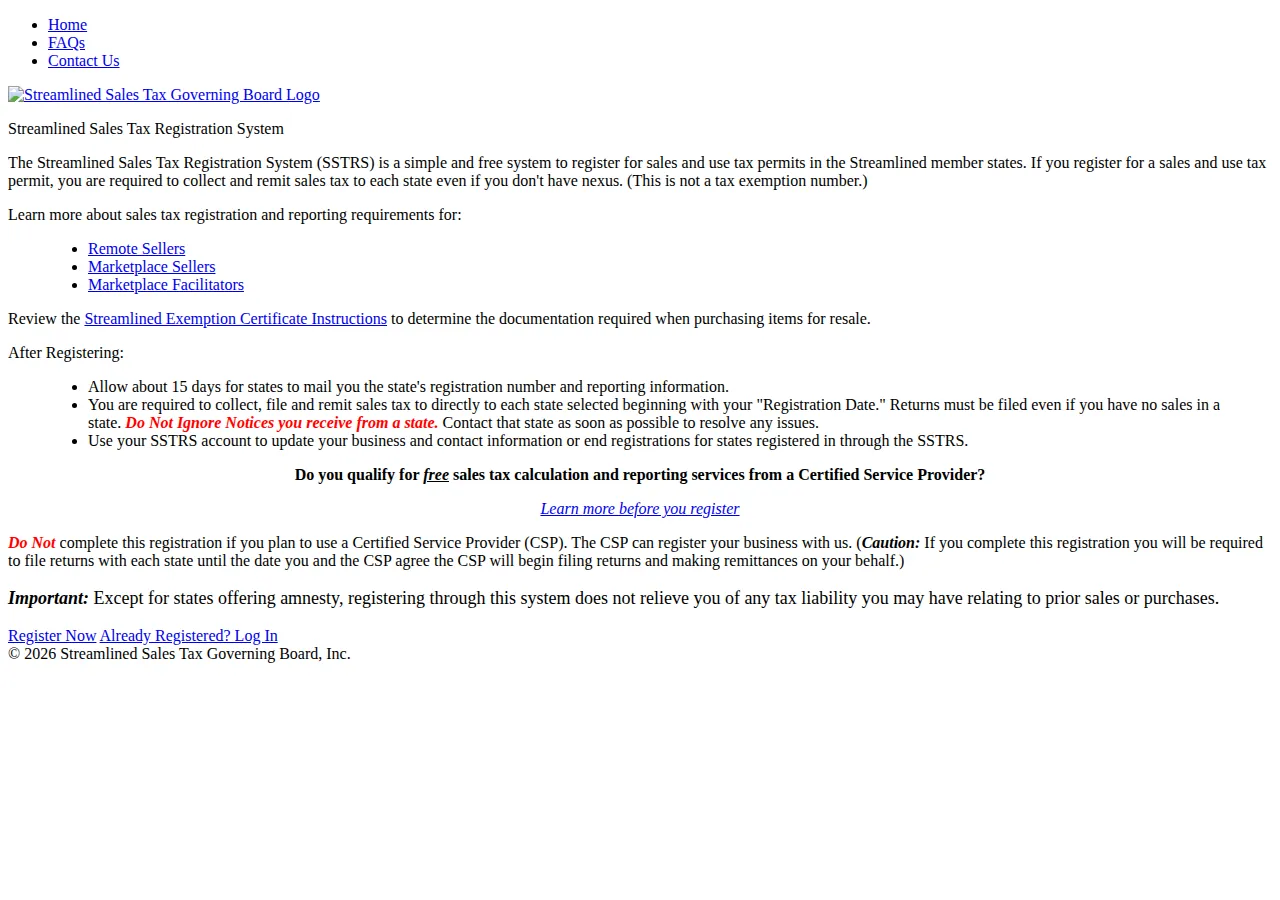
The Streamlined registration system, above: free, one registration for the member states, about 15 days for the numbers to arrive — and a warning not to register yourself if a Certified Service Provider will do it.
The state-by-state registration table
Four states carry most of the weight, and Texas counts the broadest measure: gross revenue, taxable and nontaxable together.
| State | Threshold that triggers registration | Instrument issued | Where to register | Timing rule | Authority |
|---|---|---|---|---|---|
| Texas | $500,000 total Texas revenue, preceding 12 calendar months | Sales tax permit | Texas Comptroller | Collect from 1st day of 4th month after exceeding | Texas Comptroller, Remote Sellers |
| California | $500,000 in the preceding or current calendar year | Seller's permit, or Certificate of Registration—Use Tax (out-of-state) | CDTFA, online | Register before collecting; over threshold = engaged in business in every district | CDTFA Publication 109 |
| Florida | $100,000 in the prior calendar year | Certificate of Registration (Form DR-11) + Annual Resale Certificate (Form DR-13) | Florida DOR, online or Form DR-1 | Register each location; resale certificate reissued annually | Florida Department of Revenue |
| New York | $500,000 in sales delivered in state AND more than 100 sales | Certificate of Authority | New York Business Express | Apply at least 20 days before beginning business | NY Tax Dept, TB-ST-175 |
| Streamlined (23 states) | Each member state's own threshold | State permit per state, via one SSTRS filing | sstregister.org | Collect from the Registration Date; ~15 days for numbers by mail | Streamlined Sales Tax Governing Board |
New York is the only one of the four with a two-part test: $500,000 in sales of tangible personal property delivered in the state and more than 100 such sales. A seller with $600,000 from 40 large orders does not trip the New York test, while the same seller trips the Texas test on revenue alone. Florida, at $100,000 — one-fifth of the Texas and California figures — is usually the first registration a growing seller needs.
California adds a district consequence: a retailer over the $500,000 threshold is engaged in business in every district, whether or not it has a physical presence there, and must collect the district taxes too. Texas offers the opposite simplification: a remote seller may elect the single local use tax rate of 1.75 percent instead of collecting the total local tax at each destination address.
Entity type does not change the test. An LLC, a C-Corp and an S-Corp cross the same thresholds on the same gross-revenue measure, and the application asks for the same EIN in each case. A CPA should price any disclosure before it is filed, because the lookback is where the money is. Run the threshold test monthly — make it a standing SOP, on a CSV export of all sales — and a SaaS seller should test B2B sales for resale the same way, since Texas counts them in gross revenue. The US system is not a VAT: there is no input-tax credit, so every taxable sale must be collected and remitted.
What the certificate obliges you to do
The certificate is a set of duties that start the day it is issued. In New York, the Certificate of Authority gives the seller the right to collect sales tax and to issue and accept most New York State sales tax exemption certificates — and the application must be filed at least 20 days before the business begins operating. Opening December 1 means applying by November 11. In Florida, registration produces the Certificate of Registration (Form DR-11) and the Florida Annual Resale Certificate for Sales Tax (Form DR-13), reissued to active dealers annually; a seller registered to pay use tax only receives no resale certificate. In California, an out-of-state retailer registers for a Certificate of Registration—Use Tax; a retailer with a California presence takes a seller's permit instead. The instrument follows the footprint. Our sales tax automation comparison prices the software that carries these filings once the registrations exist; our exemption certificates playbook covers the certificates the registration makes possible.
Registration-first versus voluntary disclosure: the sequencing decision
The hardest decision here is not whether to register. It is the order: register first and then disclose, or disclose first and then register. Registering does not relieve prior liability — the Streamlined system says so expressly, except for states offering amnesty. A seller with two years of unregistered sales who registers today has fixed the future and left the past exactly where it was: owed, uncollected, and aging.
A voluntary disclosure agreement is the instrument for the past. The Streamlined Governing Board announced a 2027 Voluntary Disclosure Program for Remote Sellers on October 27, 2026, and operates a Limited Lookback Program capping how far back a disclosure reaches. The arithmetic of lookback length is the whole value of such a program — the 12-month figure below is illustrative, because the program's actual cap must be confirmed at registration. Take a seller with $80,000 a month in taxable Florida sales at the state's 6 percent rate — $4,800 a month.
That $115,200 is the price of the sequence. Register first without a disclosure and the seller has announced itself while the full lookback is still on the table. Disclose first under a limited-lookback program and the same seller settles the past at a third of the exposure, then registers clean. The exception is the seller with no prior exposure — one who crossed the threshold last month, for whom registration-first is correct and delay is the only error. The boundary is the length of the unregistered period: under three months, register now; over a year, get the disclosure terms first.
Founder & CEO Insight — Enow A. Jovial
The exposure math for the unregistered period
Exposure is monthly tax multiplied by unregistered months. Florida's rate is 6 percent; California's statewide base rate is 7.25 percent. The same $80,000 a month produces a different bill in each, and the gap compounds with every month of delay.
Fourteen months is a seller who crossed a threshold in September 2025 and registers in November 2026. The $14,000 gap is the rate difference alone, before penalty or interest, which vary by state and are not priced here. Texas adds a timing rule: exceed the $500,000 safe harbor in March and collection starts July 1, the first day of the fourth month after March.
The Texas single local use tax rate softens the local side: 1.75 percent on $80,000 is $1,400 a month, $19,600 over 14 months, against tracking every jurisdiction separately. The election is made on the permit application.
Who should not register yet
Not every seller with a customer in a state should register in it. A seller below every threshold, with no physical presence and no marketplace-facilitator obligation, has no duty there — registering anyway creates filing duties and missing-return exposure for nothing. A seller whose sales run entirely through a marketplace facilitator should check the facilitator's collection first; the facilitator's registration is not the seller's, and the seller's own direct sales are a separate question. A seller planning to use a Certified Service Provider should not register through SSTRS first — the provider registers the business, and a self-registration first means filing returns until the handover date. And a seller with a long unregistered history should not register first at all: disclosure terms first, then registration.
The execution checklist
- [x] Step 1: Test every state on gross revenue for the last 12 months. Texas counts taxable and nontaxable sales together — list each state crossed and the month.
- [x] Step 2: Sort the crossed states into Streamlined and direct. The 23 full member states go through one free SSTRS registration; the four big states go direct.
- [x] Step 3: If the unregistered period is over a year, get disclosure terms before registering. Check the Streamlined 2027 Voluntary Disclosure Program and the Limited Lookback Program first.
- [x] Step 4: If a Certified Service Provider will file for you, stop — let the provider register. Do not complete the SSTRS registration yourself.
- [x] Step 5: Register, and diary the Registration Date for every state. Collection and filing run from that date, returns are due even with no sales, and SSTRS numbers arrive by mail in about 15 days.
- [x] Step 6: File the New York application at least 20 days before opening, and elect the Texas single local use tax rate on the permit application. Both choices are made before the first return.
- [x] Step 7: Price the registration against the exposure it stops. Run the monthly tax at each state's rate through the tax estimator so the next month of delay is a number.
Registration is a single act with a start date, and the start date is everything. One free Streamlined filing covers 23 states; the four big states take four direct filings with four different thresholds, instruments and clocks. Register the month a threshold is crossed, disclose before registering when there is a past to settle, and never let a registration sit unfiled. The registration is one filing. The months before it are the bill.