Sales Tax Exemption Certificates: The Resale Playbook
A retailer buys $50,000 of inventory, sells it for $75,000, and collects sales tax from the customer. The one document that decides whether the retailer also pays tax on the $50,000 purchase is the resale certificate. Hand over a valid one and the purchase is tax-free; hand over nothing, or one the auditor later voids, and the tax lands on you — plus penalty and interest.
Two certificates, two different jobs
Owners use the words resale certificate and exemption certificate as if they were the same B2B document. They are not. A resale certificate says the buyer will resell the goods in the regular course of business. An exemption certificate says the buyer qualifies for an exemption for another reason: a manufacturer buying production machinery, a nonprofit buying supplies, a farmer buying feed, a government agency buying equipment. The Streamlined Sales Tax Certificate of Exemption, SSTGB Form F0003, covers both jobs on one form — the buyer checks the letter that names the reason, and G is resale — but the reason code matters, because a certificate that claims resale for goods the buyer then uses in the office is a false statement.
At the audit, a resale certificate is judged on one question — did the goods actually get resold? — and an exemption certificate on another: did the buyer actually qualify for the exemption claimed? Keep the two piles separate in your files, because an auditor will.
The four forms that cover most of the country
Most certificate work runs through a small set of forms. Know which one your supplier expects before the order ships.
| Form | Issuer | Covers | Authority |
|---|---|---|---|
| SSTGB Form F0003 | Streamlined Sales Tax Governing Board | Multi-state exemption claims, including resale (reason G) | Streamlined Sales Tax Agreement |
| NY Form ST-120 | New York Department of Taxation and Finance | New York resale purchases | NY Tax Law, Form ST-120 (1/26) |
| CA CDTFA-230 | California Department of Tax and Fee Administration | California resale purchases | CA Revenue and Taxation Code 6094.5 |
| TX Form 01-339 | Texas Comptroller of Public Accounts | Texas resale purchases | Texas Tax Code, Form 01-339 |
The F0003 is the workhorse for sellers who operate in more than one state. The instructions warn that not all states allow all exemptions listed on it — the purchaser is responsible for knowing whether the exemption claimed is valid where the sale happens. The form never goes to the Streamlined Sales Tax Governing Board; the completed form goes to the seller, and the buyer keeps a copy. Twenty-two states are full members of the Streamlined Sales Tax Agreement: Arkansas, Georgia, Indiana, Iowa, Kansas, Kentucky, Michigan, Minnesota, Nebraska, Nevada, New Jersey, North Carolina, North Dakota, Ohio, Oklahoma, Rhode Island, South Dakota, Utah, Vermont, Washington, West Virginia, and Wisconsin.
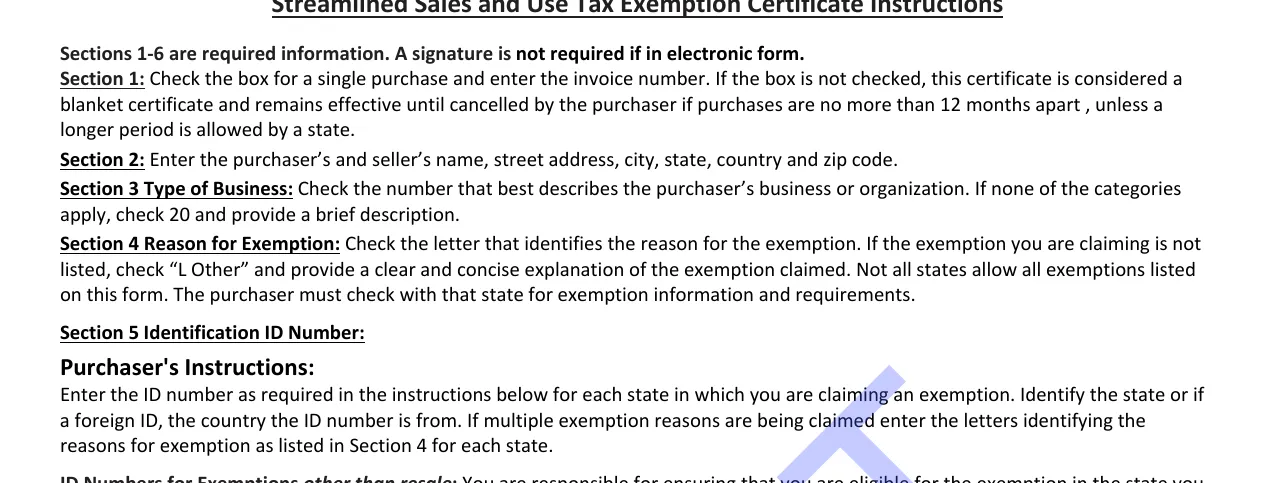
State forms still rule inside their own borders. Texas Form 01-339 requires an 11-digit Texas sales and use tax permit number on the face of the certificate — without it, the certificate is incomplete on arrival. The F0003's Section 5 takes the same job with a state sales tax ID, a federal Employer Identification Number (EIN), or a state business ID. California's CDTFA-230 requires the buyer's seller's permit number, the type of property the buyer sells, and a description of the property being purchased for resale. New York's ST-120, a fillable PDF, asks for the Certificate of Authority number in Part 1, with a separate Part 2 for out-of-state purchasers. If your supplier's state has its own form, use it.
Single-use vs blanket: the validity clock
Every certificate is either single-use or blanket, and the choice sets the validity clock. A single-use certificate covers one purchase — one invoice, one purchase order number written on the form. A blanket certificate covers a run of purchases of the same general type from the same seller. New York's ST-120 makes the buyer mark an X in one box or the other, and adds that temporary vendors must issue single-use certificates only.
The F0003 states the blanket rule outright: if the single-purchase box is not checked, the certificate is a blanket certificate and "remains effective until cancelled by the purchaser if purchases are no more than 12 months apart, unless a longer period is allowed by a state." Read that sentence twice. A blanket certificate does not expire on a fixed date; it lapses when the buying stops. A supplier who has not sold to you in over a year cannot rely on your old blanket certificate for the next order — the gap kills it. Put a 12-month review on every blanket certificate in your file, and reissue before the gap, not after the auditor finds it.
| Certificate type | Covers | Validity rule | Authority |
|---|---|---|---|
| Single-use | One invoice or purchase order | That purchase only | NY ST-120; SSTGB F0003 Sec. 1 |
| Blanket | Repeat purchases of the same type from one seller | Until cancelled, if purchases no more than 12 months apart | SSTGB F0003 instructions |
| Blanket, New York | Repeat New York resale purchases | Valid while the Certificate of Authority behind it is valid | NY ST-120 |
| Temporary vendor | One purchase only | Single-use only, no blanket option | NY ST-120 |
The 90-day rule: the clock that voids good certificates
A certificate can be complete, signed, and honest — and still worthless because it arrived late. New York's ST-120 instructions set the rule: the certificate is valid only if it was accepted in good faith, was in the vendor's possession within 90 days of the transaction, and was properly completed. The seller must get a properly completed certificate from the customer no later than 90 days after delivery of the property or performance of the service. When a certificate arrives after the 90 days, both the seller and the purchaser carry the burden of proving the sale was exempt, and extra documentation may be required. A certificate received on time but not properly completed is treated the same way, unless the deficiency is corrected within a reasonable period.
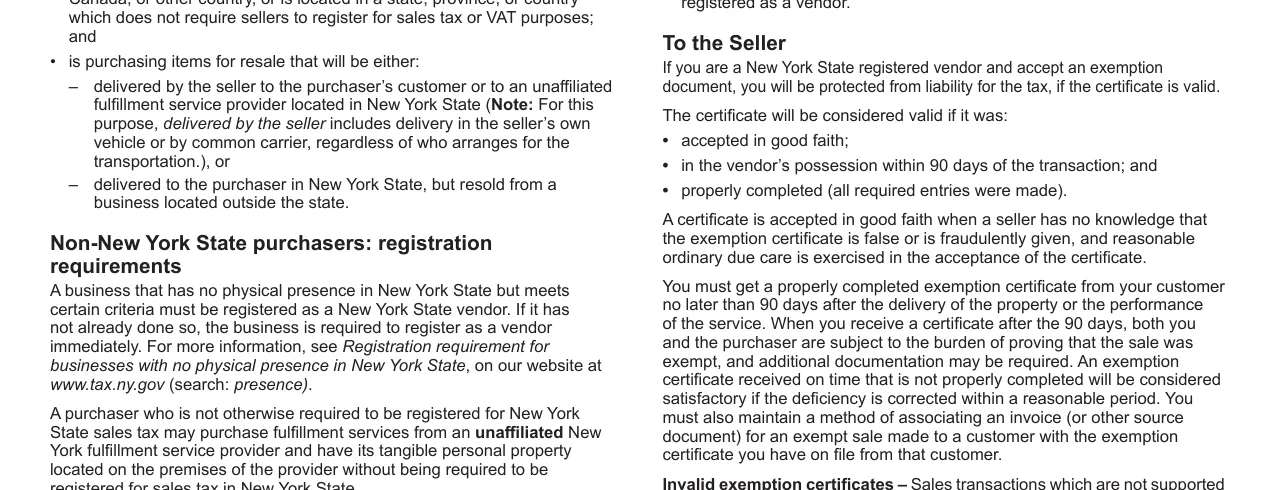
The 90-day rule is the most common reason a certificate file fails an audit. The sale was genuinely for resale and the buyer genuinely resold the goods — but the certificate sits in a drawer, dated four months after the invoice, and the auditor disallows the exemption anyway, because the rule is about possession within the window, not the underlying truth of the sale. Build the clock into the order flow: no certificate within 30 days of shipment gets a chase email; at 60 days, a phone call; at 90 days, treat the sale as taxable until the certificate lands.
Founder & CEO Insight — Enow A. Jovial
Drop shipping: the certificate chain
Drop shipping adds a third party and a second certificate. The retailer takes the order, the supplier ships direct to the customer, and the goods never touch the retailer's warehouse. The retailer gives the supplier a resale certificate in the supplier's state — or in the ship-to state, where the supplier is registered to collect — and the supplier ships tax-free on its strength. The retailer then collects tax from the customer if it has nexus in the ship-to state.
The chain breaks in two places. First, when the retailer has no resale certificate valid in the supplier's state, the supplier must charge tax on the wholesale price, and the retailer eats it. Second, when the retailer gives the supplier a certificate from the wrong state — a home-state certificate for a shipment where the supplier is not registered — the supplier may accept it in good faith and still be exposed. Map every drop-ship lane before the first order: supplier state, ship-to state, which certificate covers the wholesale leg, and who collects on the retail leg. Our Wayfair audit defense playbook covers what happens when the nexus side of that map is wrong, and the sales tax automation comparison covers the software that tracks certificates across lanes.
Marketplace facilitators: who collects now
Since the Wayfair decision, most states require marketplace facilitators — Amazon, eBay, Etsy, Walmart — to collect and remit sales tax on sales made through their platforms. That changes the certificate job but does not erase it. The facilitator collects on the marketplace sale, so the seller needs no resale certificate for those goods — but still needs certificates for everything bought for resale and sold through their own site, store, or any channel where they are the seller of record.
The trap is the mixed seller: the same inventory feeds the marketplace store and the standalone store. Goods bought tax-free and sold through the marketplace are fine — the facilitator collected the retail tax. Goods bought tax-free and then used, given away, or sold through a channel where no tax was collected are exposed. Keep marketplace and direct sales separate, and reconcile the certificate file against both.
The audit math: what a missing certificate costs
Take a retailer with $500,000 of sales shipped tax-free on certificates that turn out to be missing or invalid. The tax rate is an assumed 8 percent combined rate, stated here so the math can be checked. The tax alone is $40,000. California's penalty rule adds 10 percent of the tax, or $500, whichever is more — here 10 percent governs, so the penalty is $4,000. The total before interest is $44,000.
Interest runs on top, and it runs from the date the tax should have been paid, not from the audit date. In New York, willful misuse can be a felony with a substantial fine and a possible jail sentence — the ST-120 says so on the form itself. The $44,000 above is the cheap outcome. It assumes the missing certificates were an accident. A pattern of missing certificates across years, or certificates issued for goods the buyer used, turns a civil assessment into a fraud referral.
Now the other side of the same math. Buy $50,000 of inventory and pay the tax because no certificate was on file, at the same assumed 8 percent rate. That is $4,000 of cash out the door. Sell the inventory for $75,000 and collect 8 percent from the customer: $6,000, remitted to the state. The $4,000 paid at purchase stays trapped — it is not a deduction, it is a cost — unless you recover it through a refund claim or a use-tax credit, both of which cost staff time and which the state can deny if the paperwork is thin.
The certificate is worth $4,000 on a $50,000 order. That is the return on the five minutes it takes to issue one.
Running the certificate file like a system
A drawer of paper certificates fails silently. The certificate that lapsed, the supplier who never sent one back, the new buyer who was never asked — none of them announce themselves. Have your CPA run the file like a system instead.
- Issue before the order ships. The certificate goes out with the purchase order, not after the invoice arrives with tax on it.
- Validate on receipt. Check the permit number, the reason code, the signature, and the state. Texas wants 11 digits on the permit number; a 9-digit federal EIN in that box is a void certificate.
- Chase on a clock. Thirty days after shipment with no certificate, email. Sixty days, call. Ninety days, treat the sale as taxable in your books.
- Review blankets every 11 months. Reissue before the 12-month gap in the F0003 rule kills the certificate.
- Store the certificate with the invoice. The auditor asks for a sale and its certificate together; a certificate in one folder and an invoice in another is a certificate you cannot find under pressure.
- Renew on change. A new legal name, permit number, or ship-to state means a new certificate; old certificates do not follow the business through a reorganization.
Software exists for exactly this job — SaaS tools store the certificates, check them against state rules, and chase the missing ones through an API into the point-of-sale (POS) system. The sales tax automation comparison prices the three main tools, and the economic nexus guide covers the registration side. Under fifty certificates, a spreadsheet with a review date per supplier works; above that, the software pays for itself the first time it catches a lapse before the auditor does. Run your own numbers in the tax estimator first.