Upwork vs Fiverr vs Toptal: Freelance Marketplace Fees Playbook
Upwork vs Fiverr vs Toptal: Freelance Marketplace Fees Playbook
A $1,000 job pays $850–$1,000 on Upwork, $800 on Fiverr, and an undisclosed share of $1,000 on Toptal. The gap is the fee structure, and in 2026 it changed: Upwork's flat 10% freelancer fee is retired for new contracts. This playbook prices all three platforms on the same $1,000 job and $10,000 engagement, and ends with a rate-setting formula. Whether the worker is an employee or a contractor is a separate question, and the contractor-vs-employee-classification-irs-20-factor-playbook runs the 20-factor test before you hire on any of these platforms.
Step 1: Three different machines
Upwork is an open bidding marketplace: clients post jobs, freelancers spend Connects to propose, and contracts run hourly or fixed-price. Fiverr is a storefront: freelancers list fixed-price Gigs, buyers purchase at the listed price, and the seller's level decides visibility, gig slots, and clearance speed. Toptal is a curated network: Toptal screens applicants, matches the client with one vetted freelancer, and charges a premium. Upwork and Fiverr charge a visible percentage per transaction. Toptal charges a subscription and a deposit, and hides its margin inside the hourly rate.
Step 2: Upwork — the flat 10% is retired
Upwork's Help Center states the rule in one line: "The fee ranges from 0% to 15% per contract." The rate is set by Upwork, shown before you submit a proposal or accept an offer, and locked once sent. Upwork introduced the variable structure in May 2025 for new contracts, according to its 2025 annual report; contracts formed before May 2025 keep a flat 10% fee. The 10% figure still appears in Upwork's own examples — which is why so many 2026 guides still print it as the rule. It is the example, not the rule.
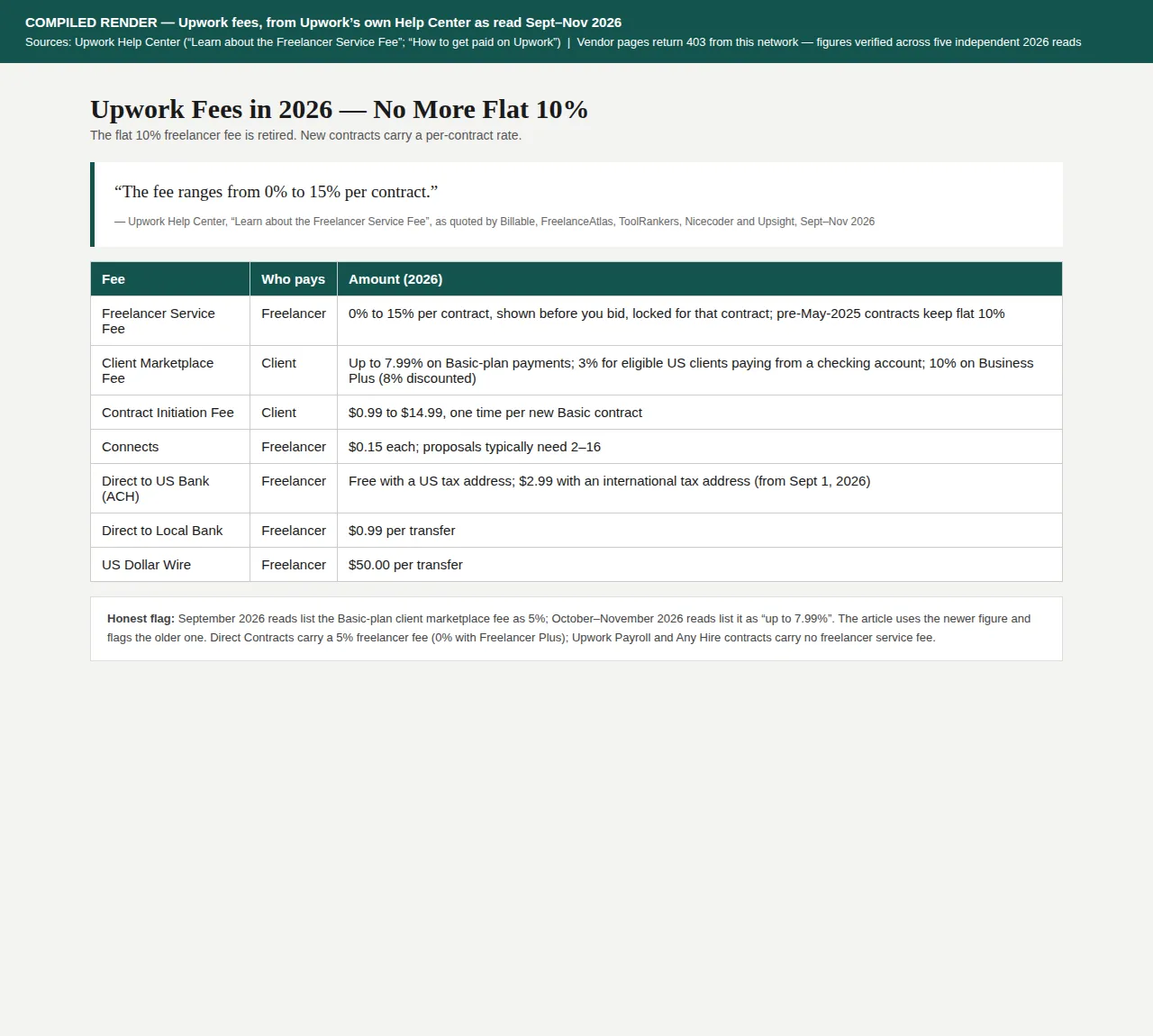
| Fee | Who pays | Amount in 2026 | Authority |
|---|---|---|---|
| Freelancer Service Fee | Freelancer | 0% to 15% per contract, locked for that contract | Upwork Help Center |
| Client Marketplace Fee | Client | Up to 7.99% Basic; 3% eligible US checking; 10% Business Plus | Upwork pricing page |
| Contract Initiation Fee | Client | $0.99 to $14.99, once per new Basic contract | Upwork pricing page |
| Connects | Freelancer | $0.15 each; proposals typically need 2–16 | Upwork Help Center |
| Withdrawal | Freelancer | ACH free US, $2.99 international from Sept 1, 2026; local bank $0.99; wire $50.00 | Upwork Help Center |
Two exceptions carry no freelancer service fee: Upwork Payroll and Any Hire contracts. Freelancer Plus costs $19.99 a month through Upwork ($27 through the App Store) and drops the Direct Contracts fee to 0%. One honest flag: September 2026 reads list the Basic-plan client fee as 5%; October–November reads list it as up to 7.99% — this guide uses the newer figure.
Step 3: Fiverr — 20% from the seller, 5.5% from the buyer
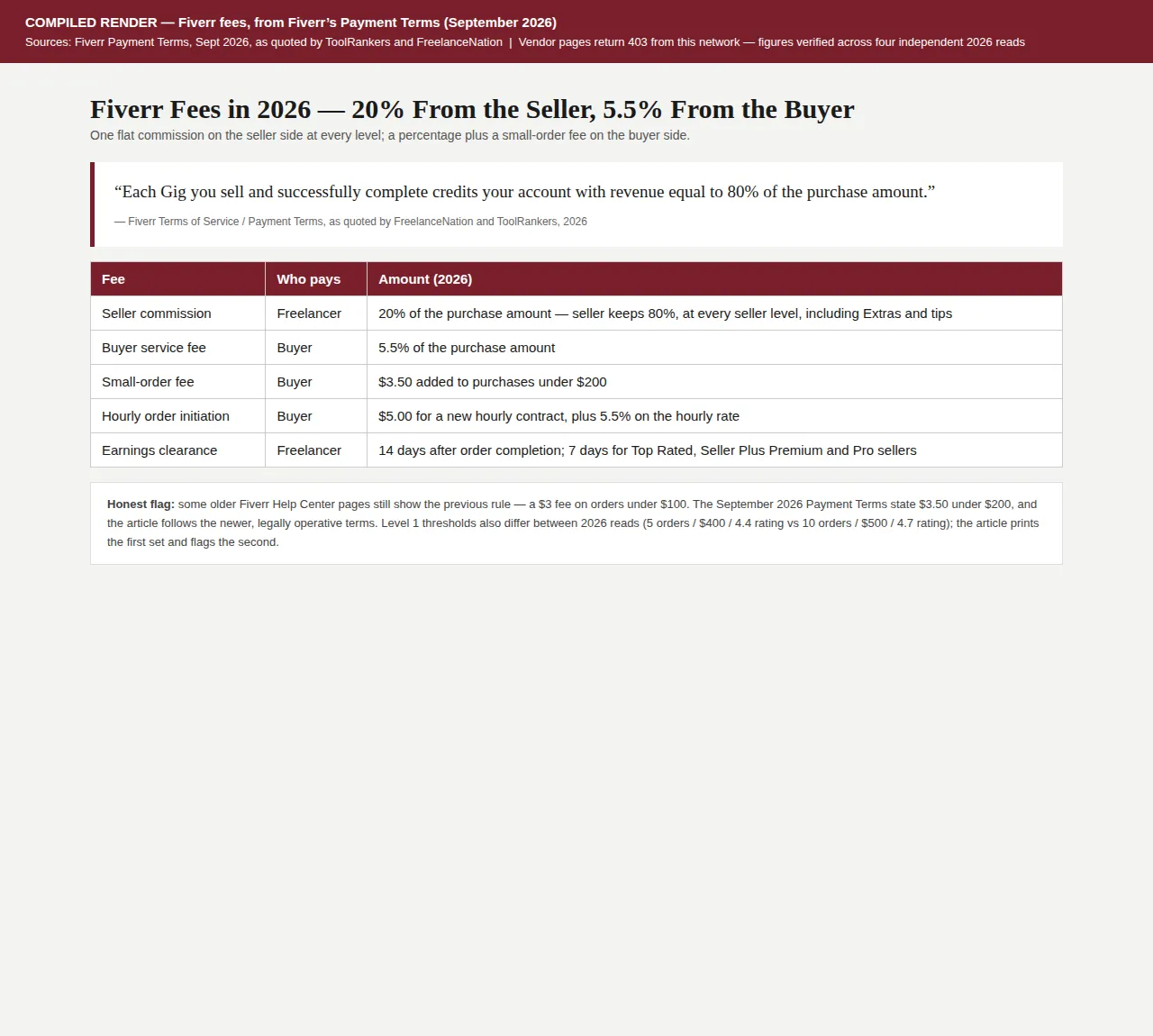
Fiverr's fee is the simplest and the heaviest on the seller. Its Payment Terms state that each completed Gig credits the seller with revenue equal to 80% of the purchase amount — a flat 20% commission at every seller level, on the order, on Gig Extras, and on tips. The buyer pays separately: a 5.5% service fee, plus a $3.50 small-order fee on purchases under $200. Hourly contracts add a $5 initiation fee, plus 5.5% on the hourly rate.
The seller level system decides how fast money clears. Fiverr evaluates accounts daily now, and Level 1 and Level 2 promote automatically when every threshold is met at once. Top Rated needs a manual review by Fiverr's editorial team.
| Level | Requirements | Clearance |
|---|---|---|
| New Seller | Profile approved, first gig published | 14 days |
| Level 1 | 60 days; 5 orders, 3+ clients; $400; 4.4+; 80% response; Success 5+ | 14 days |
| Level 2 | 120 days; 20 orders; $2,000; Success 7+; 4.6+; 90% response | 14 days |
| Top Rated | 180 days at Level 2; 40 orders, 20+ clients; $10,000; 4.7+; 90% response; Success 9+; manual review | 7 days |
The Success Score is a 1-to-10 composite per gig from Fiverr's 2024 overhaul, and the 7-day clearance is Top Rated's biggest benefit: half the wait. Pro sellers also clear in 7 days.
Step 4: Toptal — no rate card, and the margin is inside the rate
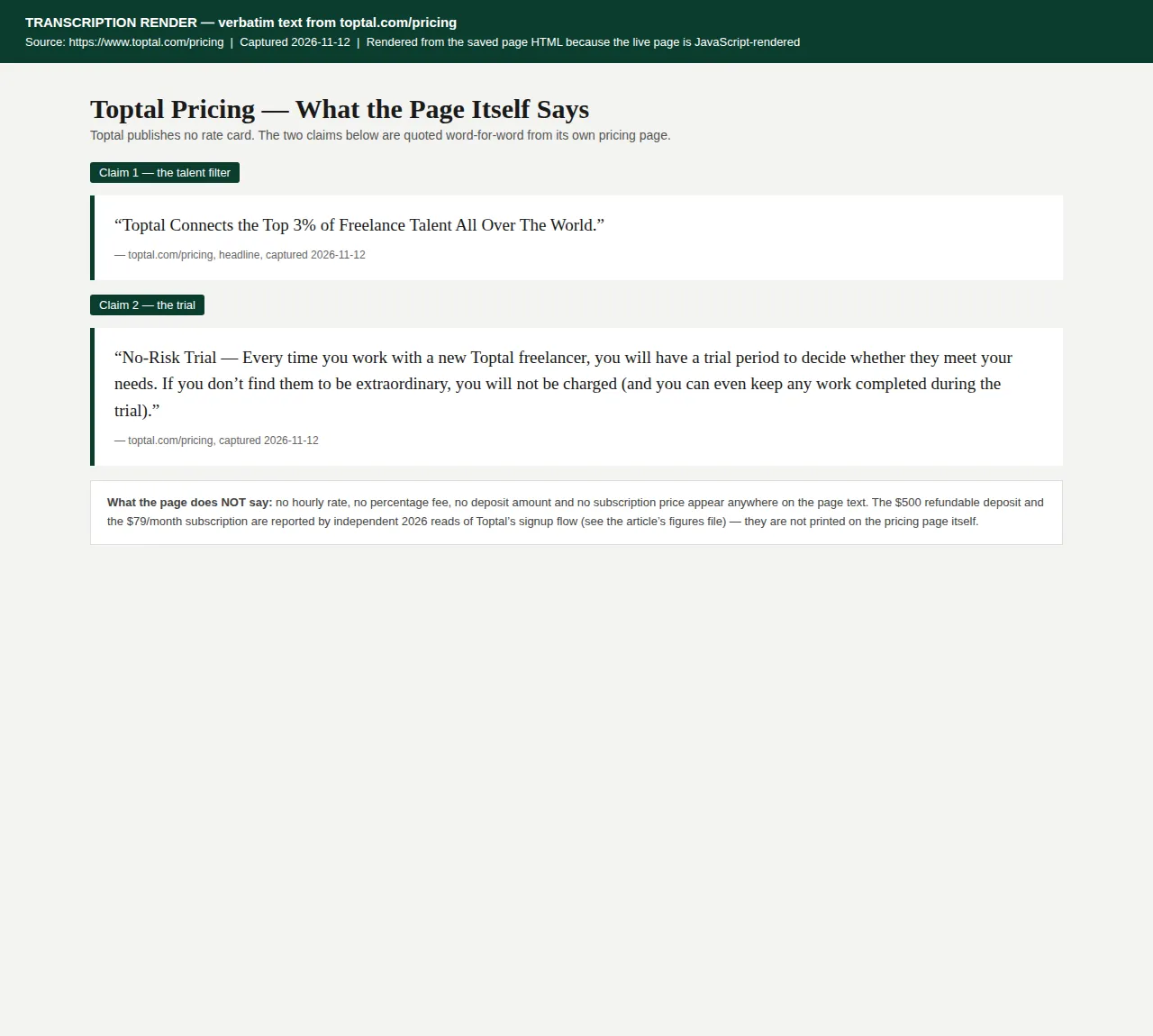
Toptal publishes no rate card. Its pricing page carries two claims and no numbers: that it connects the top 3% of freelance talent, and that every new engagement starts with a no-risk trial in which you are not charged if the freelancer does not meet your needs. The figures clients report in 2026 are a $500 refundable deposit before matching begins, credited to the first invoice; a $79-per-month subscription while your account is active; and blended hourly rates of roughly $60 to $150 or more. The deposit and subscription are not printed on the pricing page itself.
The screening is the product: a language check, a timed technical test, a live interview, and a test project. Matching typically takes 24 to 48 hours, and the trial runs up to two weeks. What you cannot see is Toptal's margin: it is built into the blended hourly rate, undisclosed, with freelancer reports putting it at up to roughly 50%. A $120-an-hour billed rate may pay the engineer $70 to $80.
Step 5: Worked example — the $1,000 job
All inputs are stated assumptions. Mara, a freelance designer, completes a $1,000 fixed-price job for Northwind Studio, a fictional buyer.
On the freelancer side, before withdrawal:
At 5%, Upwork pays $950.00; at 0%, the full $1,000.00 — a $150.00 range on the same job. On Toptal the same $1,000 buys 10 hours at a $100-an-hour blended rate, and the freelancer's share is undisclosed.
On the client side:
Plus the one-time initiation fee of $0.99 to $14.99, for a total of $1,080.89 to $1,094.89. At the 3% discounted rate, the total is $1,030.99 to $1,044.99. Fiverr's buyer pays $1,055.00 — the $1,000 price plus 5.5%, with no small-order fee. Toptal's client pays $1,000.00 of hours plus the $79.00 subscription in the first month; the $500.00 deposit is credited to the first invoice, so it is not an added cost.
The small-order edge is where Fiverr's buyer fee bites hardest. On a $50.00 order the buyer pays $56.25 in total — a 12.5% premium — while the seller keeps $40.00. On a $199.00 order the buyer pays $213.45; on a $200.00 order, $211.00. One dollar of listed price saves the buyer $2.45.
Step 6: Worked example — the $10,000 engagement and the 160-hour month
Same parties, a $10,000.00 engagement. Upwork's freelancer keeps $9,500.00 at 5%, $9,000.00 at 10%, and $8,500.00 at 15% — a $1,000.00 spread on one contract. Fiverr's seller keeps $8,000.00 and the buyer pays $10,550.00. Upwork's client pays $10,799.00 plus initiation at 7.99%, or $10,300.00 at 3%. Toptal's client pays $10,000.00 for 100 hours, plus $79.00.
As a monthly retainer the gap compounds. At 160 hours a month and a $75.00-an-hour gross rate, Upwork's freelancer bills $12,000.00 and keeps $10,800.00 at 10% or $10,200.00 at 15%; Toptal's client pays $16,079.00 a month; a $12,000.00 Fiverr order pays the seller $9,600.00 and costs the buyer $12,660.00. If the engagement ever becomes a business worth selling, the monthly run-rate is what a buyer prices — the business-valuation-ebitda-multiple-playbook runs that math on the same kind of recurring revenue.
Step 7: The two hidden costs — Connects and withdrawal
Upwork's proposal cost is easy to miss: it is paid before the work exists. Connects cost $0.15 each and a proposal typically needs 2 to 16. At 8 Connects a proposal costs $1.20; at a 1-in-10 win rate, each won contract carries $12.00 of proposal cost. On the $1,000.00 Upwork contract at a 10% fee, the effective take-home before withdrawal is $900.00 minus $12.00 — $888.00. Run a platform switch through the ROI calculator before moving a client: the fee saving has to beat the cost of the move.
Withdrawal is the second hidden cost. On $900.00 of Upwork earnings, a US freelancer withdrawing to a US bank by ACH keeps the full $900.00. An international freelancer pays $2.99 for the same ACH route, keeping $897.01; $0.99 to a local bank, keeping $899.01; and $50.00 for a US dollar wire, keeping $850.00. PayPal and Payoneer carry a small per-transfer fee that Upwork does not publish. Fiverr's withdrawal fees also vary by method and are shown at withdrawal; this guide prints no dollar figure for them because the reads disagree.
Step 8: Escrow, disputes, and who bears the risk
Upwork funds fixed-price milestones into escrow before work starts; the client has up to 14 days to review, and payment releases five days after approval. Hourly work is billed weekly and covered by Hourly Payment Protection when hours are logged through the Work Diary — the tracker that proves the work happened. Without the Work Diary, hourly protection does not apply. Fiverr's buyer pays upfront; funds are held until the order completes, then clear in 14 days, or 7 for Top Rated, Seller Plus Premium, and Pro sellers. Disputes run through Fiverr's Resolution Center, and cancellations count against the seller's completion rate. Toptal's protection is the trial: up to two weeks to decide, no charge if the match fails. For a founder weighing cash-flow timing against a monthly budget, the break-even-analysis-contribution-margin-playbook runs the same timing math on revenue versus cost.
Step 9: The tax and identity layer
Platform income is business income, and the paperwork decides how much of it you keep. A sole proprietor reports platform earnings on Schedule C under their SSN; a nonresident freelancer files under an ITIN. An LLC reports under its EIN, and an S-Corp or C-Corp files its own return. A CPA will ask for the EIN before the first filing. The self-employment tax under SECA is 15.3% on net earnings — the FICA equivalent for the self-employed — and it applies on top of income tax, which is why the platform fee is deductible as a business expense. Keep GAAP-style books even if you are not required to: the platform's 1099-K is the IRS's copy of your gross, not your net, and the gap between the two is your records. The site's 1099-K guide carries the current thresholds.
The decision
| Attribute | Upwork | Fiverr | Toptal | Authority |
|---|---|---|---|---|
| Freelancer fee | 0% to 15% per contract | 20% flat, all levels | None itemized; margin in the rate | Upwork Help Center; Fiverr Terms; Toptal page |
| Buyer fee | Up to 7.99% + $0.99–$14.99 initiation | 5.5% + $3.50 under $200 | $79/mo + $500 deposit (credited) | Upwork pricing page; Fiverr Payment Terms; client reports 2026 |
| $1,000 job, freelancer keeps | $850–$1,000 | $800 | Undisclosed share of $1,000 | Worked example, Step 5 |
| $1,000 job, client pays | $1,031–$1,095 | $1,055 | $1,079 first month | Worked example, Step 5 |
| Payment protection | Escrow + Work Diary | Upfront payment + Resolution Center | 2-week no-risk trial | Upwork Help Center; Fiverr Terms; Toptal page |
Who should pick which
Pick Upwork for custom, ongoing, or hourly work — check the percentage on every offer, because 15% on a $10,000.00 contract costs $500.00 more than 10%. Pick Fiverr for repeatable, fixed-price deliverables when you can live with 20% and a 14-day wait. Pick Toptal when a bad hire costs more than the premium. Avoid Toptal for short work, Fiverr for open-ended work, and Upwork if you cannot afford to spend Connects on unpaid proposals.
The build operation, start to finish
- [x] Read the fee on the offer before you accept it — on Upwork it is 0% to 15% and varies by contract.
- [x] Gross up your rate: net divided by one minus the fee.
- [x] Budget Connects at $0.15 each and track your win rate.
- [x] On Upwork hourly work, run the Work Diary on every hour — without it there is no payment protection.
- [x] On Fiverr, price above $200.00 where the work allows it.
- [x] File the platform's 1099-K against Schedule C, and keep GAAP-style books from the first dollar.
Founder & CEO Insight — Enow A. Jovial