UptimeRobot, Better Stack and StatusCake sell the same promise — someone watching your site while you sleep — but they charge for it in three different currencies. UptimeRobot charges per monitor, in tiers: Free is $0 for 50 monitors, Solo starts at $12 a month on annual billing, Team is $39, and Scale is $79. Better Stack charges per responder licence: Free is $0 for 10 monitors, and the paid platform starts at $29 a month per responder licence on annual billing, with extra monitors sold in blocks. StatusCake charges per monitor bundle: Free is $0 for 10 monitors, Superior is $20.41 a month on annual billing, and Business is $66.66. The meter decides the bill — and the check interval decides how much downtime the meter lets through.
The number every uptime buyer should calculate before opening a pricing page is the downtime allowance, because it turns the check interval into money. A 30-day month has 43,200 minutes. At 99.9% uptime — three nines — the allowance is 43.2 minutes of downtime a month. At 99.99% — four nines — it is 4.32 minutes. The check interval decides how much of that allowance burns before anyone is told: if an outage starts at a random moment between checks, the average wait for the next check is half the interval.
A 5-minute interval means 2.5 minutes of average detection delay. A 1-minute interval means 30 seconds. A 30-second interval means 15 seconds. At $1,000 of revenue an hour, two extra minutes of detection delay costs $33.33 per incident — and that is before the fix starts. The interval is not a feature row. It is the price of the silence between the outage and the alert.
The three meters, side by side
| Vendor | What you pay for | Entry price | Ceiling that matters | Authority |
|---|---|---|---|---|
| UptimeRobot | Per-monitor tiers | Free $0; Solo from $12/mo annual | Solo covers 10 monitors; Team 100; Scale 200 or 500 | uptimerobot.com/pricing, read Nov 20, 2026 |
| Better Stack | Per-responder licence | Free $0; paid from $29/mo per licence annual | 10 monitors included; extra 50 monitors $21/mo | betterstack.com/pricing, read Nov 20, 2026 |
| StatusCake | Per-monitor bundles | Free $0; Superior $20.41/mo annual | Free 10 monitors; Superior 100; Business 300 | statuscake.com/pricing, read Nov 20, 2026 |
UptimeRobot and StatusCake publish tier tables a buyer can read in one screen. Better Stack publishes a licence price and sells the rest as blocks and add-ons, so the total has to be assembled. Every figure in this guide is labelled with which shape it comes from, and every total below shows its arithmetic.
UptimeRobot: the per-monitor tier ladder
UptimeRobot is the oldest of the three and the most mechanical: the price follows the monitor count and the interval. Free is $0 — 50 monitors at a 5-minute interval, with HTTP, port, ping, keyword, API and UDP monitoring, basic status pages, and no login seats for a team. Solo starts at $12 a month on annual billing ($144 a year; $13 a month on monthly billing) for 10 monitors plus one third-party service monitor, a 60-second interval, all monitor types plus SSL and DNS, 3 status pages with a custom domain, and 12-month data retention. Team is $39 a month on annual billing ($468 a year; $46 monthly) for 100 monitors plus 20 third-party monitors, a 30-second interval, 3 seats, and 100 white-labelled status pages. Scale is $79 a month on annual billing ($948 a year; $98 monthly) for 200 or 500 monitors plus 40 to 100 third-party monitors, a 15-second interval, 5 seats, and unlimited status pages. Enterprise is quoted.
The annual-billing discount is about 15%, and it is worth taking only after the monitor count is settled, because the tiers are the trap. Solo's 10 monitors look generous until the count is done honestly: a business with a homepage, an API, a checkout, a status page, a blog, a DNS check, an SSL check and three regional endpoints is already at 10 monitors before staging is counted. SMS and voice call alerts are not included in any tier: credits are bought separately, 10 credits for $3 one-time, 100 for $15, and 1,000 for $100, and they do not renew with the subscription.
At the 60-monitor scenario the Team tier is the fit, because Solo's 10 monitors do not cover it:
\text{UptimeRobot Team, annual} = $39 \times 12 = $468\text{ per year}
Team covers 100 monitors at a 30-second interval, so 60 monitors sit comfortably inside it with room for 40 more. The 30-second interval gives a 15-second mean detection delay, the fastest of the three vendors' entry paid tiers. UptimeRobot is built for teams that want a dedicated monitor and nothing else — no incident management, no on-call rotation, no logs. Our Better Stack vs Statuspage vs Uptime Kuma monitoring playbook covers the self-hosted end of the same decision, for teams that would rather run the monitor than rent it.
Founder & CEO Insight — Enow A. Jovial
Better Stack: the licence that buys the whole incident
Better Stack's pricing page is the hardest of the three to read, because it no longer sells uptime monitoring as a product. It sells the platform, per responder licence. Free is $0: 10 monitors and heartbeats, 1 status page, 3 GB of web events, 30 GB of metrics, and 3-day retention. The paid platform starts at $29 a month per responder licence on annual billing ($34 a month on monthly billing), and that licence includes a single responder with unlimited phone call and SMS alerts, access to the entire platform — uptime monitoring, incident management and on-call, status pages, logs, traces, metrics, error tracking, session replay and real user monitoring — and unlimited team members on free Telemetry access. Extra monitors are sold in blocks: 50 more monitors for $21 a month on annual billing. Extra heartbeats are 10 for $17 a month. An additional public status page is $12 a month on annual billing, and the white-label, password, SSO and custom-domain features are charged per page. Telemetry capacity beyond the included amounts is sold in bundles — Nano at $25 a month on annual billing for 40 GB each of traces, logs and metrics.
The honest total for the 60-monitor scenario has to be assembled from the blocks:
\text{Better Stack, 60 monitors} = ($29 + $21) \times 12 = $600\text{ per year}
That is $348 a year for the licence plus $252 a year for the extra 50 monitors. It is the most expensive of the three for uptime alone, and the cheapest of the three for the whole incident workflow, because the $600 also buys the on-call rotation, the incident command, and the status page that the other two charge for separately or not at all. The catch is the licence unit: every responder who takes a call needs a licence, so a five-person on-call rotation costs five licences — $1,740 a year on annual billing — before a single extra monitor is bought. The page does not publish a check interval for its uptime monitors, which is itself a finding: a buyer who needs a guaranteed 30-second check must test it or get the interval in writing, because the pricing page does not state one. Better Stack suits the team that wants one vendor for monitoring, incidents and status pages, and it is the wrong buy for a team that only wants a ping every minute — the licence buys a platform the buyer will not use.
StatusCake: the bundle with the cheapest paid tier
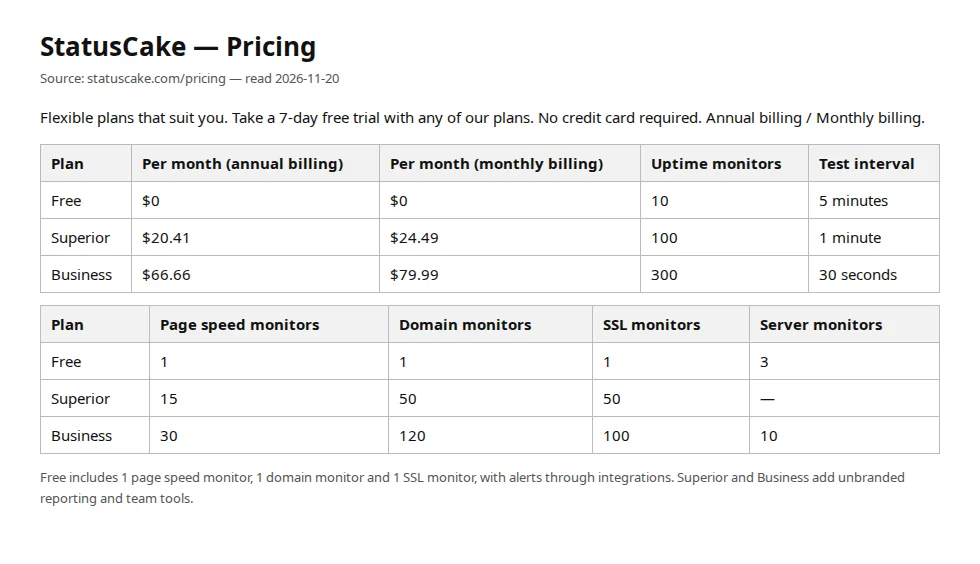
StatusCake is the simplest of the three to buy: three bundles, one price each, and the comparison table fits on a screen. Free is $0 — 10 uptime monitors at a 5-minute interval, 1 page speed monitor, 1 domain monitor, 1 SSL monitor, and alerts through integrations. Superior is $20.41 a month on annual billing ($24.49 a month on monthly billing) — 100 uptime monitors at a 1-minute interval, 15 page speed monitors, 50 domain monitors, 50 SSL monitors, and a 7-day free trial with no card required. Business is $66.66 a month on annual billing ($79.99 a month on monthly billing) — 300 uptime monitors at a 30-second interval, 30 page speed monitors, 120 domain monitors, 100 SSL monitors, and 10 server monitors. The annual totals:
\text{StatusCake Superior, annual} = $20.41 \times 12 = $244.92\text{ per year}
\text{StatusCake Business, annual} = $66.66 \times 12 = $799.92\text{ per year}
Superior is the cheapest paid tier in this comparison by $223.08 a year against UptimeRobot Team, and it covers the same 100 monitors. The gap is the interval — 1 minute against 30 seconds — and the status pages: StatusCake's pricing page does not list status pages as a Superior feature, while UptimeRobot Team includes 100 white-labelled status pages. A team that needs a public status page pays for it elsewhere or upgrades to Business. The page speed, domain and SSL monitors are the quiet value: Superior's 50 SSL monitors with expiry alerts replace a separate certificate-expiry tool, and the 50 domain monitors with blacklist checks replace a separate domain-watch service. StatusCake suits the small team that wants the most monitors for the least money and already has a status page elsewhere.
The decision: which meter matches the incident, not the monitor
| Buyer | Buy this | Skip this | Authority |
|---|---|---|---|
| Personal site, 10 monitors or fewer | Any free tier — UptimeRobot Free covers 50 | Every paid tier until the monitor count passes 50 | uptimerobot.com/pricing |
| Small team, 60 monitors, 1-minute checks | StatusCake Superior at $244.92/yr | UptimeRobot Solo — 10 monitors do not cover 60 | statuscake.com/pricing |
| Small team, 60 monitors, 30-second checks | UptimeRobot Team at $468/yr | StatusCake Superior — 1-minute interval, no status pages listed | uptimerobot.com/pricing |
| Team that runs incidents end-to-end | Better Stack licence at $600/yr for 60 monitors | All three monitor-only tiers — they do not run the incident | betterstack.com/pricing |
| Large estate, 300 monitors, 30-second checks | StatusCake Business at $799.92/yr | UptimeRobot Scale at $948/yr unless 500 monitors are needed | statuscake.com/pricing |
The annual totals at 60 monitors are $244.92 for StatusCake Superior, $468 for UptimeRobot Team, and $600 for Better Stack. The cheapest monitor is StatusCake; the cheapest incident is Better Stack; the fastest detection at the entry paid tier is UptimeRobot Team at 30 seconds.
Five steps before you sign
- Count the honest monitors. List every endpoint, certificate and domain that should wake someone, including staging. The count decides the tier.
- Pick the interval from the SLA, not the price. A 99.9% SLA allows 43.2 minutes a month; a 5-minute check burns 2.5 minutes of it on average before the alert.
- Price the status page separately. If the team needs a public status page, confirm which tier includes it — UptimeRobot Team includes 100, Better Stack includes 1, StatusCake does not list one on Superior.
- Test the alert path at 3 a.m. hours. Trigger a test outage and time the alert to the phone. The interval on the pricing page is not the time to the alert.
- Run the free tier for 30 days first. All three free tiers cost $0. Claim all three, point them at the same endpoints, and keep the one whose alerts arrive first and whose false alarms are fewest.
- [x] Honest monitor count completed, including staging and certificates
- [x] Check interval chosen from the SLA allowance, not the cheapest tier
- [x] Status page requirement confirmed against the tier that includes it
- [x] Alert path tested end-to-end, with SMS credit costs counted
- [x] Free tiers trialled side by side for 30 days before paying
Uptime monitoring in 2026 is three meters wearing the same product name. UptimeRobot charges per monitor in tiers and wins on interval. Better Stack charges per responder licence and wins on the incident workflow. StatusCake charges per bundle and wins on price. Count the monitors honestly, pick the interval from the SLA, and buy the tier that covers both — then check the Better Stack vs UptimeRobot vs Pingdom uptime monitoring pricing playbook for the older pricing shapes these three replaced, and the Cloudflare vs Fastly vs AWS CloudFront CDN pricing playbook for the delivery layer StatusCake watches. Run the downtime math in our break-even calculator before the renewal meeting.