Three vendors will watch your website and shout when it goes down, and they price the shouting three ways. UptimeRobot gives away 50 monitors free at five minutes and charges $33 a month for 100 monitors at 30 seconds. Better Stack charges $29 a month for a responder and 10 monitors, then $21 for each extra block of 50. Pingdom charges $71.50 a month for 50 checks at a one-minute interval, with no free tier. The price is the check interval and the alerting, not the monitor count. Prices as read on November 15, 2026.
The three price ladders
The table has a free tier, a responder, and a calculator. UptimeRobot's free plan is the only $0 here, and the only vendor pricing by the monitor bucket rather than the check. Better Stack prices the responder first. Pingdom prices checks, and every tier carries an SMS bundle.
| Vendor | Entry price (annual billing) | Monitors included | Fastest check interval | What the entry price buys | Authority |
|---|---|---|---|---|---|
| UptimeRobot | Free $0; Solo $12/mo | 50 free; 10 on Solo | 5 min free; 60 sec Solo; 30 sec Team; 15 sec Scale | 50 monitors at 5-min checks, status pages, SSL and DNS checks | UptimeRobot pricing page, Nov 15, 2026 |
| Better Stack | $29/mo (responder + 10 monitors) | 10 | 30 seconds | Responder with unlimited phone and SMS alerts, 10 monitors, 1 status page | Better Stack pricing page, Nov 15, 2026 |
| Pingdom | $16.50/mo (10 checks) | 10 checks | 1 minute | 10 checks, 1 advanced check, 50 SMS, public status pages | Pingdom pricing page, Nov 15, 2026 |
UptimeRobot: the volume play
UptimeRobot is the volume play. The free plan watches 50 monitors at a five-minute interval, with no card and no trial clock, and the vendor's page says it suits personal and commercial projects. Solo is $13 monthly and $12 annual, for 10 monitors at 60 seconds, 3 status pages, SSL and DNS checks, 12 months of retention. Team is $39 monthly and $33 annual, for 100 monitors at 30 seconds, 3 seats, 100 status pages, 24 months of retention. Scale is $83 monthly and $67 annual, for 200 or 500 monitors at 15 seconds, 5 seats, and unlimited status pages. Enterprise is quote-only, with the SLA, SOC 2 report, DPA and MSA.
The per-monitor cost collapses as the bucket grows: the price is per plan, not per monitor. Solo costs $1.20 a monitor a month; Team costs $0.33; Scale costs $0.34 at 200 monitors and $0.13 at 500. A team needing 100 monitors pays $33 a month on Team and gets 100 status pages with it. The annual discount is not 15 percent on every plan: Solo saves 7.7 percent, Team 15.4, Scale 19.3.
The SMS and voice credits are included, not metered: Solo 10 to 20, Team 30, Scale 50 to 200. Extra credits are one-time purchases, not a recurring charge, and extra login seats cost $15 to $19 a month each. Annual totals: Solo $144, Team $396, Scale $804. The free plan is the honest start for a side project: 50 monitors, five-minute checks, no expiry. The catch is the interval, not the price — five minutes is a long time for a checkout page to be down. UptimeRobot is GDPR compliant under a DPA and SOC 2 compliant, and its free plan covers commercial projects too.
Better Stack: the responder first
Better Stack prices the person who answers, not the monitor. The responder is $34 monthly and $29 annual, and includes a single responder with unlimited phone call and SMS alerts, 10 monitors and heartbeats, and one status page. Extra monitors come in blocks of 50 at $25 a month, or $21 annual. Extra heartbeats come in blocks of 10 at $20, or $17 annual. An extra public status page is $15, or $12 annual. Password protection is $50 per page a month, or $42 annual; white-labelling is $250, or $208 annual.
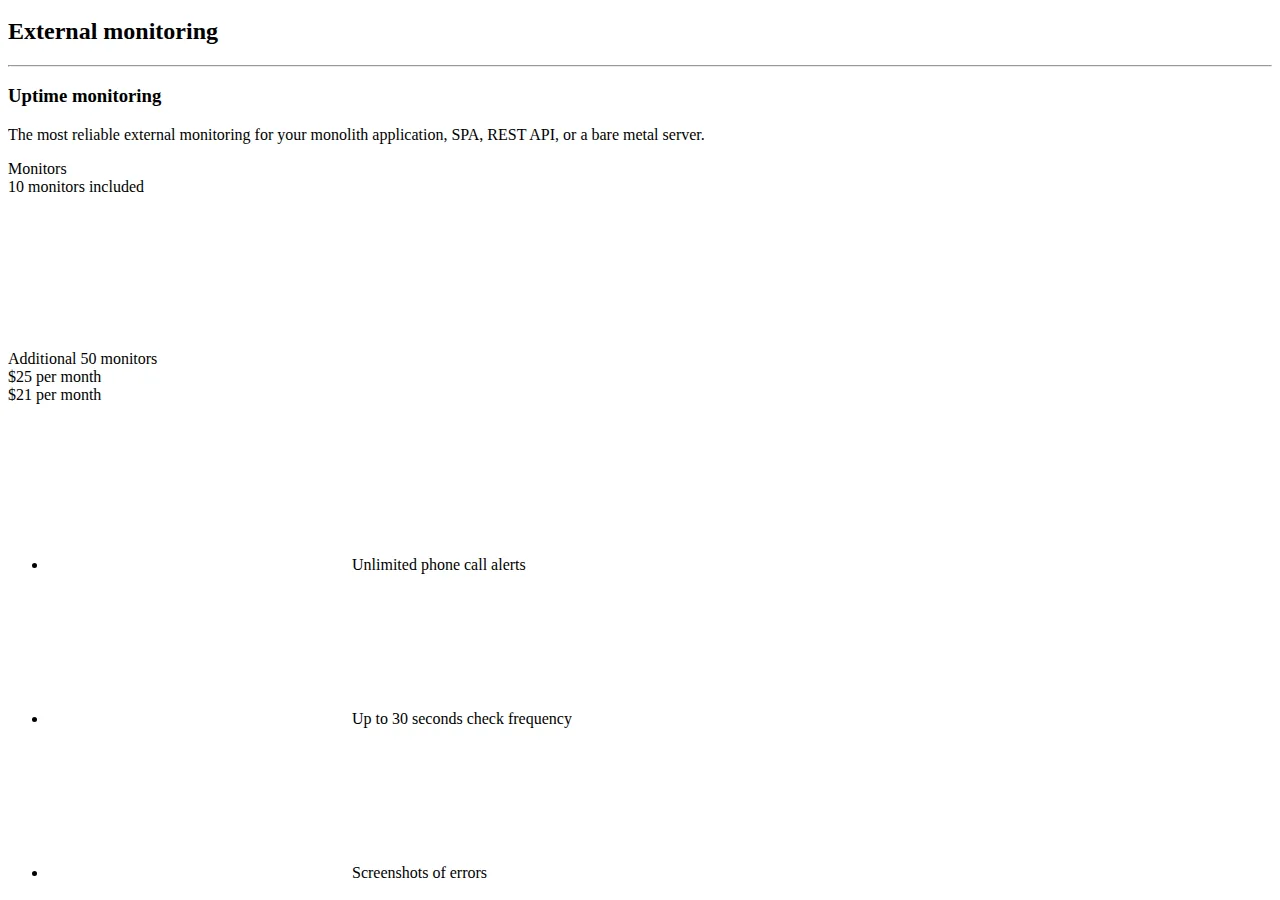
Better Stack's external monitoring pricing, above: 10 monitors included, additional 50 at $25 a month or $21 annual, up to 30-second checks.
The block is the whole pricing model: $21 per 50-monitor block is $0.42 a monitor inside the block, but the block is bought whole — 11 monitors cost the same as 50. The annual discount on the responder is 14.7 percent, or $60 a year; on the monitor block it is 16 percent, or $48 a year.
Checks run up to every 30 seconds, and the page carries a 60-day money-back guarantee. Better Stack is GDPR compliant with data stored in the EU, holds SOC 2 Type 2, and states plainly that it is not HIPAA compliant. Telemetry — logs and traces — is priced separately by gigabytes and is not priced here. Our Better Stack vs Statuspage vs Uptime Kuma monitoring playbook prices the status page itself: Better Stack charges $12 a month extra per page, UptimeRobot includes 100 on Team.
Pingdom: the dearest check, the fullest incident
Pingdom is the dearest per monitor and the most explicit about what the money buys. There is no free plan. The Synthetic Monitoring ladder is priced by the check count, and every tier carries an SMS bundle — checks plus advanced checks plus SMS, monthly price then annual: 10+1+50 for $18, or $16.50 annual; 25+4+100 for $40, or $36.33; 50+10+200 for $78, or $71.50; 100+20+350 for $149, or $136.42; 200+30+400 for $290, or $265.17; 500+50+1,000 for $680, or $622.67; 1,000+80+1,000 for $1,295, or $1,186.92.
The per-check price falls as the ladder climbs, but slowly: from $1.65 at 10 checks to $1.25 at 500, a 24 percent fall for a fifty-fold volume rise. Annual totals: 100 checks $1,637.04, 200 checks $3,182.04. The annual-billing saving on the 50-check tier is $78 a year, or 8.3 percent.
Real User Monitoring is priced separately by pageviews, monthly then annual: 100,000 for $18, or $16.50; 1 million for $118, or $107.83; 10 million for $624, or $572. A team buying 50 synthetic checks and 100,000 RUM pageviews pays $88 a month on annual billing, or $1,056 a year.
The check interval is one minute, confirmed in Pingdom's own getting-started guide, which recommends one minute and allows anything from one minute to one hour. The product page adds the operational detail: more than 100 probe servers worldwide, a second check before alerting so a single failed probe does not page anyone, root-cause analysis with a traceroute on every incident, and public status pages in all plans. The 30-day free trial covers Synthetics and RUM. Our Cloudflare DNS vs Route 53 vs Google Cloud DNS pricing playbook prices the DNS layer Pingdom's checks depend on, and the DNS check is the one that catches the outage a plain HTTP check misses.
The interval is the product
A 30-second check runs 2,880 checks a day, 86,400 a month. A 60-second check runs 43,200 a month; a five-minute check 8,640; a 15-second check 172,800. Pingdom's one-minute check runs 43,200 a month — the same count as UptimeRobot Solo, at three times the price per monitor, because Pingdom's dollar buys the probe network, not the count. That is why the interval matters more than the monitor count.
The SLA math is the same arithmetic. A 99.9 percent uptime SLA allows 43.2 minutes of downtime a month; 99.99 percent allows 4.32 minutes. UptimeRobot puts the SLA on the Enterprise plan only — the paid plans carry no uptime guarantee. That is the break-even question: a five-minute check can miss a four-minute outage entirely, and a 30-second check catches it in half a minute.
The same 50 monitors, three bills
Take a team running 50 monitors. The table prices annual billing, and the free plan is listed because it is the cheapest honest answer for a side project.
| Monitors (annual billing) | Better Stack | UptimeRobot | Pingdom | Cheapest | Authority |
|---|---|---|---|---|---|
| 10 monitors | $29 | $12 (Solo) | $16.50 | UptimeRobot | Vendor pages, Nov 15, 2026 |
| 50 monitors | $50 | $33 (Team) / $0 (Free) | $71.50 | UptimeRobot Free | Vendor pages, Nov 15, 2026 |
| 100 monitors | $71 | $33 (Team) | $136.42 | UptimeRobot | Vendor pages, Nov 15, 2026 |
| 200 monitors | $113 | $67 (Scale) | $265.17 | UptimeRobot | Vendor pages, Nov 15, 2026 |
Per monitor at 100: $0.71 Better Stack, $0.33 UptimeRobot, $1.36 Pingdom. Pingdom costs four times UptimeRobot at every volume: at 200 monitors Pingdom is $265.17 against UptimeRobot's $67. Better Stack sits in the middle, and its price buys the responder — unlimited phone and SMS — where the others sell alert credits.
Alerting and the SLA
Alerting is where the vendors diverge most: Better Stack's responder carries unlimited phone call and SMS alerts. UptimeRobot sells credits: Solo 10 to 20, Team 30, Scale 50 to 200, with extra credits as one-time purchases. Pingdom bundles SMS into every tier: 50 at 10 checks, 200 at 50, 350 at 100, 1,000 at 500. Status pages follow the same split: Better Stack charges $12 a month extra per page, UptimeRobot includes 100 on Team and unlimited on Scale, and Pingdom includes them in all plans. The SLA is the thinnest part: only UptimeRobot's Enterprise plan carries one, and neither Better Stack nor Pingdom prints an uptime guarantee on the pricing page. A buyer who needs a contractual uptime number has one vendor to call.
Who should use each — and who should not
| Vendor | Use it if | Avoid it if |
|---|---|---|
| UptimeRobot | You want the cheapest monitoring at any volume, or a free plan | You need an SLA, or a one-minute check with a probe network |
| Better Stack | You want a responder with unlimited phone and SMS and 30-second checks | You need more than 10 monitors without paying for a 50-monitor block |
| Pingdom | You want 100-plus probes, a second check before alerting, and root-cause analysis | You need a free tier, or the per-monitor price matters more |
Founder & CEO Insight — Enow A. Jovial
The buying checklist
- [x] Step 1: Count the monitors and the endpoints. A monitor is a URL, a keyword, a port or a heartbeat.
- [x] Step 2: Pick the interval from the cost of an outage. A checkout page needs 30 seconds or one minute; a blog survives five minutes.
- [x] Step 3: Price 50 monitors on all three at your own numbers. UptimeRobot Free is $0, Team is $33, Better Stack is $50, Pingdom is $71.50.
- [x] Step 4: Add the alerting. Price the SMS credits on UptimeRobot and Pingdom, and the responder on Better Stack, first.
- [x] Step 5: Check the status page. Better Stack charges $12 a month extra per page; UptimeRobot includes 100 on Team; Pingdom includes them in all plans.
- [x] Step 6: Ask for the SLA in writing. Only UptimeRobot Enterprise carries one, and a pricing-page promise is not a contract.
- [x] Step 7: Run the numbers in the pricing calculator. Our Railway vs Render vs Fly.io PaaS hosting pricing playbook prices the hosting the monitors watch.
The verdict: UptimeRobot wins the price at every volume, and its free plan is the cheapest honest start. Better Stack wins the alerting, with a responder and unlimited phone and SMS for $29 a month. Pingdom wins the probe network and the incident detail, and charges four times UptimeRobot for it. Buy the interval your outage budget allows, the alerting your on-call rotation needs.