Better Stack vs Statuspage vs Uptime Kuma: The Uptime Monitoring Playbook
Three products, three different jobs
Better Stack, Statuspage, and Uptime Kuma all appear in the same search results, but they do three different jobs. Better Stack watches your endpoints and tells your customers when they break: monitoring, on-call, and status pages in one paid subscription. Statuspage does only the second half: it tells your customers what is happening, and watches nothing. Uptime Kuma watches your endpoints and publishes a status page, and costs nothing for the software itself — you run it on your own server.
That split decides the purchase before any price does: Statuspage alone still needs a monitor, Kuma alone still needs someone on call, Better Stack buys all three at once, priced per responder. Prices below come from the vendors' own pages and the Uptime Kuma README, read on 2026-11-10.
What each one watches, and how often
Better Stack runs HTTP, TCP, ping, DNS, SSL, keyword, and cron or heartbeat checks from multiple locations. Paid plans check as often as every 30 seconds. The free tier covers 10 monitors and 10 heartbeats with Slack and email alerts only — phone call and SMS alerts start with the paid responder license.
Uptime Kuma watches HTTP and HTTPS, TCP, HTTP keyword, HTTP JSON query, WebSocket, ping, DNS record, push, Steam game server, and Docker containers, at 20-second intervals, and notifies through more than 90 services including Telegram, Discord, and Slack. Its status pages are built in: multiple pages, mapped to specific domains, with a ping chart and certificate info. The install is one Docker command on your own server: docker run -d --restart=always -p 3001:3001 -v uptime-kuma:/app/data --name uptime-kuma louislam/uptime-kuma:2
Statuspage watches nothing. It is the place where you communicate incidents and scheduled maintenance. The monitoring that detects the outage lives somewhere else — a tool like Better Stack or Uptime Kuma, a human, or a customer message — and someone has to turn that signal into a post. The free plan covers 100 subscribers, 25 components, two team members, two metrics, email, Slack, and Teams notifications, plus REST API access.
| Attribute | Better Stack | Atlassian Statuspage | Uptime Kuma | Authority |
|---|---|---|---|---|
| Job | Monitoring, on-call, status pages | Status pages only | Self-hosted monitoring, status pages | Vendor pages |
| Fastest check | 30 seconds (paid) | None | 20 seconds | Vendor pages |
| Free tier | $0: 10 monitors, 1 page | $0: 100 subscribers | $0 software (MIT) | Vendor pages |
| SLA reporting | $4 per member a month add-on | Uptime per component | None listed | Vendor pages |
The check-interval math
A check interval is a detection budget: a 30-second check can take up to 30 seconds to notice an outage, and on average takes half that:
At 30 seconds the average delay is 15 seconds; at 20 seconds it is 10. Kuma's 20-second interval is free with the software, while Better Stack's 30-second interval arrives with the $29 responder license. A 5-minute interval gives 288 checks a day and an average delay of 150 seconds — two and a half minutes before the first alert.
The price cards, side by side
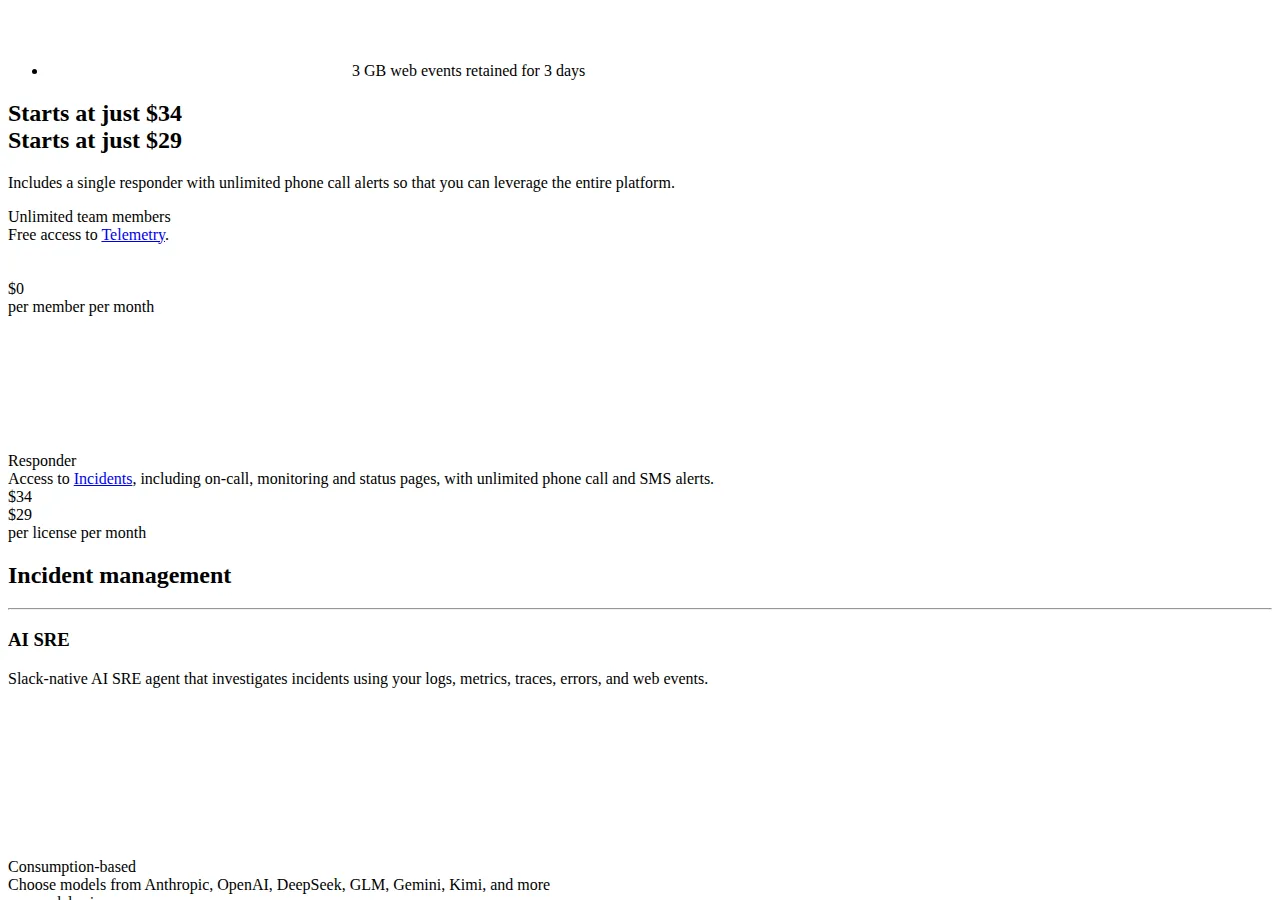
Better Stack prices by responder license first, then by monitor blocks. Free costs $0: 10 monitors, 10 heartbeats, 1 status page, with Slack and email alerts. One responder license costs $29 a month on annual billing, or $34 billed monthly, and includes unlimited phone call and SMS alerts; team members beyond the responder are $0 per member per month. Each extra block of 50 monitors costs $21 a month on annual billing, or $25 billed monthly.
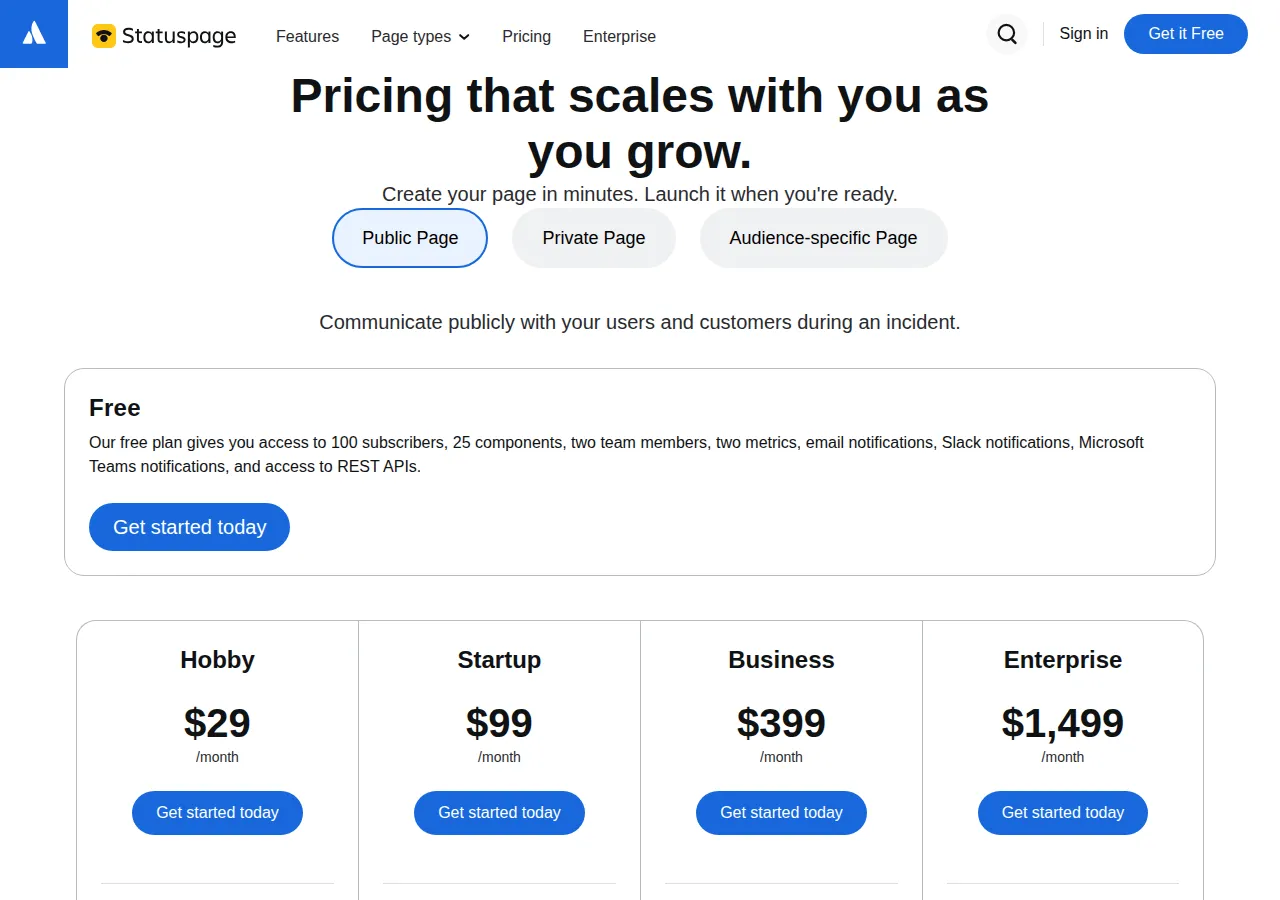
Statuspage prices public pages by subscribers and team size. Free is $0 for 100 subscribers, 25 components, 2 team members, and 2 metrics. Hobby costs $29 a month for 250 subscribers, 5 team members, and 5 metrics, and adds a custom domain and basic customization. Startup costs $99 a month for 1,000 subscribers, 10 team members, and 10 metrics, and adds SMS, webhooks, custom CSS, and single sign-on. Business costs $399 a month for 5,000 subscribers, 25 team members, and 25 metrics, and adds custom CSS, HTML, and JavaScript, component subscriptions, and role-based access. Enterprise costs $1,499 a month for 25,000 subscribers, 50 team members, and 50 metrics. Private pages are a second subscription: Starter $79 a month for 50 employees, Growth $249 for 300, Corporate $599 for 1,000, Enterprise $1,499 for 5,000.
Uptime Kuma has no price card. The software is free under the MIT license and runs in Docker on your server. The bill is the server plus the hours: patching, backups, upgrades, and answering the alert when the monitor itself fails. At a stated assumption of a $5-a-month server and 2 hours of ops time a month valued at $50 an hour, the total is $105 a month — a planning number, not a vendor price.
Status pages: what you get, and what white-label costs
Better Stack includes 1 status page free and in every responder license. Extra public pages cost $12 a month each on annual billing ($15 billed monthly). Custom CSS and JavaScript cost $12 a month per page on annual billing. White-label — removing the "Powered by Better Stack" footer — costs $208 a month per page on annual billing ($250 billed monthly).
Statuspage includes the page at every tier, and the price rises with subscribers, not pages. A custom domain starts on Hobby at $29 a month; custom CSS starts on Startup at $99; custom HTML and JavaScript wait until Business at $399. That ladder is the trap: a team that only needs its own logo and CSS pays $99 a month, and a team that needs custom JavaScript pays $399.
Uptime Kuma includes multiple status pages at $0, mapped to specific domains, with no subscriber cap and no white-label fee. What it lacks is a hosted subscriber list with SMS delivery: notifications go through the services you configure, and email depends on your own SMTP setup.
SLA reporting: who proves uptime, and who just shows it
An SLA is a promise with a number, and the number needs a report. Better Stack sells historical uptime SLA reporting as an add-on at $4 per member per month on annual billing ($5 billed monthly). Per member, so a 10-person team pays $40 a month on annual billing
Statuspage displays historical uptime per component and counts metrics by plan: 2 on Free, 5 on Hobby, 10 on Startup, 25 on Business, 50 on Enterprise.
Uptime Kuma shows uptime percentage per monitor on its status pages. Its README lists no SLA or SLI reporting feature, no incident post-mortem template, and no on-call schedule. The Datadog vs Grafana Cloud vs New Relic observability pricing playbook covers the heavier APM stack; this guide stays on uptime and status pages.
A 30-day month holds 43,200 minutes.
A 30-second interval is small against a 43-minute budget; a 5-minute interval burns 2.5 minutes of it on detection alone. The interval is not the SLA, but it is the first deduction from it.
Worked example — 50 monitors with a status page
Take a small SaaS with 50 endpoints, one person on call, and one public status page, on annual billing. Better Stack: one responder license at $29 a month, plus one block of 50 monitors at $21 a month.
Statuspage alone cannot do this job, so the honest comparison is Statuspage plus a monitor. Pair Statuspage Startup at $99 a month with Uptime Kuma on a $5-a-month server and 2 hours of ops time a month at $50 an hour:
Better Stack costs $600 a year for the same shape; the self-hosted pairing costs $2,448 a year at the stated ops-time assumption, and $1,848 of that gap is the ops time, not the software. Even at $0 an hour for its own time, the pairing costs $1,248 a year and still loses, because Statuspage Startup alone is $1,188.
Worked example — 200 monitors and the cost per check
Now take a platform with 200 endpoints, on annual billing: 10 monitors included, 190 more need four blocks of 50.
At 30-second checks, 200 monitors run 17,280,000 checks in a 30-day month:
Statuspage Business at $399 a month ($4,788 a year) still monitors nothing, so the 200-monitor bill is Business plus a monitor. Pair it with Kuma at the same $105-a-month hosting and ops assumption and the total is $504 a month, or $6,048 a year, against Better Stack's $1,356.
Uptime Kuma alone at 200 monitors costs the same $105 a month at the stated assumption — the software does not care how many monitors it runs, only the server does. That is the one shape where self-hosting wins on cash: 200 monitors, no need for a branded subscriber page, and ops time already paid for elsewhere.
| Setup, annual billing | 10 monitors a month | 50 monitors a month | 200 monitors a month | 200 monitors a year |
|---|---|---|---|---|
| Better Stack (1 responder) | $29 | $50 | $113 | $1,356 |
| Hobby plus Kuma | $134 | $134 | $134 | $1,608 |
| Startup plus Kuma | $204 | $204 | $204 | $2,448 |
| Business plus Kuma | $504 | $504 | $504 | $6,048 |
| Uptime Kuma alone (assumption) | $105 | $105 | $105 | $1,260 |
Kuma rows use the stated assumption ($5-a-month server, 2 hours of ops time a month at $50 an hour). Better Stack rows are vendor prices.
Founder & CEO Insight — Enow A. Jovial
Who should buy which
Buy Better Stack if one person needs monitoring, paging, and a status page without running infrastructure: the $29 responder license plus $21 monitor blocks is the cheapest complete answer at 10, 50, and 200 monitors, with unlimited phone and SMS alerts inside the license. Pay annually — monthly billing costs $34 per license and $25 per block.
Buy Statuspage if the customers already expect a Statuspage URL, the brand matters more than the monitor, and a separate monitoring tool already exists. Stay on Free under 100 subscribers, move to Hobby at $29 for a custom domain, and expect Startup at $99 the moment SMS, webhooks, or custom CSS become requirements. Do not buy it expecting it to detect anything.
Buy Uptime Kuma if the team already runs servers, already pays for ops time, and wants 20-second checks with no per-monitor bill and no subscriber cap. It fits a homelab or a side project with 200 endpoints. It is the wrong answer for a team with no one to patch it: an unpatched monitor is a blind spot with a dashboard. The Vercel vs Netlify vs Cloudflare Pages hosting pricing guide prices the hosted side of the same decision.
The execution checklist
- Step 1 — Count the endpoints honestly. The monitor count picks the Better Stack blocks; the subscriber count picks the Statuspage tier.
- Step 2 — Name the detection budget. A 30-second interval finds outages in 15 seconds on average; a 20-second interval in 10.
- Step 3 — Run the free tier for two weeks. Better Stack Free, Statuspage Free, Kuma in Docker.
- Step 4 — Price the annual bill. Responder license plus monitor blocks, or Statuspage tier plus the monitor behind it.
- Step 5 — Add the white-label line. Better Stack white-label is $208 a month per page on annual billing; Statuspage custom CSS starts at $99 and custom JavaScript at $399.
- Step 6 — Test the alert path end to end. Kill a test endpoint and confirm the phone call, the SMS, and the status page post all fire.
- Step 7 — Write the SLA number down. 99.9 percent allows 43.2 minutes a month; 99.99 percent allows 4.32.
- Step 8 — Diary the renewal and the patching. A self-hosted monitor needs patching on a schedule, not when it breaks.
Better Stack is the cheapest complete answer for monitoring, paging, and a status page in one subscription. Statuspage is the right page when the brand and the subscriber list matter. Uptime Kuma is the right monitor when the team already runs infrastructure. Pick by the job and pay annually.