Idle business cash has a cost, and it is measured in the yield the cash is not earning. A $500,000 operating reserve sitting in a checking account at 0.10 percent earns $500 a year. The same $500,000 in Treasury bills at the November 16, 2026 auction rates earns about $21,725 a year — and the interest is exempt from state and local income tax. The obstacle is not the return; it is the lock-up. A 52-week bill cannot fund next Friday's payroll. A ladder solves that: buy bills at staggered maturities, so a rung matures every few weeks, the cash is free again, and the rung is re-bought at the new auction rate. This playbook builds the ladder from the auction results as read on November 16, 2026.
The instrument: a bill is a discount, not a coupon
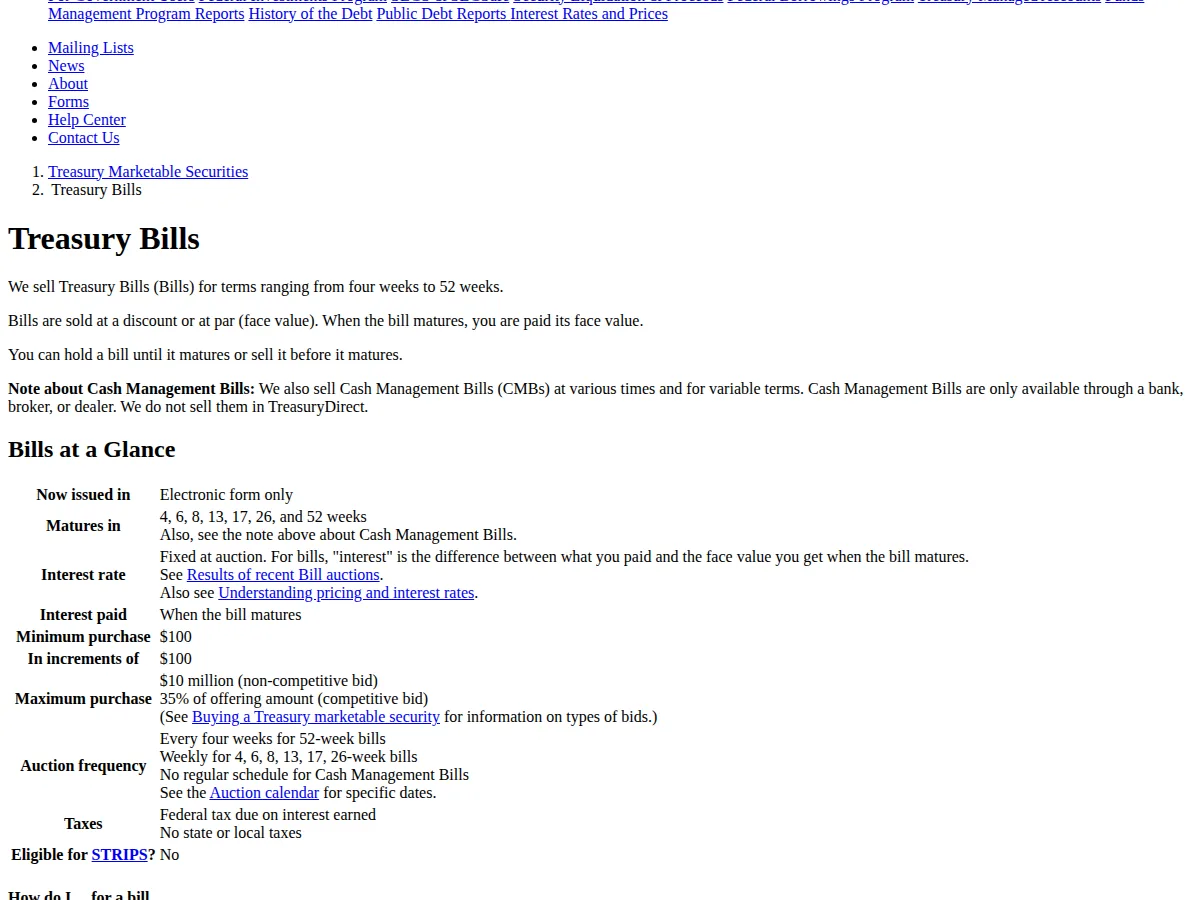
A Treasury bill pays no interest while you hold it. It is sold at a discount to face value and pays face value at maturity; the difference is the interest. TreasuryDirect sells bills for terms of 4, 6, 8, 13, 17, 26, and 52 weeks, in electronic form only, with a $100 minimum purchase in $100 increments and a $10 million maximum on a noncompetitive bid. Auctions run weekly for 4- through 26-week bills and every four weeks for 52-week bills. A noncompetitive bidder accepts whatever rate the auction sets and is guaranteed the full amount bid, up to the $10 million limit — the right way for a business to buy, because a business has no edge in bidding a rate.
The price follows one formula, the bank-discount convention the Treasury uses at auction:
A 13-week bill at a 4.155 percent high rate, 91 days to maturity, prices at 98.9497 per $100 of face value. The buyer pays $98,949.71 for $100,000 of face value and receives $1,050.29 at maturity. The investment rate — the bond-equivalent yield the buyer actually earns — is 4.257 percent on that bill, higher than the discount rate because the discount is measured on face value over 360 days while the return is measured on money invested over 365.
The five-rung ladder, priced from the November 16 auctions
The ladder below uses the high rates from the TreasuryDirect auction results for November 2026: the 4-week bill at 3.955 percent (November 12), the 8-week at 4.080 percent (November 12), the 13-week at 4.155 percent (November 16), the 26-week at 4.310 percent (November 16), and the 52-week at 4.290 percent (October 27). Each rung is $100,000 of face value. The cost column is what the business actually pays; the interest column is what each rung earns in its first cycle.
| Rung | Term | Days | High rate | Cost for $100,000 face | Interest at maturity |
|---|---|---|---|---|---|
| Rung 1 | 4-week bill | 28 | 3.955% | $99,692.39 | $307.61 |
| Rung 2 | 8-week bill | 56 | 4.080% | $99,365.33 | $634.67 |
| Rung 3 | 13-week bill | 91 | 4.155% | $98,949.71 | $1,050.29 |
| Rung 4 | 26-week bill | 182 | 4.310% | $97,821.06 | $2,178.94 |
| Rung 5 | 52-week bill | 364 | 4.290% | $95,662.33 | $4,337.67 |
| Total | — | — | — | $491,490.82 | $8,509.18 |
The business pays $491,490.82 for $500,000 of face value and collects $8,509.18 as the rungs mature over the first year. That is the first-cycle interest, not the annual yield: the 4-week rung matures and is re-bought roughly thirteen times a year, the 8-week rung six and a half times, the 13-week rung four times, the 26-week rung twice. Rolled for a full year at the same rates, each rung's effective annual yield is 4.098, 4.237, 4.326, 4.517, and 4.547 percent respectively — a blended 4.345 percent, or $21,725.26 a year on the $500,000 face value:
That $21,725.26 assumes the November 16 rates hold for a year. They will not — the ladder's whole design is that each rung re-prices at the new auction rate when it matures. If rates fall, the yield falls with them; if rates rise, it rises. The honest statement is the first cycle: $8,509.18 of certain interest on $491,490.82 paid, and a re-pricing every four weeks thereafter. Compare that with the cash-parking decision itself in our Treasury bills vs money market funds playbook, which prices the two vehicles head to head.
Founder & CEO Insight — Enow A. Jovial
The tax edge: the state cannot touch it
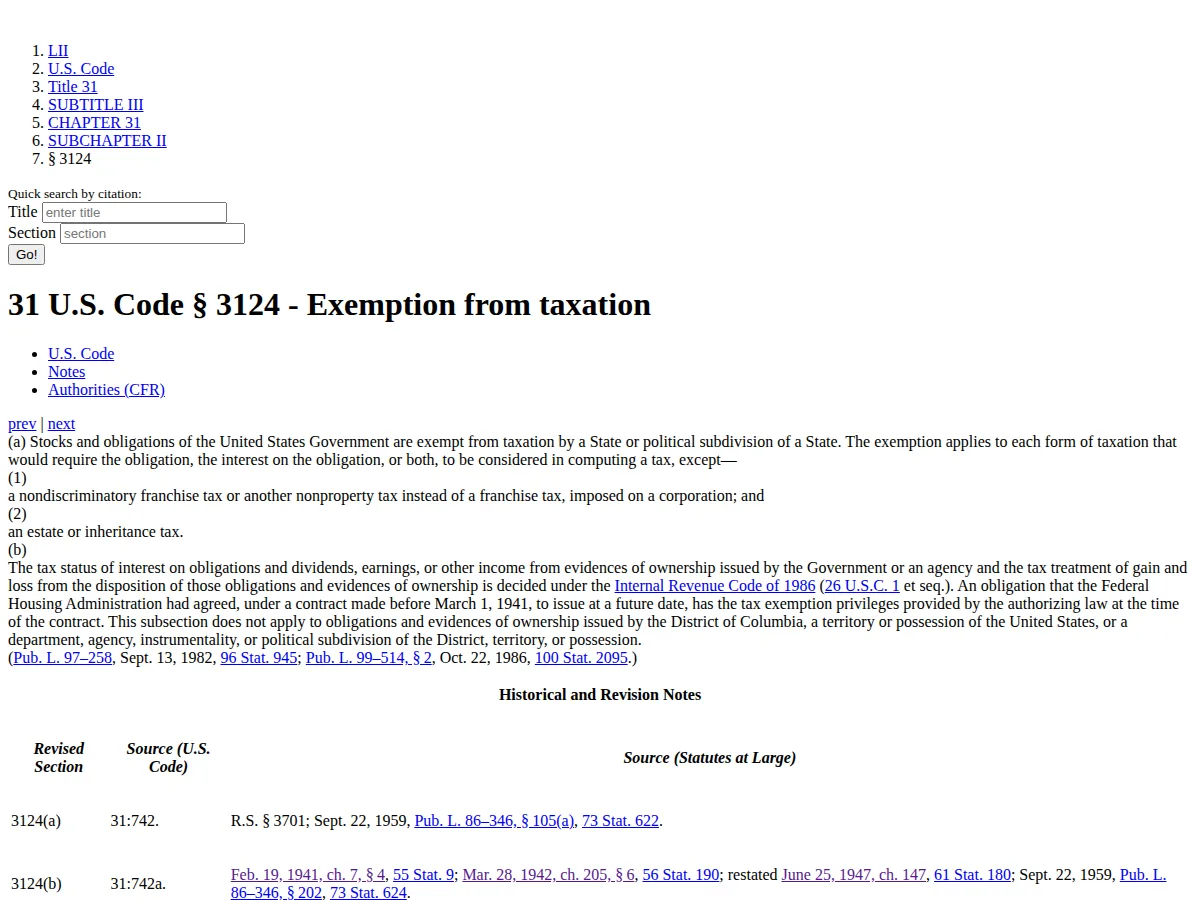
The ladder's second return is tax, and it is written into the statute. Under 31 U.S.C. § 3124(a), stocks and obligations of the United States Government are exempt from taxation by a State or political subdivision — the exemption applies to the obligation, the interest on it, or both, except for a nondiscriminatory franchise tax or an estate or inheritance tax. Federal income tax still applies. The discount is interest for federal purposes, and under 26 U.S.C. § 454(b) it is not treated as accruing until the obligation is disposed of — for a bill held to maturity, the interest is reported in the year of maturity. Your CPA confirms the timing: accrual-method holders follow different rules.
The state saving is real money at the top marginal rates. On the ladder's $21,725.26 of annual interest at the November 16 rates:
A California business earns the same $21,725.26 a money market fund quoting the same APY would pay, and keeps $2,889.46 the fund's state-taxable distributions would have lost. Run the saving for your own state through the tax estimator with the ladder's interest entered as federally taxable, state-exempt income. The high-yield business savings rates playbook prices the savings-account alternative the ladder competes with — note that savings interest is fully state-taxable, so a savings account must pay a higher headline rate to match a bill.
Building it: TreasuryDirect or a brokerage
A business buys bills in one of two places, and the choice is operational, not financial — the rate is the auction rate either way.
TreasuryDirect. The Treasury's own portal sells bills at auction through noncompetitive bids and charges no fees. A business opens an entity account: whether the entity is a C-Corp, an S-Corp, an LLC, a partnership, a professional LLC, a sole proprietorship, or a trust, the registration is eligible, and the account needs an EIN, a U.S. address, a linked U.S. bank account that accepts ACH debits and credits, and an entity account manager who certifies authority to act alone on the entity's behalf. The trade-offs are operational: one manager acting alone, paper forms for anything unusual, and no secondary market inside the portal — a bill bought in TreasuryDirect can be sold before maturity, but only by transferring it to a bank or broker first.
Brokerage. A broker buys at the same auction or in the secondary market, and adds what TreasuryDirect does not: multiple authorized users, approval workflows, auto-roll of maturing bills into the next auction, and same-day sale. The cost is a spread or commission on secondary trades; auction purchases at most large brokers carry no commission. A business that needs two-person approval on cash movements, or that might need to sell a rung on a day's notice, should use a brokerage. A business that buys and holds every rung to maturity can use TreasuryDirect and pay nothing.
| Channel | Fees | Multi-user / approvals | Auto-roll | Same-day sale |
|---|---|---|---|---|
| TreasuryDirect entity account | $0 | No — one manager acts alone | No | No — transfer to a broker first |
| Brokerage | $0 at auction; spread on secondary trades | Yes | Yes, at most brokers | Yes |
| Authority | TreasuryDirect FAQ, entity accounts | TreasuryDirect FAQ | Broker documentation | TreasuryDirect, Treasury Bills page |
Sizing the rungs from the cash-flow forecast
A ladder is sized backwards from the dates the cash is due, not forwards from the amount of cash available. The method:
- List the dated obligations the reserve must cover: payroll dates, quarterly estimated tax installments, rent, insurance premiums, and the next tax payment.
- Keep one full payroll cycle in the FDIC-insured operating account, untouched by the ladder. Laddered cash is not operating cash.
- Size each rung to the obligation that falls just after it matures. A $40,000 quarterly tax installment due in thirteen weeks is a $40,000 13-week rung, not a $100,000 one.
- Space the rungs so that a maturity lands in every payroll cycle — with weekly auctions for 4- through 26-week bills, the spacing can be as tight as the forecast requires.
- Re-buy each rung on its maturity date at the new auction rate, or let the brokerage auto-roll it. A rung that is not re-bought is cash sitting idle again.
Example: a business with $120,000 of quarterly obligations and a $500,000 reserve does not need five $100,000 rungs. It needs rungs of $120,000 at 13 weeks for the tax installment, $60,000 at 4 weeks for the next payroll cycle, and the balance spread across 26- and 52-week rungs for the reserve that has no dated claim. The $100,000 rungs in the table above are an illustration at round numbers; the real ladder is cut to the forecast.
Ladder versus the alternatives
| Vehicle | Yield at Nov 2026 | State tax | Liquidity | Best for |
|---|---|---|---|---|
| T-bill ladder | ~4.35% blended | Exempt (§ 3124) | A rung every 4 weeks | Reserves with dated obligations |
| Money market fund | Varies daily | Taxable on the Treasury share unless the fund reports it | Same day | Cash with no dated claim |
| High-yield savings | Varies, bank-set | Fully taxable | Same day | Operating buffer |
| Certificate of deposit | Fixed at purchase | Fully taxable | Penalty on early withdrawal | Cash with one fixed date |
| Checking account | ~0.10% | Fully taxable | Immediate | One payroll cycle only |
| Authority | TreasuryDirect auction results, Nov 2026 | 31 U.S.C. § 3124(a) | Treasury Bills page; fund/bank terms | — |
The ladder wins on after-tax yield for dated reserves and loses on immediacy for everything else. The Series I bonds vs Treasury bills playbook covers the inflation-protected alternative for cash with a horizon beyond a year — I bonds cannot be sold for twelve months, so they are not a rung in this ladder.
Who should not build one, and the build checklist
A ladder is wrong for a business whose reserve is smaller than one payroll cycle — there is nothing to stagger. It is wrong for cash that must be available tomorrow, and for a business with no one to run the re-buys: an unmaintained ladder decays into a pile of matured cash in a settlement account, earning nothing, which is where the exercise started. It is also wrong as a speculation on rates — a ladder is a schedule for cash with jobs, not a position on the yield curve.
- [x] Forecast first: list dated obligations for the next 52 weeks before buying a single bill.
- [x] Keep one payroll cycle in the operating account — laddered cash is not operating cash.
- [x] Open the buying channel: TreasuryDirect entity account (EIN, U.S. address, linked bank, one manager) or a brokerage account with auto-roll.
- [x] Buy the rungs at auction, noncompetitive — accept the auction rate; do not bid a rate.
- [x] Record each rung's CUSIP, maturity date, and cost in the cash schedule, with the obligation it funds.
- [x] Re-buy or auto-roll on every maturity date — an unrolled maturity is idle cash again.
- [x] Report the discount as interest in the year of maturity (§ 454(b)), federally taxable and state-exempt (§ 3124(a)).
- [x] Review the rung sizes quarterly against the forecast — a rung that no longer matches an obligation is re-sized at its next maturity.
The schedule, not the bet
A Treasury bill ladder is not an investment thesis. It is a calendar applied to a reserve: dated cash, dated bills, each rung re-priced at auction when it matures, the interest exempt from state tax and reported federally in the year it lands. At the November 16, 2026 auction rates, $500,000 of reserve earns $8,509.18 in its first cycle and about $21,725 a year rolled — against $500 in a checking account. Build it from the forecast, keep a payroll cycle out of it, and let the maturities do the work.