Series I Bonds vs Treasury Bills: The Savings-Bond Head-to-Head Playbook
A Series I bond issued in November 2026 earns 5.51 percent; a 26-week T-bill from the November 5, 2026 auction earns 4.298 percent. Two of the safest dollars in America, two very different rates. The I Bond pays about 1.21 points more — but it also locks your money for a full year, caps purchases at $10,000 a year, and takes back three months of interest if you leave before five years. The companion cash-parking comparison covers bills against money funds; here the tax rules and the holding rules do most of the deciding.
How the I Bond rate is built
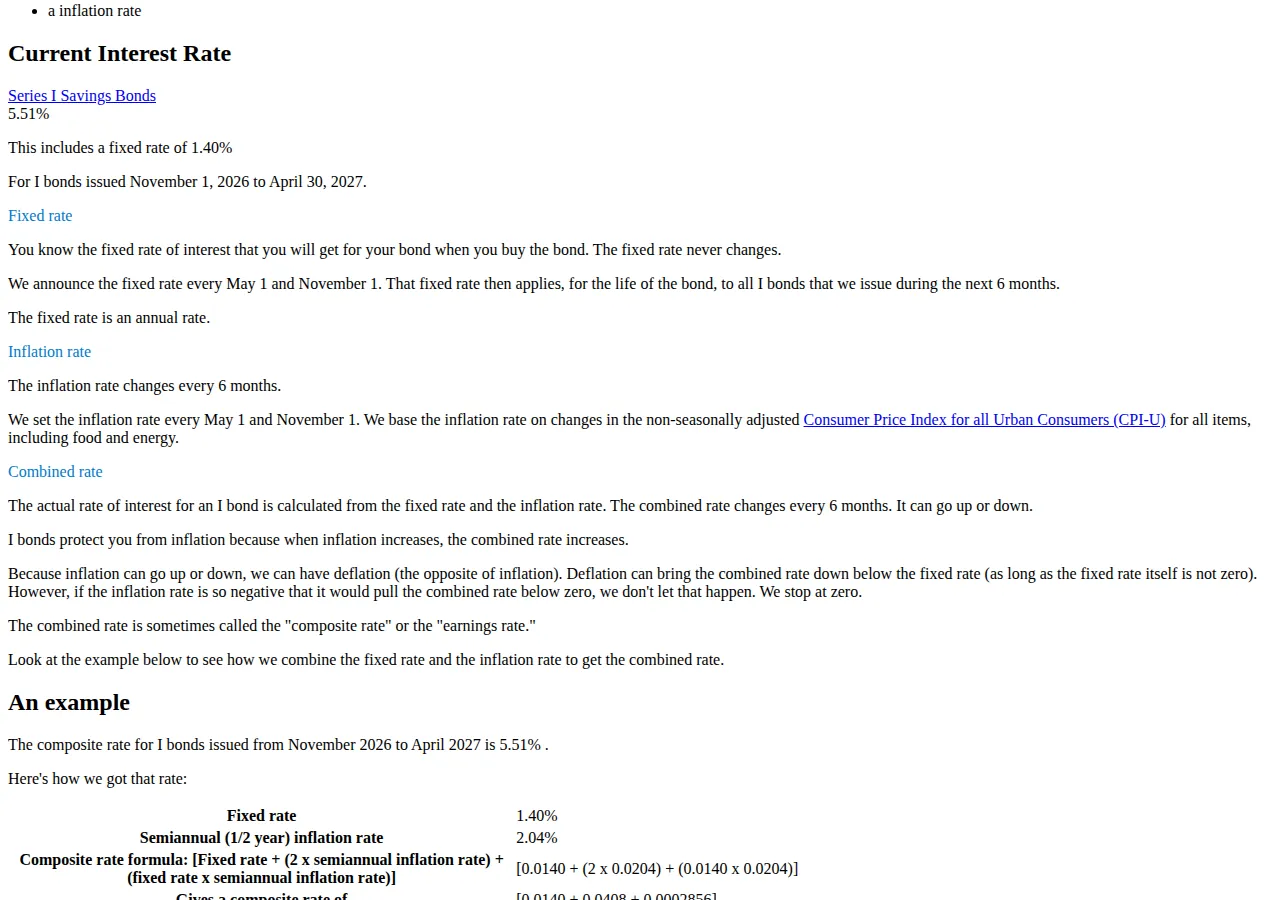
An I Bond earns a composite rate made of two parts: a fixed rate that never changes for the life of your bond, and a semiannual inflation rate that resets every May 1 and November 1 from the Consumer Price Index for all Urban Consumers (CPI-U). The November 1, 2026 reset gives a fixed rate of 1.40 percent and a semiannual inflation rate of 2.04 percent:
The published 5.51 percent is that 0.0550856 rounded — the worked math below uses the exact 5.50856 percent, so a $10,000 bond earns $275.43 in its first six months, not $275.50. Interest compounds semiannually, and the bond earns from the first day of the month you buy it. The fixed rate has climbed from 1.20 percent in November 2024 and 0.90 percent in May 2026 to 1.40 percent now — the highest since 2007. That fixed rate is the bond's guaranteed real return: at least 1.40 percent above CPI-U for 30 years, and the composite can never fall below zero even in deflation. Your bond's rate changes every six months from its own issue date (31 CFR Part 359).
How a T-bill is priced
A Treasury bill pays no coupon. You buy it below face value at auction and receive the full face value at maturity; the discount is the interest. TreasuryDirect states the pricing formula, using a 360-day year:
The discount rate is not the return. The investment rate — the coupon-equivalent yield on the price you paid, on a 365-day year — is the number to compare, and Treasury publishes it with every auction result. The most recent auctions as of November 11, 2026:
| Term | Issue date | Days | High discount rate | Price per $100 | Investment rate |
|---|---|---|---|---|---|
| 13-week | Nov 5, 2026 | 91 | 4.040% | $98.978778 | 4.138% |
| 26-week | Nov 5, 2026 | 182 | 4.150% | $97.901944 | 4.298% |
| 52-week | Oct 29, 2026 | 364 | 4.290% | $95.662333 | 4.496% |
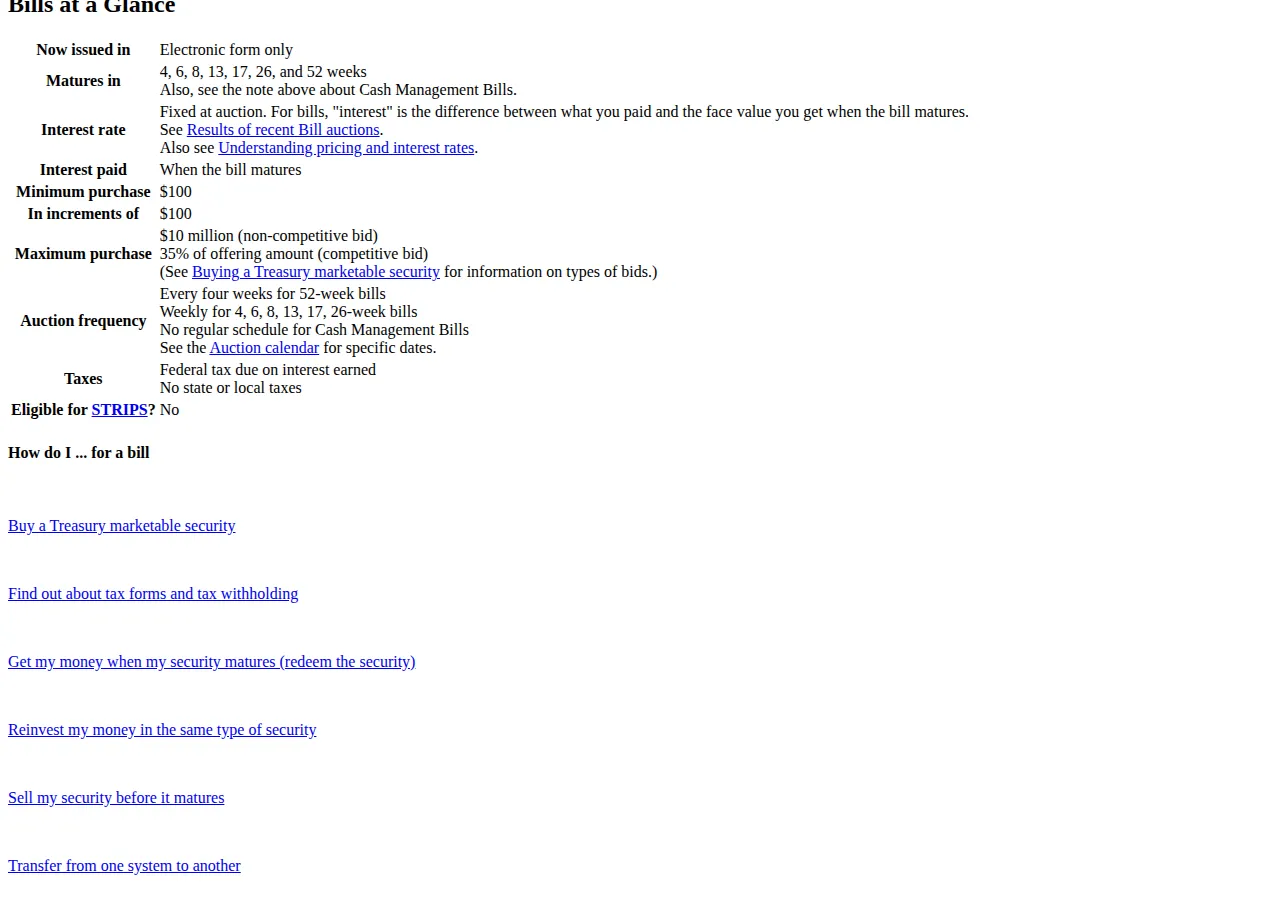
Check the 26-week price against the formula: $100 × (1 − 0.04150 × 182/360) = $100 × (1 − 0.0209806) = $97.901944, exactly the published price. Bills come in 4, 6, 8, 13, 17, 26, and 52-week terms; the 52-week auctions every four weeks, the rest weekly. The minimum is $100 in $100 increments, and a noncompetitive bid — the kind an individual places through TreasuryDirect, accepting whatever rate the auction sets — can run to $10 million. Unlike a savings bond, a bill is marketable: you can sell it before maturity through a broker.
Worked example — $10,000 for 12 months
Worked example — $10,000 in a November 2026 I Bond and $10,000 in a 26-week ladder at the November 5, 2026 auction, held 12 months. The I Bond first, six months at 5.50856 percent:
That $275.43 is the first half's interest. The second-half rate is not yet known — it will be set May 1, 2027 — so the 12-month figure is a stated assumption: if the composite held at 5.50856 percent, the value would be $10,275.43 × 1.0275428 = $10,558.44, or $558.44 of interest. Now the penalty: redeeming at 12 months loses the last three months of interest, $10,275.43 × 0.0550856 / 12 = $47.17 a month, so $141.51. The redeemable value is $10,558.44 − $141.51 = $10,416.94, and the interest kept is $416.94.
The T-bill ladder: $10,000 buys $10,200 of face value of the 26-week bill — 102 × $97.901944 = $9,986.00, leaving $14.00 in cash. At maturity on May 6, 2027 you receive $10,200 — $214.00 of interest — and rolling it into the next 26-week bill at the same price earns another $214.00. After 12 months you hold $10,200 plus $228.00 of cash: $428.00 of interest. Before tax, the I Bond's $416.94 trails the ladder's $428.00 — the penalty eats the whole rate advantage. After tax at a 22 percent federal bracket, with no state tax on either, the I Bond keeps $416.94 × 0.78 = $325.21 and the ladder keeps $428.00 × 0.78 = $333.84. The bill wins by $8.63 — and it lets you sell at any point, while the I Bond gives you nothing at all for the first year. Run the ROI calculator on your own bracket: the penalty, not the rate, decides a one-year hold.
Worked example — $10,000 for five years
Worked example — the same $10,000 for five years, assuming rates hold. The I Bond, compounding semiannually at 5.50856 percent with no penalty after year five, reaches $10,000 × (1.0275428)^10 = $13,121.97, or $3,121.97 of interest. The T-bill ladder, rolling 26-week bills at the same 4.298 percent investment rate, reaches $10,000 × (100 / 97.901944)^10 = $12,361.95, or $2,361.95 of interest. The gap is $760.02 before tax, and tax timing widens it: the I Bond's interest is not taxed until redemption, so all $3,121.97 compounds untouched and the tax — $686.83 at 22 percent — is paid once at the end, leaving $2,435.14 after tax. The ladder pays tax on each bill's interest in the year it matures, so tax paid early never compounds.
The five-year case also has a floor the ladder cannot match. If inflation fell to zero for five years, the I Bond would still earn its 1.40 percent fixed rate: $10,000 × (1.007)^10 = $10,722.47. The bill has no floor. The 2.04 percent semiannual inflation rate annualizes to about 4.12 percent, so the 52-week bill's 4.496 percent is only about 0.37 percent in real terms.
The tax chapter: deferral, exemption, and the education exclusion
Interest on both is subject to federal income tax and exempt from state and local income tax under 31 U.S.C. § 3124. I Bond interest can be reported annually or deferred until redemption or final maturity at 30 years, whichever comes first; it is reported on Form 1099-INT in the redemption year if you defer. T-bill interest is taxed in the year the bill matures or is sold, with no deferral election.
The education exclusion is the I Bond's second tax advantage, and it is narrow by design. Under 26 U.S.C. § 135, interest on a qualified Series EE or I bond is excluded from federal income tax entirely when the proceeds pay qualified higher education expenses — tuition and fees at an eligible institution, or a contribution to a 529 plan or Coverdell account — in the same tax year the bond is redeemed. The bond must have been issued after December 31, 1989 to an owner who was at least 24 years old on the issue date, so a bond registered in a child's name never qualifies — buy it in your own name or jointly with your spouse. File as anything except married filing separately, and claim the exclusion on IRS Form 8815. The 529 plan guide covers the account the proceeds can roll into, and the Roth IRA limits guide covers the other bucket savers usually compare against.
For 2026 the phase-out runs from $101,800 to $116,800 of modified adjusted gross income for single filers, and from $152,650 to $182,650 for joint filers — three independent 2026 reads agree. The statute phases it out ratably over a $15,000 window for single filers ($30,000 joint), so a single filer with $109,300 of MAGI — exactly halfway — keeps half:
If the proceeds also exceed the qualified expenses, a second fraction applies: only the share actually spent on tuition and fees is excludable. The exclusion is real money inside the window and zero above $116,800 single or $182,650 joint — check Form 8815 for the redemption year, as the thresholds move yearly.
The locks, the caps, and the exits
The I Bond's rules are the whole trade. You cannot redeem for 12 months — not for an emergency, not for a better rate, not at any price. Redeem before five years and you lose the last three months of interest. You can buy at most $10,000 in electronic I Bonds per Social Security Number per calendar year, and a trust or business with its own Employer Identification Number gets its own $10,000 — the limit is per SSN or EIN, so a married couple can buy $20,000 a year. The minimum is $25, to the penny above that. And the bond is non-marketable: no secondary market, only redemption through the Treasury.
The T-bill has no comparable lock: $100 minimum in $100 increments, noncompetitive bids to $10 million, and bills can be sold before maturity. The cost of that freedom is reinvestment risk — every bill matures into cash that must be re-bid at whatever rate the next auction sets, while the I Bond's fixed rate is locked for the life of the bond.
The decision table
| Decision factor | Series I Bond | Treasury bill | Authority |
|---|---|---|---|
| Rate, Nov 2026 | 5.51% composite (1.40% fixed + 2.04% inflation) | 4.298% investment rate, 26-week; 4.496%, 52-week | TreasuryDirect; Nov 1, 2026 reset; Nov 5 / Oct 29 auctions |
| Real return today | 1.40% guaranteed (the fixed rate) | About 0.37% (4.496% minus ~4.12% annualized CPI) | CPI-U semiannual rate 2.04% |
| Earliest exit | 12 months, no exceptions | Any time; sellable before maturity | 31 CFR Part 359; TreasuryDirect Bills page |
| Early-exit cost | Last 3 months of interest, before 5 years | None beyond the market price | TreasuryDirect I Bonds page |
| Annual purchase cap | $10,000 per SSN/EIN, electronic only | $10 million noncompetitive; no practical cap | TreasuryDirect I Bonds; Bills at a Glance |
| Federal tax | Deferred until redemption; § 135 education exclusion possible | Taxed in the year the bill matures | 26 U.S.C. § 135; TreasuryDirect tax pages |
| State/local tax | Exempt | Exempt | 31 U.S.C. § 3124 |
Operator boundaries: who should buy which, and who should avoid each
Buy the I Bond if your horizon is five years or more, you are under the $10,000 annual cap anyway, you want inflation protection with a guaranteed real return, and you can lock the money away for a year. It fits a college fund started when a child is young — the § 135 exclusion only works if the owner was 24 at issue and the bond is in the parent's name — and an emergency fund's second tier. Avoid it for money you might need within a year, for amounts above $10,000 a year per SSN, and for money you need to move fast: there is no market to sell into.
Buy the T-bill if the money has a date — a tax payment, a house deposit, a tuition bill — because the maturity date is a contract, not a hope. It fits a ladder: 13-week bills rolling every quarter, or 26-week bills twice a year, each maturity funding the next rung. Avoid it as a long-term inflation hedge: no fixed real return, no deferral, no education exclusion, and every roll is a fresh bet on next week's auction.
The buying checklist
- Decide the horizon first: under 12 months means bills only; five years or more opens the I Bond.
- Confirm the current composite rate — it resets every May 1 and November 1.
- Check the latest auction investment rate; the discount rate is not the return.
- Count your annual room: $10,000 per SSN or EIN, calendar year, electronic only.
- Register education-bound bonds in the parent's name, never the child's.
- Run the penalty math before redeeming under five years.
- Run the break-even calculator on your bracket.
- Note the § 135 phase-outs — $101,800–$116,800 single, $152,650–$182,650 joint for 2026 — and claim on Form 8815.
Founder & CEO Insight — Enow A. Jovial
The bill answers "when do I get my money back" with a date on a calendar. The bond answers "what will my money be worth" with a rate that tracks inflation and a fixed real return underneath it. The bond pays more, the bill moves faster, and the 12-month penalty is the hinge — measure your horizon first.