The filing obligation that shrank to one category
For two years, every guide on beneficial ownership reporting told the same story: form a company in the United States, file a report with FinCEN, and do it within 30 days of formation. That story is now wrong for every company formed in the United States, and any operator still following it is doing paperwork the law no longer requires — while the one group that still must file is easy to miss, because it is defined by where the company was formed, not by who owns it.
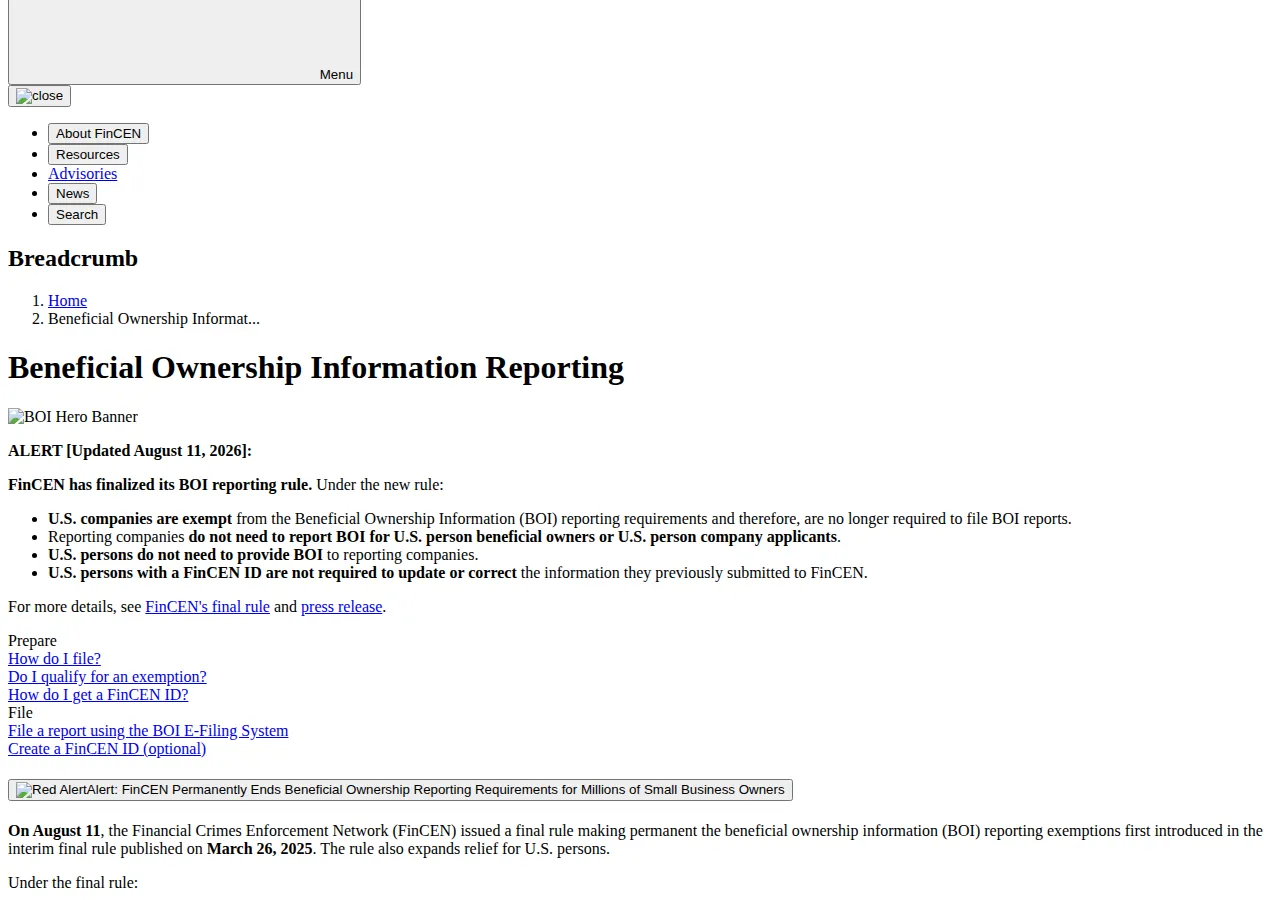
The Corporate Transparency Act, 31 U.S.C. § 5336, created the reporting regime. FinCEN's March 2025 interim final rule narrowed it. FinCEN's final rule of August 11, 2026, effective August 14, 2026, made that narrowing permanent and widened it in two specific ways. This guide is the transition record: what each rule changed, who files now, the exact deadlines that still bind, and the penalty arithmetic for getting it wrong. It is not a repeat of the filing workflow — for the step-by-step report itself, see the companion guide on FinCEN BOI reporting. This guide answers the prior question: do you file anything at all?
> [!KEY TAKEAWAY]
> Since August 14, 2026, only entities formed under the law of a foreign country and registered to do business in a U.S. state or tribal jurisdiction must file beneficial ownership reports — and they report only their non-U.S.-person beneficial owners. A Delaware LLC owned entirely by foreign nationals is exempt, because it was formed in the United States. A German GmbH registered to do business in Texas is not exempt, because it was formed abroad.
Who this guide is for, and who should stop here
This guide is for founders and operators with a foreign-formed entity doing business in the United States, for foreign founders who formed a U.S. company and are unsure whether the old filing advice still applies to them, and for advisers cleaning up client files that still contain BOI filing tasks created in 2024 or 2025.
Stop here and file nothing if your company was formed under U.S. state or tribal law — a Delaware LLC, a Wyoming corporation, a Texas limited partnership — regardless of where its owners live. Formation jurisdiction, not owner nationality, is the test now. A founder living in Lagos or Berlin who formed a Delaware LLC formed a U.S. company, and that company is exempt.
Do not stop here if a foreign-formed company in your structure has registered to do business in any U.S. state. That registration is the trigger, and the 30-day clock runs from notice of it, not from the date you first thought about the filing.
The three dates that rewrote the regime
| Date | What happened | Who it bound | Authority |
| :--- | :--- | :--- | :--- |
| January 1, 2025 (original schedule) | Initial BOI reports due for companies existing before 2024, under the original rule | U.S. and foreign reporting companies | 31 U.S.C. § 5336; 31 CFR 1010.380 (original) |
| March 26, 2025 (interim final rule published) | Domestic companies exempted; "reporting company" narrowed to foreign-formed entities registered in the U.S.; foreign companies registered before March 26, 2025 given until April 25, 2025 | Foreign reporting companies only | FinCEN interim final rule, March 2025 |
| August 14, 2026 (final rule effective) | Interim narrowing made permanent; U.S.-person company applicants also excluded; U.S.-person FinCEN ID holders need not update or correct prior submissions; FinCEN to delete previously submitted U.S.-person BOI | Foreign reporting companies only, reporting non-U.S. persons only | FinCEN final rule, issued August 11, 2026 |
The interim rule, issued March 21, 2025 and published March 26, 2025, did the heavy lifting: it redefined "reporting company" to mean only an entity formed under the law of a foreign country and registered to do business in a U.S. state or tribal jurisdiction by filing a document with a secretary of state or similar office. Every entity created in the United States fell out of the definition at that stroke, including entities previously called domestic reporting companies.
The August 2026 final rule adopted that definition with two substantive changes beyond the interim rule. First, reporting companies need not report U.S.-person company applicants — under the interim rule, the applicant exclusion was less complete. Second, U.S. persons who hold a FinCEN ID are not required to update or correct information they previously submitted. FinCEN also stated it will delete previously submitted BOI reported by U.S. persons from its database. Those two changes matter most to advisers: a foreign company's file no longer needs to chase U.S. co-founders for identifying documents, and a U.S. person who filed in 2024 has no update duty if their address or passport changes.
The decision table: do you file?
| Situation | File? | What you report | Authority |
| :--- | :--- | :--- | :--- |
| U.S.-formed LLC or corporation, any owner nationality | No | Nothing | FinCEN final rule, August 2026 |
| Foreign-formed company, not registered in any U.S. state | No | Nothing, until registration | 31 CFR 1010.380 reporting-company definition |
| Foreign-formed company registered in a U.S. state | Yes | Company information plus BOI of each non-U.S.-person beneficial owner | FinCEN BOI reporting page; 31 U.S.C. § 5336 |
| Foreign company with only U.S.-person owners | Yes, company report | Company information; no owner BOI to report, because U.S.-person owners are excluded | FinCEN final rule, August 2026 |
| U.S. person who is a beneficial owner of a foreign reporting company | No personal filing | Nothing; the company does not report you | FinCEN final rule, August 2026 |
| U.S. person holding a FinCEN ID from a 2024 filing | No update duty | Nothing, even if your information changes | FinCEN final rule, August 2026 |
A beneficial owner, for this regime, is an individual who exercises substantial control over the reporting company or owns or controls at least 25 percent of its ownership interests. That definition did not change. What changed is whose beneficial owners count: only non-U.S. persons are reported now. A foreign company with four 25-percent owners — three non-U.S. persons and one U.S. person — reports three owners, not four.
The deadlines that still bind
For a foreign reporting company, the initial report is due within 30 calendar days after the earlier of actual notice that its registration is effective or the secretary of state's public notice of registration. Updates and corrections are due within 30 days of the change or of becoming aware of the inaccuracy. There is no filing fee.
The deadline formula is unforgiving because the trigger is notice, not your internal awareness. If the secretary of state posts the registration on a Friday and your registered agent forwards it the following Tuesday, the clock already ran four days.
$
\text{Days remaining} = 30 - (\text{Notice date to filing date, in calendar days})
$
A foreign company that registered before March 26, 2025 faced a one-time catch-up deadline of April 25, 2025 under the interim rule. That date is history now, but it matters for penalty exposure: a foreign company that missed it and never filed has been accruing exposure since then, and the final rule did not forgive it.
Penalty arithmetic, stated exactly
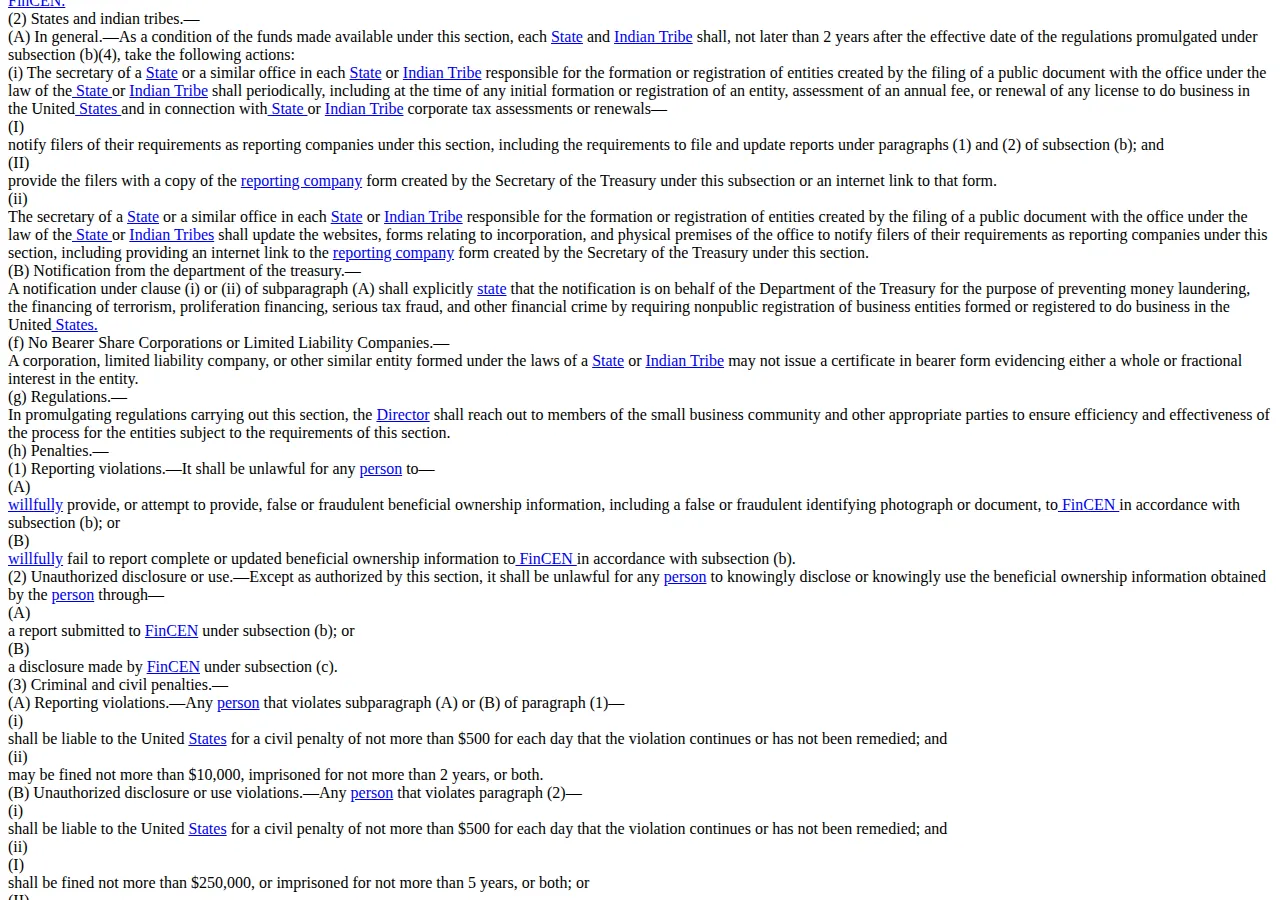
31 U.S.C. § 5336(h) sets the penalties in the statute itself. Willful failure to report, or willful provision of false or fraudulent information, carries a civil penalty of not more than $500 for each day the violation continues or has not been remedied, and a criminal fine of not more than $10,000, imprisonment for not more than 2 years, or both. FinCEN adjusts the daily civil figure for inflation in its penalty rules, so treat $500 as the statutory text and confirm the current adjusted daily figure before quoting an exposure number to a client — the direction of adjustment is upward, never downward.
$
\text{Statutory civil exposure} = \$500 \times \text{days unremedied}
$
At the statutory figure, 90 days unremedied is $45,000; 365 days is $182,500. Those are arithmetic on the statute, not a prediction of what FinCEN will assess in any given case — the statute says "not more than," and enforcement discretion applies. But the shape of the exposure is the point: it grows daily, it does not cap at a single missed filing, and it attaches to willful conduct. An honest missed deadline discovered and cured promptly is a different conversation from a filing ignored for a year. The companion guide on non-resident penalties works through the penalty posture for foreign owners in more depth.
> [!WARNING]
> Do not confuse the BOI exemption with a general compliance exemption. A foreign company registered in a U.S. state still owes state annual reports, franchise taxes where they apply, federal tax filings, and — for a foreign-owned U.S. disregarded entity — Form 5472. The BOI rule changed; the rest of the compliance calendar did not. See the Form 5472 guide for the filing that still carries its own $25,000 penalty.
Worked scenario: a German GmbH registers in Texas
A Munich software company, GmbH, registers to do business in Texas on October 6, 2026. The Texas secretary of state's public notice posts October 6; the company's registered agent forwards it October 9. The 30-day clock runs from October 6, the earlier notice date, so the initial BOI report is due November 5, 2026. The GmbH has four owners: two German nationals at 30 percent each, one U.S. citizen at 30 percent, and one French national at 10 percent.
Applying the final rule: the GmbH is a reporting company because it was formed under German law and registered in Texas. Its beneficial owners are the individuals at 25 percent or more, plus anyone with substantial control. The two German 30-percent owners are reported. The U.S. citizen at 30 percent is not reported, even though the ownership threshold is met, because U.S.-person beneficial owners are excluded. The French 10-percent owner is not reported unless that individual exercises substantial control. If the GmbH's managing director, a French national, exercises substantial control despite owning nothing, that director is reported on the control prong.
If the GmbH later appoints a new non-U.S. managing director with substantial control, the update is due within 30 days of the change. If the U.S. citizen owner moves house, nothing is due — that owner is not in the report at all.
Contrast the trap: the same founders also own a Delaware LLC formed in 2025. Under the 2024 advice still circulating in old blog posts, that LLC would have owed a BOI report. Under the final rule it owes nothing, and any 2024 report filed for it is a historical artifact FinCEN says it will delete for U.S. persons. Filing a fresh report for it now would be wasted effort, and worse, it would put current personal data into a database FinCEN is emptying of exactly that data.
Operator boundaries: who should not rely on this guide alone
Do not treat this guide as a substitute for checking the current FinCEN BOI page before you act, because this regime has changed twice in seventeen months and the pattern of change is narrowing, not stability. Do not assume a state foreign qualification and a BOI registration are the same filing — they are separate, with separate forms and separate clocks. Do not file a BOI report for a U.S. company "just to be safe": an unnecessary filing creates a record with no legal benefit and hands FinCEN data it has said it does not want. Do not let a registered agent's forwarding delay become your deadline excuse — calendar the 30 days from the secretary of state's posting, and confirm the posting date yourself.
The boundary that matters most is the one founders get backwards: owner nationality does not decide anything anymore. Formation jurisdiction decides whether the company files; owner nationality decides which owners appear in the report. Every error in the old advice traces back to mixing those two tests up.
Execution checklist
> [!TIP]
> Keep a one-page entity map for the whole structure: entity name, formation jurisdiction, each U.S. registration with its notice date, and the BOI status of each entity (exempt, filed, due). Most BOI failures are not legal errors — they are calendar errors in structures where nobody owned the map.
> [!FOUNDER]
> "The BOI story is a warning about advice with an expiry date. For a year, founders paid advisers to file reports the government then decided it never needed from them, and the advisers who kept filing after March 2025 were selling the old law. Check the rule as it stands on the day you act, not the day you first read about it — in this regime, the day matters more than the doctrine."
> — Enow A. Jovial, Founder & Chief Executive Officer