The fee is not the price
Three vendors sell subscription billing, and the first mistake is treating them as three prices for the same product. Stripe Billing is billing inside a payments stack: the company that moves the money also runs the subscription and the retry. Chargebee is a billing layer above the gateway, with 40 or more payment gateways. Recurly is subscription operations: billing plus retention and dunning.
The price lists reflect that split. Stripe charges a percentage of billing volume and nothing else on pay as you go. Chargebee charges a percentage of invoicing volume, with an optional monthly fee that buys a lower percentage. Recurly charges a monthly fee plus a percentage, with the first $40,000 free of the percentage. None includes card processing. Capture runs through tokenized checkout, so card numbers stay inside the vendor PCI-DSS scope.
> [!KEY TAKEAWAY]
> Compare platform fees on the same volume, then add the same gateway cost to all three. The cheapest pricing page is not always the cheapest invoice — Recurly wins at $50,000 a month and loses at $500,000.
The three price lists
Stripe Billing on pay as you go costs 0.7% of billing volume with no recurring fee, counting transactions processed on and off Stripe. One-off invoices are excluded and priced through Stripe Invoicing at 0.4% per paid invoice on Starter, capped at $2.00. Annual tiers run $620 a month for up to $100,000 of monthly volume, $1,500 up to $250,000, $2,950 up to $500,000, and $5,750 up to $1,000,000, with 0.67% above each cap. The tiers come from independent 2026 reads.
Chargebee Flow gives two options: $0 plus 0.80% of monthly invoicing volume, or $99 a month plus 0.65%. The pricing page prints the breakeven as $66,000 of monthly invoicing volume, and the arithmetic agrees: $99 divided by the 0.15-point gap is $66,000. Flow includes 100 million usage events a month. Enterprise is custom priced by active subscribers, and Revenue Recognition is a separate product with no published price.
Recurly Starter costs $249 a month plus 0.9% of billing volume, with the first $40,000 of billings each month included at no charge. All-Access, the plan Recurly marks most popular, requires a $1 million billing volume minimum and costs as low as under 1% of billing volume, billed annually — no exact rate is published. Engage starts at $1,600 a month and Revenue Recognition at $850 a month, both billed annually.
| Line | Stripe Billing | Chargebee Flow | Recurly Starter | Authority |
| :--- | :--- | :--- | :--- | :--- |
| Entry price | 0.7% of volume, $0/mo | $0 + 0.80% or $99 + 0.65% | $249/mo + 0.9% above $40K | Vendor pages |
| Free allowance | None | None | First $40K/mo free | Recurly page |
| Annual contract | $620–$5,750/mo, 0.67% over | None published | All-Access: under 1%, $1M min, annual | Corroborated reads |
| One-off invoices | Invoicing 0.4%, $2.00 cap | In invoicing volume | In billing volume | Vendor pages |
| Revenue recognition | From $25/mo | Quote only | RevRec from $850/mo, annual | Corroborated |
| Usage events | Meters API incl.; Metronome $0.04/1K + 0.8% | 100M events/mo included | Usage billing included | Vendor pages |

The math at three volumes
Scenario: Meridian Analytics, a B2B SaaS company selling a $100-a-month seat. Three volumes, one average invoice value — 500 invoices a month is $50,000 of billing volume, 5,000 is $500,000, and 50,000 is $5,000,000. Platform fee only.
$
\text{Monthly Platform Fee} = \text{Base Fee} + \text{Rate} \times \text{Billable Volume}
$
At $50,000 a month, Stripe pay as you go is 0.007 times $50,000, which is $350. Chargebee is 0.008 times $50,000, which is $400, against $99 plus 0.0065 times $50,000, which is $424. Recurly is $249 plus 0.009 times the $10,000 above its allowance, which is $339. Recurly wins by $11 over Stripe and $61 over Chargebee.
At $500,000 a month, Stripe pay as you go is $3,500, but the annual tiers beat it: tier 1 is $620 plus 0.67% of $400,000, which is $3,300; tier 2 is $1,500 plus 0.67% of $250,000, which is $3,175; tier 3 is $2,950 at its cap. Chargebee is $99 plus 0.0065 times $500,000, which is $3,349. Recurly Starter is $249 plus 0.009 times $460,000, which is $4,389. Stripe wins by $399 and $1,439.
At $5,000,000 a month, Stripe tier 4 is $5,750 plus 0.67% of the $4,000,000 above its cap, which is $32,550. Chargebee is $99 plus 0.0065 times $5,000,000, which is $32,599. Recurly Starter is $249 plus 0.009 times $4,960,000, which is $44,889. Stripe wins by $49 over Chargebee — a rounding error at this scale — and by $12,339 over Recurly Starter.
| Monthly volume | Invoices | Stripe | Chargebee | Recurly Starter | Authority |
| :--- | :--- | :--- | :--- | :--- | :--- |
| $50,000 | 500 | $350 (PAYG) | $400 ($0 + 0.80%) | $339 | Vendor pages |
| $500,000 | 5,000 | $2,950 (tier 3) | $3,349 ($99 + 0.65%) | $4,389 | Vendor pages |
| $5,000,000 | 50,000 | $32,550 (tier 4) | $32,599 ($99 + 0.65%) | $44,889 | Vendor pages; tiers corroborated |
The crossovers decide the choice, and each one is exact. Recurly Starter beats Stripe pay as you go below $55,500 of monthly volume, where both cost $388.50. Chargebee at $99 plus 0.65% beats Stripe pay as you go above $198,000 a month, where both cost $1,386. Chargebee beats Recurly Starter above $84,000 a month, where both cost $645. Chargebee beats Stripe tier 4 only above $5,245,000 a month, where both cost $34,191.50.
Dunning and smart retries
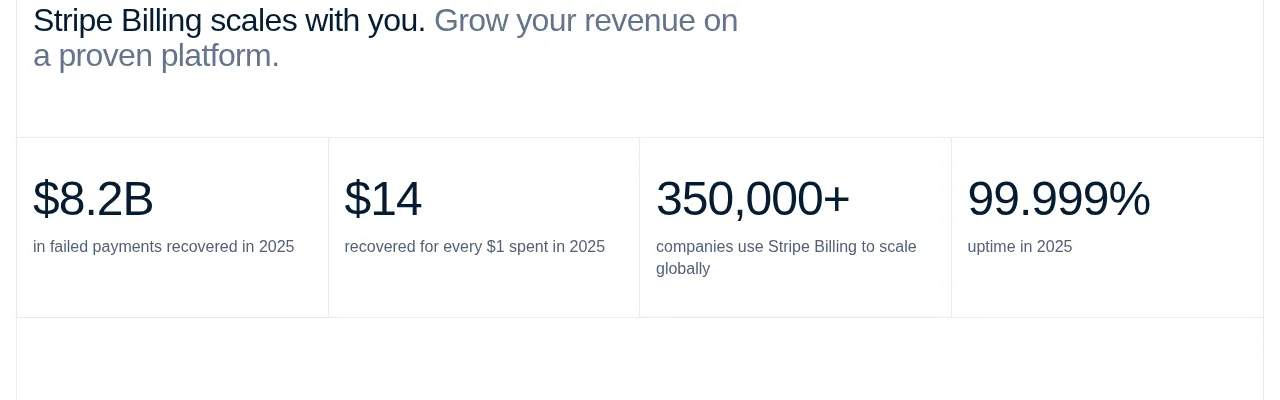
The platform fee is the small line; failed payments are the large one. Stripe's recovery stack is Smart Retries plus customer emails and a hosted payment-update page, included in Billing. Stripe publishes that businesses using its recovery tools recover 55% of failed payments on average, that $8.2 billion was recovered in 2025, and that $14 was recovered for every $1 spent in 2025. Retool, a real company named on Stripe's Billing page, recovered $600,000 in failed payments with Stripe.
Chargebee's dunning is configured, not automatic in the same way: retrying payment collection after a transaction fails. A site can set up to 4 retry attempts, with an interval in days between each attempt, and a maximum of 45 days per attempt. Basic dunning is included in Flow and Enterprise, and smart dunning — Chargebee's ML-powered retry timing — is included in both plans as well. What Chargebee does not publish, anywhere this cycle could find, is a recovery rate.
Recurly splits dunning by plan. Starter includes 1 dunning campaign and static churn-prevention tools. All-Access includes multiple dunning campaigns and intelligent churn-prevention tools. Recurly-published benchmarks, cited by independent 2026 analysis, put past-due invoice recovery at 53.5% for B2B and 34.6% for B2C.
$
\text{Recovered Revenue} = \text{Failed Invoice Value} \times \text{Recovery Rate}
$
Take Meridian at $500,000 a month and assume 5% of monthly invoice value fails on first attempt — a stated assumption for this worked example, not an industry fact. Failed value is $25,000 a month. At Stripe's published 55% recovery, $13,750 comes back and $11,250 is lost. Each point of recovery rate is worth $250 a month, so a 10-point gap is $2,500 a month — more than six times the $399 platform-fee gap between Stripe tier 3 and Chargebee.
> [!WARNING]
> No vendor publishes a recovery rate for your business. Stripe's 55% is an average across every Stripe Billing customer, from B2B SaaS with corporate cards to consumer subscriptions on prepaid debit. Measure your own rate by decline code for 90 days before you credit any vendor with a number.
Proration and metered billing
A mid-cycle plan change is where billing engines show their design. Stripe calculates prorations down to the second by default through the proration_behavior parameter, set to create_prorations on update. By default, prorations roll into the next invoice rather than billing or refunding immediately. Chargebee offers two proration modes: day-based, where charges are calculated by days, and millisecond-based, where the time difference is calculated to millisecond precision. Recurly exposes proration_settings with independent charge and credit controls, each set to full amount, prorated amount, or none.
Worked example: a Meridian customer on a $100-a-month plan upgrades to a $200-a-month plan on day 15 of a 30-day cycle. The credit for the old plan is 15 divided by 30 times $100, which is $50. The charge for the new plan is 15 divided by 30 times $200, which is $100. The net amount due is $100 minus $50, which is $50.
$
\text{Prorated Credit} = \frac{\text{Days Remaining}}{\text{Days in Period}} \times \text{Old Plan Price}
$
$
\text{Prorated Charge} = \frac{\text{Days Remaining}}{\text{Days in Period}} \times \text{New Plan Price}
$
$
\text{Net Due} = \text{Prorated Charge} - \text{Prorated Credit} = \$100 - \$50 = \$50
$
Metered billing follows the same split. Chargebee Flow includes 100 million usage events a month. Stripe includes basic usage-based billing through its Meters API as part of Billing pricing, and routes heavy usage-based pricing to Metronome, now a Stripe product, at $0.04 per 1,000 ingest events plus 0.8% of billing volume — so 10 million events a month costs $400 in ingest fees plus the volume percentage. Recurly includes usage-based billing in Starter.
Sales tax
Stripe Tax costs 0.5% per transaction where the business is registered to collect taxes, and Stripe manages the registrations behind it. At Meridian's $500,000 a month, with every transaction taxable where registered, that is 0.005 times $500,000, or $2,500 a month in tax-calculation fees — the tax itself passes through to the customer and the government and is not a vendor fee. Chargebee includes US sales tax, EU VAT, and global tax support in both Flow and Enterprise, marked included on the pricing page. Recurly ships a built-in tax solution powered by Avalara on all plans, with the option to connect a separate Avalara AvaTax account. A CPA should confirm nexus first, whether the business files as an LLC or a C-Corp.
> [!TIP]
> Price tax as a percentage of taxable volume, not as a flat line. A business with half its customers in non-taxable jurisdictions pays half the Stripe Tax figure above.
Worked example: Meridian Analytics at 5,000 subscribers
Scenario: Meridian Analytics runs 5,000 subscribers at $100 a month, billing $500,000 a month through 5,000 invoices. The full monthly cost of each stack, with the same gateway under all three, is the platform fee plus card processing plus tax calculation, minus dunning recovery. Subscription state syncs to the CRM and invoice lines export as a CSV for the ERP.
Card processing at Stripe's standard 2.9% plus 30 cents per domestic card charge is 0.029 times $500,000 plus $0.30 times 5,000, which is $14,500 plus $1,500, or $16,000 a month. That figure is identical under all three vendors when Stripe is the gateway — but it dwarfs the platform fees.
Stripe: platform fee $2,950 on tier 3, processing $16,000, tax $2,500, total $21,450 before recovery. At the published 55% recovery on $25,000 of failed invoice value, $13,750 comes back, leaving a net cost of $7,700 a month. Chargebee: platform fee $3,349, processing $16,000, tax included, total $19,349 before recovery, with no published recovery rate to subtract. Recurly Starter: platform fee $4,389, processing $16,000, tax included, total $20,389 before recovery; at the Recurly-published B2B benchmark of 53.5%, recovery is $13,375, leaving a net cost of $7,014 a month.
On platform fee alone Stripe wins at this volume. On net cost after published recovery, Recurly Starter edges Stripe by $686 a month — but only if Meridian's customers behave like Recurly's B2B benchmark population, which is an assumption, not a fact. The card-processing comparison prices the $16,000 gateway line in full, the storefront platform comparison covers billing inside a storefront, and the ASC 606 guide covers what happens to the $500,000 after it is billed under US GAAP.
> [!FOUNDER]
> "Founders compare the percentage and ignore the retry. The percentage is negotiated once and then forgotten; the retry runs every night for the life of the company. I would take the vendor with the better recovery rate at the higher percentage every time, because a point of recovery is worth more than a tenth of a point of platform fee at any volume that matters."
> — Enow A. Jovial, Founder & Chief Executive Officer
Who should not use this
A business that processes mostly outside Stripe should not choose Stripe Billing on the percentage alone, because the 0.7% applies to volume Stripe never collects. A business under $55,500 of monthly volume should not default to Stripe, because Recurly Starter is cheaper there. A business that needs a published recovery rate before signing should not choose Chargebee on dunning claims, because no rate is published. A business that needs exact enterprise pricing in writing should not shortlist Recurly All-Access or Chargebee Enterprise without a quote in hand.
The selection sequence
1. Record the baseline: billing volume, invoice count, average invoice value.
2. Split the gateway from the platform: price card processing once, at 2.9% plus 30 cents per domestic card charge.
3. Run the three platform formulas: Stripe pay as you go and the tier below your volume, Chargebee both Flow options, Recurly Starter.
4. Find your crossover: $55,500 Recurly vs Stripe, $198,000 Chargebee vs Stripe, $84,000 Chargebee vs Recurly.
5. Price the add-ons: Stripe Revenue Recognition from $25 a month, Recurly RevRec from $850 a month.
6. Price tax on taxable volume only: Stripe Tax at 0.5%; Chargebee and Recurly included.
7. Measure your failure rate: pull 90 days of failed payments by decline code.
8. Run dunning as a trial: enable Smart Retries or the equivalent on a live cohort and measure the recovered dollars.
9. Test one proration change per vendor: upgrade a test subscription on day 15 and confirm the $50 net due lands on the invoice.
10. Sign for the volume you will have in 12 months: the vendor that wins today loses at the next crossover. Gateway onboarding runs KYC checks before the first payout.
Run the same period through the ROI calculator to annualise the saving, and confirm the revenue-recognition treatment against the ASC 606 guide before the first close.