The money you owe someone else is a liability with a clock on it
Every business holds money that is not its own: an uncashed vendor check, a payroll check an ex-employee never collected, a customer credit, a refund that bounced back, a dividend on shares whose owner moved house. The owner has not vanished — the owner has gone quiet. Unclaimed property law answers one question: how long may you hold it before the state takes custody?
The answer is a dormancy period, set by statute for each property type in each state. When the clock runs out, the property is "presumed abandoned" and the holder must report it and pay or deliver it to the state administrator, who holds it in custody for the owner.
Who is a holder
Delaware section 1130 defines a "holder" as a person obligated to hold property for the owner's account or to deliver or pay it to the owner. A "business association" covers essentially every operating entity: C-Corp, S-Corp, LLC, partnership, financial organization, insurance company, utility, sole proprietorship. If your company owes money to someone and cannot deliver it, you are a holder; the "owner" holds the legal, beneficial, or equitable interest.
This guide is for the person who runs the books: the controller, the CFO, the payroll manager, the transfer agent, the Delaware-incorporated founder. It is not for the owner searching for lost money, and it is not a substitute for counsel once an examination notice has arrived: then the voluntary disclosure door is already closed. Size does not matter: a ten-person company with one uncashed $4,800 vendor check is a holder, and the thresholds that excuse small property from the due-diligence mailing do not excuse it from the report.
What counts as unclaimed property
The property that surprises founders is the ordinary kind: vendor credits, customer overpayments, uncashed checks, security deposits, gift-card balances, unclaimed wages, and — for issuers — shares and dividends whose owners have gone silent. The dormancy clock starts on the last indication of interest by the owner: a deposit from maturity or the last owner contact, whichever is earlier; a security from the last indication of interest; a gift card from the later of purchase, top-up, balance verification, or last contact. Any owner contact restarts the clock, and the record of that contact is the only evidence that moves the report date.
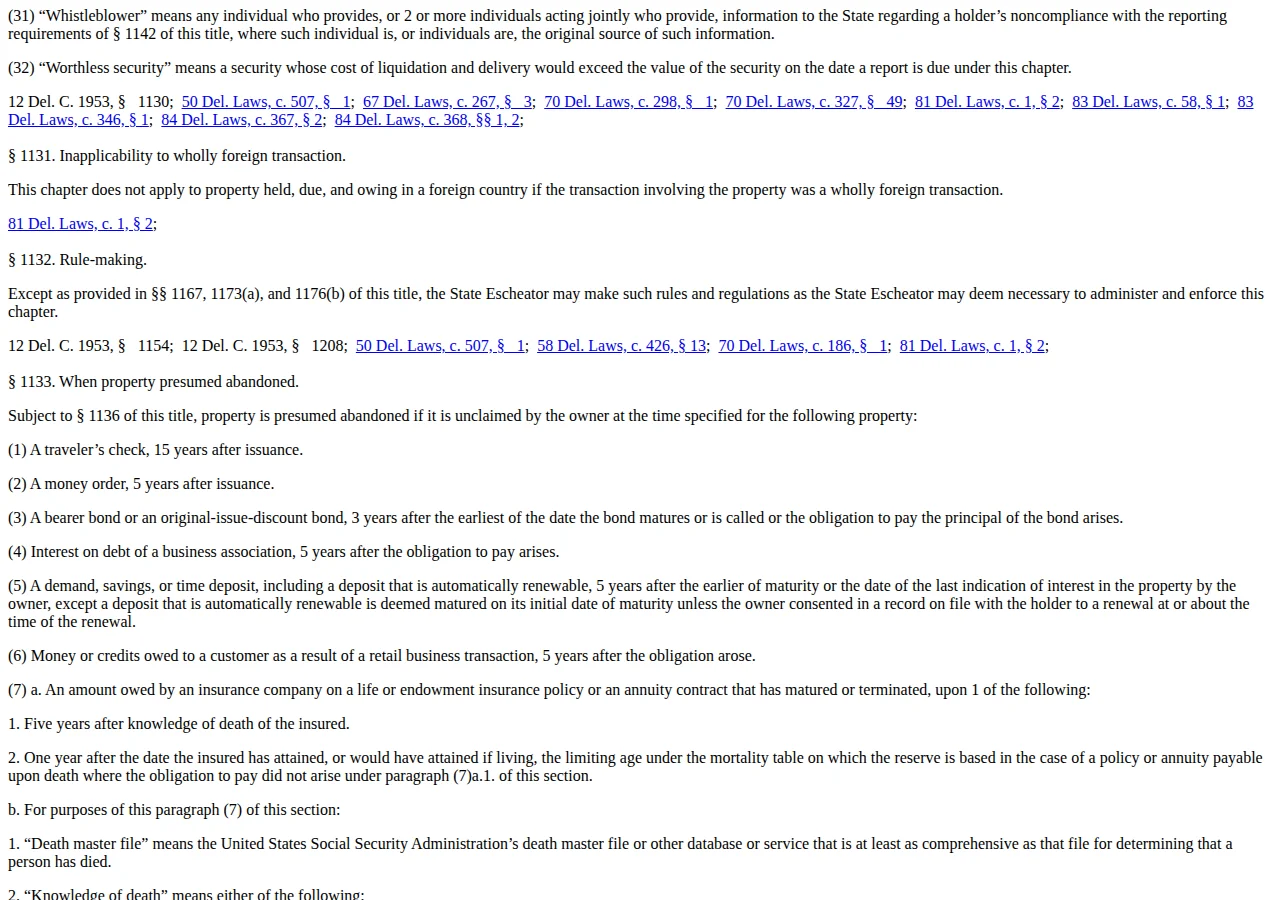
The dormancy table: Delaware, the model act, and California
Delaware gives wages five years; the model act and California give them one, and the earlier clock controls. The governing law follows the owner's last known address first, and the holder's state of incorporation second.
| Property type | Delaware (12 Del. C. § 1133) | RUUPA 2016 (§ 201) | California (CCP §§ 1513–1521) |
|---|---|---|---|
| Traveler's check | 15 years after issuance | 15 years | 15 years |
| Money order | 5 years after issuance | 7 years | 7 years |
| Bearer / OID bond | 3 years after maturity or call | 3 years | 3 years |
| Demand, savings, time deposit | 5 years after maturity or last owner contact | 3 years | 3 years |
| Retail business credit | 5 years after obligation arose | 3 years (catch-all) | 3 years |
| Life insurance / annuity | 5 years after knowledge of death | 3 years | 3 years |
| Wages, commissions, bonuses | 5 years after amount becomes payable | 1 year | 1 year |
| Security | 3 years after last indication of interest | 3 years | 3 years |
| Gift / stored-value card | 5 years after purchase, top-up, or last contact | 3 years | 3 years |
| IRA / tax-deferred account | 3 years after required-distribution date | 3 years | 3 years |
The dormancy clock, worked
Example A — the vendor credit. A Delaware corporation owes a vendor $4,800 from June 30, 2021, never cashed. Under section 1133(6), money owed from a retail business transaction is presumed abandoned 5 years after the obligation arose:
The property becomes reportable in the report due March 1, 2027. Under California's 3-year clock the same $4,800 would have been reportable in the November 1, 2024 notice report — two years earlier.
Due diligence: the mailing that must come first
Before the report, the holder must try to return the property. Delaware section 1148 requires notice to the owner by first-class mail, not more than 120 days and not less than 60 days before filing the report, where the holder has a valid address on file, and the property is worth $50 or more. A security is the exception: the notice goes out regardless of value. The report must state that the section 1148 notice was complied with.
Keep the mailing list, the letter, the date mailed, and any returned envelopes — the mailing is the first document an examiner asks for.
The transfer-agent angle: SEC Rule 17Ad-17
SEC Rule 17Ad-17 requires every recordkeeping transfer agent — and every broker-dealer with lost-securityholder accounts — to exercise reasonable care to find a lost securityholder: one whose mail was returned undeliverable with no new address known. The rule prescribes two database searches: the first between 3 and 12 months after the securityholder becomes lost, the second between 6 and 12 months after the first search.
No search is required where the securityholder is deceased, is not a natural person, or the account is worth less than $25.
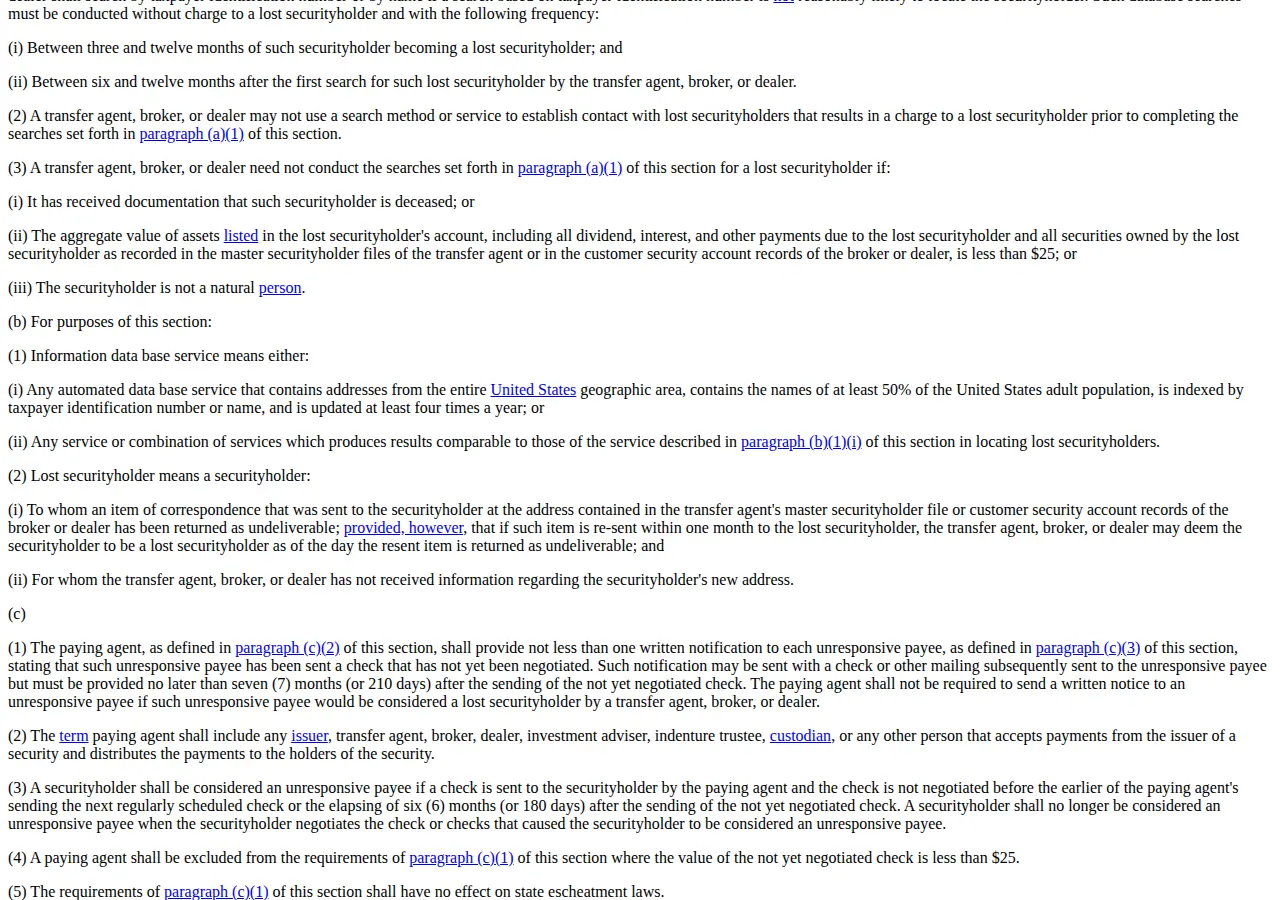
A securityholder becomes an "unresponsive payee" when a check is sent and not negotiated before the earlier of the paying agent's next regularly scheduled check or 6 months (180 days) elapsing. The paying agent must then send at least one written notification that a check was sent and not yet negotiated, no later than 7 months (210 days) after the check was sent. Paragraph (c)(5) is explicit: the federal rule has no effect on state escheatment laws.
The annual report: contents, dates, and the NAUPA file
Delaware section 1142 requires an annual report to the State Escheator, in a web-based record only since March 1, 2018. A holder may contract with a third party to file, but section 1142(c) keeps the holder responsible for timely, accurate reporting and for paying or delivering the property.
Section 1143 fixes the contents: a signed, verified report describing the property, giving the owner's name, last-known address, and SSN or ITIN if known, the commencement date for abandonment, a statement that the section 1148 notice was complied with, and a designated contact individual with address, phone, email, and title. The file carries the holder's EIN.
The filing dates are in section 1144: March 1 for most holders, covering the 12 months preceding January 1; November 10 for banks, covering the 12 months preceding July 1; December 20 for insurers. Extensions are available for good cause, and a partial payment stops interest on the amount paid. An amended report is no refund route: no return of property already paid where a claim has been paid on it or the report was filed under an examination or voluntary disclosure — and for a cost-of-goods-sold (COGS) error, only if filed within 3 years.
The file follows the NAUPA standard. NAUPA II is a fixed-width, non-delimited ASCII format of 625-byte records: type 1 (holder), 2 (property), 3 (additional owners), 5 (securities), 6 (tangible property), and 9 (summary). All 50 states have used the NAUPA standard since 2004. NAUPA III, an XML format, is in development — build for NAUPA II today.
The penalty arithmetic
Delaware section 1183 sets the price of lateness. Interest: 0.5 percent per month from the due date until paid, capped at 50 percent of the amount due. Late filing: the lesser of 5 percent per month (capped at 50 percent) or $100 per day, capped at $5,000. Late payment: 0.5 percent per month, capped at 25 percent. Fraud: 75 percent of the fraud-attributable deficiency. Section 1184 adds a willful-evasion penalty of $1,000 per day, up to $25,000, plus 25 percent of the property that should have been reported.
Example B — interest. A holder's $120,000 of 2024 property is remitted 30 months late:
Example C — the late-filing penalty. The report is 4 months late:
Section 1183(b) charges the lesser, so the penalty is $5,000 — the per-day cap binds. Total exposure: $120,000 principal plus $18,000 interest plus $5,000 penalty, $143,000 before any late-payment penalty.
Section 1156 bars the State Escheator from acting more than 10 years after the duty arose, tolled by an examination notice, a VDA invitation, or a VDA election.
The Delaware VDA program vs an audit
Since July 1, 2015, Delaware cannot open a new examination unless the Secretary of State has first invited the holder in writing to enter a voluntary disclosure agreement. The invitation is the fork in the road: the statute gives the holder 90 days to return the intent form, and missing the window means referral to the State Escheator for examination.
Section 1173(a)(1) requires the Secretary of State to waive interest and penalty under sections 1183 and 1184 for holders that complete the voluntary disclosure in good faith. The look-back for a holder entering on or after July 1, 2016 is 10 years prior, counted from the calendar year the intent was accepted. The holder must pay in full or enter a payment plan within 2 years of acceptance. The program is closed to a holder that has received an examination notice, previously withdrew, or was removed for bad faith.
Example D — VDA vs audit. The $120,000, 30 months late:
The difference is $23,000 on a $120,000 liability — 19 percent — before any late-payment penalty or section 1184 exposure. The VDA also ends the examination risk for the disclosed property, except on a finding of fraudulent or willful misrepresentation.
The decision table
| Situation | The holder's answer | Authority |
|---|---|---|
| Property past its dormancy date, no exam notice | Enter the Delaware VDA; interest and penalties waived | 12 Del. C. § 1173(a)(1), (c)(2) |
| Examination notice already mailed | VDA closed; cooperate | 12 Del. C. §§ 1172(a), 1173(e)(3) |
| Property under $50, valid address on file | No mailing required — unless a security | 12 Del. C. § 1148 |
| Lost securityholder, account over $25 | Two database searches | 17 CFR § 240.17Ad-17(a)(1) |
| Uncashed dividend check | Written notice within 210 days | 17 CFR § 240.17Ad-17(c)(1) |
Who should not rely on this alone
A holder with an open examination, inside the 90-day VDA window, or with securities it cannot value should not run this playbook unsupervised — bring in a CPA or unclaimed-property counsel. A company whose only unclaimed property is a single small check should still file: an unfiled $400 check is the seed of a $5,000 penalty. Our FinCEN BOI reporting guide covers the federal ownership filing beside this state duty, our Delaware annual report and franchise tax playbook runs the other March 1 Delaware deadline, and our state pass-through entity tax election playbook covers the state tax election often confused with this duty.
Run the holder operation
- Inventory the liabilities: pull every uncashed check, unclaimed wage, customer credit, refund, deposit, gift-card balance, and unclaimed dividend, with last known address and last contact date.
- Run the clocks: apply the dormancy period for the property type in the owner's state — Delaware's where the address is unknown.
- Mail due diligence: first-class mail 60 to 120 days before the report date for every item at $50 or more, and for every security regardless of value.
- Build the NAUPA II file: one file per state, record types 1, 2, 3, 5, 6, and 9.
- File and remit: March 1 (November 10 for banks, December 20 for insurers); remit by ACH and keep the confirmation.
- Decide the VDA question every year: if unreported property from prior years surfaces, elect the VDA before any examination notice arrives.
- [x] Every liability inventoried.
- [x] Dormancy clock run per property type and per state.
- [x] Due-diligence letters mailed inside the 60-to-120-day window.
- [x] Rule 17Ad-17 searches calendared; unresponsive-payee notices inside 210 days.
- [x] NAUPA II file built and validated.
- [x] Report filed and remitted; confirmation and records retained 10 years plus dormancy.
Failure modes
Reporting to the wrong state: the owner's last known address controls. Treating the VDA invitation as optional mail: the 90-day window closes and the examination opens. Destroying old ledgers: the 2016 records are still live evidence in 2026.
Founder & CEO Insight — Enow A. Jovial
Run the clocks, mail the letters, file the NAUPA report by March 1 — then check the exposure in our tax estimator.