Every Delaware corporation has the same appointment on March 1. The annual franchise tax report is a separate filing from the franchise tax calculation most founders already know — its own fee, its own contents, its own penalty ladder — collected in the same sitting as the tax. Miss the report and the statute fixes your tax for you, adds $200, charges 1.5 percent a month, and after a year declares your charter void. Figures are from the Delaware Code as read on November 16, 2026, and from the Division's fee schedule revised August 1, 2026.
What the report is, in statute
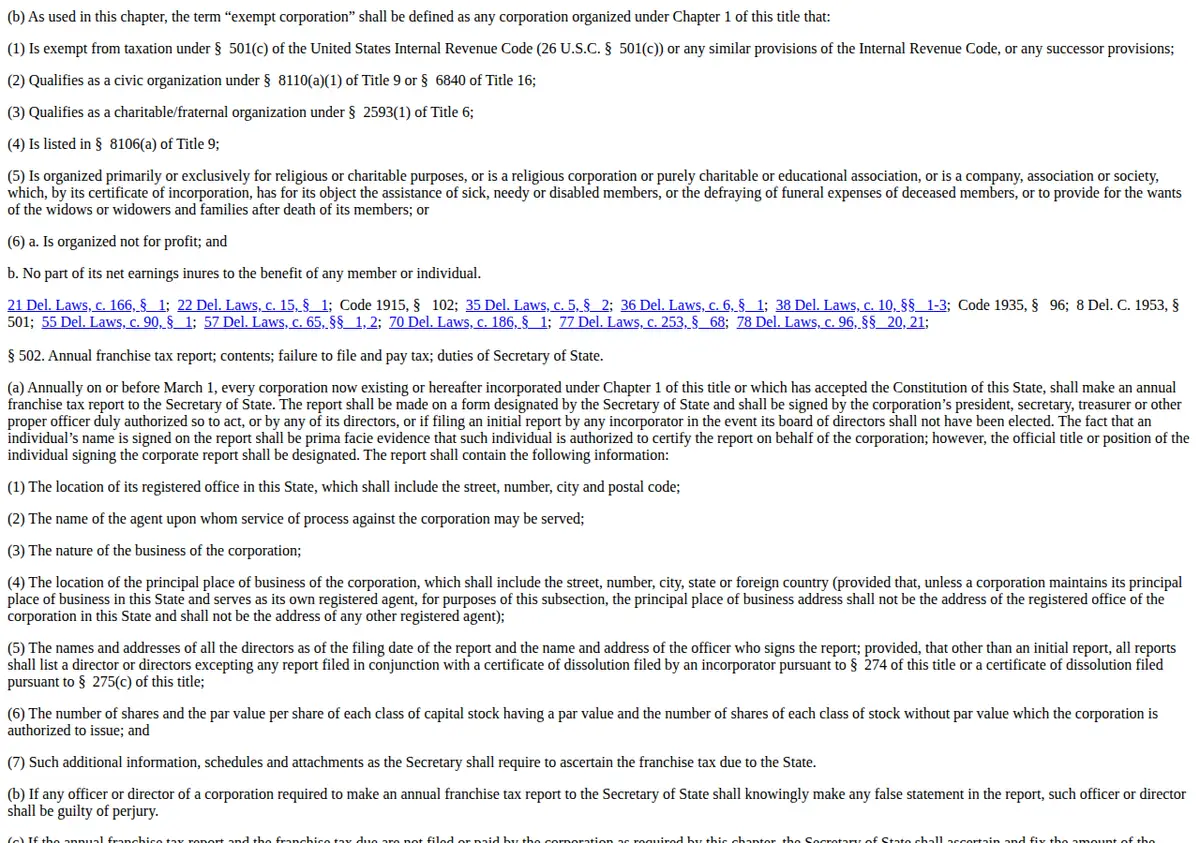
The duty is in 8 Del. C. § 502(a): annually on or before March 1, every corporation incorporated under Chapter 1 of Title 8 — or that has accepted the Constitution of Delaware — shall make an annual franchise tax report to the Secretary of State, on a form the Secretary designates, signed, with the signer's title designated, by the president, secretary, treasurer, or another authorized officer, or by any director. If the board has not yet been elected, an incorporator may sign an initial report. The signature is prima facie evidence the signer is authorized.
Section 502(a) requires seven items: the registered office in Delaware; the agent for service of process; the nature of the business; the principal place of business — which may not be the registered office or another agent's address unless the corporation maintains that place in Delaware and serves as its own agent; the names and addresses of all directors as of the filing date, plus the signing officer; the share counts and par values by class; and whatever additional information the Secretary requires to ascertain the tax due.
Two consequences follow — first, § 502(b): an officer or director who knowingly makes a false statement in the report is guilty of perjury — the director list and share counts are sworn statements. Second, under § 503(b), unless the corporation submits a statement of the shares actually issued and its total gross assets, it pays the Authorized Shares Method tax even when the Assumed Par Value Capital Method would have been cheaper. Our Delaware franchise tax calculation playbook runs both methods in full.
What the sitting costs
Two charges. The report costs $50 for a non-exempt domestic corporation under 8 Del. C. § 391(a)(18) and the Division's fee schedule revised August 1, 2026; exempt corporations pay $25 and no franchise tax. The franchise tax is the second charge, computed under 8 Del. C. § 503: at least $175 under the Authorized Shares Method or $400 under the Assumed Par Value Capital Method, and at most $200,000 — $250,000 for a Large Corporate Filer (listed stock, GAAP or IFRS reporting, compiled each December 1).
| Charge | Amount | Authority |
|---|---|---|
| Annual report fee, non-exempt domestic corporation | $50 | § 391(a)(18); fee schedule rev. Aug 1, 2026 |
| Annual report fee, exempt corporation | $25 | § 391(a)(18); fee schedule rev. Aug 1, 2026 |
| Franchise tax, minimum (Authorized Shares Method) | $175 | § 503(a)(1), (c) |
| Franchise tax, minimum (Assumed Par Value Capital Method) | $400 | § 503(a)(2), (c) |
| Franchise tax, maximum | $200,000 | § 503(c) |
| Franchise tax, maximum (Large Corporate Filer) | $250,000 | § 503(c) |
| Late filing penalty | $200 | § 502(c) |
| Interest on unpaid tax | 1.5% per month | § 504(c) |
| Returned-check fee | $60 | § 504(g) |
The total due at the sitting is the sum of the two charges:
With 5,000 authorized shares the tax is the $175 minimum and the sitting costs $225; with 10,000 shares the tax is $250 and the sitting costs $300. With 1,000,000 shares the Authorized Shares Method tax is $8,665 — $250 for the first 10,000 shares plus $85 for each further 10,000 shares or part thereof — so the corporation should file the § 503(b) statement, because the Assumed Par Value Capital Method may cut the bill to a fraction of that figure. Run the numbers through the pricing calculator before the sitting: the method election is made by filing the statement. The first report is due March 1 of the year after incorporation — a corporation formed June 15, 2026 files by March 1, 2027.
The quarterly schedule nobody budgets
Corporations whose franchise tax liability for the current year is estimated at $5,000 or more do not pay once a year. Under 8 Del. C. § 504(a) they file a tentative return and pay in four instalments: 40 percent on June 1, 20 percent on September 1, 20 percent on December 1, and the remainder, as finally determined, with the report on March 1. The tentative return is based on the preceding year's tax under § 504(e), and the penalties for nonpayment of an instalment are the same as for nonpayment of the tax under § 504(f).
An $8,000 estimated liability means $3,200 on June 1, $1,600 on September 1, $1,600 on December 1, and the $1,600 remainder with the report on March 1 — and interest under § 504(c) runs on every unpaid instalment from its own due date.
What late actually costs
The late ladder has three rungs, each automatic. First, § 502(c): if the report and the tax due are not filed or paid by March 1, the corporation pays $200, added to the franchise tax and collected in the same manner — the $200 becomes part of the tax itself. Second, § 504(c): unpaid tax bears interest at 1.5 percent for each month or portion thereof until fully paid. Third, § 504(g): a check returned for insufficient funds or stopped payment draws a $60 fee, also added to the tax.
Because the $200 penalty becomes part of the tax, the interest base includes it. Example: a corporation owing the $175 minimum, three months late, pays:
Interest is charged per month or portion thereof, so a filing eleven days late costs the same interest as a filing thirty days late. The Secretary also has a power founders miss: under § 502(c), if the report is not filed, the Secretary ascertains and fixes the tax under § 503(a)(1) — the Authorized Shares Method, almost always the more expensive method for a venture-backed cap table — and that fixed amount stands unless the corporation later files the report and the § 503(b) statement to elect the other method. Filing late therefore costs the penalty, the interest, and usually the method.
The void ladder: § 510, § 511, and § 312
Under 8 Del. C. § 510, if a corporation neglects or refuses for one year to pay any franchise tax assessed against it, or to file a complete annual franchise tax report, its charter is void and all its powers are declared inoperative — unless the Secretary, for good cause shown, has given further time. On or before November 30 each year, the Secretary must notify each delinquent corporation that its charter will become void unless the taxes are paid and the complete report is filed by March 1 of the following year.
Then § 511: on or before June 30 each year the Secretary reports the delinquents to the Governor, who proclaims those charters repealed; under § 512 the list is published online on or before October 31 for one week, with notice in a Delaware newspaper.
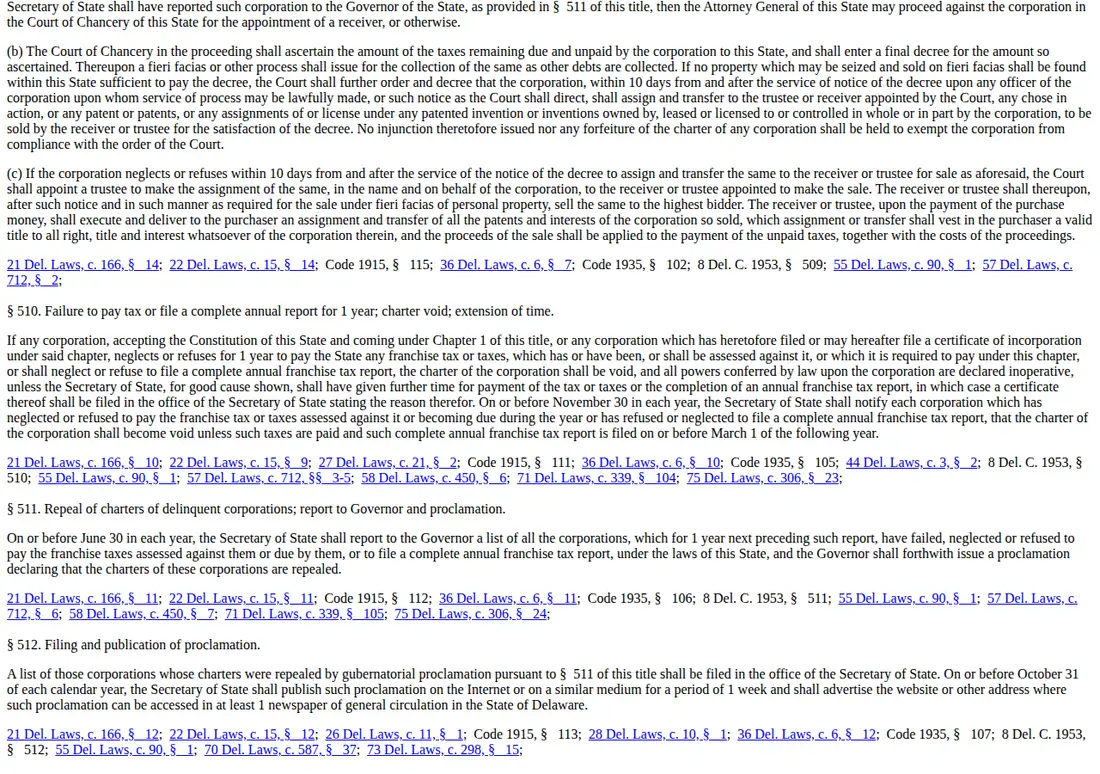
The cure is 8 Del. C. § 312: a corporation whose certificate has become forfeited or void may at any time procure a revival, with all its rights — and subject to all its duties, debts, and liabilities — by complying with that section. Revival is not free: the corporation must pay the back taxes, penalties, and interest that accrued while it was void.
| Stage | Deadline | What happens | Authority |
|---|---|---|---|
| Report + tax due | March 1 | $50 report fee + franchise tax | §§ 502(a), 504(a) |
| Late penalty + interest | From March 2 | $200 added; 1.5% per month | §§ 502(c), 504(c) |
| Void notice | On or before November 30 | Secretary warns charter will become void | § 510 |
| Charter void | After 1 year of neglect | Charter void; powers inoperative | § 510 |
| Revival | Any time | Certificate revived on compliance | § 312 |
Who files what: domestic, exempt, foreign, LLC
Not every Delaware entity files the same thing, and the most common error is applying the corporation rules to an LLC or the domestic rules to a foreign corporation. Domestic for-profit corporations file the report and pay franchise tax by March 1 for the $50 fee. Exempt domestic corporations — the § 501(b) categories, including nonprofits — file the report by March 1, pay $25, and owe no franchise tax. Foreign corporations qualified in Delaware file an annual report by June 30, pay a fee set by the Division's current schedule, and owe no Delaware franchise tax — confirm the foreign fee against the live schedule rather than quoting a guide. LLCs file no annual report: they pay a flat $400 annual tax by June 1 under 6 Del. C. § 18-1107(b), raised from $300 by House Bill 400, retroactive to January 1, 2026 — a figure our LLC dissolution playbook also carries, because a dissolving LLC must clear that tax too.
The registered agent is the address for service of process named in the report under § 502(a)(2); if the agent dies, resigns, refuses to act, leaves Delaware, or cannot be found with due diligence while the corporation is in default, § 502(d) allows service of process upon the Secretary of State. Keep the agent current and paid. Franchise tax is not income tax, and it is not payroll tax either: a C-Corp with Delaware-source income files a separate corporate income tax return with the Division of Revenue, and its EIN, CPA, and GAAP books govern that return, not this filing.
Execution checklist
- [x] Step 1 — Confirm the cap table before January: authorized shares by class, par values, shares issued, and total gross assets.
- [x] Step 2 — Run both methods: compute both methods, take the lesser, and prepare the § 503(b) statement so the cheaper method can be elected.
- [x] Step 3 — Check the tentative schedule: if the estimated liability is $5,000 or more, calendar June 1 (40 percent), September 1 and December 1 (20 percent each).
- [x] Step 4 — Verify the director list and the agent: every director as of the filing date, the signing officer's name and title, and the registered office address — a false statement is perjury under § 502(b).
- [x] Step 5 — File and pay in one sitting through the Division's online portal: report plus tax, before March 1, and keep the confirmation. Pay by a method that cannot bounce — a returned check adds $60 under § 504(g).
- [x] Step 6 — Diary November 30 and June 30: the void-notice date and the repeal-proclamation date. If either passes with the filing outstanding, the only move is to file, pay, and revive under § 312.
Founder & CEO Insight — Enow A. Jovial
Who should not use this playbook as written
A foreign corporation should not apply the March 1 deadline or the $50 fee to itself — its report is due June 30 and its fee is set by a different schedule line. An LLC should not file a franchise tax report — it pays the $400 annual tax by June 1 and has no report. An exempt corporation should not pay franchise tax — it files the report, pays $25, and stops. And no corporation should use this playbook's figures as a substitute for the Division's live fee schedule: the Division revised its schedule on August 1, 2026, and the online Delaware Code has lagged behind recently enacted fee changes during 2026. The statute text here was read from the Delaware Code Online on November 16, 2026 — confirm the live schedule before you file.
When the filing changes
The filing changes by legislation: House Bill 400 raised the LLC annual tax from $300 to $400 retroactive to January 1, 2026. Three triggers should send a founder back to the Division's schedule before the next March 1: a new fee-schedule revision (the Division revises in August); any amendment to §§ 502, 503, or 510; and a change in the corporation's capital structure, which can flip the cheaper method from one year to the next.