SoFi vs Ally vs Capital One: The High-Yield Savings Playbook — APYs, Limits, and the Annual Interest Math
The decision is not the rate. It is the rate you can keep.
Three of the largest online savings accounts in the United States pay within ten basis points of each other, and that narrow gap is why the headline rate is the wrong place to start. SoFi advertises the highest number, but only as a six-month boost. Ally and Capital One pay the same 3.20%, yet one caps withdrawals at ten per statement cycle and the other will not let you touch an ATM with the savings account at all. This playbook prices all three from the banks' own pages, read on November 10, 2026; every rate carries its date, so re-check it on the bank's own page before you open an account.
The three rates, dated
| Account | APY, Nov 10, 2026 | Rate vintage | Minimum | Fee | Authority |
|---|---|---|---|---|---|
| SoFi Savings (standard) | 3.30% | Current as of 10/20/2026 | $0 | $0 | SoFi, sofi.com/banking/ |
| SoFi Savings (boosted) | Up to 4.40% | Promotion 10/20/2026–12/31/2027 | $0, with direct deposit or $5,000+ every 31 days | $0 | SoFi, sofi.com/banking/ |
| Ally Savings Account | 3.20% | Correct as of 11/09/2026 | $0 | $0 | Ally Bank, ally.com/bank/savings-account-rates/ |
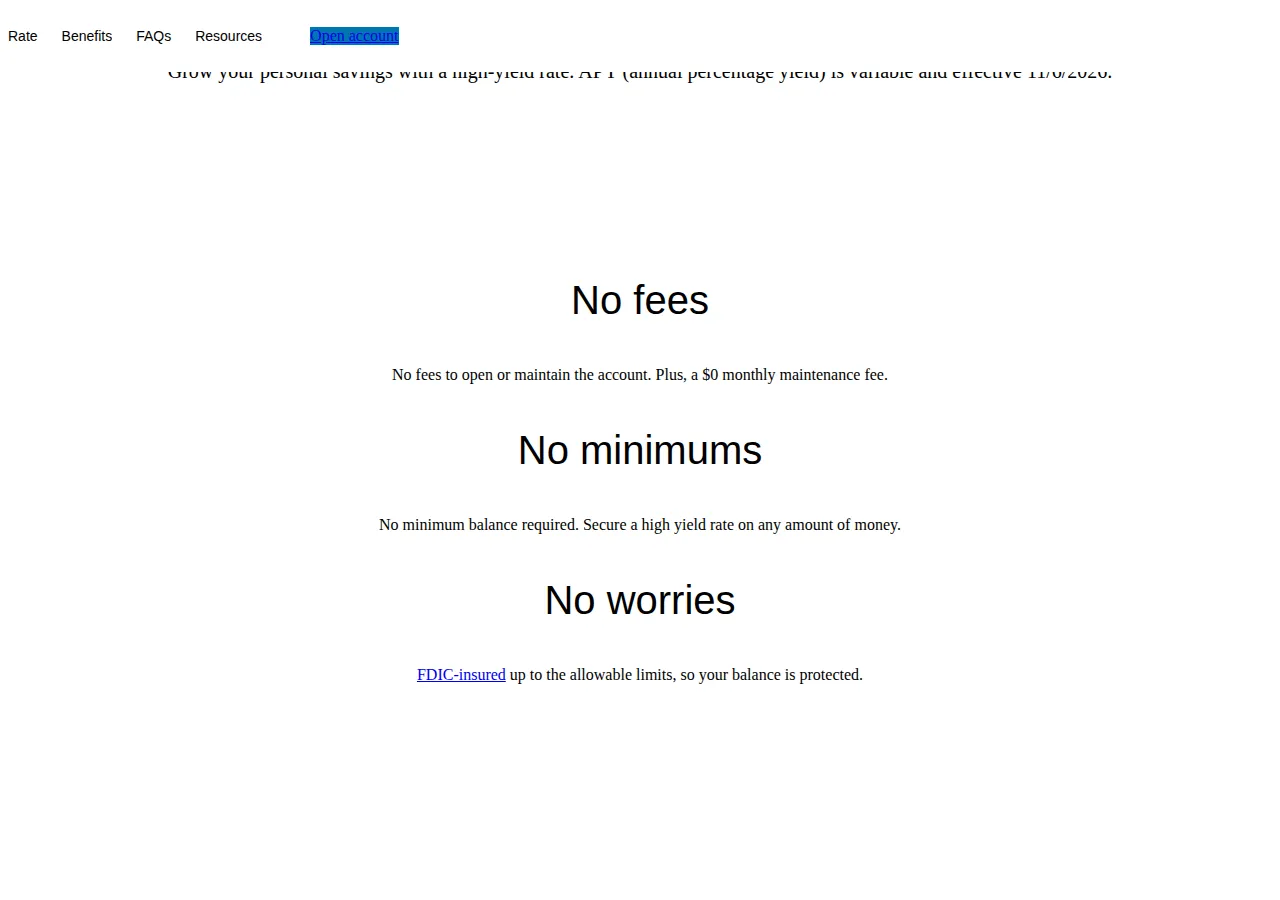
| Capital One 360 Performance Savings | 3.20% (corroborated) | Variable, effective 11/6/2026 | $0 | $0 | Capital One page + two trackers, Nov 10, 2026 |
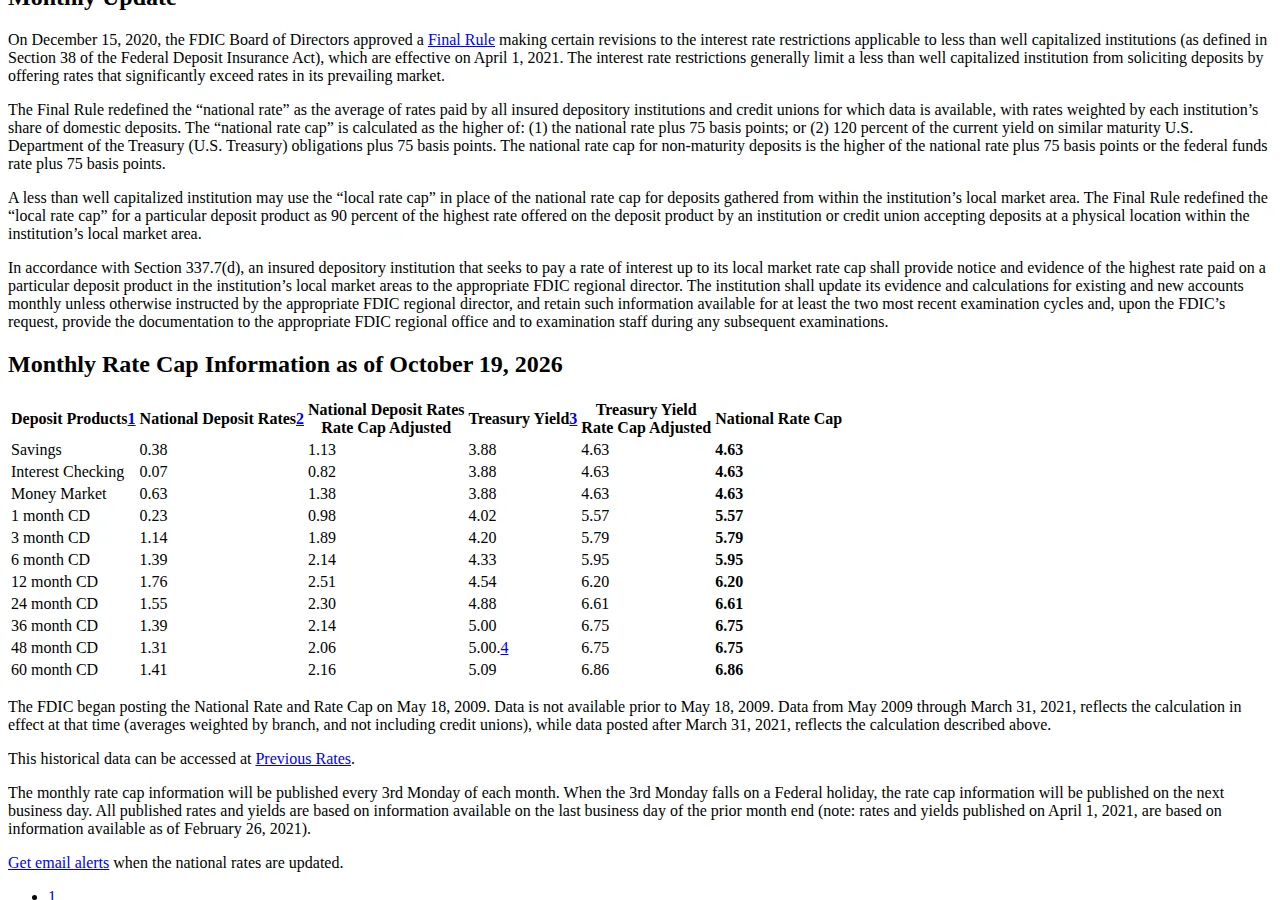
| FDIC national average, savings | 0.38% | October 2026 | — | — | FDIC, National Rates and Rate Caps |
One figure needs a plain explanation. Capital One's own page states the 360 Performance Savings APY is variable and effective November 6, 2026 — but the number itself did not render: the rate line displayed "NaN APY" on the page as read on November 10, 2026. The 3.20% used here is corroborated twice: Banksparency and YourBestSavings both record 3.20% from Capital One's own site on November 10, 2026.
The comparison that matters is against the national average: the FDIC's national savings rate for October 2026 is 0.38%. Ally's 3.20% is 8.4 times that average; SoFi's standard 3.30% is 8.7 times it. The real contest here is over conditions and access.
The annual interest math, worked in the open
APY already includes compounding, so one-year interest on an untouched balance is a single multiplication:
A $25,000 balance at SoFi's standard 3.30% APY:
The same balance at Ally's or Capital One's 3.20% APY:
And at the FDIC national average of 0.38%:
| Balance | SoFi 3.30% | SoFi boosted 4.40% | Ally 3.20% | Capital One 3.20% | National avg 0.38% |
|---|---|---|---|---|---|
| $5,000 | $165.00 | $220.00 | $160.00 | $160.00 | $19.00 |
| $10,000 | $330.00 | $440.00 | $320.00 | $320.00 | $38.00 |
| $25,000 | $825.00 | $1,100.00 | $800.00 | $800.00 | $95.00 |
The 4.40% column is not a rate you hold; the boost lasts up to six months. A full promo year is six months at 4.40% and six months at 3.30%, which on $10,000 is:
Against Ally's $320.00 on the same $10,000, the boost is worth $65.00 over the year — not $120.00, the gap the two headline rates suggest. On $25,000 the promo year earns $962.50 against Ally's $800.00. The boost itself, isolated, is worth this much over its six months:
On $25,000 that is $137.50; on $10,000, $55.00; on $5,000, $27.50. Run your own balance through the ROI calculator first.
SoFi: the highest rate, behind a direct-deposit gate
SoFi Savings pays 3.30% APY as its standard rate, current as of October 20, 2026 on SoFi's own page, and up to 4.40% APY with the limited-time 1.10% APY Boost. The boost is for members new to SoFi Checking and Savings, lasts up to six months, applies to one SoFi Savings account, and requires an Eligible Direct Deposit or $5,000 or more in qualifying deposits every 31 days. SoFi charges no minimum balance and no account, service, or maintenance fees.
The gate matters more than the rate. SoFi's page states that members with Eligible Direct Deposit activity can earn 3.30% APY on savings balances. Eligible Direct Deposit means a recurring deposit of regular income, such as payroll, pension, or government benefits; a one-off transfer from your own account at another bank is not one. If your income does not arrive as a recurring payroll or benefits deposit into SoFi, the headline rate may not be the rate you get — and SoFi's page states no separate published rate for members without direct deposit activity, so this playbook invents none. SoFi Bank, N.A. is Member FDIC, with up to $250,000 of FDIC insurance per depositor per legal category of account ownership.
Ally: the simplest rate, with a withdrawal count that bites
Ally's Savings Account pays 3.20% APY on all balances, correct as of November 9, 2026 on Ally's own rate page. No minimum balance is required to open or earn, and there are no monthly maintenance fees. Interest is compounded daily, with no direct deposit requirement, no linked account, and no balance tier.
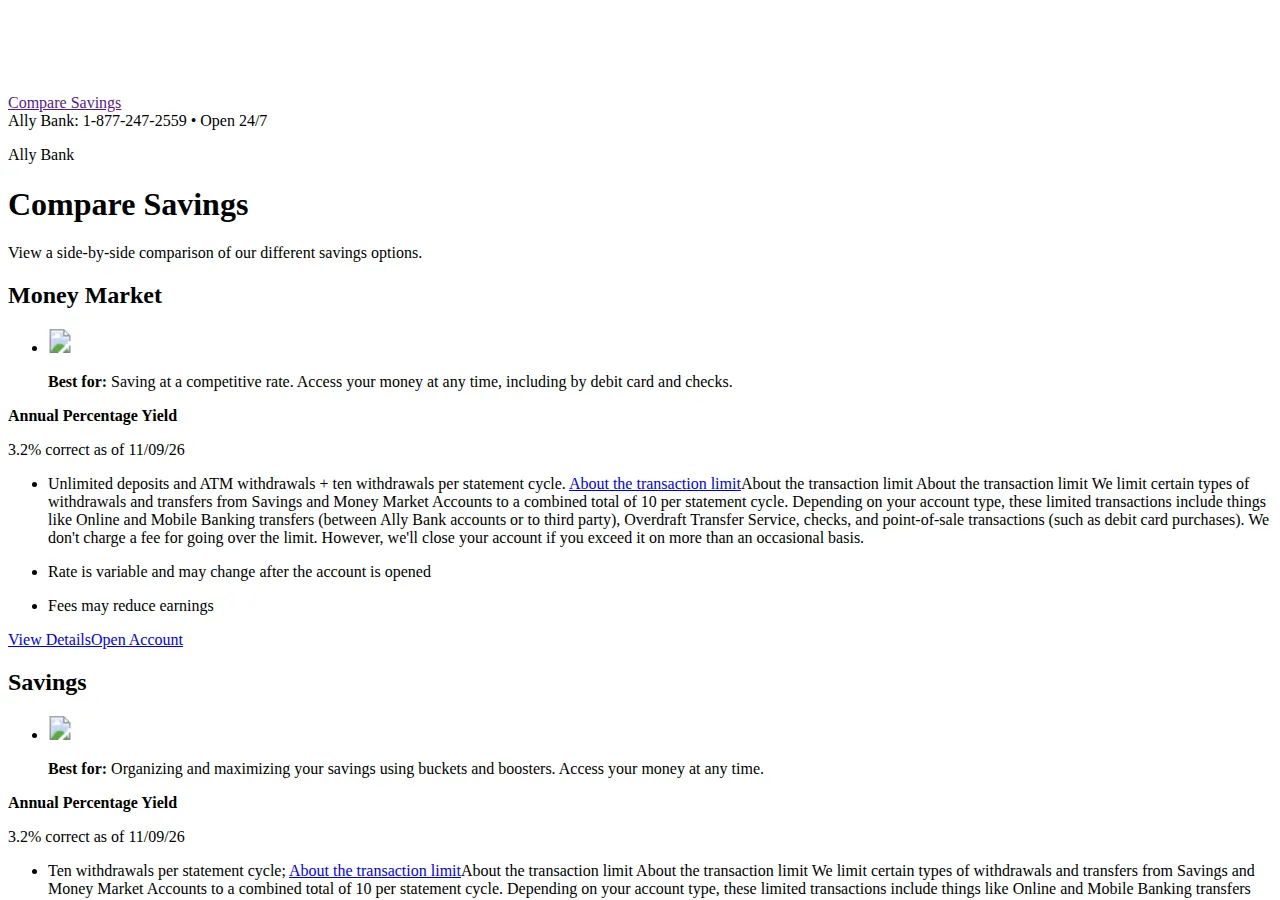
The boundary that matters at Ally is the withdrawal count. Ally limits certain withdrawals and transfers from Savings and Money Market Accounts to a combined total of 10 per statement cycle — including online and mobile banking transfers, overdraft transfers, checks, and point-of-sale transactions. Ally states it does not charge a fee for going over the limit, but it will close the account if the limit is exceeded on more than an occasional basis. Ten counted moves a month, and the penalty for repeated excess is account closure, not a fee. Our high-yield business savings playbook prices the same APY ladder for business reserves.
Capital One: branches and buckets, no ATM, no minimum
Capital One's 360 Performance Savings pays the same 3.20% APY as Ally on the whole balance — Capital One states explicitly that, unlike tiered savings accounts, it offers the same rate on the entire balance. No minimum balance, no monthly maintenance fee, and no fees to open the account. Interest accrues daily and compounds monthly. The account opens in about five minutes, and once approved you have 60 days to fund it.
Two features separate Capital One from the other two. First, it has physical locations: more than 200 branches and Capital One Cafés across Louisiana, Maryland, New Jersey, New York, Texas, Virginia, and Washington, D.C. Second, the savings account has no ATM access of its own. Capital One's own FAQ states you can withdraw online or at a branch, but not by using an ATM; to withdraw using an ATM you first transfer money to a checking account, such as its no-fee, no-minimum 360 Checking account.
Fees and minimums, side by side
| Item | SoFi Savings | Ally Savings | Capital One 360 Performance Savings |
|---|---|---|---|
| Monthly maintenance fee | $0 | $0 | $0 |
| Minimum to open / earn | $0; Eligible Direct Deposit activity for 3.30% | $0 | $0 |
| Withdrawal limit | Not stated on the page read | 10 counted withdrawals per statement cycle | No stated monthly count; no ATM withdrawals from savings |
| ATM access | Via linked SoFi checking | Not applicable to the Savings Account | None from savings |
| Compounding | Monthly | Daily | Accrues daily, compounds monthly |
| Branches | None | None | 200+ branches and Cafés |
| FDIC insurance | Up to $250,000 per depositor per ownership category | Up to the legal maximum | Up to the allowable limits |
Nobody in this trio charges a monthly fee or demands a minimum balance. What remains is the set of conditions attached to the rate and to access: SoFi's is direct deposit, Ally's is the withdrawal count, Capital One's is the ATM gap. Pick the account whose condition you will never trip.
FDIC insurance and the $250,000 line
All three banks are Member FDIC, and that membership is the only safety claim in this article that does not depend on a rate. The FDIC insures deposits up to $250,000 per depositor, per insured bank, for each account ownership category:
A $300,000 balance in one category at one bank leaves $50,000 uninsured; $100,000 is fully insured at any of the three banks. A single-owner account and a joint account at the same bank are separate categories — but two single-owner accounts share one limit.
The tax line: interest is ordinary income
Interest from a savings account is taxed as ordinary income in the year it is paid, and the bank reports it on Form 1099-INT. The payer threshold for the form is $10 of interest in the calendar year, but the taxpayer threshold is zero: all taxable interest must be reported, whether or not a 1099-INT arrives. At 3.20% APY, a $5,000 balance earns $160.00 in a year — above the $10 threshold. Our Form 1099-INT vs 1099-DIV playbook works the form box by box. Run the tax through the tax estimator first: at a 22% marginal rate, $800.00 of interest keeps $624.00 after federal tax, and the $65.00 promo-year advantage of SoFi over Ally on $10,000 keeps about $50.70. Treasury bills offer one contrast: their interest is exempt from state and local income tax. Our Treasury bills vs money market funds playbook prices that trade-off for cash parking.
Who should pick which account
| Saver | Pick | Why | Authority |
|---|---|---|---|
| Paycheck lands by direct deposit, wants the highest rate | SoFi Savings | 3.30% standard, up to 4.40% boosted | SoFi, sofi.com/banking/ |
| Paid irregularly, no recurring direct deposit | Ally Savings | 3.20% with no direct deposit requirement, no minimum, no monthly fee | Ally Bank, ally.com/bank/savings-account-rates/ |
| Moves money often, more than ten withdrawals a month | Capital One 360 Performance Savings, or SoFi | No 10-per-cycle limit | Capital One, capitalone.com; SoFi, sofi.com/banking/ |
| Needs cash from an ATM with no extra step | None of the three as a standalone savings account | Capital One savings has no ATM access | Capital One, capitalone.com |
Founder & CEO Insight — Enow A. Jovial
The emergency-fund worked example
Take a household with $3,000 of monthly expenses and a six-month target of $18,000. At SoFi's standard 3.30% APY, $18,000 earns $594.00 in a year; at Ally's or Capital One's 3.20%, $576.00; at the national average of 0.38%, $68.40. The gap between the best of the three and the national average is $525.60 a year on money that does nothing but sit there.
Open it, then check it
- [x] Open with the rate page open: read the current APY on the bank's own page and screenshot it with the date before you apply.
- [x] Set up the qualifying activity on day one: for SoFi, set up the Eligible Direct Deposit or $5,000 in qualifying deposits every 31 days before the first cycle ends, or the boost never starts.
- [x] Count your withdrawals at Ally: list every recurring transfer out and confirm the counted total stays under ten per statement cycle.
- [x] Link the checking account at Capital One: open or link a 360 Checking account first, so ATM cash is one transfer away.
- [x] Confirm the first interest credit: check the first statement; a missing credit means a condition was not met.
Thirty days after opening: re-read the bank's rate page, confirm SoFi's boost is applied, count Ally's withdrawals, and confirm the balance is below the $250,000 FDIC limit. Once a year, re-price all three banks at your actual balance.
What to do on Monday morning
If your emergency fund still sits in a branch savings account near the 0.38% national average, move it this week: $18,000 earns $68.40 a year there and $576.00 at Ally or Capital One. Pick the account whose condition fits your life — direct deposit for SoFi, ten withdrawals a month for Ally, a transfer to checking for ATM cash at Capital One — open it, fund it, and confirm the first interest credit. Then leave the money alone.