Social Security Benefits Taxation: The Section 86 Playbook — Provisional Income, the Lump-Sum Election, and Form W-4V
Ruth, 68 and single, receives $24,000 a year in Social Security, plus a $20,000 pension and $1,000 of taxable interest. Her first instinct is that benefits this modest cannot be taxed. They can: $4,000 of her $24,000 lands in gross income. Dan and Maria, married filing jointly, receive $36,000 in combined benefits with $35,000 of other income; $13,650 of their benefits is taxable. The difference is provisional income, measured against two thresholds Congress fixed in 1984 and 1993 and has never indexed.
The statute in one page — section 86(a) through (f)
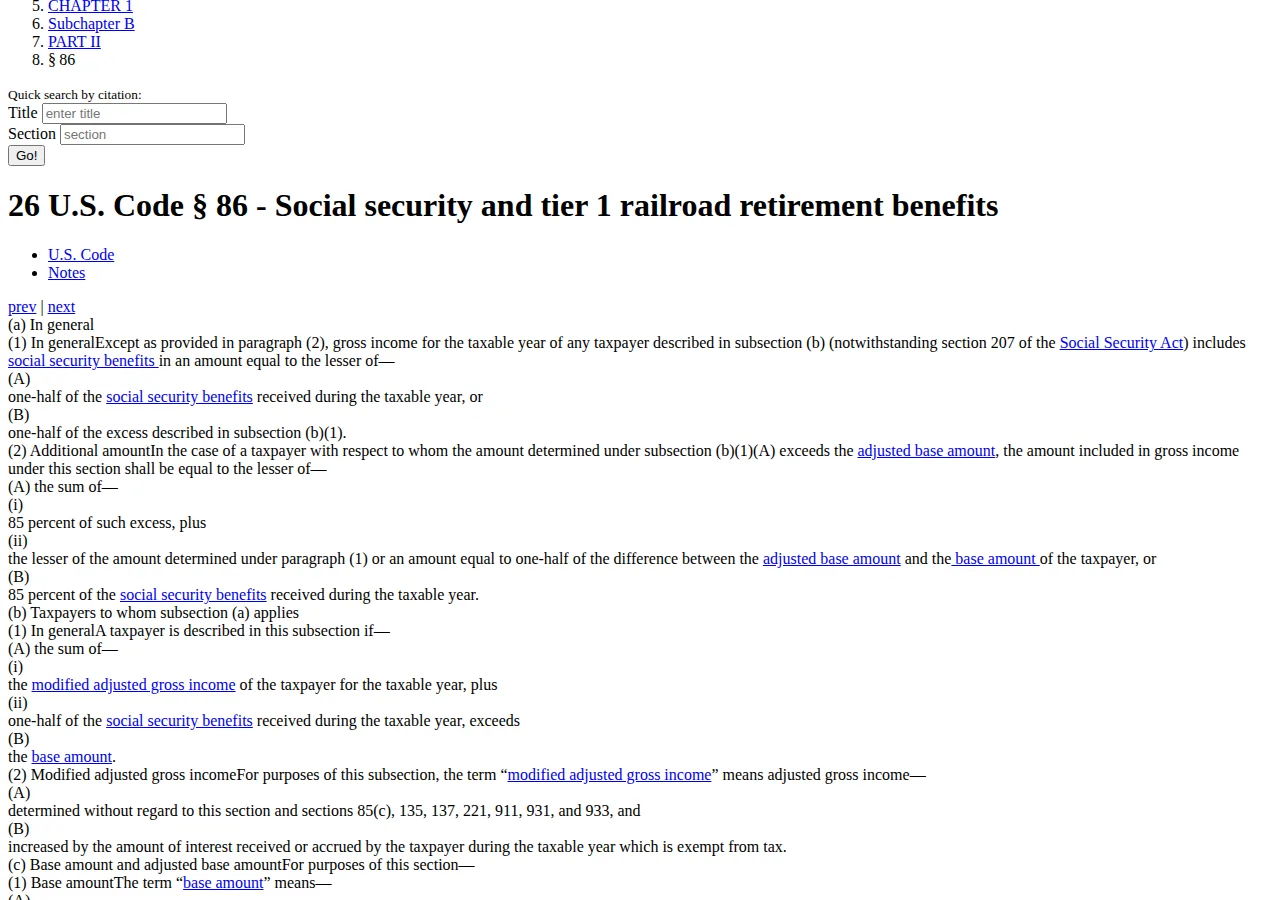
Section 86(a)(1) states the general rule: gross income includes benefits "in an amount equal to the lesser of (A) one-half of the social security benefits received during the taxable year, or (B) one-half of the excess described in subsection (b)(1)." That is the 50 percent tier. Section 86(a)(2) adds the second tier: above the adjusted base amount, the amount included is the lesser of 85 percent of that excess plus the lesser of the paragraph (1) amount or one-half of the gap between the adjusted and base amounts, or 85 percent of benefits received.
The test in section 86(b)(1) is whether modified AGI plus one-half of benefits exceeds the base amount. Modified AGI, under section 86(b)(2), is adjusted gross income determined without regard to section 86 and sections 85(c), 135, 137, 221, 911, 931, and 933, increased by tax-exempt interest. The exclusions people reach for do not shrink the test, and tax-exempt interest counts.
| Filing status | Base amount | Adjusted base amount | 50% tier band | Authority |
|---|---|---|---|---|
| Single, head of household, qualifying surviving spouse | $25,000 | $34,000 | $9,000 | § 86(c)(1)–(2) |
| Married filing jointly | $32,000 | $44,000 | $12,000 | § 86(c)(1)–(2) |
| Married filing separately, lived apart all year | $25,000 | $34,000 | $9,000 | § 86(c)(1); Pub. 915 |
| Married filing separately, lived together at any time | $0 | $0 | $0 | § 86(c)(1)–(2) |
The band width caps the 50 percent tier: one-half of the $9,000 single band is $4,500, and one-half of the $12,000 joint band is $6,000 — the maximum line 14 of Worksheet 1 can produce. Congress added the 85 percent tier in 1993 (Public Law 103-66, section 13215) and has not indexed the thresholds since.
Provisional income, line by line
Most errors here are input errors, not arithmetic. The benefit number is Form SSA-1099, box 5 — net benefits, box 3 gross benefits minus box 4 repayments. It is not the gross amount, and it is not the monthly check times twelve where a repayment intervenes.
Worksheet A in Publication 915 is the quick check: one-half of benefits, plus all other income including tax-exempt interest, compared with the base amount. At or below the base amount, no benefits are taxable. Above it, Worksheet 1 computes the taxable part in 19 lines, ending at line 19 — entered on Form 1040, line 6b, with net benefits on line 6a.
Worked example 1 — Ruth, single, the 50 percent tier
Ruth's numbers: benefits $24,000, pension $20,000, taxable interest $1,000, no tax-exempt interest. Her provisional income is:
Provisional income of $33,000 exceeds the $25,000 base by $8,000 but stays below the $34,000 adjusted base, so only the 50 percent tier applies:
On Worksheet 1, line 10 is $8,000, line 11 is $9,000, line 12 is zero, line 14 is $4,000, line 16 is zero, and line 19 is $4,000. Ruth reports $24,000 on line 6a and $4,000 on line 6b.
Worked example 2 — Dan and Maria, joint, the 85 percent tier
Dan and Maria file jointly. Combined benefits are $36,000. Other income is a $30,000 pension, $2,000 of taxable interest, and $3,000 of tax-exempt interest. Modified AGI adds the tax-exempt interest back, so modified AGI is $35,000 and provisional income is:
Provisional income exceeds the $32,000 base by $21,000 and the $44,000 adjusted base by $9,000. Section 86(a)(2) gives:
The $10,500 is the paragraph (1) amount — the lesser of half the benefits ($18,000) and half the excess over the base ($10,500) — and the $6,000 is one-half of the $12,000 joint band. They report $36,000 on line 6a and $13,650 on line 6b. Without the $3,000 of tax-exempt interest, taxable benefits would fall to $11,100.
The married-filing-separately trap — base amount zero
Section 86(c)(1)(C) sets the base amount to zero for a taxpayer married at year-end who files separately and does not live apart from their spouse at all times during the year; the adjusted base amount is zero too. Worksheet 1: skip lines 9 through 16, multiply line 8 by 85 percent, and take the smaller of that and 85 percent of benefits.
Take a filer with $20,000 of benefits and $15,000 of other income, married filing separately after living with their spouse all year. Provisional income is $25,000, and the taxable amount is the smaller of 85 percent of $25,000 ($21,250) and 85 percent of benefits ($17,000) — $17,000 taxable, on $20,000 of benefits. The joint return would have tested combined income against a $32,000 base.
The lump-sum election — section 86(e)
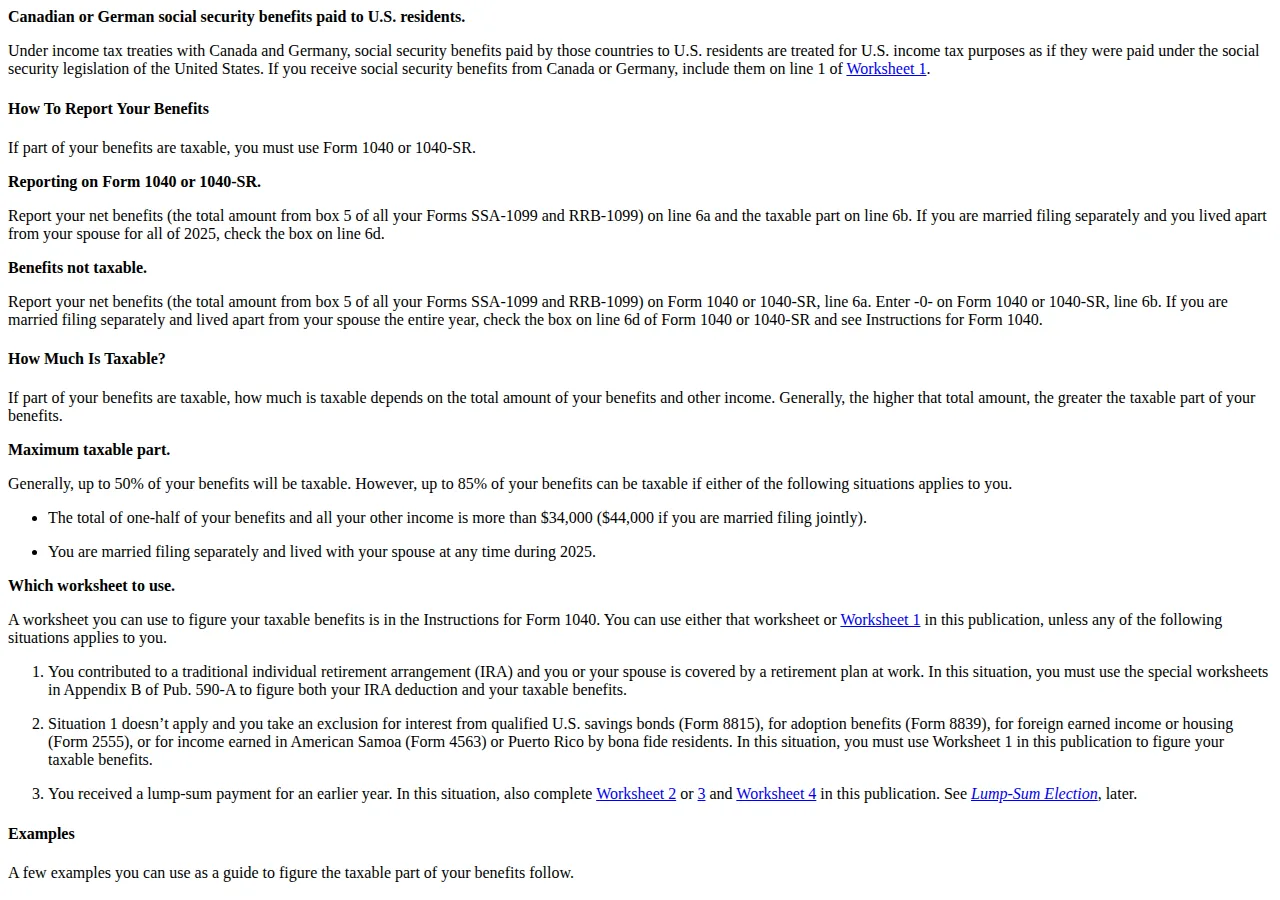
A lump-sum (retroactive) payment is included in the year it is received, even if it covers earlier years. Section 86(e)(1) offers an election: the part attributable to prior years is capped at the sum of the increases in gross income those years would show if the part were taken into account there. Publication 915 Worksheets 2, 3, and 4 do the work: refigure the earlier year with the lump sum included, subtract the taxable benefits already reported, and add the remainder to this year's taxable benefits figured without the lump sum. Compare Worksheet 4, line 21 with Worksheet 1, line 19, and report the lower amount. Elect by checking the box on line 6c; revocation needs the Secretary's consent under section 86(e)(2)(B).
Ana, single, received $30,000 of benefits in 2025, of which $12,000 was a lump sum for 2024, against $28,000 of other income. Under the regular method, provisional income is $43,000 and taxable benefits $12,150. Under the election, her 2024 is refigured first: 2024 benefits become $30,000 against $20,000 of other income, giving provisional income of $35,000 and refigured taxable benefits of $5,350. She already reported $2,000 for 2024, so the taxable part of the lump sum is:
Without the lump sum, her 2025 benefits are $18,000 against $28,000 of other income, giving $7,050. The election total is:
That is $1,750 less than the regular-method figure, so Ana checks the box on line 6c, enters $30,000 on line 6a, and $10,400 on line 6b. Two cautions: no adjustment is made to the earlier year's return, and pre-1984 lump-sum amounts are not taxed.
Withholding — Form W-4V and the four rates
No tax is withheld from Social Security benefits unless the beneficiary asks for it. Form W-4V (Rev. January 2026), line 6, offers exactly four rates for Social Security benefits and tier 1 railroad retirement benefits: 7, 10, 12, or 22 percent of each payment. Unemployment compensation is different — line 5 allows only 10 percent. The form goes to the payer, the SSA, not to the IRS. Beneficiaries can also change withholding online through a my Social Security account or by calling 1-800-772-1213, and line 7 stops withholding on a new form.
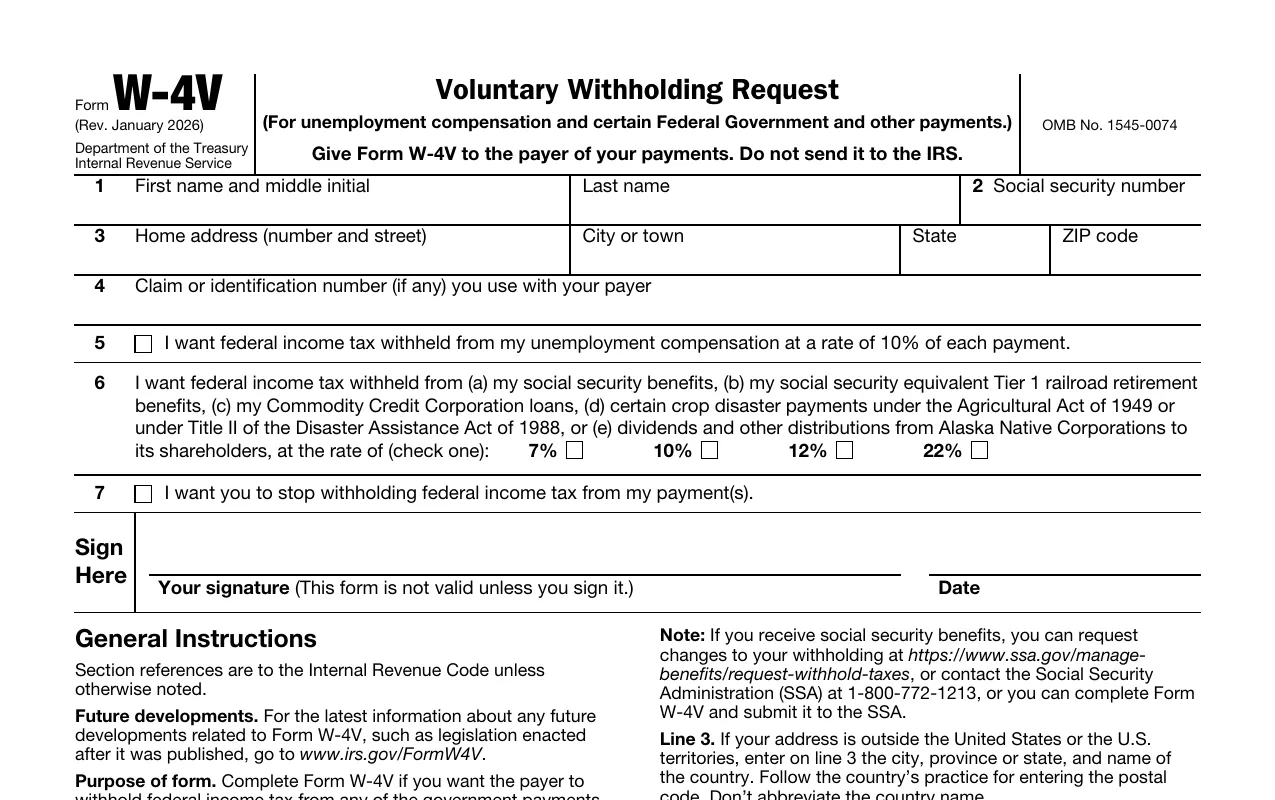
The trap is that withholding applies to the gross monthly payment, not to the taxable portion. Dan and Maria receive $3,000 a month. At 22 percent, withholding is $660 a month, $7,920 a year — against roughly $3,003 of tax on their $13,650 of taxable benefits at a 22 percent marginal rate. At 10 percent it is $300 a month, $3,600 a year:
Pick the rate against the tax on the taxable portion, not against the benefit amount. The tax estimator runs the same comparison on your own numbers.
Section 86 vs section 1402 — the self-employment interaction
The interaction runs in both directions. First, benefits themselves are never subject to self-employment tax: section 1402(a) defines net earnings from self-employment as gross income derived from a trade or business, less attributable deductions, and benefits are not trade-or-business income, so the 15.3 percent tax — 12.4 percent under section 1401(a) plus 2.9 percent under section 1401(b)(1) — never touches the benefit check. Second, self-employment earnings do enter provisional income, in full, through modified AGI: a retiree who keeps consulting pays twice on the same dollar.
Sam, single, is a sole-proprietor consultant with $40,000 of Schedule C net profit and $24,000 of benefits. Schedule SE, line 4a, multiplies net profit by 92.35 percent — the mirror of section 1402(a)(12):
Section 164(f)(1) allows a deduction for one-half of the section 1401 taxes, $2,825.91, so modified AGI is $37,174.09. Provisional income is $49,174.09 — above the $34,000 adjusted base by $15,174.09. Taxable benefits are:
Sam reports $17,398 of taxable benefits on line 6b, and pays $5,651.82 of self-employment tax. The $36,940 sits far below the 2026 wage base of $184,500 on Schedule SE, line 7, so the full 12.4 percent applies; the additional 0.9 percent Medicare tax under section 1401(b)(2) starts only above $200,000 single or $250,000 joint. Section 86(f) adds a third boundary: benefits are treated as a pension or annuity for section 32(c)(2) earned income, section 219(f)(1) compensation, and section 911(b)(1) foreign earned income — benefits alone are not earned income, and they cannot fund an IRA. Our Schedule SE self-employment tax playbook carries the full computation, and the Roth vs traditional IRA playbook covers IRA compensation.
Follow the identifiers. Form SSA-1099, box 2, carries the beneficiary's SSN; Form RRB-1099, box 2, carries the recipient's SSN, ITIN, or EIN. A sole proprietor reports Schedule C profit under an SSN; an LLC with an EIN reports it under that EIN. An S-Corp owner takes FICA wages on Form W-2 plus a distribution of previously taxed earnings that generally is not gross income and does not enter provisional income, while the wages do; a C-Corp owner's dividends enter modified AGI in full. SECA is the self-employed counterpart to FICA, and a CPA works from GAAP books while the section 86 computation runs on tax-basis modified AGI.
Who this is for — and who should stop here
This playbook is for a U.S. resident beneficiary whose benefits plus other income approach or cross the base amount, a working retiree with Schedule C or partnership income, and anyone who received a retroactive lump sum. It is not for a nonresident alien: Publication 915 states these rules do not apply, and instead 85 percent of benefits are taxed at 30 percent unless a treaty exempts them — residents of Canada, Egypt, Germany, Ireland, Israel, Italy, Japan, Romania, and the United Kingdom are exempt, and a resident of Switzerland is taxed at 15 percent. It is not for a beneficiary whose only income is benefits.
| Approach | What it does | Cost or risk | Authority |
|---|---|---|---|
| Form W-4V at 10% or 12% | Closest match for most households | Recheck yearly | Form W-4V, line 6 |
| Form W-4V at 22% | Covers the tax at the top | Over-withholds for most | Form W-4V, line 6 |
Founder & CEO Insight — Enow A. Jovial
Execution checklist
- Step 1: Take box 5 of Form SSA-1099 (and RRB-1099).
- Step 2: Add one-half of box 5 to modified AGI.
- Step 3: Compare with the base and adjusted base amounts.
- Step 4: Run Worksheet 1; enter net benefits on line 6a, taxable benefits on line 6b.
- Step 5: If a lump sum covers earlier years, run Worksheets 2 or 3 and 4; check line 6c if Worksheet 4 is lower.
- Step 6: If self-employed, complete Schedule SE, take the section 164(f) deduction, and re-run provisional income.
- Step 7: Choose withholding — Form W-4V at 7, 10, 12, or 22 percent — or estimated tax on Form 1040-ES.
- Step 8: Check the filing-status trap: married filing separately, lived together, means a zero base amount.
- Step 9: File Form 1040 or 1040-SR by April 15, 2026, a Wednesday; keep the worksheets.