Three application-security vendors sell the same outcome — vulnerabilities found before production — and meter it three different ways. Snyk charges by the contributor. SonarQube Cloud charges by the line of code. Veracode charges by the application and does not publish the price at all. A team that buys on the feature list alone will pay for the wrong meter, because the meter, not the feature list, decides the bill at every size the team grows into.
The comparison below prices one workload three ways: 5 developers, 100,000 lines of private code, 1 application. At that size all three vendors have a stated figure or a stated absence of one, so the math is reproducible from the vendors' own pages. At larger sizes the published pricing stops at different points for each vendor, and the article says exactly where each one stops instead of estimating past it.
Founder & CEO Insight — Enow A. Jovial
The three meters
| Vendor | Meter | Free tier | Paid starting price | What the meter counts | Authority |
|---|---|---|---|---|---|
| Snyk | Per contributor (Team) / credits (Enterprise) | $0, 5 projects, 100 Snyk Code tests a month | Team from $25 a month | Contributors active in the last 90 days; public repos not counted | Snyk pricing page, read Nov 18, 2026 |
| SonarQube Cloud | Per lines of code | Up to 50,000 LOC private projects | Team from $34 a month for up to 100,000 LOC | Private lines of code analyzed in the organization | SonarQube Cloud pricing page, read Nov 18, 2026 |
| Veracode | Per application (SAST) / per URL (DAST) / per project or contributor (SCA) | None | Quote only | Applications scanned; unlimited scans and developers per application | Veracode pricing page (no list) + independent 2026 pricing reads |
The meters punish different growth. Snyk's Team plan caps at 10 developers: an 11th developer moves the team off the $25 flat price and onto Enterprise credits, whose rate is not published on the page. The runtime-error sibling is the Sentry vs Rollbar vs Bugsnag error-tracking pricing playbook: Sentry catches the error after it ships, Snyk catches the vulnerability before it does. SonarQube's Team plan is priced by LOC blocks: the page publishes the first block, $34 a month for up to 100,000 lines, and prices higher blocks through its calculator rather than a printed ladder. Veracode's per-application meter is the only one that does not move when developers join or lines are added: 50 developers on 1 application cost the same as 5 developers on 1 application, and the price moves only when applications are added.
Snyk: the contributor meter
Snyk's pricing page sells two models at once. Small teams get a flat rate; enterprises buy credits. The Free plan costs $0 a month and covers SCA, SAST, infrastructure-as-code, and container scanning, with real-time code scanning and IDE, CLI, and source-code-manager integrations — limited to 5 projects and 100 Snyk Code tests a month. The Team plan starts at $25 a month, billed monthly, for development teams of up to 10 developers, and adds 100 projects, 1,000 Snyk Code tests a month, a Jira integration, and next-business-day support.
The Enterprise plan is credit-based: buy credits at transparent rates, use them for any Snyk capability, and decide what to use as security needs evolve. The page states the credit rate as 1.0 credit per active contributor per day, but the price of a credit is set in the sales conversation. The Evo capabilities — AI pentesting and coding-agent security — are not available on the Free or Team plans at all; they require an Enterprise platform subscription.
Two limits decide whether Team fits. The first is headcount: a team of 11 developers cannot buy Team at any price, because the plan is defined as "up to 10 developers." The second is test volume: 1,000 Snyk Code tests a month is roughly 33 tests a day across the whole team, and a team scanning every pull request across several repositories will cross it. The page publishes no overage rate past either limit, so a team near either ceiling should treat Team as a trial with a known end, not a permanent tier.
SonarQube Cloud: the lines-of-code meter
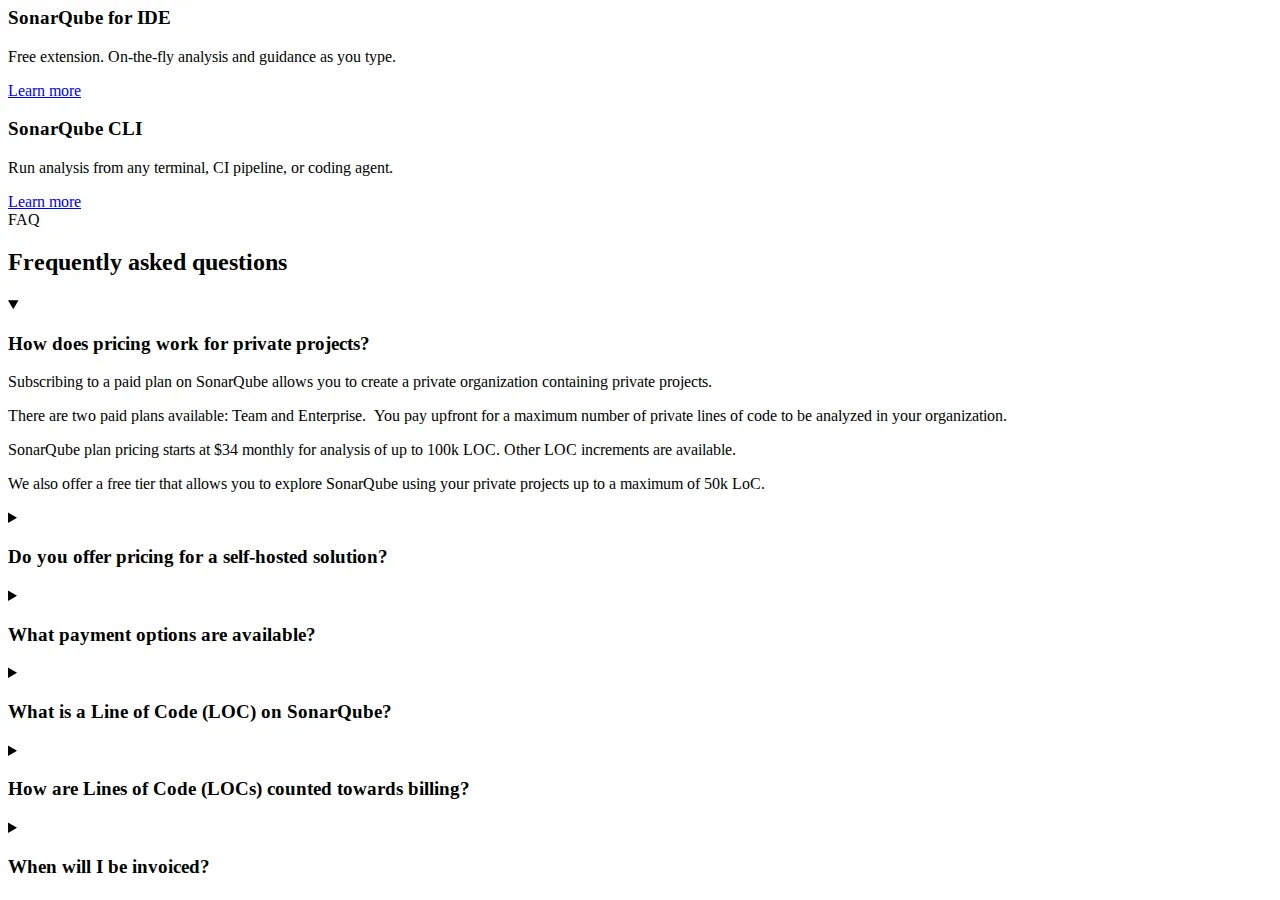
SonarQube Cloud prices the code, not the people. The Team plan is for under 50 developers and starts at $34 a month for analysis of up to 100,000 lines of code, with a 14-day free trial and no credit card required. The free tier allows private projects up to a maximum of 50,000 lines of code, with no card and no expiry. The page previously listed the Team plan at $65 a month; the current $34 figure is the price as read on November 18, 2026.
The Enterprise plan is for over 50 developers and is priced by conversation: it includes SonarQube Enterprise across 45+ languages, SSO and SCIM, portfolios, OWASP and MISRA reporting, zero data retention, and bring-your-own-key with large language models. One line on the Enterprise card matters more than the rest: SonarQube Advanced Security "needs additional subscription." Advanced Security is the SAST and SCA layer — CVE detection, malicious-package detection, SBOM generation, and license policy — included in the trial but not in the Team plan's base price. A team buying SonarQube Cloud for vulnerability detection must price the add-on, not the $34 headline.
The LOC meter charges for code that nobody touches: a 400,000-line legacy service that deploys twice a year costs the same as one that deploys daily, because the meter counts lines analyzed, not scans run. The counterweight is that the meter does not move when developers join: a team that doubles from 10 to 20 developers on the same codebase pays nothing more, while a Snyk Team customer at the 10-developer cap is forced onto Enterprise credits by the same hire.
Veracode: the application meter, priced by quote
Veracode publishes no price list. Its pricing page leads to a demo request, and every product page on the site does the same. The pricing model is described in Veracode's own documentation and in independent 2026 pricing reads: Static Analysis is licensed per application, Dynamic Analysis per URL, and Software Composition Analysis per application or project, or per contributing developer. A Static Analysis license covers one application for a minimum 12-month term and includes unlimited scans, unlimited platform users, unlimited developers per application, and all integrations. Static Analysis comes in three license types — Standard, Small for applications up to 5 MB of analysis size, and Component for microservice components of an application already covered by a Standard or Small license.
The only Veracode product with a public price is Veracode Security Labs, the secure-coding training product, listed at $750 for a 12-month contract on AWS Marketplace. For the scanning products, independent 2026 reads converge on a floor: Static Analysis starts near $15,000 a year for 1 to 5 applications, roughly $3,000 to $5,000 per application, with the per-application rate falling as the portfolio grows — about $1,500 to $2,500 at 6 to 25 applications, and about $800 to $1,500 at 51 to 100. Those figures are estimates from procurement data and user reports, not vendor-published prices: Veracode sets the final price per quote, based on the number of applications, the products combined, and the term. There is no free tier for any scanning capability.
The per-application meter inverts the other two vendors' economics. A team with 40 developers and 2 applications pays for 2 applications. A team with 4 developers and 40 microservices pays for 40 applications — at the estimated $1,500 to $2,500 rate for a 6-to-25-application portfolio, that bill lands near $60,000 to $100,000 a year before DAST or SCA are added. The meter rewards few, large applications and punishes many small ones, which is the opposite of how a microservices estate grows.
The worked math: one workload, three bills
The profile is 5 developers, 100,000 lines of private code, 1 application, monthly billing:
The two published prices sit $108 apart a year, and the gap is smaller than it looks: Snyk's $25 covers up to 10 developers and 1,000 code tests a month; SonarQube's $34 covers up to 100,000 lines and includes the Advanced Security trial but not the subscription. At the stated profile both are rounding errors against a single developer's hourly rate, and the choice between them is a capability decision, not a price decision. Veracode's estimated floor is $14,700 a year above Snyk Team and $14,592 above SonarQube Team — the premium for the per-application model and the compliance reporting that comes with it.
The unit economics make the meters comparable:
A team that hires its 11th developer breaks Snyk Team and must move to Enterprise credits at an unpublished rate. A team that grows past 100,000 lines moves to the next SonarQube LOC block, priced through the page's calculator. A team that adds a second application moves Veracode from one quoted license to two. Each vendor's published pricing stops at a different boundary: buy the vendor whose boundary your growth will not cross in the next year.
Who should buy which, and who should not
| Profile | Snyk Team | SonarQube Cloud Team | Veracode |
|---|---|---|---|
| 5 developers, 100k LOC, 1 app | $300/yr — fits | $408/yr — fits | ~$15,000/yr estimate — 50x the others |
| 25 devs, 500k LOC, 5 apps | Team cap exceeded — Enterprise, unpriced | Above 100k LOC — calculator price | ~$15,000–$25,000/yr estimate |
| 40 devs, 2 apps, audit deadline | Enterprise credits — unpriced | Enterprise — quote | Per-application meter favors this shape |
| 4 devs, 40 microservices | $300/yr — fits | $408/yr — fits | ~$60,000–$100,000/yr estimate |
Do not buy Snyk Team if the team will pass 10 developers or 1,000 code tests a month within the year — the plan has no published overage, and the next step is an Enterprise sales conversation. Do not buy SonarQube Cloud Team for vulnerability detection without pricing the Advanced Security add-on — the $34 headline buys code quality and a trial of the security layer, not the layer itself. Do not buy Veracode for a small portfolio: the estimated $15,000 floor buys the same SAST coverage Snyk and SonarQube sell for a few hundred dollars a year, and the premium only earns its keep when the buyer needs the compliance reporting, policy gates, and attestation trail that enterprise customers and regulators ask for by name.
Release gating is the companion decision: the LaunchDarkly vs Split vs Flagsmith feature-flag pricing playbook prices the flags that gate a risky deploy while these scanners decide whether the code is safe to release.
The decision sequence, in order:
- [x] Step 1: Count the three meters — developers on the team, private lines of code in the organization, applications to be scanned — and write down which vendor's published pricing stops first.
- [x] Step 2: Price the stated profile — Snyk Team $25 a month, SonarQube Cloud Team $34 a month, Veracode quote-only with the $15,000 estimated floor, and record the $108 gap between the two published prices.
- [x] Step 3: Test the ceilings — 1,000 Snyk Code tests a month, 100,000 SonarQube lines, 10 Snyk developers — and confirm the team's 12-month growth stays inside them.
- [x] Step 4: Price the add-ons — SonarQube Advanced Security is a separate subscription; Snyk Evo requires Enterprise; Veracode DAST is priced per URL and SCA per project or contributor.
- [x] Step 5: Get the two quotes in writing — Veracode's per-application quote and Snyk Enterprise's credit rate — before signing, because neither appears on a public page.
- [x] Step 6: Check the compliance requirement — if a customer or regulator names Veracode-style attestation, the $15,000 floor is the price of the requirement; if nobody names it, the $300 tier is the answer.
The scanners agree on the outcome and disagree on the meter. Snyk sells the contributor, SonarQube sells the line of code, Veracode sells the application. Count the thing your team actually grows — people, lines, or applications — and the cheapest vendor picks itself.